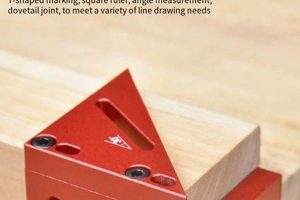
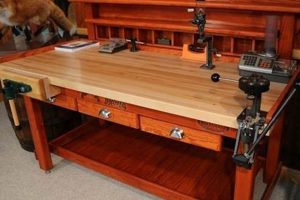
Instruments utilized in the shaping and assembly of wood with a high degree of accuracy constitute a specific category of implements. These instruments, ranging from marking devices to cutting machines, are designed to achieve tight tolerances and exacting dimensions in woodworking projects. An example includes a digital angle gauge used to set a miter saw to a precise angle, ensuring accurate cuts for intricate joinery.
The use of high-accuracy implements offers several advantages. It minimizes material waste, enhances the quality and appearance of finished products, and reduces the need for rework or adjustments. Historically, achieving this level of refinement relied on skilled craftsmanship and manual techniques. However, advancements in manufacturing and technology have led to the development of more sophisticated and readily available instruments, making accurate woodworking accessible to a wider range of practitioners.
The following sections will delve into specific categories of these instruments, exploring their functions, applications, and considerations for selection. Furthermore, the impact of computer-aided design (CAD) and computer numerical control (CNC) technology on woodworking will be examined, highlighting how these innovations contribute to improved accuracy and efficiency.
Tips for Achieving Excellence in Woodworking
The attainment of superior results in woodworking is intrinsically linked to the selection, maintenance, and skillful deployment of appropriate implements. Optimal performance necessitates a comprehensive understanding of their capabilities and limitations.
Tip 1: Prioritize High-Quality Measurement Devices: Precise measurements are the foundation of accurate woodworking. Invest in reliable squares, rules, and calipers. Verify their accuracy regularly using calibrated standards. For digital instruments, ensure they are properly calibrated according to the manufacturer’s instructions.
Tip 2: Sharpening Implements Regularly: Sharp cutting edges are crucial for clean cuts and reduced material waste. Develop a consistent sharpening routine for chisels, plane irons, and saw blades. Use appropriate sharpening stones or systems and maintain the correct bevel angles.
Tip 3: Employ Appropriate Clamping Strategies: Secure workpieces firmly during assembly using appropriate clamps. Distribute clamping pressure evenly to prevent distortion or damage to the wood. Consider using cauls or shims to protect delicate surfaces.
Tip 4: Master the Art of Marking and Layout: Accurate marking is essential for precise joinery. Use sharp marking knives and fine-tipped pencils to create clear, visible lines. Employ marking gauges to transfer dimensions accurately.
Tip 5: Utilize Templates and Jigs: For repetitive tasks or complex shapes, create templates or jigs to ensure consistency and accuracy. Templates can be made from durable materials such as acrylic or plywood. Secure templates firmly to the workpiece during routing or shaping operations.
Tip 6: Understand Grain Direction and its Impact on Cutting: Grain direction significantly affects the quality of cuts. Cut with the grain whenever possible to minimize tear-out and ensure smooth surfaces. Adjust cutting techniques and implement appropriate support when cutting against the grain.
Tip 7: Practice Proper Machine Setup and Maintenance: Regular maintenance of power tools is crucial for optimal performance and longevity. Clean machines thoroughly after each use and lubricate moving parts as needed. Verify that blades and bits are properly aligned and secured before operation.
Tip 8: Consider Investing in Computer Numerical Control (CNC) Technology: For intricate designs or high-volume production, CNC routers and milling machines offer unparalleled accuracy and repeatability. Learn the basics of CAD/CAM software to create and execute complex cutting programs.
Adherence to these guidelines will contribute to a significant improvement in the quality and accuracy of woodworking projects, resulting in enhanced craftsmanship and reduced material costs.
The next section will cover advanced techniques in joinery and finishing, building upon the foundation of accuracy established by the proper application of woodworking implements.
1. Accuracy

Accuracy, in the context of woodworking implements, refers to the degree to which a measurement or cut conforms to a known standard or intended dimension. The attainment of accurate results is inextricably linked to the characteristics of instruments designed for this purpose. High-quality implements mitigate errors stemming from inaccuracies in measurement, layout, and execution. For instance, a square manufactured to exacting tolerances will yield consistently perpendicular angles, a prerequisite for strong and aesthetically pleasing joinery. The consequence of inaccurate instruments manifests as dimensional discrepancies, misaligned joints, and compromised structural integrity in finished pieces. In furniture construction, an inaccurate miter saw can lead to gaps in frame corners, necessitating remedial action and increasing material waste.
The importance of accuracy extends beyond merely achieving desired dimensions; it also minimizes cumulative errors. In complex projects involving numerous components, even slight inaccuracies in individual pieces can compound, resulting in significant deviations from the intended design. Calibrated measuring devices, coupled with careful marking techniques, are essential for preventing such occurrences. Digital readouts on equipment such as thickness planers allow for precise material removal, ensuring uniformity in component thickness and facilitating consistent assembly. Furthermore, the selection of implements suitable for the task at hand is crucial. While a hand saw may suffice for rough cuts, a table saw equipped with a high-quality blade and precision fence is essential for achieving accurate rip cuts on larger panels.
In summary, accuracy is not merely a desirable attribute but a fundamental requirement for achieving professional-quality results in woodworking. The use of high-quality instruments designed for precision, coupled with meticulous technique and a thorough understanding of material properties, are essential for minimizing errors and ensuring the successful execution of woodworking projects. Challenges remain in maintaining instrument calibration and mitigating user error, underscoring the need for ongoing training and adherence to best practices. The pursuit of accuracy directly aligns with the broader goal of creating durable, aesthetically pleasing, and structurally sound wooden objects.
2. Calibration

Calibration represents a critical, yet often overlooked, facet of maintaining the utility and effectiveness of accurate woodworking tools. The inherent precision of instruments such as measuring tapes, squares, levels, and digital devices is contingent upon their initial accuracy and subsequent maintenance. Over time, environmental factors, mechanical stress, and simple wear and tear can induce deviations from established standards. If unaddressed, these deviations compromise the tool’s ability to deliver reliable results, negating the intended benefit of utilizing accurate implements in the first instance. For example, a framing square subjected to repeated impacts may develop subtle bends, rendering it unsuitable for establishing true right angles in joinery. Similarly, a digital caliper can drift out of calibration due to fluctuations in temperature or battery voltage, yielding inaccurate dimensional readings. The effects of compromised calibration are far-reaching, potentially leading to dimensional errors, misaligned joinery, and structural weaknesses in finished projects.
The process of calibration involves comparing the tool’s readings or outputs against known standards or references. This can be accomplished through the use of calibration blocks, certified measuring devices, or specialized calibration equipment. Depending on the type of instrument and the nature of the observed deviation, adjustments may be made to restore the tool’s accuracy. In the case of a mechanical level, the vial may be repositioned to align with a true horizontal plane. For a digital measuring device, a reset or adjustment procedure, as specified by the manufacturer, may be necessary. The frequency of calibration depends on factors such as tool usage, environmental conditions, and the desired level of accuracy. Instruments used in critical applications, such as those employed in the construction of precision furniture or musical instruments, may require more frequent calibration than those used for general-purpose woodworking.
In summation, calibration is not merely a perfunctory task but an essential component of ensuring the ongoing reliability and effectiveness of accurate woodworking instruments. It mitigates the risk of accumulated errors, preserves the integrity of finished projects, and ultimately contributes to the overall quality of craftsmanship. While calibration may require an investment of time and resources, the long-term benefits, in terms of reduced waste, improved accuracy, and enhanced project outcomes, far outweigh the costs. A commitment to regular calibration reinforces the value of high-accuracy tools and promotes a culture of precision in woodworking practices. The challenge moving forward involves the development of user-friendly calibration methods and the widespread dissemination of knowledge regarding its importance within the woodworking community.
3. Sharpness
The correlation between sharpness and high-accuracy woodworking instruments is fundamental to achieving clean, precise cuts and minimizing material waste. A dull cutting edge necessitates increased force, leading to potential deviation from intended lines and an elevated risk of splintering or tear-out, particularly in hardwoods. Chisels, planes, and saws, regardless of their inherent design precision, function sub-optimally when their cutting edges are not acutely sharpened. For example, attempting to cut a dovetail joint with a dull chisel will likely result in ill-fitting components, requiring significant rework or rendering the joint structurally unsound. The attribute of sharpness is not merely a desirable characteristic but an essential component of the tool’s ability to deliver accurate and predictable results. Neglecting this factor undermines the potential advantages offered by sophisticated measuring and marking devices, effectively transforming a high-accuracy tool into a source of potential error.
The practical application of sharp cutting instruments is evident across diverse woodworking tasks. In cabinetmaking, a sharp plane iron allows for the creation of perfectly flat and smooth surfaces, essential for seamless joinery and consistent finishing. Similarly, a sharp saw blade ensures clean, accurate cuts when dimensioning lumber, minimizing the need for additional planing or sanding. The economic implications of maintaining sharp cutting edges are also significant. Reduced material waste, decreased labor time spent on correction, and improved product quality contribute to enhanced efficiency and profitability in professional woodworking settings. Furthermore, the use of sharp tools enhances user safety by reducing the force required for cutting, thereby minimizing the risk of accidental slips or injuries.
In summary, the connection between sharpness and woodworking instruments designed for precision is inextricable. Sharpness is not simply a condition but an integral functional aspect that directly influences the accuracy, efficiency, and safety of woodworking operations. Challenges persist in educating woodworkers on proper sharpening techniques and in promoting the adoption of consistent sharpening schedules. Ultimately, the commitment to maintaining acutely sharpened cutting edges is a cornerstone of professional woodworking practice and a prerequisite for realizing the full potential of high-accuracy tools.
4. Maintenance

The longevity and reliability of high-accuracy woodworking instruments are directly contingent upon adherence to a comprehensive maintenance regimen. Neglecting appropriate care protocols can lead to diminished accuracy, compromised performance, and premature failure of otherwise durable tools.
- Cleaning and Lubrication
Accumulated dust, debris, and resin can impede the smooth operation of moving parts, introduce inaccuracies in measurement, and accelerate wear. Regular cleaning with appropriate solvents and the application of lubricants to specified components, such as threads, gears, and bearings, are essential. Failure to address these issues can manifest as binding, reduced sensitivity, and increased friction, thereby compromising the tool’s ability to deliver precise results. Example: Saw blades require regular cleaning to prevent pitch buildup, which can cause inaccurate cuts and overheating.
- Edge Preservation and Sharpening
For cutting implements, maintaining a keen edge is paramount. Dull blades or chisels necessitate increased force, leading to inaccurate cuts and potentially hazardous situations. Regular honing, sharpening, and proper storage are crucial for preserving edge geometry and maximizing cutting efficiency. Neglecting this aspect results in tear-out, splintering, and compromised surface finishes. Example: Chisels benefit from routine honing to maintain a razor-sharp edge for clean and accurate paring.
- Calibration and Adjustment
High-accuracy measuring devices, such as squares, calipers, and digital angle finders, require periodic calibration to ensure their continued reliability. Calibration involves comparing the tool’s output against a known standard and making necessary adjustments to correct any deviations. Environmental factors, mechanical stress, and component aging can all contribute to calibration drift, necessitating regular checks. Example: Digital calipers should be periodically checked against gauge blocks to verify measurement accuracy.
- Storage and Handling
Proper storage and handling practices minimize the risk of damage, corrosion, and misalignment. Tools should be stored in a clean, dry environment, protected from extreme temperatures and humidity fluctuations. Delicate instruments should be stored in protective cases to prevent accidental impacts or abrasion. Careless handling can result in bent edges, chipped blades, and compromised structural integrity. Example: Planes should be stored on their sides or with blade protectors to prevent damage to the cutting edge.
These maintenance practices, while seemingly routine, collectively contribute to the preservation of accuracy, the extension of tool lifespan, and the optimization of woodworking outcomes. Prioritizing maintenance is not merely an operational consideration but an investment in the long-term quality and precision of woodworking endeavors.
5. Ergonomics
Ergonomics, the study of designing equipment and workplaces to fit the worker, is critically intertwined with the effective application of high-accuracy woodworking instruments. The prolonged use of implements, particularly those requiring fine motor control and sustained concentration, can induce physical strain and fatigue. These adverse effects, in turn, directly compromise the user’s ability to maintain accuracy and precision. For instance, a poorly designed chisel handle can cause hand cramping, leading to erratic cuts and increased risk of error. Similarly, an awkwardly positioned workbench can force the user to adopt uncomfortable postures, resulting in back pain and diminished focus. The consequences of ergonomic deficiencies extend beyond individual discomfort, impacting productivity, increasing the likelihood of workplace injuries, and ultimately compromising the quality of finished work. Instruments that necessitate awkward grips or excessive force can impede the smooth, controlled movements essential for achieving accurate results. Thus, ergonomic design constitutes an integral component of implements intended for high-accuracy woodworking.
The incorporation of ergonomic principles into woodworking tool design manifests in several key areas. Handle shapes are contoured to fit the natural curvature of the hand, reducing strain and improving grip strength. Lightweight materials are employed to minimize fatigue during extended use. Adjustable features, such as workbench height and tool rests, allow users to customize the workspace to their individual needs and preferences. Furthermore, the strategic placement of controls and displays promotes ease of access and minimizes unnecessary reaching or bending. Specific examples include planes with ergonomically shaped handles that distribute pressure evenly across the palm, reducing hand fatigue during prolonged planing operations. Similarly, saws with vibration-dampening technology minimize hand and arm fatigue, enabling more accurate and controlled cuts. The utilization of power tools with well-designed handles and readily accessible safety switches enhances both comfort and safety, contributing to improved accuracy and reduced risk of injury.
In summary, ergonomics is not merely an ancillary consideration but a fundamental aspect of instrument design. The creation of comfortable, efficient, and safe working environments is essential for maximizing the benefits of high-accuracy tools and minimizing the risk of physical strain and error. Challenges remain in promoting awareness of ergonomic principles among woodworkers and in encouraging manufacturers to prioritize ergonomic design considerations. However, by recognizing the inextricable link between ergonomics and accurate woodworking, it is possible to cultivate a more sustainable and productive working environment, ultimately enhancing the quality and precision of finished wooden objects. The future of instrument design lies in the integration of advanced ergonomic features, contributing to improved user well-being and optimized woodworking outcomes.
6. Application

The effective utilization of high-accuracy woodworking instruments is contingent not only on the inherent qualities of the tools themselves, but also, critically, on their appropriate application. The correct instrument, employed for its intended purpose within its specified operating parameters, maximizes accuracy and efficiency. Conversely, misapplication diminishes tool performance, potentially inducing damage and compromising the quality of the final product. The following points elaborate on key facets of proper application in relation to these instruments.
- Task-Specific Tool Selection
The selection of implements should align with the specific requirements of the woodworking task at hand. A delicate marking knife, optimized for fine scribing, is ill-suited for heavy-duty material removal. Similarly, a hand plane designed for smoothing surfaces is inappropriate for dimensioning rough lumber. Selection based on task-specific requirements minimizes the risk of tool damage and ensures optimal performance. Example: Employing a dovetail saw, rather than a general-purpose saw, facilitates accurate cuts for tight-fitting dovetail joints.
- Adherence to Operating Parameters
Every woodworking implement possesses defined operating parameters that dictate its optimal performance. Exceeding these parameters can lead to inaccurate results and tool damage. Examples include operating a router at excessive speeds, applying excessive force to a hand plane, or using a dull saw blade. Adherence to recommended speeds, feeds, and cutting depths is essential for maintaining accuracy and extending tool lifespan. Example: Routing a deep profile in a single pass, exceeding the router bit’s recommended cutting depth, can cause chatter, burning, and potentially break the bit.
- Proper Technique and Skill Development
The acquisition of appropriate technique is paramount for maximizing the benefits of high-accuracy instruments. Even the most sophisticated tool cannot compensate for a lack of skill or improper technique. Hands-on training, guided instruction, and continuous practice are essential for developing the necessary proficiency. Mastery of techniques such as accurate marking, consistent clamping, and controlled cutting is critical for achieving precise results. Example: Achieving a perfectly flat surface with a hand plane requires developing a consistent and controlled planing stroke, maintaining proper blade angle, and avoiding excessive force.
- Material Compatibility
The selection of implements should consider the material being worked. Certain tools are optimized for specific wood species or material thicknesses. Using an inappropriate tool can result in tear-out, splintering, or other forms of material damage. Hardwoods, for instance, often require sharper cutting edges and slower cutting speeds than softwoods. Similarly, thin materials may necessitate specialized clamping techniques to prevent distortion during cutting or shaping. Example: Using a coarse-toothed saw blade to cut thin plywood can result in excessive splintering and a ragged edge. Selecting a blade with a higher tooth count and appropriate kerf minimizes this risk.
In conclusion, appropriate application, encompassing tool selection, adherence to operating parameters, technique, and material compatibility, represents a critical determinant of success in woodworking. Maximizing the utility of instruments designed for accuracy necessitates a comprehensive understanding of these principles, coupled with diligent practice and a commitment to continuous improvement.
Frequently Asked Questions
This section addresses common inquiries regarding the selection, utilization, and maintenance of instruments designed to achieve a high degree of accuracy in woodworking projects.
Question 1: What distinguishes a high-accuracy woodworking implement from a standard tool?
Instruments designed for precision woodworking are manufactured to tighter tolerances, employ higher-quality materials, and often incorporate features that enhance control and repeatability. These implements are designed to minimize error and provide consistent results, unlike standard tools which may prioritize affordability over accuracy.
Question 2: How frequently should instruments used for accurate woodworking be calibrated?
The calibration frequency depends on usage intensity, environmental conditions, and the inherent stability of the instrument. Professional woodworkers utilizing tools daily in demanding environments should calibrate more frequently than hobbyists. At a minimum, measuring devices should be checked annually against known standards. Digital instruments may require more frequent calibration due to electronic drift.
Question 3: What are the primary causes of inaccuracies when using woodworking tools?
Inaccuracies stem from various sources, including instrument defects, improper calibration, insufficient sharpening, incorrect technique, and material variability. Mitigation requires a systematic approach that addresses each potential source of error, starting with tool selection and extending to skill development and environmental control.
Question 4: Can computer numerical control (CNC) technology truly replace hand skills in achieving precision woodworking?
CNC technology offers unparalleled accuracy and repeatability in certain applications, particularly for intricate designs and high-volume production. However, it complements, rather than replaces, hand skills. Understanding wood properties, tool selection, and finishing techniques remains essential, even when employing CNC machinery. Furthermore, setup, programming, and maintenance of CNC equipment require specialized knowledge.
Question 5: What is the most critical aspect of maintaining instruments utilized in precision woodworking?
While sharpening, lubrication, and proper storage are all essential, consistent cleaning is arguably the most critical aspect. Removing accumulated dust, debris, and resin prevents binding, reduces wear, and maintains the tool’s intended accuracy. Neglecting cleaning can lead to premature failure and compromised performance, regardless of the instrument’s inherent quality.
Question 6: Is it cost-effective to invest in higher-priced, high-accuracy woodworking instruments?
The cost-effectiveness depends on the intended application and the value placed on accuracy and efficiency. For professional woodworkers or hobbyists undertaking demanding projects, the initial investment is typically justified by reduced material waste, improved product quality, and decreased rework. For occasional use or less critical applications, more affordable options may suffice.
In summation, achieving excellence through high-accuracy instruments is predicated on a comprehensive understanding of their capabilities, limitations, and the importance of consistent maintenance. A commitment to precision, coupled with ongoing skill development, constitutes the foundation of successful woodworking practices.
The following segment will discuss emerging trends in woodworking technology and their implications for accuracy and efficiency.
Conclusion
The preceding discussion has examined various facets of precision woodworking tools, from their fundamental definition and operational considerations to essential maintenance practices and ergonomic factors. The exploration underscores the critical role these instruments play in achieving accurate, efficient, and aesthetically pleasing woodworking outcomes. Success hinges not only on the inherent qualities of the implements themselves but also on the user’s understanding of their limitations, proper application techniques, and commitment to ongoing maintenance and calibration.
In light of the information presented, practitioners are encouraged to prioritize the acquisition, responsible use, and diligent care of precision woodworking tools. As technology continues to evolve, the pursuit of accuracy in woodworking will undoubtedly remain a paramount objective, requiring continuous adaptation, skill development, and a deep appreciation for the art and science of crafting with wood. The future of woodworking lies in the harmonious integration of human skill and technological advancement, guided by a unwavering commitment to excellence.