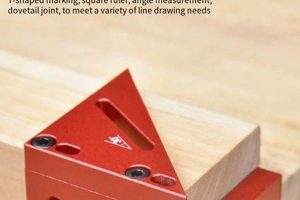
This instrument, primarily used in woodworking, allows for the precise transfer of measurements and shapes from one workpiece to another. It achieves this by creating a fine line, or score, on the material’s surface. For example, when fitting a cabinet into an irregular space, the contours of the wall can be accurately replicated onto the cabinet side using this tool, ensuring a seamless fit.
Accuracy is paramount in woodworking, and this tool facilitates that precision. By enabling exact duplication and marking, it minimizes errors and reduces material waste. Historically, it has been an essential element in joinery and fitting, contributing significantly to the quality and craftsmanship of finished pieces. Its capacity to accurately transfer details around obstructions or complex shapes is invaluable.
The following sections will delve into the various types of these marking instruments, examining their specific applications and optimal usage techniques for achieving superior results in woodworking projects.
Enhancing Woodworking Precision
Effective use of a scribe woodworking tool significantly improves accuracy and efficiency in various woodworking tasks. The following tips outline key techniques for optimizing its performance.
Tip 1: Material Selection: The hardness of the scribe’s point should be appropriate for the material being marked. Harder materials necessitate a more durable point to ensure a clear, consistent line.
Tip 2: Consistent Pressure: Maintain uniform pressure throughout the scribing process. Varying pressure can result in inconsistent line depth, compromising accuracy. Practice on scrap material to develop a feel for the appropriate force.
Tip 3: Point Maintenance: Regularly inspect and sharpen the scribe’s point. A dull or damaged point produces inaccurate lines and can damage the workpiece. Use a honing stone to restore the point to its optimal sharpness.
Tip 4: Lighting Conditions: Adequate lighting is crucial for accurate scribing. Poorly lit workspaces can obscure the scribe line, leading to errors. Use task lighting to illuminate the work area effectively.
Tip 5: Secure Workpiece: Ensure the workpiece is securely clamped or held in place during scribing. Movement during the process will result in inaccurate lines and require rework.
Tip 6: Follow the Grain: When scribing along the grain of the wood, align the scribe with the grain direction. This minimizes the risk of the scribe point catching or tearing the wood fibers.
Tip 7: Utilize Marking Gauges: For parallel lines, employ a marking gauge incorporating a scribe. This ensures consistent distance and accurate parallel lines, particularly useful in joinery.
Employing these techniques ensures accurate marking and efficient use of the scribe, ultimately contributing to higher-quality woodworking projects.
The subsequent sections will address specific applications of scribing in advanced woodworking techniques.
1. Marking Accuracy

Marking accuracy is fundamental to woodworking, dictating the precision of cuts, joinery, and overall project quality. The scribe woodworking tool serves as a primary instrument in achieving this accuracy, facilitating the transfer of measurements and shapes with minimal deviation.
- Point Geometry and Material Interaction
The geometry of the scribe’s point directly influences the fineness and clarity of the marked line. A properly sharpened point, suited to the material’s density, creates a visible indentation without tearing or compressing the wood fibers. The interaction between the point and material dictates the precision of the mark.
- Parallelism and Dimensional Transfer
Many woodworking tasks require the transfer of precise dimensions or the creation of parallel lines. Scribes, particularly those integrated into marking gauges, allow for the consistent replication of measurements, ensuring parts fit together accurately. Deviations in parallelism introduce errors in joinery and assembly.
- Mitigation of Parallax Error
Traditional marking methods, such as pencils, introduce parallax error due to the width of the lead. Scribes, with their fine points, minimize this error by creating a nearly infinitesimal line. This reduction in parallax is critical when working with tight tolerances and complex shapes.
- Durability and Longevity of Marks
Unlike pencil lines, scribe marks are often more durable and resistant to accidental erasure. The indentation created by the scribe provides a lasting reference point, particularly useful in complex projects that require multiple stages of cutting and assembly. This durability enhances the overall reliability of the marking process.
These aspects demonstrate the integral role of the scribe woodworking tool in ensuring marking accuracy. Its capacity to create fine, durable lines while minimizing parallax error makes it an indispensable instrument for woodworkers seeking precise results. The careful selection and maintenance of this tool directly correlate with the accuracy and quality of the finished product.
2. Material Compatibility

Material compatibility is a crucial consideration when utilizing a scribe woodworking tool. The tool’s effectiveness and the quality of the resulting mark depend significantly on the properties of both the scribe’s material and the workpiece being marked.
- Hardness Differential
The relative hardness between the scribe point and the workpiece material directly impacts the scribe’s performance. A scribe point that is too soft may dull quickly or deform, leading to inaccurate lines. Conversely, an excessively hard scribe on a soft wood can cause splintering or tear-out, compromising the precision of the mark. Selecting a scribe material slightly harder than the workpiece is generally recommended to achieve a clean, consistent line without damaging the wood.
- Wood Density and Grain Direction
The density and grain direction of the wood influence how the scribe interacts with the material. Denser woods require a sharper, more robust scribe to create a clear indentation. When scribing across the grain, the risk of tear-out increases, necessitating careful technique and a well-honed scribe. Softer woods, while easier to mark, are more susceptible to compression and require a lighter touch to maintain accuracy.
- Abrasiveness of Materials
Certain wood species contain silica or other abrasive compounds that can rapidly dull a scribe point. Exotic hardwoods, for example, may require the use of scribes made from high-speed steel or carbide to maintain sharpness over extended use. The abrasiveness of the material dictates the frequency of sharpening and the selection of appropriate scribe materials.
- Moisture Content
The moisture content of the wood affects its hardness and dimensional stability. Wood with high moisture content is generally softer and more pliable, making it easier to mark but also more prone to distortion after scribing. Conversely, excessively dry wood can be brittle and prone to splintering. Ideally, the wood should be acclimated to a stable moisture content before scribing to ensure accurate and lasting marks.
The proper understanding of material compatibility, coupled with the selection of an appropriate scribe woodworking tool and technique, is essential for achieving precise and reliable results. Ignoring these factors can lead to inaccurate markings, increased material waste, and compromised project quality. The careful consideration of wood properties ensures that the scribe effectively serves its purpose in woodworking.
3. Point Sharpness

Point sharpness is paramount to the effectiveness of any scribe woodworking tool. The tool’s capacity to create accurate, clean, and lasting marks hinges directly on the condition and geometry of its point. A dull or damaged point compromises the integrity of the marking process, leading to errors and rework.
- Line Definition and Accuracy
A keen point produces a fine, well-defined line, crucial for precise measurements and transfers. A dull point, conversely, creates a wider, less distinct mark, increasing the potential for parallax error and inaccuracies in subsequent cuts or joinery. Sharpness ensures the scribe follows the intended path without wandering or tearing the wood fibers.
- Minimizing Wood Fiber Distortion
A sharp point cleanly severs wood fibers, creating a crisp line with minimal distortion or compression of the surrounding material. A dull point, on the other hand, crushes and tears the fibers, resulting in a ragged edge and a less precise mark. This is particularly critical when working with hardwoods or delicate veneers, where excessive distortion can lead to visible imperfections.
- Force Application and Control
A sharp point requires less force to create a visible mark, allowing for greater control and reducing the risk of slipping or overshooting the intended line. A dull point necessitates increased pressure, which can fatigue the user and make it more difficult to maintain accuracy, especially when working on intricate details or complex curves.
- Material Compatibility and Tool Longevity
Maintaining point sharpness extends the lifespan of the scribe by preventing excessive wear and tear. A sharp point effectively cuts through the wood, reducing the strain on the tool. Regularly honing the point ensures consistent performance across a variety of wood types and prolongs the intervals between replacements, contributing to long-term cost savings.
The consistent maintenance of point sharpness is thus a fundamental aspect of using a scribe woodworking tool effectively. Neglecting this critical factor diminishes the tool’s precision and increases the likelihood of errors, ultimately impacting the quality and accuracy of the finished woodworking project. Regular honing and proper storage practices are essential for preserving the sharpness and extending the utility of this invaluable tool.
4. Consistent Pressure

The application of consistent pressure is a critical component when utilizing a scribe woodworking tool, directly influencing the accuracy and clarity of the resulting mark. Variances in pressure introduce inconsistencies in line depth and width, compromising the precision of measurements and transfers. Effective scribing necessitates a controlled and uniform force to ensure the scribe point maintains continuous contact with the workpiece surface, creating a reliable reference line.
In practical applications, maintaining consistent pressure becomes particularly vital when scribing across varying grain densities or irregularities in the wood surface. For instance, when scribing a line along a complex curve or across a knot, fluctuations in pressure can cause the scribe to deviate from the intended path, leading to inaccuracies. Similarly, when transferring measurements onto multiple workpieces, inconsistent pressure results in variations in the marked lines, preventing accurate replication. Achieving consistent pressure often requires practice and a feel for the tool, developing muscle memory to ensure uniform application across different materials and contours.
Ultimately, understanding the direct correlation between consistent pressure and the quality of the scribe mark is essential for achieving professional-grade results in woodworking. While the tool itself provides a means of marking, the user’s technique in applying consistent pressure determines the accuracy and reliability of those marks. Addressing the challenge of maintaining consistent pressure through practice, proper tool maintenance, and a focused approach is key to maximizing the benefits of a scribe woodworking tool. This focus contributes significantly to the overall precision and quality of woodworking projects.
5. Workpiece Stability

Workpiece stability is a foundational requirement for achieving accurate and reliable results when employing a scribe woodworking tool. Any movement or vibration during the scribing process directly compromises the precision of the marked line, leading to errors in subsequent operations such as cutting, joinery, or fitting. Stable workpieces provide a reliable reference surface, ensuring the scribe follows the intended path without deviation.
- Clamping Techniques and Fixture Design
Secure clamping is essential to prevent workpiece movement. Clamps must be appropriately sized and positioned to provide firm, even pressure without distorting the material. In complex projects, custom fixtures may be necessary to support the workpiece and maintain its orientation. A properly designed clamping system eliminates vibration and ensures the workpiece remains stationary during the scribing process. For example, when scribing a dovetail joint, a dedicated jig can hold the tail board securely, preventing it from shifting while the scribe transfers the layout from the pin board.
- Surface Preparation and Support
The surface on which the workpiece rests must be flat and stable. Uneven surfaces can cause the workpiece to rock or shift, resulting in inaccurate scribing. A solid workbench or a dedicated surface plate provides a reliable foundation. For larger workpieces, additional support may be necessary to prevent sagging or deflection. Surface preparation ensures the workpiece is properly supported and prevents unwanted movement during the marking process.
- Vibration Isolation and Damping
External vibrations from machinery or foot traffic can disrupt the scribing process. Vibration isolation techniques, such as using damping materials or isolating the workbench, can minimize the impact of these vibrations. Damping materials absorb energy and reduce the amplitude of vibrations, creating a more stable environment for scribing. Vibration isolation is particularly important in workshops where machinery is in operation.
- Material Properties and Internal Stresses
Internal stresses within the workpiece material can cause it to move or distort during scribing. This is particularly relevant when working with reclaimed wood or materials that have not been properly acclimated to the shop environment. Relieving internal stresses through proper seasoning and handling techniques can improve workpiece stability. Understanding the material properties and mitigating internal stresses enhances the accuracy of the scribing process.
These considerations highlight the integral role of workpiece stability in optimizing the performance of a scribe woodworking tool. Secure clamping, proper surface preparation, vibration isolation, and addressing material properties all contribute to a stable work environment. By prioritizing stability, woodworkers can achieve more accurate and consistent results, maximizing the benefits of the scribe and improving the overall quality of their projects.
6. Parallel Lines

The accurate creation of parallel lines is a fundamental requirement in woodworking, and the scribe woodworking tool plays a crucial role in achieving this precision. The tool’s design and application directly influence the uniformity and accuracy of parallel lines, which are essential for various joinery techniques, decorative elements, and overall structural integrity. A consistent distance between parallel lines, facilitated by the tool, ensures proper fit and aesthetic appeal in the finished product. Deviations from parallelism can lead to structural weaknesses or visual inconsistencies, underscoring the importance of the scribe in this context. For instance, in crafting a series of equally spaced grooves for a drawer bottom, a marking gauge incorporating a scribe consistently marks parallel lines, guaranteeing the drawer bottom fits snugly within the frame.
The practical application of scribes for creating parallel lines extends to more complex scenarios, such as replicating intricate patterns or dividing surfaces into equal sections. A wheel marking gauge with a fine scribe point is often used to create parallel lines when inlaying decorative stringing, ensuring the stringing sits flush with the surrounding surface. This instrument’s ability to maintain a consistent offset from an edge or previously marked line allows for the precise replication of patterns. Furthermore, parallel lines are crucial in cutting tenons for mortise-and-tenon joints. Inaccuracies in the parallelism of these lines can compromise the strength and stability of the joint, leading to structural failure. A marking gauge with a scribe enables the woodworker to consistently mark the tenon’s thickness, ensuring a tight and accurate fit within the mortise.
In summary, the scribe woodworking tool significantly enhances the creation of parallel lines, which are pivotal for structural integrity, aesthetic appeal, and precise joinery in woodworking projects. Challenges in achieving parallelism with a scribe typically arise from inconsistencies in tool calibration, workpiece stability, or user technique. However, with proper calibration, secure workholding, and careful application, the scribe woodworking tool becomes an indispensable instrument for producing accurate and uniform parallel lines, contributing to the overall quality and longevity of woodworking creations.
7. Grain Direction
Grain direction in wood profoundly influences the performance and accuracy of a scribe woodworking tool. Understanding the orientation of wood fibers is essential to prevent tear-out, ensure clean lines, and achieve optimal scribing results. Ignoring grain direction can lead to inaccurate marks and compromised joinery.
- Tear-Out Mitigation
Scribing against the grain increases the risk of tear-out, where wood fibers splinter and detach from the surface. To minimize this, scribing should ideally occur with the grain. For example, when marking dovetail joints, orienting the scribe in the direction of the grain reduces the likelihood of splintering, resulting in a cleaner, more precise joint.
- Line Accuracy and Precision
The grain’s alignment affects the scribe’s ability to create a consistent line. Scribing with the grain allows the tool to follow the natural path of the fibers, producing a straighter and more predictable mark. Conversely, scribing across the grain can cause the scribe to wander or deviate from the intended line. This becomes crucial in applications such as fitting cabinet doors or drawers, where exact dimensions are critical.
- Material Selection and Tool Adjustment
Different wood species exhibit varying grain patterns and densities, requiring adjustments in scribing technique. Softer woods may require a lighter touch to prevent compression or tearing, while denser woods necessitate a sharper scribe and increased pressure. Understanding the material’s characteristics allows for appropriate tool selection and technique modification. For instance, when scribing hardwoods, a specialized scribe with a hardened steel point may be necessary to maintain sharpness and prevent wear.
- Joinery Strength and Stability
Grain direction impacts the strength and stability of joints. When scribing joinery elements, such as mortises and tenons, aligning the scribe marks with the grain direction ensures the finished joint is properly oriented for maximum strength. Misalignment can weaken the joint and increase the risk of failure under stress. Therefore, meticulous attention to grain direction is essential in ensuring the long-term durability of woodworking projects.
These considerations highlight the interconnectedness of grain direction and the effective use of a scribe woodworking tool. By understanding and adapting to the grain’s influence, woodworkers can minimize errors, improve accuracy, and enhance the overall quality and longevity of their creations. Proper technique, informed by knowledge of wood characteristics, ensures the scribe functions optimally in various woodworking applications.
Frequently Asked Questions
This section addresses common inquiries regarding the purpose, application, and maintenance of a scribe woodworking tool.
Question 1: What defines a scribe woodworking tool’s primary function?
Its primary function is to transfer measurements and create accurate layout lines on wood surfaces. It achieves this by creating a fine, visible indentation, minimizing errors associated with broader marking instruments.
Question 2: How does the point material influence a scribes performance?
The point material significantly affects its ability to mark various wood types. Harder materials, such as hardened steel or carbide, are suitable for dense hardwoods, while softer points may suffice for softer woods. The choice directly impacts the longevity and precision of the tool.
Question 3: What are common techniques to ensure accurate scribing?
Consistent pressure, a sharp point, and a stable workpiece are essential. The scribe should be held firmly and moved smoothly along the intended line, maintaining uniform contact. Securing the workpiece prevents movement during the process.
Question 4: How does grain direction impact the use of a scribe woodworking tool?
Scribing with the grain minimizes the risk of tear-out. Scribing against the grain can cause splintering and inaccurate lines. Awareness of grain orientation is crucial for achieving clean, precise marks.
Question 5: How frequently should a scribe point be sharpened?
The frequency depends on usage and wood type. Regular inspection is recommended. If the scribe begins to produce a wider or less distinct line, sharpening is necessary to restore optimal performance.
Question 6: What are the common errors associated with using a scribe woodworking tool?
Inconsistent pressure, a dull point, and workpiece movement are common sources of error. These can result in inaccurate measurements and flawed layout lines. Proper technique and attention to detail can mitigate these issues.
In summary, proper selection, technique, and maintenance are critical for maximizing the effectiveness of a scribe woodworking tool.
The subsequent section will explore advanced applications of scribes in complex woodworking projects.
Conclusion
Throughout this exploration, the scribe woodworking tool has been presented as a vital instrument for achieving precision in woodworking. Emphasis has been placed on the significance of point sharpness, consistent pressure, workpiece stability, material compatibility, and the influence of grain direction. Correct application of these principles determines the accuracy and overall quality of woodworking projects.
Mastering the use of the scribe woodworking tool is therefore not merely a technical skill but an investment in superior craftsmanship. Continued dedication to refined technique and a thorough understanding of material properties will unlock the full potential of this essential tool, elevating the standard of woodworking endeavors.