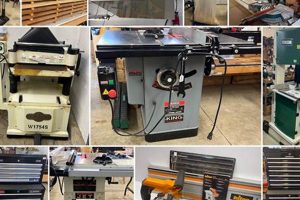
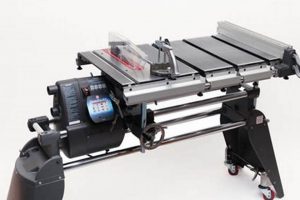
Devices designed to restore and maintain the cutting edges of woodworking implements fall under the category of edge maintenance apparatus. These setups are vital for ensuring tools like chisels, planes, and knives perform optimally. An example includes a combination water-cooled grinder and honing station, which provides both initial shaping and final polishing of the cutting surface.
Proper edge maintenance is paramount for achieving clean, accurate cuts and maximizing tool lifespan. Historically, craftspeople relied on natural sharpening stones and manual techniques. Modern systems offer increased precision and efficiency, reducing the time and effort required to keep implements in peak condition. Sharp tools improve safety by requiring less force, thereby minimizing the risk of slippage and injury.
The subsequent discussion will delve into the various types of available equipment, examining their features, advantages, and disadvantages. Factors to consider when selecting appropriate equipment for specific woodworking needs will be addressed, along with practical guidance on their effective utilization.
Edge Maintenance Best Practices
Effective edge maintenance relies on understanding equipment capabilities and tool requirements. Consistent application of these practices extends tool life and enhances woodworking precision.
Tip 1: Selection Based on Steel Type: Different steel compositions require specific abrasives. High-speed steel benefits from harder, more aggressive abrasives like CBN or diamond, while carbon steel responds well to traditional water stones or oil stones. Matching the abrasive to the steel minimizes wear and optimizes sharpening speed.
Tip 2: Controlled Grinding Techniques: Overheating during grinding alters the steel’s temper, softening the cutting edge. Implement multiple passes with light pressure and frequent cooling to prevent heat buildup. Consider water-cooled grinding systems for enhanced temperature control.
Tip 3: Honing for Refinement: Honing refines the edge after grinding. Progressively finer honing compounds or stones remove microscopic imperfections, resulting in a razor-sharp edge. Leather stropping further polishes and aligns the edge.
Tip 4: Consistent Angle Maintenance: Maintaining a consistent bevel angle is critical for edge geometry. Sharpening jigs and guides ensure accuracy and repeatability, especially for beginners. Adjust the bevel angle based on the tool’s intended use; lower angles for carving, higher angles for impact resistance.
Tip 5: Regular Maintenance Schedule: Regular light honing is more effective than infrequent, aggressive grinding. Implement a maintenance schedule based on usage. Visual inspection before each use reveals minor dullness needing immediate attention.
Tip 6: Abrasive Cleaning and Truing: Clogged or out-of-true abrasives compromise sharpening quality. Clean water stones frequently during use and flatten them regularly with a lapping plate. Dress grinding wheels to maintain a true, even surface.
Tip 7: Understanding Burr Formation: The formation of a burr, a thin wire of metal on the edge, indicates successful grinding. Remove the burr completely during honing by alternating strokes on each side of the blade.
Adherence to these principles ensures consistent, predictable results and optimal performance from woodworking implements. Sharply honed tools are safer, more efficient, and contribute directly to higher quality craftsmanship.
The following sections will examine specific factors influencing equipment selection and address common challenges encountered during the edge maintenance process.
1. Abrasive Material Selection

Abrasive material selection constitutes a foundational aspect of implement maintenance. The type of abrasive directly influences the speed, precision, and quality of edge restoration within maintenance apparatus.
- Grit Size and Material Removal Rate
Grit size, measured numerically, indicates abrasive particle density. Coarser grits, characterized by lower numbers (e.g., 120 grit), facilitate rapid material removal for reshaping damaged edges. Finer grits, with higher numbers (e.g., 8000 grit), are employed for polishing and refining edges. Selecting an appropriate grit sequence optimizes efficiency and prevents excessive material loss. For instance, a heavily damaged chisel may require initial grinding with a coarse diamond stone before progressing to finer water stones for honing.
- Abrasive Material Hardness and Tool Steel Compatibility
Abrasive material hardness dictates its effectiveness on different types of tool steel. Harder abrasives, such as diamond and cubic boron nitride (CBN), are necessary for sharpening high-speed steel (HSS) and powdered metallurgy steels, which possess superior wear resistance. Softer abrasives, like aluminum oxide and silicon carbide, are suitable for carbon steel tools. Incorrect abrasive selection can lead to ineffective sharpening or premature wear of the abrasive itself. Using a water stone on HSS, for example, would result in minimal material removal and rapid stone degradation.
- Bonding Agent Influence on Abrasive Performance
The bonding agent, the material holding the abrasive particles together, affects the abrasive’s cutting action and lifespan. Vitrified bonds, common in grinding wheels, offer a rigid structure for aggressive material removal. Resin bonds, found in coated abrasives, provide flexibility and conformability for profiling. Metallic bonds, used in diamond grinding wheels, offer exceptional durability for demanding applications. Selecting a bonding agent compatible with the intended task maximizes abrasive efficiency and minimizes the risk of premature failure. A resin-bonded diamond wheel, for instance, would be unsuitable for heavy stock removal on hardened steel.
- Coolant Compatibility and Abrasive Swarf Management
The chosen abrasive must be compatible with the coolant used during the sharpening process. Water stones require water as a lubricant to prevent clogging and dissipate heat. Oil stones utilize oil to suspend swarf (metal particles) and maintain a clean cutting surface. Dry grinding abrasives require efficient dust collection systems to remove airborne particles and prevent health hazards. Mismatched coolant and abrasive combinations can lead to reduced cutting efficiency, abrasive loading, and increased heat generation. Using oil on a water stone, for example, would render it ineffective due to pore clogging.
The interplay of grit size, abrasive hardness, bonding agent, and coolant compatibility defines the overall performance of maintenance systems. Strategic abrasive material selection, informed by tool steel composition and intended application, is crucial for achieving optimal edge geometry and extending the lifespan of valuable woodworking implements.
2. Angle maintenance precision
Angle maintenance precision is an indispensable component of effective edge maintenance. The bevel angle directly dictates the tool’s cutting efficiency, durability, and suitability for specific tasks. Inconsistent angle maintenance degrades cutting performance, accelerates wear, and can lead to tool failure. Accurate angle reproduction during sharpening, achieved through jigs or guided systems, ensures consistent tool geometry. For example, a plane iron sharpened with a precise 25-degree bevel will shear wood fibers cleanly, while an inconsistently sharpened blade with a rounded edge will tear and produce an uneven surface. Precision in angle maintenance maximizes the benefits derived from these systems.
Deviations from the designed bevel angle necessitate increased force during operation, elevating the risk of tool slippage and potential injury. Incorrect angles can result in weakened cutting edges prone to chipping or folding over, reducing the implement’s effective lifespan. Consider the case of a chisel used for mortise chopping; an excessively steep bevel angle reduces its ability to penetrate the wood efficiently, while an overly shallow angle weakens the edge, leading to damage upon impact. The ability to accurately reproduce and maintain the designed bevel angle represents a critical factor in system selection. Moreover, precision minimizes material removal during the maintenance process, preserving the original tool profile and maximizing its service life.
In summation, angle maintenance precision forms a pivotal link in the chain of effective woodworking. This careful attention prevents tool degradation and promotes safety. While challenges may include the initial setup and calibration of these systems, and the acquisition of skills required for consistent operation, the resultant enhancement in tool performance and longevity underscores the practical significance of integrating precision angle control. These systems increase production, minimize waste, and provide the user the confidence knowing there tools are the safest they can be for the job.
3. Coolant implementation efficacy
Coolant implementation efficacy constitutes a critical factor in woodworking tool sharpening. The effective application of coolants directly affects the quality of the sharpened edge, the lifespan of the sharpening equipment, and the overall efficiency of the sharpening process.
- Heat Dissipation and Temper Preservation
The primary function of a coolant is heat dissipation. Friction generated during sharpening elevates the temperature of both the tool and the abrasive surface. Excessive heat can alter the temper of the tool steel, reducing its hardness and edge retention. Coolants, such as water or oil, absorb and dissipate heat, maintaining the steel’s temper. Ineffective cooling leads to overheating, resulting in a softened edge and diminished tool performance. For instance, grinding a high-speed steel chisel dry can quickly ruin its edge, while using a water-cooled grinder preserves its hardness.
- Swarf Suspension and Abrasive Cleaning
Coolants also serve to suspend swarf, the fine metal particles removed during sharpening. This suspension prevents the swarf from clogging the abrasive surface, maintaining its cutting efficiency. Additionally, the coolant carries the swarf away from the cutting zone, preventing it from being re-introduced and causing scratches or imperfections on the newly sharpened edge. If coolant is improperly applied swarf can build up, reducing the abrasives useful surface and slowing cutting power of said abrasive. Oil as a coolant suspends swarf, whereas water floats it away.
- Coolant Type and Abrasive Compatibility
The type of coolant must be compatible with both the tool steel and the abrasive material. Water is commonly used with water stones and certain grinding wheels, while oil is used with oil stones and some diamond abrasives. Using an incompatible coolant can lead to reduced abrasive effectiveness, stone degradation, or even corrosion of the tool steel. For example, using oil on a water stone can clog its pores, rendering it ineffective. It is important to always consult the abrasive’s manufacture for specific applications to ensure optimized performance.
- Coolant Delivery Methods and Flow Rate
The method of coolant delivery and the flow rate are crucial for effective heat dissipation and swarf removal. Adequate coolant flow ensures a consistent supply of lubrication and cooling, preventing localized overheating. Systems with adjustable flow rates allow for optimizing the coolant delivery based on the tool size, material, and sharpening technique. Insufficient coolant flow results in elevated temperatures and reduced abrasive efficiency. Too little flow, for example, could cause increased heat and potential warping. Effective coolant implementation necessitates considering the delivery method and maintaining an appropriate flow rate.
In conclusion, effective coolant implementation profoundly influences the outcome. Maintaining proper temperature and clean cutting surface guarantees that the tools used in any wood shop can be kept in great condition.
4. Burr removal technique
The removal of the burr formed during grinding is an essential step in woodworking tool edge maintenance. The burr, a thin, fragile lip of metal created as the abrasive removes material from the tool, signifies that the sharpening process has reached the edge. However, its presence compromises the sharpness and integrity of the cutting edge. Proper burr removal is integral to achieving a clean, keen edge within comprehensive edge maintenance.
- Honing Angle and Burr Removal Effectiveness
The angle at which the tool is honed directly influences burr removal efficiency. Honing at a slightly steeper angle than the primary bevel concentrates pressure on the burr, facilitating its detachment. Conversely, honing at too shallow an angle may burnish the burr without removing it, resulting in a false sense of sharpness. The selection of an appropriate honing angle is thus crucial for effective burr removal and overall edge refinement. A micro-bevel, a slight increase in the secondary honing angle, can also aid in swiftly removing the burr.
- Abrasive Progression and Burr Minimization
The systematic use of progressively finer abrasives minimizes burr formation. Coarse abrasives used for initial shaping generate a substantial burr. Successive honing with finer abrasives gradually reduces its size, culminating in a near-microscopic burr that is easily removed with final polishing. Skipping abrasive grits or attempting to achieve a fine edge with a coarse abrasive alone results in a larger, more difficult-to-remove burr, ultimately compromising edge quality. This progression helps achieve the finest possible edge with the least effort.
- Stropping and Burr Alignment/Removal
Stropping, the process of polishing the tool’s edge on a leather strop charged with abrasive compound, serves to both align and remove the remaining burr. The flexible nature of the leather allows it to conform to the edge, gently bending and detaching the burr. Furthermore, the abrasive compound polishes the edge, creating a highly refined cutting surface. Stropping is particularly effective for removing microscopic burrs that may remain after honing, enhancing the tool’s sharpness and edge retention. Consistent stropping helps maintain an edge longer, as well.
- Directional Stropping and Edge Integrity
The direction of stropping strokes significantly impacts the burr removal process. Stropping away from the cutting edge helps to lift and detach the burr, while stropping towards the edge can fold it over, creating a false sharpness. Using alternating strokes on each side helps. Maintaining consistent stropping direction is critical for preserving edge integrity and achieving a truly sharp, clean edge. Applying light pressure is important to avoid rounding the edge.
The effective removal of the burr formed during sharpening is not merely a finishing touch; it represents a crucial step in achieving optimal woodworking tool performance. The interplay of honing angle, abrasive progression, stropping technique, and stropping direction dictates the success of burr removal, directly influencing the tool’s sharpness, edge retention, and overall cutting efficiency. Without proper burr removal, woodworking tools cannot achieve their full potential, potentially compromising project quality and increasing the risk of tool-related incidents.
5. Honing stage consistency

The consistency of the honing stage within edge maintenance directly influences the cutting performance and longevity of woodworking implements. The honing stage, following grinding and burr removal, serves to refine the edge, removing microscopic imperfections and creating a highly polished surface. Variances in honing pressure, angle, or abrasive grit can compromise the intended edge geometry and diminish sharpness. These inconsistencies, resulting from fluctuations in operator technique, can lead to unpredictable cutting behavior, increased effort, and diminished project quality. For example, inconsistent pressure during honing may create a slightly convex edge instead of a precisely flat one, resulting in uneven wood removal during planing. The maintenance apparatus must, therefore, facilitate consistent application of honing parameters to deliver predictable results.
The practical implications of honing stage consistency extend to the tool’s overall lifespan. A consistently honed edge is less susceptible to chipping or folding over under stress. Furthermore, minimizing inconsistencies during honing reduces the amount of material removed with each maintenance cycle, preserving the original tool profile over time. Consider the impact on carving chisels; inconsistent honing can lead to asymmetrical bevels, requiring more frequent and aggressive grinding to correct, thereby shortening the usable life of the tool. The precision inherent in advanced systems directly addresses this concern, enabling repeatable and consistent honing. Moreover, consistent honing simplifies the sharpening process, reducing the time and effort required to maintain implements in peak condition.
In summation, honing stage consistency represents a key determinant of edge maintenance success. Implementing systems that promote consistent pressure, angle, and abrasive use minimizes irregularities, optimizing both the cutting performance and useful life of woodworking implements. While challenges remain in achieving perfect uniformity, particularly for manual honing methods, striving for consistent technique and employing precision-guided systems mitigates these challenges, ultimately contributing to improved woodworking outcomes.
6. Equipment Calibration Accuracy

Equipment calibration accuracy constitutes a cornerstone of reliable woodworking tool sharpening. Precise calibration ensures that the equipment operates within specified parameters, delivering consistent and predictable results during edge maintenance. Deviation from calibration standards introduces errors in bevel angles, surface flatness, and abrasive pressure, ultimately compromising the sharpness and longevity of woodworking tools.
- Bevel Angle Repeatability
Calibration accuracy directly affects the repeatability of bevel angles. Sharpening systems rely on calibrated jigs or guides to maintain the desired angle between the tool and the abrasive. Miscalibration introduces variations in this angle, leading to inconsistent edge geometry. For instance, a grinding jig that is miscalibrated by even half a degree can result in a noticeable difference in the cutting performance of a plane iron, producing tear-out instead of a smooth surface. Accurate calibration ensures that the tool is sharpened to the intended angle every time.
- Abrasive Surface Trueness
The flatness and trueness of the abrasive surface are critical for even material removal. Calibration procedures ensure that grinding wheels and sharpening stones are properly dressed and flattened, eliminating high spots or concavities. An uncalibrated surface can lead to uneven sharpening, concentrating pressure on certain areas of the tool and creating a skewed bevel. Consider a water stone with a slight depression in the center; sharpening a chisel on such a stone will result in rounded edges and a less effective cutting edge. The abrasives must be verified to be true to obtain intended performance.
- Pressure Application Consistency
Calibrated sharpening systems often incorporate mechanisms to control the pressure applied during sharpening. This consistency is essential for preventing uneven material removal and overheating. Miscalibration in pressure application can lead to excessive wear on the abrasive or damage to the tool’s temper. For example, a power-driven sharpening system with a faulty pressure sensor might apply too much force, causing the tool to overheat and lose its hardness. In order to keep a system optimized, sensors must be calibrated.
- Measurement and Verification Tools
Calibration accuracy relies on the use of precise measurement and verification tools, such as digital protractors, flatness gauges, and straightedges. These tools are used to assess the accuracy of the sharpening equipment and identify any deviations from the specified standards. Regular calibration checks with reliable instruments ensure that the sharpening system remains within acceptable tolerance levels. Utilizing calibrated instruments is crucial for determining if calibration is even needed.
Effective calibration safeguards tool investments, minimizing the risk of damage from improper sharpening techniques. Integrating regular calibration checks into edge maintenance ensures systems remain optimally performing. Precise woodworking results, reduced tool wear, and enhanced user safety, are the benefits of good calibration in equipment related to tool sharpening.
7. User skill proficiency
The successful implementation of edge maintenance is significantly mediated by operator expertise. While advanced apparatus offer precision and repeatability, the attainment of optimal results hinges on the user’s understanding of sharpening principles and the ability to execute proper techniques. The interaction between operator skill and system capabilities defines the overall effectiveness.
- Abrasive Selection and Application Expertise
Proficiency in abrasive selection involves understanding the characteristics of various abrasives (e.g., water stones, oil stones, diamond plates) and their suitability for different tool steels. Application expertise encompasses the ability to apply appropriate pressure, maintain consistent angles, and manage slurry or swarf. An experienced user recognizes the subtle cues indicating proper abrasive engagement, such as the sound and feel of the cutting action. Novices, lacking this skill, may apply excessive pressure, leading to uneven wear or damage to both the tool and the abrasive.
- Angle Control and Freehand Sharpening Competence
The ability to maintain a consistent bevel angle is crucial for achieving a sharp and durable edge. Skilled operators can achieve accurate angles through freehand sharpening, relying on muscle memory and tactile feedback. However, even experienced users may benefit from jigs or guides for complex bevels or when sharpening small tools. Lack of angle control leads to rounded edges, inconsistent bevels, and reduced cutting performance. Furthermore, familiarity with a variety of sharpening systems allows the user to adapt to various tool and steel conditions.
- Burr Detection and Removal Mastery
Detecting the formation of a burr, a thin wire of metal on the edge, signals the completion of the grinding phase. Mastering burr removal techniques, such as stropping or honing, is essential for creating a clean, sharp edge. An inexperienced user may fail to completely remove the burr, resulting in a false sense of sharpness and a fragile edge. They may also be unable to detect the direction of the burr, thus being unable to create a true sharp edge.
- Equipment Maintenance and Troubleshooting Acumen
User skill proficiency extends to equipment maintenance and troubleshooting. Competent operators can identify and address common problems, such as clogged abrasives, misaligned jigs, or worn components. They also understand the importance of regular cleaning, lubrication, and calibration to maintain optimal equipment performance. Lack of maintenance acumen can lead to premature equipment failure and compromised sharpening results.
In conclusion, integrating operator skill into the edge maintenance process is imperative. The interplay between a knowledgeable user and a capable piece of equipment unlocks maximum cutting performance and tool longevity. Continued learning, experimentation, and refinement of technique are integral to achieving consistent and predictable sharpening outcomes. This knowledge comes with experience, and by gaining experience tool sharpening becomes a more precise task with greater and more efficient results.
Frequently Asked Questions
The following elucidates critical aspects of maintaining woodworking implements, addressing common inquiries regarding optimal performance and longevity.
Question 1: What distinguishes water stones from oil stones in implement maintenance?
Water stones utilize water as a lubricant and coolant, generating a slurry that aids in polishing. Oil stones employ oil for the same purpose, but the oil also helps suspend metal particles, preventing clogging. The choice depends on tool steel type and personal preference.
Question 2: How does grit size affect sharpening efficacy?
Grit size denotes the coarseness of the abrasive. Lower grit numbers (e.g., 120) facilitate rapid material removal for reshaping, while higher numbers (e.g., 8000) are used for refining and polishing. A progressive sequence of grits is typically required.
Question 3: Why is angle consistency paramount during honing?
Maintaining a consistent bevel angle ensures optimal cutting geometry and durability. Inconsistent angles lead to rounded edges and diminished sharpness. Jigs and guides are recommended to ensure angle accuracy.
Question 4: What constitutes the “burr” and why must it be removed?
The burr is a thin lip of metal formed on the edge during grinding. Its presence compromises sharpness and edge integrity. Burr removal, typically achieved through stropping or honing, is essential for a clean cutting edge.
Question 5: How does steel hardness relate to abrasive selection?
Harder tool steels, such as high-speed steel (HSS), require harder abrasives like diamond or CBN. Softer carbon steels can be effectively sharpened with aluminum oxide or silicon carbide abrasives. Matching abrasive hardness to steel hardness optimizes performance and prevents premature abrasive wear.
Question 6: What maintenance is required for sharpening equipment itself?
Sharpening equipment requires regular maintenance to ensure accuracy and longevity. This includes flattening water stones, dressing grinding wheels, cleaning oil stones, and calibrating jigs and guides. Proper maintenance ensures consistent sharpening results.
Optimal maintenance is key. Knowledge of these factors is vital for successful, safe practices in woodworking. Sharply maintained tools, through their effective sharpening, provide the safest working practice and production.
The subsequent section will delve into specific equipment options, offering a comparative analysis.
Conclusion
This discourse has provided a comprehensive overview of edge maintenance, encompassing equipment selection, abrasive properties, technique refinement, and calibration considerations. A consistent theme has emerged: the effective maintenance of woodworking implements demands a synthesis of appropriate technologies and skilled application. The choice of system is dependent on a multitude of factors including budget, tool steel type, and frequency of use.
The ultimate benefit of employing the right systems lies in the enhanced performance, increased safety, and extended lifespan of essential tools. Continued exploration and meticulous application of the practices detailed herein remain paramount for woodworkers seeking to achieve the pinnacle of their craft. The pursuit of sharpness is not merely a technical exercise, but an investment in quality craftsmanship, user safety, and the enduring legacy of the art.
![Mastering the Care & Use of Japanese Woodworking Tools [Tips] | Step-by-Step Guides, Tools & Inspiration to Build Beautiful Wooden Decor on a Budget](https://woodfromhome.com/wp-content/uploads/2026/05/th-83-300x200.jpg "Mastering the Care & Use of Japanese Woodworking Tools [Tips] Step-by-Step Guides, Tools & Inspiration to Build Beautiful Wooden Decor on a Budget")