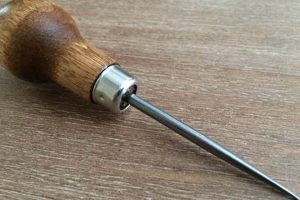
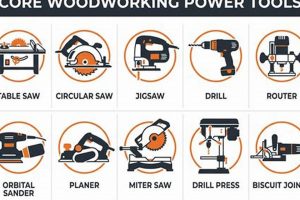
Fundamental implements for shaping wood are paramount in any woodworking endeavor. These instruments, ranging from hand-operated saws and chisels to powered routers and sanders, facilitate the cutting, shaping, and finishing of timber. For instance, a well-tuned hand plane ensures a smooth surface, while a sharp chisel allows for precise joinery.
The availability of appropriate instruments significantly impacts efficiency and precision in woodworking projects. A well-equipped workshop allows for the creation of durable and aesthetically pleasing objects, from furniture to intricate carvings. Historically, advancements in metallurgy and engineering have led to the development of more efficient and versatile implements, increasing both the scope and quality of woodworking.
The subsequent sections will delve into specific categories of instruments, detailing their function, selection criteria, and proper usage. This exploration will cover measuring tools, cutting tools, shaping tools, assembly tools, and finishing tools, providing a framework for building a functional and effective woodworking setup.
Guidance on Acquiring Woodworking Implements
The following outlines several key considerations when selecting fundamental woodworking implements for a workshop.
Tip 1: Prioritize Quality over Quantity: Investing in fewer, higher-quality instruments is generally preferable to acquiring a large collection of lower-grade alternatives. Quality tools offer improved performance, durability, and long-term cost-effectiveness.
Tip 2: Understand Specific Task Requirements: Before purchasing, determine the precise applications for each instrument. A dovetail saw, for example, is specialized for fine joinery, while a circular saw is suited for rapid stock cutting.
Tip 3: Evaluate Ergonomics and Comfort: Handling characteristics directly affect user fatigue and control. Select instruments with comfortable grips and balanced weight distribution to optimize performance and reduce strain.
Tip 4: Research Material Composition: The materials used in tool construction influence durability and performance. High-carbon steel blades, for instance, retain an edge longer than those made from softer metals.
Tip 5: Consider Power Source and Maintenance Needs: Power tools require a reliable electricity supply and regular maintenance. Hand tools demand periodic sharpening and cleaning to maintain optimal functionality.
Tip 6: Seek Reputable Brands and Manufacturers: Established brands typically offer superior quality control and customer support. Research product reviews and ratings to assess the reputation of potential suppliers.
Tip 7: Explore Used or Refurbished Options: High-quality used instruments can provide significant cost savings. Carefully inspect used items for signs of wear and ensure functionality before purchase.
Adhering to these guidelines can facilitate the acquisition of durable, functional, and appropriate instruments, contributing to enhanced woodworking outcomes.
The concluding section will offer a summary of the core concepts discussed, reinforcing the critical importance of the right tools in woodworking.
1. Precision

Precision, in the context of woodworking, is intrinsically linked to the effectiveness of fundamental instruments. Accuracy in measurement, cutting, and assembly directly influences the quality and structural integrity of the finished product.
- Measuring Instrument Calibration
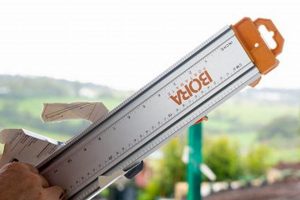
The accuracy of measuring tapes, squares, and levels dictates the initial dimensions of a project. A miscalibrated measuring tool can lead to cumulative errors, resulting in ill-fitting joints or skewed assemblies. For example, if a square is not perfectly 90 degrees, any structure built using it will be out of square, compromising its structural integrity and aesthetic appeal.
- Cutting Tool Sharpness and Control
Sharp blades on saws, chisels, and planes are paramount for clean, precise cuts. A dull blade requires excessive force, increasing the risk of wandering and splintering. Controlled hand movements, guided by sharp cutting edges, enable the creation of tight-fitting joinery, such as dovetails or mortise-and-tenon joints, essential for durable and aesthetically pleasing constructions.
- Assembly Tool Accuracy
The proper use of clamping systems and fastening tools ensures that components are joined securely and accurately. Misaligned clamps or incorrectly driven screws can distort the assembly, leading to structural weakness or visual imperfections. Precise application of pressure during glue-ups, facilitated by well-maintained clamps, guarantees strong and gap-free bonds.
- Finishing Tool Application
The application of finishes requires careful control to achieve a uniform and aesthetically pleasing result. Incorrectly applied finishes, due to faulty spray guns or uneven brush strokes, can detract from the overall quality of the project. Precision in this stage enhances the aesthetic appeal and provides crucial protection to the wood.
The cumulative effect of precision in each stage of woodworking highlights the significance of well-maintained and accurate instruments. Inaccurate measurements, imprecise cuts, and flawed assembly can result in projects that are structurally unsound and visually unappealing, underlining the imperative of employing implements that facilitate accurate execution.
2. Durability

The resilience of woodworking instruments directly influences their long-term usability and cost-effectiveness. Implementing robust materials and construction techniques enhances the capacity of these instruments to withstand sustained usage, thereby justifying their initial investment.
- Material Composition and Hardness
The selection of high-quality materials, such as hardened steel for blades and dense hardwoods for handles, determines an instrument’s capacity to resist wear and deformation. High-carbon steel retains its edge longer than softer metals, reducing the frequency of sharpening. Dense hardwoods, such as maple or walnut, withstand repeated impacts and resist cracking, prolonging handle integrity. Instruments fabricated from inferior materials exhibit premature wear, necessitating frequent replacements.
- Joint Construction and Reinforcement
The manner in which component parts are joined contributes significantly to the overall structural integrity. Dovetail joints, mechanical fasteners, and epoxy resins provide robust connections capable of withstanding substantial forces. Reinforced stress points, such as metal ferrules on chisel handles, prevent splitting under repeated hammering. Weak or poorly executed joints represent potential failure points, compromising the instrument’s functionality.
- Surface Treatments and Corrosion Resistance
Protective coatings and finishes mitigate the effects of moisture, chemicals, and abrasion. Powder coating on metal components and varnishes on wooden surfaces shield against rust and degradation. Corrosion-resistant materials, such as stainless steel, are employed in instruments intended for use in humid or corrosive environments. Inadequate surface treatment accelerates deterioration, diminishing the instrument’s lifespan.
- Design for Impact and Stress Dissipation
Instrument design can mitigate the effects of impact and stress, distributing forces evenly throughout the structure. Ergonomic handle designs reduce strain on the user while simultaneously minimizing stress concentrations within the handle itself. Instruments with robust internal structures are better equipped to withstand accidental drops or impacts without sustaining significant damage.
The cumulative effect of these factors determines the longevity and reliability of woodworking instruments. Investing in durable implements minimizes replacement costs, reduces downtime, and ensures consistent performance over an extended period, underscoring the economic and practical benefits of prioritizing robustness in woodworking tool selection.
3. Functionality

Functionality, as an attribute of woodworking instruments, denotes the capacity to effectively perform a designated task. The design, construction, and maintenance of these implements directly influence their functional efficacy, determining whether they can execute intended operations with precision and efficiency. Instruments must be tailored to specific applications, such as sawing, shaping, or fastening, to achieve optimal results. For instance, a backsaw, designed with a thin blade and reinforced spine, excels in producing accurate cuts for joinery, whereas a general-purpose handsaw is more suited for rough stock removal. The selection of an instrument inappropriate for a given task compromises the quality of the output, potentially leading to rework or project failure.
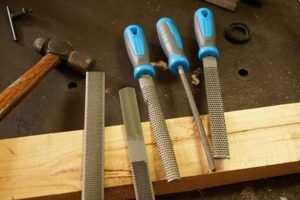
A primary function of woodworking instruments is to convert raw materials into usable components for construction. Cutting tools, such as saws and chisels, are employed to dimension timber and create joinery elements. Shaping implements, including planes and rasps, refine surfaces and produce contoured profiles. Fastening systems, comprising screws, nails, and adhesives, secure components together to form structural assemblies. Deficiencies in any of these functional areas undermine the integrity of the finished product. For example, dull chisels impede the creation of clean mortise-and-tenon joints, resulting in weak or misaligned connections. A lack of appropriate clamping systems during glue-up can lead to gaps and structural instability.
The practical significance of understanding functionality lies in enabling informed instrument selection and proper utilization. Woodworkers must possess a clear understanding of the purpose and limitations of each instrument to maximize its effectiveness and minimize the risk of errors. Furthermore, regular maintenance, such as sharpening blades and lubricating moving parts, is essential to preserving functional integrity. Ultimately, a commitment to functionality ensures that woodworking projects are executed with precision, efficiency, and durability, enhancing both the quality of the finished product and the overall woodworking experience.
4. Versatility
In the realm of essential woodworking tools, versatility represents a critical attribute, influencing both the range of projects a craftsman can undertake and the economic efficiency of a workshop. Instruments exhibiting versatility reduce the need for extensive tool collections, allowing for broader application across diverse woodworking tasks.
- Multi-Functional Hand Planes
Certain hand planes, such as block planes and jack planes, can perform multiple functions, from smoothing surfaces to shaping edges and rebates. A well-tuned jack plane, for example, can effectively flatten a board, remove stock, and prepare surfaces for finishing. This multi-functionality reduces the need for separate specialized planes, offering both cost savings and space efficiency within the workshop.
- Combination Squares and Measuring Tools
Combination squares, sliding bevels, and multi-gauge measuring tools integrate several measurement and marking functions into a single instrument. A combination square can serve as a square, a depth gauge, a height gauge, and a marking tool. This versatility eliminates the need for multiple specialized measuring instruments, streamlining workflow and improving accuracy across various layout tasks.
- Variable-Speed Power Tools
Power tools equipped with variable-speed controls, such as drills, routers, and sanders, offer adaptability for different materials and operations. A variable-speed drill can be used for driving screws at low speeds and drilling holes at higher speeds, accommodating various material densities and fastener sizes. This adaptability enhances precision and reduces the risk of damaging the workpiece.
- Interchangeable Blade Systems
Some saws and knives feature interchangeable blade systems, allowing a single handle to accommodate a variety of blade types for different cutting tasks. A utility knife with interchangeable blades can be used for scoring lines, cutting thin materials, and shaping softwoods. This versatility minimizes the need for multiple specialized cutting tools, providing a cost-effective and space-saving solution for diverse cutting needs.
The capacity of essential woodworking tools to perform multiple functions or adapt to various materials directly enhances workshop productivity and reduces investment costs. Instruments exhibiting versatility are particularly valuable for woodworkers with limited space or budget, enabling them to tackle a wide range of projects with a reduced set of implements. The strategic selection of versatile tools, therefore, represents a cornerstone of efficient and effective woodworking practice.
5. Ergonomics

The integration of ergonomic principles into the design and selection of fundamental woodworking implements directly affects user well-being and operational efficiency. Instruments engineered with consideration for human biomechanics mitigate the risk of musculoskeletal disorders, thereby enhancing long-term productivity. Ill-designed instruments impose undue strain on joints and muscles, leading to fatigue, discomfort, and potentially chronic injuries. For instance, a hand plane with a poorly shaped handle necessitates excessive gripping force, increasing the likelihood of carpal tunnel syndrome. Conversely, a plane with an ergonomically contoured handle distributes pressure evenly, reducing strain and improving control. The cause-and-effect relationship between tool design and user health underscores the importance of ergonomic considerations in woodworking.
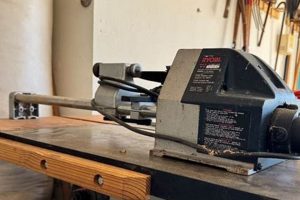
The practical application of ergonomic principles extends beyond handle design to encompass tool weight, balance, and vibration dampening. Instruments that are excessively heavy require greater exertion to manipulate, increasing the risk of shoulder and back injuries. Poorly balanced tools necessitate constant adjustments to maintain control, contributing to fatigue and imprecision. Vibration from power tools can induce hand-arm vibration syndrome, a debilitating condition affecting blood circulation and nerve function. Vibration-dampening features, such as cushioned grips and anti-vibration systems, mitigate these risks. The implementation of ergonomic designs in essential woodworking tools demonstrates a proactive approach to preventing occupational hazards and promoting a safer working environment.
Prioritizing ergonomics in the selection and use of woodworking instruments presents both immediate and long-term benefits. Reduced fatigue and discomfort translate to improved focus, accuracy, and work quality. The prevention of musculoskeletal disorders minimizes healthcare costs and lost productivity. A comprehensive understanding of ergonomic principles empowers woodworkers to make informed decisions regarding tool selection, posture, and work practices, ultimately fostering a sustainable and health-conscious approach to the craft. Overcoming the challenge of recognizing subtle design flaws and adopting ergonomic work habits requires ongoing education and a commitment to prioritizing well-being alongside productivity.
6. Maintenance

The sustained performance and longevity of implements are intrinsically linked to diligent maintenance practices. Such practices are not merely supplementary but integral to realizing the full potential of each tool and ensuring consistent, high-quality results.
- Sharpening Cutting Edges
The sharpness of blades, chisels, and plane irons directly affects cutting efficiency and precision. Regular honing and sharpening are essential to maintain optimal cutting angles and remove microscopic imperfections. Neglecting this aspect leads to increased cutting effort, tear-out, and compromised joinery. Proper sharpening techniques, employing whetstones or specialized sharpening jigs, are critical for preserving tool geometry and extending blade life.
- Lubrication of Moving Parts
Power tools and hand tools with moving components, such as gears and pivots, require periodic lubrication to minimize friction and prevent premature wear. Applying appropriate lubricants, such as machine oil or grease, reduces heat buildup, ensures smooth operation, and extends the lifespan of the tool. Failure to lubricate moving parts can result in increased resistance, reduced power output, and potential mechanical failure.
- Cleaning and Corrosion Prevention
Woodworking environments generate dust, shavings, and residue that can accumulate on tools and contribute to corrosion. Regular cleaning with brushes, cloths, and appropriate solvents removes debris and prevents the formation of rust. Applying protective coatings, such as wax or oil, shields metal surfaces from moisture and corrosive agents. Neglecting cleaning and corrosion prevention accelerates tool degradation and impairs performance.
- Handle and Structural Integrity Inspection
The handles of hand tools and the overall structural integrity of both hand and power tools warrant periodic inspection. Loose handles, cracked frames, or damaged components compromise safety and precision. Tightening loose fasteners, repairing cracks, and replacing worn parts are essential maintenance tasks. Failure to address structural issues can lead to tool failure, user injury, and compromised project outcomes.
Effective maintenance practices are indispensable for preserving the functionality, safety, and lifespan of fundamental woodworking implements. Consistent adherence to these practices represents a responsible investment that yields tangible benefits in terms of performance, durability, and cost-effectiveness.
Frequently Asked Questions
The following addresses common queries pertaining to fundamental woodworking implements, providing concise and informative answers.
Question 1: What constitutes a starting set of essential woodworking tools for a beginner?
A foundational set comprises a measuring tape, combination square, hand saw, set of chisels, block plane, hand drill, and a selection of clamps. These instruments enable basic dimensioning, shaping, and assembly operations.
Question 2: Is it more prudent to acquire individual tools or a pre-packaged set?
While sets may offer an initial cost advantage, individual selection allows for prioritizing quality in essential implements. Opting for higher-grade individual tools generally proves more economical in the long term.
Question 3: What are the key criteria for selecting a suitable hand saw?
Blade sharpness, tooth geometry, handle ergonomics, and saw type are paramount. Crosscut saws are designed for cutting across the grain, while rip saws are intended for cutting along the grain.
Question 4: How frequently should woodworking tools undergo maintenance?
Cutting edges should be sharpened as needed, typically after noticeable performance degradation. Moving parts require lubrication every few months, while cleaning and corrosion prevention should be performed regularly, ideally after each use.
Question 5: What safety precautions are indispensable when utilizing power tools?
Eye protection, hearing protection, and dust masks are mandatory. Proper grounding, blade guards, and adherence to manufacturer instructions are also critical for preventing accidents.
Question 6: Can the functionality of multiple specialized tools be replicated with a single versatile implement?
While versatility can reduce the need for extensive tool collections, specialized instruments generally offer superior precision and efficiency for specific tasks. Striking a balance between versatility and specialization optimizes both cost and performance.
These answers provide a foundational understanding of key considerations surrounding fundamental woodworking implements. Prioritizing quality, safety, and proper maintenance will enhance both the efficiency and longevity of any woodworking endeavor.
The subsequent section will explore advanced tool options and specialized techniques for enhancing woodworking capabilities.
Conclusion
This exploration has underscored the critical role of essential woodworking tools in achieving precision, durability, functionality, versatility, ergonomics, and long-term performance within woodworking practices. The quality, maintenance, and proper application of these implements directly influence the success and longevity of woodworking projects. From foundational tasks to complex joinery, the selection and conscientious use of appropriate instruments are non-negotiable for achieving professional results.
The principles outlined herein serve as a framework for both aspiring and experienced woodworkers. Continuous learning and refinement of skills, coupled with a commitment to tool maintenance and safety, are essential for realizing the full potential of the craft. The enduring legacy of woodworking relies on the skillful application of knowledge and the unwavering commitment to employing the correct instruments for each and every task.