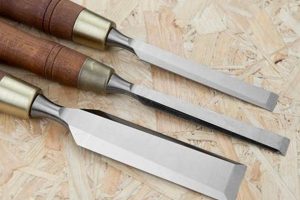
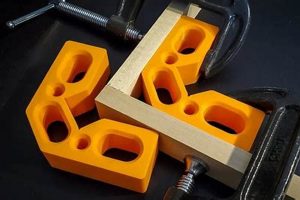
The term describes an instrument utilized in the craft of shaping and joining wood. This instrument allows for the creation of angled cuts and joints, essential for constructing furniture, cabinetry, and various other wooden structures. Examples include a sliding bevel, used to transfer angles, and a bevel-edged chisel, employed for precise paring and shaping.
Accuracy in woodworking hinges on the precise execution of angled cuts. The described instruments facilitate this accuracy, resulting in strong, aesthetically pleasing joints and structures. Historically, the creation of complex wooden objects relied heavily on the skillful use of such tools, demonstrating their fundamental importance to the craft.
Therefore, a thorough understanding of these instruments is crucial for any woodworker. The subsequent sections will delve into specific types, usage techniques, and maintenance procedures related to these essential items in the woodworker’s arsenal.
Working with Angled Cutting Instruments
The accurate and efficient utilization of angled cutting instruments is paramount for quality woodworking. The following tips provide guidance on optimizing the performance and longevity of these crucial tools.
Tip 1: Sharpening is Critical. A dull edge compromises precision and increases the risk of accidents. Regular sharpening, using appropriate stones or honing systems, is essential for maintaining optimal cutting performance.
Tip 2: Proper Angle Transfer. When using a sliding bevel, ensure the angle is accurately transferred from the plan or reference piece. Tighten the locking mechanism securely to prevent slippage during layout.
Tip 3: Select the Right Tool for the Job. Different angled cutting instruments are designed for specific tasks. Using the correct tool, whether a chisel, plane, or saw, optimizes efficiency and quality.
Tip 4: Practice Controlled Movements. When paring with a beveled chisel, maintain a firm grip and use controlled movements. Avoid excessive force, which can lead to splitting or damage.
Tip 5: Consistent Hand Pressure. When using an angled hand plane, apply consistent downward pressure to ensure a smooth and even cut. Avoid uneven pressure, which can result in ripples or gouges.
Tip 6: Use a Backing Board. When sawing thin stock at an angle, use a backing board to prevent splintering and ensure a clean cut. This is particularly important with delicate hardwoods.
Tip 7: Store Tools Properly. Angled cutting instruments should be stored in a dry environment to prevent rust and corrosion. Use tool rolls or dedicated storage solutions to protect the edges from damage.
Consistent application of these tips will enhance the quality and efficiency of woodworking projects. Proper tool care, accurate angle transfer, and controlled execution are vital for achieving professional results.
The subsequent sections will discuss advanced techniques and specialized applications of angled cutting instruments, further expanding the woodworker’s skillset.
1. Angle Accuracy

Angle accuracy represents a cornerstone of precision in woodworking, intrinsically linked to the proper utilization of woodworking angled tools. Deviations from specified angles can compromise the structural integrity and aesthetic appeal of finished projects. The relationship is therefore crucial for achieving professional-grade results.
- Impact on Joint Strength
Inaccurate angles in joinery, such as dovetails or mortise and tenon joints, directly affect the strength and durability of the connection. Deviations can lead to weak joints that are prone to failure under stress. Consequently, instruments must maintain tight tolerances during angle transfer and layout to ensure robust connections.
- Aesthetic Considerations
Visually, inaccurate angles are immediately noticeable, particularly in projects involving mitered corners or beveled edges. Even slight discrepancies disrupt the flow of lines and surfaces, detracting from the overall aesthetic quality of the piece. Precision is essential for creating visually harmonious and professional-looking results.
- Tool Calibration and Maintenance
Achieving angle accuracy requires consistent calibration and maintenance of angled tools. Misaligned or poorly maintained tools can introduce errors into the angle setting, leading to inaccurate cuts. Regular checks with a reliable square or protractor are necessary to ensure the tool is functioning within acceptable tolerances.
- Material Properties Influence
Material variations can also impact angle accuracy. Hardwoods and softwoods respond differently to cutting forces, potentially causing slight deviations in the final angle. The selection of appropriate cutting techniques and blade types is critical for mitigating these effects and maintaining the desired angle precision across different wood species.
In summary, angle accuracy is paramount for both the structural integrity and aesthetic appeal of woodworking projects. This accuracy is directly dependent on the quality and proper use of woodworking angled tools, as well as consistent attention to calibration, maintenance, and material properties. Skillful application of these elements is fundamental to successful woodworking.
2. Edge Sharpness

Edge sharpness is an essential attribute directly influencing the performance and utility of any woodworking tool incorporating a beveled cutting edge. The effectiveness and precision with which such tools perform their intended tasks are inextricably linked to the degree of keenness maintained on the cutting surface.
- Cutting Efficiency and Effort
A honed edge minimizes the force required to sever wood fibers. Consequently, sharp instruments reduce physical exertion on the part of the woodworker, leading to improved efficiency and reduced fatigue over prolonged use. A dull instrument, conversely, necessitates increased force, potentially resulting in inaccurate cuts and compromised control.
- Cleanliness of Cut and Tear-Out Reduction
The acuity of the cutting edge directly impacts the quality of the resulting surface. Sharp instruments produce clean, crisp cuts, minimizing the incidence of tear-out, particularly in figured or end-grain wood. Conversely, a blunted edge tends to crush or tear fibers, resulting in a ragged, unprofessional finish. Appropriate sharpening techniques and honing are thus crucial for achieving optimal surface quality.
- Tool Control and Safety
Surprisingly, a sharp instrument offers greater control and enhanced safety during woodworking operations. The reduced force required for cutting allows for more precise manipulation and reduces the likelihood of slips or sudden movements. Dull tools, conversely, demand greater force, increasing the potential for loss of control and accidental injury. Maintaining a keen edge is, therefore, not merely a matter of efficiency but also of safety.
- Longevity of the Tool
Regular sharpening and honing, while seemingly counterintuitive, extend the lifespan of woodworking instruments. By maintaining a sharp edge, less force is required for cutting, reducing stress on the blade and minimizing wear and tear. Neglecting edge maintenance, conversely, accelerates the degradation of the cutting surface, requiring more aggressive sharpening methods and ultimately shortening the tool’s useful life.
The correlation between edge sharpness and the functionality of woodworking bevel tools is thus undeniable. Regular maintenance of the cutting edge, utilizing appropriate sharpening techniques and honing methods, is indispensable for achieving optimal performance, ensuring user safety, and prolonging the useful life of these essential instruments.
3. Material Compatibility

Material compatibility, with respect to woodworking angled tools, dictates the effectiveness and longevity of both the tool and the resultant workpiece. The properties of the material being worked hardness, density, grain structure, and resin content significantly influence the selection, adjustment, and application of the angled tool.
- Hardwood vs. Softwood Considerations
Hardwoods, characterized by tighter grain structures and greater density, necessitate sharper blade angles and more robust tool construction to prevent premature dulling or tool failure. Softwoods, being less dense, generally allow for shallower cutting angles and require less force, though resin content can present challenges in maintaining a clean cutting edge. Proper tool selection based on wood type is therefore critical.
- Impact of Abrasive Materials
Certain wood species contain abrasive minerals or silica inclusions that accelerate blade wear. Working with these materials requires more frequent sharpening and may necessitate the use of specialized alloy blades designed for increased wear resistance. Failure to account for abrasive properties can lead to rapid tool degradation and compromised cut quality.
- Adhesive and Coating Effects
The presence of adhesives or coatings on the workpiece alters its surface properties and cutting characteristics. Glue lines, for example, can dull blades more rapidly than solid wood. Similarly, coatings can cause chipping or tear-out if the angled tool is not properly adjusted. Evaluating the impact of these surface treatments is essential for achieving clean cuts and preventing damage to the workpiece.
- Tool Material Selection and Maintenance
The composition of the angled tool itself must be compatible with the materials being worked. High-speed steel (HSS) blades, for example, offer superior wear resistance compared to carbon steel blades when working with abrasive materials. Furthermore, proper lubrication and cleaning are essential for preventing corrosion and maintaining optimal performance, regardless of the wood species being used.
In conclusion, the successful application of woodworking angled tools hinges on a comprehensive understanding of material properties and their interaction with the tool’s cutting edge. Careful consideration of these factors, coupled with appropriate tool selection, adjustment, and maintenance, ensures optimal performance and extends the lifespan of both the tool and the projects it creates. Ignoring material compatibility can lead to inefficient work, poor results, and damage to both tools and materials.
4. Secure Adjustment

Secure adjustment constitutes a critical factor in the effective and reliable utilization of woodworking bevel tools. The ability to maintain a set angle or position during operation directly impacts the precision and quality of the resultant cut or joint. Instability in adjustment introduces inaccuracies, compromises structural integrity, and ultimately diminishes the value of the woodworking process.
- Locking Mechanism Efficacy
The primary function of any secure adjustment system within a bevel tool lies in the efficacy of its locking mechanism. This mechanism, whether a setscrew, lever clamp, or other design, must reliably resist movement or slippage under applied force. Examples include a well-machined brass setscrew in a sliding bevel, or a cam-over lever on a bevel gauge. Failure in this area leads to inconsistent bevel angles and necessitates repeated readjustments, increasing project time and reducing accuracy.
- Material Stability and Rigidity
The materials used in the construction of the adjustment components play a significant role in maintaining a secure setting. Components must exhibit sufficient rigidity to resist deformation under stress. For instance, a bevel gauge with a blade made from thin, flexible steel will be prone to bending and angle distortion, regardless of the locking mechanism’s quality. High-quality bevel tools utilize hardened steel or other dimensionally stable materials for critical adjustment components.
- Calibration Retention
Even with a robust locking mechanism and rigid materials, the overall design must ensure calibration retention over time. Thread wear in setscrews, loosening of pivot points, or dimensional changes due to temperature fluctuations can all compromise the accuracy of the set angle. A well-designed tool will incorporate features to mitigate these effects, such as fine-pitch threads, hardened contact surfaces, and thermal compensation features.
- Ergonomic Considerations
While primarily focused on stability, a secure adjustment system must also be easily manipulated and set by the user. Overly complex or difficult-to-use adjustment mechanisms can increase the likelihood of errors or incomplete locking, leading to inaccuracies. A well-designed system will offer intuitive adjustment and secure locking with minimal effort, promoting efficient and accurate workflow.
In essence, secure adjustment is not merely a desirable feature, but a fundamental requirement for woodworking bevel tools intended for precision work. Compromises in locking mechanism efficacy, material stability, calibration retention, or ergonomic design directly translate to reduced accuracy, increased rework, and diminished overall project quality. The investment in high-quality tools with robust and reliable adjustment systems is, therefore, a sound one for any woodworker seeking professional-grade results.
5. Application Technique

The successful utilization of a woodworking bevel tool is inextricably linked to the application technique employed. The tool’s design and precision afford the potential for accurate angled cuts and joinery, yet that potential remains unrealized without proper execution. Application technique, therefore, serves as the crucial bridge between the tool’s inherent capabilities and the desired outcome. For example, using a bevel-edged chisel to pare a dovetail joint requires a controlled, deliberate approach, applying minimal pressure and precise hand movements. A haphazard technique will invariably result in a poorly fitted joint, regardless of the chisel’s quality.
Different types of bevel tools necessitate distinct application techniques. A sliding bevel, used to transfer angles, demands accurate referencing against both the original angle and the workpiece, ensuring the blade is firmly locked in place before marking. Similarly, using a bevel-up hand plane requires careful adjustment of the mouth opening and blade depth to prevent tear-out and achieve a smooth, consistent bevel. Furthermore, the appropriate stance and grip, facilitating controlled movement and balanced pressure, are essential components of the overall application technique. Seasoned woodworkers often develop a ‘feel’ for the tool, allowing them to intuitively adjust their technique based on the wood’s resistance and grain direction.
Ultimately, the effective application of a woodworking bevel tool requires a combination of knowledge, skill, and practice. Understanding the tool’s limitations, selecting the appropriate technique for the task, and consistently refining one’s skills are all essential elements. While high-quality tools undoubtedly contribute to improved results, even the finest instrument will fall short in the hands of someone lacking the requisite application technique. Mastery of these techniques distinguishes the skilled woodworker and is indispensable for achieving professional-quality results.
6. Tool Maintenance

The longevity and performance of a woodworking bevel tool are directly contingent upon consistent and appropriate maintenance. Lack of proper care invariably leads to diminished cutting efficiency, reduced accuracy, and eventual tool failure. Tool maintenance, therefore, constitutes an integral component of owning and utilizing any precision angled tool within the woodworking domain. Neglecting this aspect translates to a diminished return on investment and potentially compromised project outcomes. For instance, a bevel-edged chisel left unsharpened will tear rather than cleanly sever wood fibers, resulting in imprecise joints and increased material waste. Similarly, a sliding bevel with a rusted locking mechanism will fail to maintain a set angle, leading to inaccurate angle transfer and subsequent errors in joinery. These examples underscore the causal relationship between maintenance practices and the tool’s functional effectiveness.
Effective tool maintenance encompasses several key areas. Sharpening, achieved through honing or grinding, restores and maintains the keenness of the cutting edge, essential for clean and efficient wood removal. Cleaning, typically involving the removal of pitch, rust, and debris, prevents corrosion and ensures smooth operation of moving parts. Lubrication, applied to joints and threads, reduces friction and prevents wear. Proper storage, in a dry and protected environment, safeguards against environmental damage. Each of these maintenance tasks contributes to the overall health and performance of the tool, directly influencing its ability to perform its intended function accurately and reliably. A well-maintained bevel gauge, for example, will consistently provide accurate angle references, enabling the creation of precise miters and bevels crucial for furniture construction and architectural trim work. This level of accuracy directly affects the quality and value of the finished product.
In summation, the consistent application of appropriate tool maintenance practices is not merely an optional undertaking, but a fundamental requirement for preserving the functionality and extending the lifespan of woodworking bevel tools. Neglect results in decreased efficiency, compromised accuracy, and potential tool failure, while diligent care ensures consistent performance and maximizes the return on investment. Understanding the practical significance of this relationship empowers woodworkers to optimize their tools and achieve superior results in their craft. The commitment to tool maintenance thus reflects a commitment to quality workmanship and professional standards.
Frequently Asked Questions
This section addresses common inquiries regarding woodworking bevel tools, aiming to clarify their use, maintenance, and selection within the craft.
Question 1: What distinguishes a bevel tool from other woodworking instruments?
A bevel tool, unlike general-purpose cutting instruments, is specifically designed for creating or measuring angled surfaces. Its primary function is the generation or replication of non-perpendicular edges and joints, differentiating it from tools intended for square cuts or shaping alone.
Question 2: How frequently should a bevel tool be sharpened?
Sharpening frequency is contingent on usage intensity and the hardness of the material being worked. However, any noticeable decrease in cutting efficiency or the presence of tear-out necessitates immediate sharpening to maintain optimal performance and prevent damage to the tool or workpiece.
Question 3: What are the signs of a poorly adjusted bevel tool?
Indications of improper adjustment include inconsistent bevel angles, difficulty maintaining a set angle during use, and excessive play or movement in the tool’s components. These symptoms compromise accuracy and necessitate immediate adjustment or repair.
Question 4: Is it necessary to lubricate woodworking bevel tools?
Lubrication is advisable for tools with moving parts, such as sliding bevels or adjustable bevel gauges. A light application of oil or grease to pivot points and threaded components reduces friction, prevents corrosion, and ensures smooth operation.
Question 5: How does wood grain affect the use of a bevel tool?
The grain direction significantly influences the outcome of bevel cuts. Cutting against the grain can result in tear-out or splintering, particularly with hardwoods. Employing appropriate cutting techniques and selecting blade angles that minimize these effects is crucial.
Question 6: What are the essential safety precautions when using a woodworking bevel tool?
Safety measures include wearing appropriate eye protection, securing the workpiece to prevent movement, and maintaining a firm grip on the tool. Furthermore, ensuring the blade is sharp and the tool is properly adjusted minimizes the risk of accidents.
In summary, a thorough understanding of these fundamental principles ensures the effective and safe utilization of woodworking bevel tools, contributing to superior craftsmanship and project outcomes.
The subsequent section will explore advanced techniques and specialized applications of woodworking bevel tools, further enhancing the woodworker’s skill set.
Conclusion
This exposition has clarified the multifaceted nature of the woodworking bevel tool. From the necessity of edge acuity and secure angle adjustment to the influence of material compatibility and proper application technique, each aspect contributes to its effective utilization. Regular maintenance and an understanding of tool limitations are equally paramount.
The mastery of the woodworking bevel tool remains a cornerstone of skilled craftsmanship. Continued exploration of advanced techniques and a commitment to consistent tool care will undoubtedly yield superior results and further elevate the art of woodworking. Its careful use creates the basis for exceptional work.
![Buy Woodworking Tools Sales Online - [Your Brand] | Step-by-Step Guides, Tools & Inspiration to Build Beautiful Wooden Decor on a Budget](https://woodfromhome.com/wp-content/uploads/2026/05/th-213-300x200.jpg "Buy Woodworking Tools Sales Online - [Your Brand] Step-by-Step Guides, Tools & Inspiration to Build Beautiful Wooden Decor on a Budget")