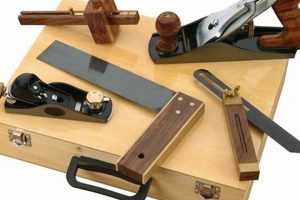
Instruments utilized to transfer designs, patterns, or dimensions onto wood surfaces before cutting, carving, or shaping are essential for precision in woodworking. These implements facilitate the accurate replication of complex shapes or simple guidelines, ensuring consistency and minimizing errors. For example, a compass can transcribe circles and arcs, while templates enable the reproduction of identical elements across multiple pieces.
Accuracy in woodworking is paramount, and the use of appropriate implements aids in achieving this accuracy. They contribute to minimizing material waste, reducing the likelihood of miscuts, and improving the overall quality of the finished piece. Historically, basic versions of these instruments have been employed by woodworkers for centuries, evolving in design and materials to meet increasingly complex demands.
The subsequent sections will detail specific categories of instruments, including their functionalities, advantages, and applications within various woodworking projects. Discussions will cover items such as marking gauges, scribes, and specialized layout tools. Furthermore, considerations for selecting the appropriate instrument for a given task will be addressed.
Optimizing Woodworking Precision
Effective employment of implements designed for design transfer significantly impacts the accuracy and efficiency of woodworking projects. The following recommendations aim to enhance the user’s approach to incorporating these essential tools into their workflow.
Tip 1: Select Instruments According to Task Specificity: Prioritize implements designed for the particular shape or mark required. A marking gauge excels at parallel lines, while a compass is optimal for circles or arcs. Choosing the correct tool reduces the chance of error.
Tip 2: Maintain Sharpness and Calibration: Regularly inspect and sharpen any instruments with points or edges. A dull point will produce a less defined mark, leading to inaccuracies. Calibration is crucial for tools such as marking gauges to ensure consistent measurements.
Tip 3: Utilize Appropriate Marking Pressure: Employ sufficient pressure to create a visible and easily followed line without damaging the wood surface. Excessive pressure can cause chipping or indentations, while insufficient pressure may result in a faint and unreliable mark.
Tip 4: Employ Supplemental Lighting: Adequate lighting is essential for accurate design transfer. Ensure that the work area is well-lit to facilitate clear visibility of the marking surface and the instruments point. Shadowing can distort perception and lead to errors.
Tip 5: Practice on Scrap Material: Before transferring a design onto the final workpiece, practice on scrap material. This allows for refinement of technique and ensures the instrument is functioning correctly. It also minimizes the risk of damaging valuable materials.
Tip 6: Secure Templates and Patterns: When employing templates or patterns, secure them firmly to the wood surface to prevent movement during marking. Clamps or adhesive sprays can be utilized to maintain stability and accuracy.
Tip 7: Consider Wood Grain Orientation: Be mindful of the wood grain orientation when transferring designs. Marking against the grain can result in splintering or tear-out, while marking with the grain provides a smoother and more precise line.
Adherence to these principles will improve precision, minimize waste, and enhance the overall quality of woodworking projects. Mastering the utilization of instruments for design transfer is a fundamental aspect of achieving professional-level results.
The subsequent sections will explore specific instruments, examining their strengths and appropriate applications within the broader context of woodworking techniques.
1. Accuracy

Accuracy serves as a cornerstone in woodworking, directly impacted by the selection and proper application of instruments used to transfer designs. Inadequate precision during the design transfer phase cascades into subsequent operations, influencing the final dimensions, fit, and aesthetic quality of the finished piece. The instruments employed are not merely facilitators; they are integral in maintaining dimensional control throughout the woodworking process. A small deviation during the initial tracing stage amplifies as the project progresses, leading to cumulative errors that necessitate rework or render the piece unusable. For example, inaccuracies when transferring a template for a mortise and tenon joint can result in a weak or misaligned joint, compromising the structural integrity of the entire assembly.
The relationship between accuracy and design transfer instruments extends beyond basic dimension replication. Sophisticated woodworking projects often require the precise alignment of intricate patterns or the creation of complex curves. In these scenarios, the selection of high-quality implements, such as precision compasses, marking gauges with fine adjustment mechanisms, and specialized layout tools, becomes crucial. Consider the construction of a curved tabletop; inconsistencies in tracing the initial curve will directly translate into irregularities in the finished surface, detracting from its visual appeal and potentially affecting its functionality. The accurate use of these instruments requires skill and experience, emphasizing the need for woodworkers to develop a strong understanding of measurement techniques and tool handling.
In summary, accuracy is not merely a desirable outcome; it is an essential prerequisite for successful woodworking. The quality of instruments used to transfer designs dictates the level of precision achievable, directly influencing the structural integrity, aesthetic quality, and overall success of the project. Investing in high-quality instruments and developing proficiency in their use is fundamental to minimizing errors and achieving professional-level results. The pursuit of accuracy, facilitated by appropriate implements, remains a defining characteristic of skilled craftsmanship in woodworking.
2. Material Compatibility

The selection of instruments for design transfer in woodworking necessitates careful consideration of material compatibility. The interaction between the tool and the wood species significantly influences the precision and quality of the resulting mark, ultimately impacting the overall outcome of the project.
- Wood Hardness and Marking Pressure
The hardness of the wood directly dictates the required marking pressure. Softer woods, such as pine or basswood, require a lighter touch to prevent excessive indentation or tear-out. Conversely, harder woods, like maple or oak, necessitate increased pressure to create a visible and lasting line. The selected instruments should allow for controlled application of force to accommodate varying wood densities.
- Grain Structure and Fiber Orientation
The grain structure and fiber orientation of the wood influence the smoothness and clarity of the marked line. Marking against the grain can lead to splintering or uneven lines, particularly in woods with pronounced grain patterns. Instruments with sharp, refined points, such as marking knives, are often preferred for their ability to sever wood fibers cleanly, resulting in more precise marks. The angle of approach relative to the grain also plays a crucial role in achieving optimal results.
- Resin Content and Surface Treatment
Woods with high resin content, such as certain pines and firs, can present challenges during marking. The resin can clog the tips of marking instruments, leading to smudging or inconsistent lines. Additionally, surface treatments, such as stains or sealants, can affect the adherence of marking media to the wood surface. Careful selection of marking implements and appropriate surface preparation techniques are essential for overcoming these issues.
- Instrument Material and Wood Reactivity
The material composition of the marking instrument itself must be considered in relation to the wood being worked. Certain metals can react with specific wood species, leading to staining or discoloration. For example, some ferrous metals can react with the tannins in oak, resulting in dark stains. Selecting instruments made from non-reactive materials, such as brass or hardened steel, mitigates the risk of adverse reactions.
The interplay between wood properties and instrument characteristics underscores the importance of thoughtful material selection. Optimizing this compatibility leads to improved accuracy, reduced marking errors, and enhanced overall woodworking precision. Skillful woodworkers understand these nuances and adapt their techniques accordingly to achieve superior results.
3. Ergonomics

The ergonomic design of woodworking implements used for transferring designs significantly influences user comfort, precision, and long-term physical well-being. Prolonged use of poorly designed instruments can lead to musculoskeletal disorders, decreased accuracy, and reduced overall efficiency. Therefore, considering ergonomic factors in the selection and application of these instruments is a critical aspect of professional woodworking practices. Cause-and-effect relationships are evident: for example, a tool with a handle that requires excessive grip strength can result in hand fatigue, leading to inaccurate lines and potential for carpal tunnel syndrome. The implement’s weight, balance, and handle shape directly affect the user’s ability to maintain control and precision over extended periods.
Ergonomic considerations extend beyond the immediate comfort of the user. The position of the hand and wrist, the required range of motion, and the overall posture adopted while using an instrument all contribute to long-term physical health. For instance, a marking gauge that necessitates excessive bending or twisting can strain the back and shoulders. Similarly, a tool with a small or awkwardly shaped handle may force the user to adopt an unnatural grip, increasing the risk of repetitive strain injuries. Real-world examples demonstrate the practical significance of this understanding: woodworkers who prioritize ergonomic tools often report reduced pain, improved accuracy, and increased productivity compared to those who use less thoughtfully designed implements. A well-designed marking knife, for example, will fit comfortably in the hand, allowing for controlled pressure and minimal wrist strain, leading to cleaner cuts and reduced fatigue.
In conclusion, the integration of ergonomic principles into the design and selection of implements used for design transfer in woodworking is essential for promoting user well-being, enhancing accuracy, and improving overall efficiency. While the initial cost of ergonomically designed tools may be higher, the long-term benefits in terms of reduced injuries, increased productivity, and improved quality make it a worthwhile investment. Addressing challenges related to ergonomic design, such as balancing comfort with durability and precision, requires ongoing research and development. Understanding the connection between ergonomics and woodworking tools is not merely about comfort; it is about fostering sustainable and healthy woodworking practices.
4. Durability

The longevity of instruments employed for design transfer in woodworking is a critical factor influencing efficiency and cost-effectiveness. The capacity of these instruments to withstand repeated use, resist wear and tear, and maintain precision over extended periods directly affects the quality and consistency of woodworking projects. A durable instrument minimizes the need for frequent replacements, reducing expenses and interruptions to workflow. For instance, a marking gauge constructed from hardened steel, properly maintained, can provide decades of accurate service, whereas a tool made from inferior materials may quickly degrade, leading to imprecise markings and the need for costly replacements. The selection of robust materials and sound construction techniques are therefore paramount in ensuring the durability and reliability of these implements.
The environmental conditions in which woodworking tracing tools are used also impact their durability. Exposure to moisture, extreme temperatures, and abrasive materials can accelerate the degradation of even high-quality instruments. Proper storage and maintenance practices, such as regular cleaning and lubrication, are essential for mitigating these effects. Consider a scribe used in a humid environment; without adequate protection, the metal components may corrode, compromising its accuracy and structural integrity. Conversely, a scribe stored in a dry, controlled environment and regularly cleaned will maintain its functionality for a significantly longer period. This illustrates the practical significance of environmental factors and maintenance routines in preserving the durability of these valuable tools.
In summary, durability is an indispensable attribute of instruments designed for design transfer in woodworking. It directly impacts the accuracy, consistency, and cost-effectiveness of woodworking operations. While initial investment in high-quality, durable implements may be higher, the long-term benefits in terms of reduced replacement costs, minimized downtime, and sustained precision far outweigh the initial expense. Addressing challenges related to durability, such as material selection and environmental factors, requires careful consideration and proactive maintenance strategies. Understanding the connection between durability and woodworking tools is essential for achieving consistent, high-quality results in woodworking endeavors.
5. Marking Media

The effectiveness of instruments for design transfer in woodworking is inextricably linked to the properties of the employed marking media. The choice of marking medium dictates the visibility, permanence, and precision of the transferred design. The type of implement used to scribe, draw, or otherwise impart a design onto wood necessitates careful selection based on the wood species, desired level of detail, and subsequent woodworking operations. For instance, a fine-tipped marking knife used on hardwoods produces a crisp, permanent line conducive to accurate chisel work, whereas a graphite pencil on softwoods provides a less defined, erasable mark suitable for initial layout. Therefore, the interplay between the implement and marking medium is fundamental to achieving optimal results.
The characteristics of marking media significantly impact the accuracy and efficiency of woodworking tasks. A dark, highly visible line is essential for minimizing parallax errors during cutting or shaping. The fineness of the marking tip or edge determines the level of detail that can be accurately transferred. Furthermore, the resistance of the marking medium to smudging or fading ensures the longevity of the design throughout the woodworking process. Consider the implications of using a crayon on a surface requiring a precisely measured mortise and tenon joint. The wide mark and potential for smearing would inevitably lead to inaccuracies, potentially compromising the joint’s integrity. Conversely, a carefully scribed line using a sharp marking knife offers a degree of precision unattainable with broader marking methods. Practical applications underscore the need for aligning the marking media with both the specific woodworking task and the properties of the chosen wood.
In summary, the success of design transfer in woodworking hinges on the appropriate selection and application of marking media in conjunction with suitable implements. The visibility, permanence, and precision of the transferred design are all influenced by the characteristics of the marking medium. Addressing challenges related to marking media, such as achieving optimal visibility on various wood species or preventing smudging during subsequent operations, requires careful consideration and experimentation. The understanding of the connection between marking media and woodworking tracing tools is integral to achieving accurate and high-quality woodworking outcomes.
Frequently Asked Questions
The following addresses common inquiries concerning instruments employed for design transfer in woodworking. This section aims to clarify misconceptions and provide detailed information regarding their selection, utilization, and maintenance.
Question 1: What distinguishes a marking gauge from a mortise gauge?
A marking gauge typically features a single pin or cutter used to scribe a line parallel to an edge. A mortise gauge incorporates two adjustable pins or cutters, enabling the simultaneous marking of both sides of a mortise.
Question 2: How does wood hardness influence the choice of marking medium?
Softer woods generally benefit from softer marking media, such as pencils, to avoid excessive indentation. Harder woods often require sharper, more durable media, like marking knives, to create a visible and lasting line.
Question 3: What is the proper method for sharpening a marking knife?
Sharpening a marking knife requires a fine-grit honing stone. The knife should be held at a consistent angle and drawn across the stone in a controlled motion, maintaining the existing bevel.
Question 4: How does one prevent marking gauges from damaging delicate wood surfaces?
Applying minimal pressure and ensuring the cutting pin or blade is sharp are essential. Additionally, consider using a marking gauge with a rounded or burnishing pin to avoid cutting the wood fibers.
Question 5: What are the advantages of using a beam compass over a traditional compass for large circles?
A beam compass, which utilizes a beam or rod to extend the pivot point, provides greater stability and accuracy when drawing circles larger than those achievable with a traditional compass.
Question 6: How frequently should woodworking tracing tools be inspected and maintained?
Regular inspection, ideally before each use, is recommended. Maintenance, including cleaning and sharpening, should be performed as needed based on usage and observed wear.
These responses provide fundamental information for selecting and utilizing instruments for design transfer. Consistent application of these guidelines will contribute to enhanced accuracy and efficiency in woodworking practices.
The following sections will delve into advanced techniques and specialized instruments for woodworking design transfer.
Conclusion
This exploration has illuminated the critical role of woodworking tracing tools in achieving precision and accuracy. The proper selection, maintenance, and skillful application of these implements are fundamental to producing high-quality woodworking projects. From marking gauges to specialized compasses, each instrument serves a specific purpose, contributing to the overall fidelity of design transfer. Attention to factors such as material compatibility, ergonomics, and durability ensures optimal tool performance and longevity. Mastering the nuances of these instruments is essential for any serious woodworker.
The effective use of woodworking tracing tools transcends mere replication; it represents a commitment to craftsmanship and precision. Continued refinement of techniques, coupled with a thorough understanding of tool capabilities, will undoubtedly lead to enhanced accuracy and increased efficiency in woodworking endeavors. Therefore, a dedication to mastering these tools is an investment in the pursuit of excellence within the craft.