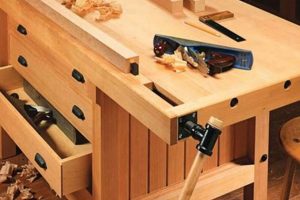
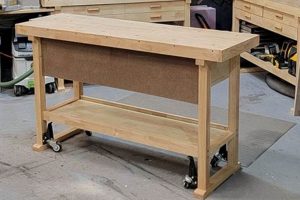
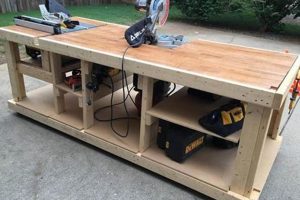
A structure crafted within a non-commercial setting, typically a personal workshop or garage, specifically designed to facilitate various woodworking tasks. These constructions often feature a flat, stable surface capable of supporting materials during cutting, shaping, and assembly. The defining characteristic is their creation by an individual rather than mass production by a manufacturer, resulting in unique designs tailored to the builder’s specific needs. An example includes a sturdy bench built from reclaimed lumber, featuring integrated vises and storage for tools.
The significance of these projects lies in their adaptability and cost-effectiveness. They allow woodworkers to create surfaces perfectly suited to their space and workflow, often at a lower expense than purchasing commercially available options. Historically, such constructions represent a core tenet of the woodworking craft, embodying resourcefulness and a deep understanding of materials and joinery techniques. The individualized nature encourages innovation and a deeper connection to the woodworking process.
The subsequent discussion will delve into diverse design considerations, material selections, construction techniques, and essential features of these custom-built work platforms, providing insights for those seeking to create their own efficient and personalized woodworking workspace.
Essential Considerations for Building a Custom Woodworking Surface
The following guidelines offer practical advice for individuals embarking on the creation of a bespoke woodworking structure, emphasizing stability, functionality, and durability.
Tip 1: Prioritize a Rigid Frame: A robust frame is paramount. Employ mortise-and-tenon or similarly strong joinery techniques to minimize racking and ensure a stable platform for precision work. Consider the weight and forces that will be applied during various woodworking operations.
Tip 2: Select Durable Surface Material: Choose a dense, solid wood such as hard maple or birch plywood for the tabletop. These materials resist dents and wear, maintaining a smooth, consistent surface over time. A sealed finish provides additional protection against spills and moisture.
Tip 3: Incorporate Integrated Workholding: Plan for the inclusion of vises, dog holes, or clamping systems to securely hold workpieces during cutting, shaping, and assembly. The placement of these features should align with the woodworker’s common tasks and preferred techniques.
Tip 4: Optimize for Ergonomics: Determine the appropriate height to minimize strain and maximize comfort during extended work sessions. The ideal height will depend on the individual’s stature and the type of tasks typically performed.
Tip 5: Integrate Storage Solutions: Incorporate drawers, shelves, or cabinets beneath the tabletop to provide convenient access to essential tools and materials. Efficient organization enhances workflow and reduces clutter.
Tip 6: Ensure a Level Surface: Before completing the build, confirm that the tabletop is perfectly level. This precision is critical for accurate cutting, joinery, and assembly. Shims or adjustable feet can be used to compensate for uneven floors.
Tip 7: Consider Mobility: For smaller workshops, adding heavy-duty casters allows the structure to be easily moved for cleaning or reorganization. Locking casters provide stability during use.
By adhering to these recommendations, individuals can construct a personalized woodworking surface that enhances their craftsmanship and productivity.
The subsequent section will address common challenges and troubleshooting strategies encountered during the construction and use of this essential woodworking apparatus.
1. Stability

Stability is a foundational requirement of any serviceable woodworking surface. Within the context of a user-constructed structure, often referred to as a homemade woodworking table, the degree of stability directly impacts the precision, safety, and overall quality of woodworking operations. Instability manifests as unwanted movement or vibration during cutting, shaping, or assembly, leading to inaccuracies and potential hazards. The effect of insufficient stability can range from slightly misaligned joinery to catastrophic failure of the workpiece or tool. The cause stems from inadequate frame construction, weak joinery, or an uneven supporting base. The incorporation of robust structural elements and careful consideration of weight distribution are essential for achieving adequate stability in a self-built woodworking table.
For instance, a table with legs connected solely by screws, without additional bracing or joinery, is likely to exhibit significant wobble under even moderate loads. In contrast, a frame constructed with mortise-and-tenon joints, reinforced with cross-braces, will provide a far more rigid and stable platform. The addition of a heavy, solid wood top further enhances stability by increasing the overall mass and dampening vibrations. Examples of stable, user-built tables often feature thick aprons beneath the tabletop, securely fastened to substantial legs. The practical significance of understanding this relationship lies in the ability to anticipate and mitigate potential instability issues during the design and construction phases, resulting in a more reliable and safer woodworking environment.
In summary, the pursuit of stability in a user-created woodworking surface is not merely a matter of structural integrity; it is a prerequisite for accurate and safe woodworking practices. Addressing stability challenges effectively requires a thorough understanding of construction principles, material properties, and the forces involved in woodworking tasks. A stable homemade woodworking table represents a valuable asset, enabling the woodworker to execute projects with confidence and precision.
2. Workholding

Workholding refers to the methods and devices used to secure a workpiece firmly in place during woodworking operations. In the context of a homemade woodworking table, effective workholding is not merely a desirable feature, but a fundamental requirement for safe and accurate execution of woodworking tasks. Inadequate workholding is a primary cause of errors, inefficiencies, and potential injuries in the workshop. Examples range from a workpiece slipping during a delicate cut, resulting in a ruined piece, to a larger board moving unexpectedly during routing, posing a significant safety risk. The importance of integrating reliable workholding solutions into a homemade woodworking table stems from the need to counteract the forces generated by hand tools and power tools.
Practical application manifests in various forms, tailored to the specific woodworking tasks anticipated. These include: vises, which provide a robust clamping force for edge work and joinery; dog holes, strategically positioned across the tabletop to accommodate bench dogs and other clamping accessories; and T-tracks, offering versatile attachment points for jigs and fixtures. A well-designed homemade woodworking table will incorporate a combination of these solutions, strategically positioned to maximize versatility and accessibility. For instance, a user might install a face vise on one end of the table for holding larger panels and a smaller vise on the side for detail work. The inclusion of dog holes arranged in a grid pattern allows for flexible clamping configurations for a variety of workpiece shapes and sizes. By understanding the forces involved in specific woodworking operations and planning accordingly, a user can optimize the effectiveness of the workholding system on their homemade woodworking table.
In summary, the effective integration of workholding mechanisms is paramount to the utility and safety of a homemade woodworking table. A careful consideration of the anticipated woodworking tasks, coupled with strategic placement of vises, dog holes, and other accessories, empowers the woodworker to execute projects with greater precision, efficiency, and safety. The challenges associated with workholding can be mitigated through thoughtful design and diligent construction, resulting in a valuable and versatile woodworking asset.
3. Surface Material

The selection of surface material is a critical determinant of the functionality and longevity of any homemade woodworking table. The table’s surface is the primary interface between the woodworker and the workpiece, influencing precision, ease of use, and resistance to damage. The selection process involves a careful assessment of material properties, including hardness, stability, flatness, and resistance to impact, abrasion, and chemical exposure. Choosing an inappropriate material can lead to premature wear, surface irregularities, and compromised accuracy. For example, a softwood surface is susceptible to dents and scratches from dropped tools or abrasive materials, diminishing its usefulness over time. Conversely, a well-chosen surface material provides a stable, durable platform for accurate cutting, joinery, and assembly. Practical significance is realized in the long-term performance and usability of the table.
Considerations extend beyond immediate durability. Dimensional stability, the material’s ability to resist changes in size and shape due to fluctuations in humidity and temperature, is paramount. Solid hardwoods, such as hard maple or birch, offer excellent dimensional stability and hardness, making them suitable choices. High-quality plywood, particularly Baltic birch, provides a cost-effective alternative with comparable stability and resistance to warping. The application of a durable finish, such as polyurethane or epoxy resin, further enhances the surface’s resistance to moisture and chemical spills. The choice of finish should complement the wood species and consider the intended use of the table. For instance, a table used primarily for hand tool work may benefit from a traditional oil finish, which provides a smooth, low-friction surface.
In conclusion, the choice of surface material is a fundamental decision that profoundly impacts the performance and lifespan of a homemade woodworking table. Selecting a material that balances durability, stability, and cost, coupled with the application of an appropriate finish, ensures a reliable and functional workspace for a wide range of woodworking activities. Addressing this crucial element effectively results in a valuable asset that enhances the woodworker’s capabilities and contributes to the quality of their work. The challenges associated with surface material selection can be mitigated through careful research and a thorough understanding of material properties and woodworking techniques.
4. Ergonomic Height

Ergonomic height, in the context of a user-constructed woodworking station, is not merely a matter of comfort, but a critical design parameter directly affecting the woodworker’s posture, reach, and overall efficiency. A properly configured table height minimizes physical strain and promotes optimal biomechanics during prolonged work sessions. Conversely, an incorrectly sized table can contribute to musculoskeletal disorders and reduce productivity. The selection of an appropriate height demands careful consideration of the individual’s stature and the nature of tasks to be performed.
- Reducing Strain and Fatigue
An ergonomically optimized homemade woodworking table alleviates excessive bending, reaching, and twisting, thereby reducing strain on the back, shoulders, and wrists. Continuous forward bending, for example, can lead to chronic back pain. By adjusting the table height to allow for a more upright posture, the woodworker can mitigate these risks and maintain focus for extended periods. This facet directly impacts long-term physical well-being.
- Optimizing Reach and Control
The table height influences the woodworker’s ability to reach and manipulate tools and materials effectively. A surface that is too low restricts arm movement and reduces leverage, while one that is too high compromises control and precision. The ideal height allows for comfortable reach and optimal power transmission when using hand tools or operating machinery. Proper reach contributes to accuracy and efficiency.
- Task-Specific Height Adjustments
Different woodworking tasks necessitate variations in table height. Fine detail work, such as carving or inlay, may benefit from a slightly higher surface to facilitate close visual inspection. Conversely, tasks requiring significant force, such as planing or sawing, may be more effectively performed at a lower height to enhance stability and leverage. This versatility can be achieved through adjustable-height legs or the use of risers.
- Customization and Individualization
The concept of ergonomic height underscores the importance of tailoring the homemade woodworking table to the individual user. Factors such as height, arm length, and personal preferences influence the optimal table height. A customized table provides a workspace that is uniquely suited to the woodworker’s needs, promoting comfort, efficiency, and long-term physical health. This facet emphasizes the personalized nature of ergonomic design.
These considerations highlight the crucial role of ergonomic height in optimizing the design and functionality of a homemade woodworking table. A thoughtfully designed table not only enhances the woodworking experience but also contributes to the woodworker’s long-term health and well-being. The benefits derived from an ergonomically sound workstation extend beyond immediate comfort, encompassing increased productivity, reduced risk of injury, and a more enjoyable woodworking experience.
5. Storage Solutions

The integration of storage solutions within a homemade woodworking table directly impacts the efficiency and organization of the woodworking workspace. The presence of adequate storage minimizes clutter, reduces search time for tools and materials, and contributes to a safer working environment. A lack of planned storage necessitates the scattering of tools and supplies across the work area, increasing the risk of accidents and hindering the smooth flow of woodworking operations. The causal relationship is clear: insufficient storage directly causes decreased efficiency and increased potential for mishaps. The incorporation of appropriate storage features is therefore an integral component of a well-designed homemade woodworking table.
Practical examples demonstrate the tangible benefits. A homemade woodworking table featuring built-in drawers allows for the systematic organization of hand tools, measuring instruments, and small hardware items. Open shelving beneath the tabletop can accommodate larger power tools, lumber scraps, or partially completed projects. A cabinet with doors protects sensitive materials from dust and damage. The inclusion of a dedicated storage space for fasteners (screws, nails, bolts) prevents them from being lost or mixed, streamlining assembly processes. Furthermore, integrated storage reduces the need for separate storage units within the workshop, conserving valuable floor space and consolidating essential resources within easy reach.
In conclusion, the thoughtful incorporation of storage solutions into a homemade woodworking table is not merely an aesthetic enhancement, but a practical imperative. Optimizing storage capacity, accessibility, and organization enhances productivity, promotes safety, and streamlines workflow. Challenges related to space limitations or design complexity can be addressed through careful planning and innovative solutions, resulting in a woodworking surface that is both functional and efficient. The significance lies in the understanding that a well-organized workspace directly contributes to the quality and enjoyment of the woodworking process.
6. Level Surface

The concept of a level surface is inextricably linked to the functional utility of a homemade woodworking table. A perfectly horizontal and planar worksurface serves as the datum from which accurate measurements, precise cuts, and stable assemblies are derived. A non-level surface introduces compounding errors into woodworking projects, directly impacting the fit and finish of completed pieces. This relationship manifests as skewed joints, misaligned components, and an overall compromise in structural integrity. The causal link is clear: a deviation from level on the table surface leads to corresponding deviations in the project itself. The importance lies in establishing a reliable reference plane for all subsequent woodworking operations.
Practical examples underscore this point. When constructing a cabinet, a non-level table surface will result in the cabinet’s frame being out of square. This, in turn, affects the fit of doors and drawers, leading to gaps, binding, and functional impairment. Similarly, when assembling a tabletop from multiple boards, a level table ensures that the boards are flush and aligned, facilitating seamless glue-up and preventing unsightly discrepancies. The process of leveling a homemade woodworking table involves the use of precision instruments, such as levels and straightedges, combined with shimming techniques or adjustable feet to compensate for uneven floors. Regular verification of the table’s levelness is essential to maintaining accuracy over time.
In summary, a level surface is not merely a desirable attribute of a homemade woodworking table, but a fundamental prerequisite for achieving quality results. Addressing the challenge of establishing and maintaining levelness requires diligent attention to detail during construction and ongoing monitoring throughout the table’s lifespan. The significance of this understanding lies in its direct impact on the accuracy, stability, and overall success of woodworking projects. Failing to address this crucial element can lead to frustration, wasted materials, and a compromise in craftsmanship.
7. Portability
Portability, in the context of a homemade woodworking table, represents a design consideration balancing functionality with spatial constraints. The inherent challenge involves enabling relocation of the worksurface without compromising structural integrity or stability during use. While a stationary workbench offers maximum rigidity, situations arise where a movable platform provides enhanced flexibility, particularly in smaller workshops or shared workspaces. The decision to prioritize portability directly influences the design and construction methods employed, impacting material selection, joinery techniques, and the inclusion of specialized hardware. The significance of portability lies in its potential to optimize workflow within a dynamic environment.
Practical implementation often involves incorporating casters, typically heavy-duty locking types, onto the table’s legs. These casters allow for relatively easy movement across smooth surfaces, while the locking mechanism ensures stability when the table is in use. Smaller, lighter homemade woodworking tables may forgo casters in favor of simpler carrying handles or a design that allows for easy disassembly and reassembly. Examples include A-frame tables or those constructed from modular components. The selection of lightweight materials, such as certain types of plywood or aluminum framing, can further enhance portability. However, a careful balance must be struck between weight reduction and structural integrity, as excessive weight savings can compromise the table’s overall stability and load-bearing capacity. The design must also consider the potential for uneven floor surfaces, which can affect the table’s stability even when casters are locked. Leveling feet, in conjunction with casters, offer a means to mitigate this issue.
In summary, the integration of portability into a homemade woodworking table requires a nuanced approach, carefully weighing the benefits of mobility against potential compromises in stability and durability. Addressing these challenges effectively involves a thorough understanding of material properties, structural engineering principles, and the specific needs of the woodworking environment. A well-designed portable woodworking surface expands the possibilities of the workshop, adapting to changing spatial demands and facilitating diverse woodworking activities. Prioritizing portability requires the balancing of multiple design considerations for a final useful woodworking table.
Frequently Asked Questions
The following addresses common inquiries regarding the design, construction, and utilization of a user-built woodworking surface, offering clear and concise answers to promote informed decision-making.
Question 1: What are the primary advantages of constructing a woodworking table versus purchasing a commercially available model?
A user-built surface allows for complete customization to specific needs, spatial constraints, and budgetary limitations. Individuals can tailor dimensions, features, and material choices to precisely match their woodworking requirements, often at a lower cost than pre-fabricated alternatives. This customization is difficult to replicate with mass-produced options.
Question 2: Which material is most suitable for the tabletop of a homemade woodworking table?
Solid hardwoods, such as hard maple or birch, offer exceptional durability and stability. High-quality plywood, specifically Baltic birch, provides a cost-effective alternative with comparable performance. The choice depends on the individual’s budget, skill level, and intended use. However, any selected material should be appropriately sealed to prevent moisture damage.
Question 3: What is the optimal height for a woodworking table?
The optimal height is subjective and dependent on the individual’s stature. A general guideline suggests a height that allows the user to work comfortably with their forearms parallel to the floor. Fine-tuning may be necessary based on the types of woodworking tasks predominantly performed. Adjustability, if feasible, offers maximum versatility.
Question 4: How can stability be maximized in a user-built woodworking table?
Employing robust joinery techniques, such as mortise-and-tenon joints, is crucial for creating a rigid frame. Cross-bracing, particularly at the legs, further enhances stability. A heavy tabletop also contributes to overall stability by increasing mass and dampening vibrations. Distribution of weight across the frame is also critical for balance.
Question 5: What are essential workholding mechanisms to incorporate into a homemade woodworking table?
Vises (both face and tail vises) provide versatile clamping force for a wide range of tasks. Dog holes, arranged strategically across the tabletop, accommodate bench dogs and other clamping accessories. T-tracks offer flexible attachment points for jigs and fixtures. The choice of workholding devices is contingent on the user’s specific woodworking techniques.
Question 6: How should casters be selected for a portable woodworking table?
Heavy-duty locking casters are recommended. The weight rating of the casters should exceed the anticipated weight of the table and any tools or materials stored on it. The locking mechanism must be reliable to ensure stability when the table is in use. Consider the floor surface when selecting caster wheel material.
In summary, constructing a homemade woodworking table involves considering key factors such as material selection, stability, ergonomics, and workholding. Careful planning and diligent execution are essential for creating a functional and durable workspace.
The subsequent section will provide a detailed step-by-step guide for constructing a basic woodworking table design.
In Conclusion
The preceding discussion has explored critical facets of the homemade woodworking table, encompassing design considerations, material selection, construction techniques, and essential features. Understanding the interconnectedness of stability, workholding, surface material, ergonomics, and storage solutions is paramount for creating a functional and efficient workspace. Diligent planning and careful execution are necessary to realize a user-built table that enhances woodworking capabilities.
The enduring relevance of the homemade woodworking table lies in its adaptability to individual needs and its potential to foster a deeper connection with the woodworking craft. Continued exploration of innovative designs and techniques will undoubtedly contribute to the evolution of this essential tool, empowering woodworkers to achieve ever-greater levels of precision and creativity. Further research and experimentation in table construction will continue to elevate the craft of woodworking.