Ensuring a table stands steadily and does not wobble typically involves addressing discrepancies in leg length. This process, crucial in furniture construction, often necessitates methods for correcting unevenness after assembly. An example includes shimming one or more legs to compensate for minor height differences.
A level table is essential for both aesthetic appeal and practical use. It prevents items placed on the surface from sliding and contributes to the overall stability and longevity of the furniture piece. Historically, various techniques have been employed, from simple visual adjustments to precise measurements with specialized tools, to achieve a perfectly balanced surface.
The following sections will detail several approaches used to identify and rectify disparities in table leg height. These methods range from basic visual inspections to the use of leveling feet and carefully executed woodworking techniques.
Tips for Achieving Level Table Legs
The successful creation of a stable and functional table hinges on the precision with which its legs are leveled. Several techniques can aid in this endeavor, ensuring the final product meets quality standards.
Tip 1: Utilize a Reliable Level: A quality level, either a spirit level or a laser level, is indispensable. Place the level across the tabletop in multiple directions to identify the direction of the unsteadiness. The legs resting on the higher side will need correction.
Tip 2: Employ Shims Strategically: Shims, thin wedges of wood or plastic, provide a simple and effective solution for minor discrepancies. Place shims beneath the shortest leg until the table is stable. Mark the shim to match the leg’s profile, then trim the excess.
Tip 3: Consider Adjustable Leveling Feet: For tables intended for use on uneven floors, consider installing adjustable leveling feet. These feet screw into the bottom of each leg and can be adjusted individually to compensate for variations in floor height.
Tip 4: Plane Down the Tallest Leg(s): If the discrepancy is significant and shims are not aesthetically desirable, carefully plane down the tallest leg(s). Ensure the table is stable during this process, and use a hand plane or sanding block to gradually remove material until the table sits level. Periodically check for level during the process.
Tip 5: Employ a Marking Gauge for Consistent Cuts: When shortening legs, a marking gauge ensures uniform material removal. Set the gauge to the desired length, score a line around each leg, and then cut along the marked line. This ensures each leg is cut to the same length.
Tip 6: Check for Level on the Intended Surface: Leveling should always occur on the surface where the table will ultimately reside. An apparently level table in the workshop may still wobble on an uneven floor.
Tip 7: Test with Weight: After leveling, place weight on the tabletop to simulate real-world use. This can reveal subtle imbalances that are not apparent when the table is unloaded. Re-adjustments can then be made as needed.
Achieving perfectly level table legs requires patience and attention to detail. These tips provide practical strategies for overcoming common challenges in furniture construction and ensuring a stable, functional final product.
The subsequent section will explore more advanced woodworking techniques for addressing more substantial discrepancies in leg height or angle.
1. Precise Measurement

Accurate dimensional assessment constitutes a foundational element in achieving level table legs. Deviations, even minor ones, can manifest as instability or visual imbalance. A meticulous approach to measurement is therefore critical.
- Initial Assessment of Discrepancies
Before any adjustments are made, a thorough measurement of each table leg is imperative. This involves determining the precise height of each leg relative to the others. Tools such as a precision ruler, digital calipers, or a laser distance measurer can provide the necessary accuracy. This initial assessment quantifies the degree of unevenness requiring correction.
- Determining the Reference Point
Leveling hinges on establishing a reliable reference point. In most cases, this involves identifying the shortest leg. All other legs must then be adjusted to match this minimum height. Accurate measurement is crucial in determining the absolute shortest leg, as an erroneous determination will lead to an incorrect leveling strategy.
- Measurement During Material Removal
When material removal from the taller legs is the chosen leveling method, precise measurement becomes an iterative process. As material is removed, the height of each leg must be continually re-measured against the established reference. This prevents over-correction and ensures that each leg is brought down to the exact target height. Failure to measure accurately during this process can result in legs shorter than the reference, creating a new set of imbalances.
- Angle Measurement and Correction
Beyond height, the angle at which each leg meets the tabletop is also critical. Uneven angles can create the illusion of uneven height and compromise stability. Precise angle measurement, using a digital protractor or angle finder, allows for accurate correction of any angular discrepancies. This often requires shimming or re-attaching legs to achieve perfect perpendicularity, further emphasizing the connection between accurate measurement and a stable, level table.
The examples above underscore that the success of any leveling technique is directly proportional to the accuracy of the measurements used to guide it. Whether employing shims, adjustable feet, or material removal, precise measurement minimizes errors and maximizes the likelihood of achieving a perfectly level table.
2. Stable Base

The concept of a stable base directly impacts the effectiveness of techniques employed to level table legs. A flawed, unstable foundational structure negates even the most precise efforts to achieve a level surface. Instability introduced by inadequate joinery, material defects, or an improperly constructed frame will manifest as ongoing movement, rendering leg leveling a temporary, rather than permanent, solution. Consider, for example, a table with legs attached using weak glue joints. While shims or other leveling methods might initially correct for unevenness, the inherent instability of the joints will cause the legs to shift over time, leading to renewed wobbling.
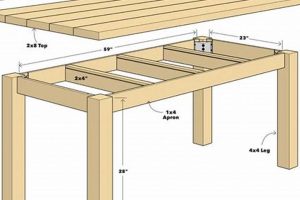
The importance of a stable base extends beyond preventing future movement. It also serves as a crucial reference point during the leveling process. When the base is rigid and square, it provides a consistent plane against which to measure and adjust leg heights. Conversely, a base that flexes or twists introduces errors into the measurement process, making it difficult to determine the true height discrepancies. This is particularly relevant in situations where the tabletop itself is not perfectly flat; a stable base ensures that the legs are leveled relative to a fixed plane, rather than conforming to irregularities in the tabletop surface. Another practical application of this principle is seen when leveling a table with an apron or skirt; the apron must be securely attached and square to the legs to provide a stable reference for leg length adjustments.
In summary, the establishment of a stable base is not merely a preliminary step but an integral component of achieving permanently level table legs. Challenges associated with unstable bases can be mitigated through the selection of appropriate materials, the use of robust joinery techniques, and rigorous quality control throughout the construction process. Understanding the symbiotic relationship between base stability and successful leg leveling contributes directly to the creation of durable, functional, and aesthetically pleasing furniture.
3. Appropriate Shims

The selection and application of appropriate shims are instrumental in achieving level table legs. Shims, thin wedges or pieces of material, compensate for minor discrepancies in leg height that cause instability. The effectiveness of this method hinges directly on the suitability of the shim material, dimensions, and placement. Using cardboard or other compressible materials as shims, for instance, provides only a temporary solution, as such materials deform under load, eventually leading to renewed instability. Conversely, durable materials like hardwood, plastic, or metal offer greater longevity and maintain their dimensions under pressure. The thickness of the shim must also correspond to the precise height difference. Shims that are too thick create an artificial high point, while those that are too thin fail to provide adequate support.
The strategic placement of shims is equally crucial. Shims should be positioned to provide maximum support across the entire foot of the leg. A small shim placed at the edge of a leg can create a pivot point, exacerbating the instability. Ideally, the shim conforms to the shape of the leg and distributes weight evenly. Further, the shim should be securely attached to the leg or floor to prevent it from shifting over time. Examples include adhering the shim with construction adhesive or using a non-slip pad beneath the shim. In historical restoration projects, shimming is often used to preserve the original character of antique furniture, where altering the leg length would be undesirable. In such cases, carefully crafted wooden shims, stained to match the existing wood, are used to provide subtle and unobtrusive leveling.
In summary, shims play a significant role in achieving a level table, but their utility depends on the judicious selection of materials, dimensions, and placement. This approach provides an effective, non-invasive solution for minor height discrepancies and maintains the stability of the table over an extended period. Understanding the relationship between the material properties of the shim, the shape of table legs, and the weight borne by each leg is key for successful woodworking.
4. Leveling Feet

Leveling feet represent a specialized hardware component often incorporated into woodworking projects to address uneven surfaces and achieve stable furniture. Their integration into furniture design directly influences the methods employed to achieve level table legs, offering an adjustable solution post-construction.
- Adjustability and Compensation for Uneven Surfaces
Leveling feet offer the primary advantage of adjustability. Unlike fixed table legs, these components allow individual height modification, compensating for irregularities in flooring or ground surfaces. This adaptability is particularly pertinent in environments where perfectly level floors are uncommon, such as older buildings or outdoor settings. The adjustment range typically varies depending on the design of the leveling foot, but even minor adjustments can significantly improve stability and prevent wobbling.
- Integration into Table Leg Design
Leveling feet can be integrated into table leg designs in various ways. Some designs feature threaded inserts within the table leg into which the leveling foot screws. Others utilize a mounting plate that is affixed to the bottom of the leg. The choice of integration method influences the structural integrity of the leg and the ease of adjustment. It is important to consider the load-bearing capacity of both the leveling foot and the integration method to ensure long-term stability. Correct implementation avoids compromising the leg’s structural integrity.
- Material Selection and Durability
The materials used in the construction of leveling feet impact their durability and suitability for different applications. Common materials include steel, plastic, and rubber. Steel leveling feet offer high load-bearing capacity and resistance to corrosion but may be less suitable for delicate flooring surfaces. Plastic feet provide a balance of durability and floor protection, while rubber feet offer enhanced grip and vibration dampening. The selection of appropriate materials depends on the intended use of the table and the environmental conditions.
- Aesthetic Considerations
While primarily functional, leveling feet also contribute to the overall aesthetic of the table. Designs range from discreet, low-profile feet to more prominent, decorative options. The choice of leveling foot style should complement the overall design of the table. Considerations include the finish, shape, and size of the foot in relation to the table leg and the surrounding environment. In some cases, custom-designed leveling feet may be fabricated to seamlessly integrate with the table’s aesthetic.
In conclusion, the incorporation of leveling feet into woodworking projects provides a practical and adaptable solution for achieving level table legs. The appropriate selection, integration, and adjustment of these components contribute to both the stability and aesthetic appeal of the finished piece. The design must be given care for the correct operation of these mechanisms.
5. Consistent Cuts

Achieving level table legs relies heavily on the precision of each cut made during construction. Inconsistent cuts, even by fractions of an inch, compound to create unevenness that directly undermines the stability of the finished piece. The correlation is causal: imprecise cuts necessitate remedial actions, such as shimming or planing, to compensate for the initial error. Without accurate and repeatable cuts, the subsequent process of leveling becomes significantly more complex and time-consuming, potentially compromising the structural integrity or aesthetic quality of the table. Examples of cutting techniques used for consistency include miter saws, table saws with precision fences, and hand saws used in conjunction with marking gauges. The selection of an appropriate tool often depends on the scale of the project and the type of wood being used.
The importance of consistent cuts extends beyond simply equalizing leg lengths. In tables with angled or tapered legs, maintaining consistent angles and tapers is equally critical. Discrepancies in these elements not only contribute to unevenness but also affect the visual balance of the table. To mitigate these risks, the use of jigs and templates is commonplace. These tools provide a standardized reference point for each cut, ensuring uniformity across all legs. Furthermore, careful attention must be paid to the sharpness and condition of the cutting tools. Dull blades can lead to splintering and inaccurate cuts, regardless of the precision of the measuring techniques employed. The effect is cumulative; a series of slightly inaccurate cuts can ultimately lead to a significant deviation from the intended design, resulting in a table that is both unstable and visually unappealing.
In conclusion, consistent cuts are not merely a preliminary step but an integral component of achieving level table legs. Ignoring this fundamental principle introduces challenges that complicate the entire woodworking process. Precision in cutting directly translates to stability and visual appeal in the finished product. While leveling feet and shims offer potential solutions, the most effective approach involves minimizing the need for such adjustments through meticulous execution of each cut. The quality of the cuts can either make or break the final result, so woodworking should emphasize precision cutting practices.
6. Surface Considerations

The final resting surface exerts a significant influence on efforts to achieve level table legs. A floor deemed visually flat may possess subtle undulations imperceptible to the naked eye, yet substantial enough to disrupt the stability of a table. Consequently, the process of ensuring equal leg height should ideally occur on the very surface where the table will ultimately reside. A table leveled on a perfectly flat workbench may exhibit wobbling when placed on an uneven floor. This discrepancy arises from the fact that each leg interacts independently with the floor surface; even minor height differences, when amplified by an uneven floor, become readily apparent.
This interaction necessitates a pragmatic approach to the leveling process. Rather than aiming for absolute perfection based on measurements taken in isolation, the focus shifts to achieving stability in situ. One practical consequence involves checking table stability with weight applied to the tabletop, simulating real-world use conditions. Added weight can reveal subtle rocking motions that may not be evident when the table is unloaded. Addressing these issues might require further adjustments to leg height, shimming, or the use of leveling feet, tailored to the specific characteristics of the floor. Moreover, the type of flooring material also affects stability. A table placed on a carpeted surface will exhibit different characteristics compared to one placed on a hard surface like tile or wood. Carpet compression, for example, can introduce inconsistencies in leg support, necessitating adjustments that would not be required on a more rigid surface. The ambient humidity can also alter the stability of wooden tables on certain surfaces.
Therefore, accounting for floor-related variables is not merely an ancillary consideration but an integral component of establishing a level table. Ignoring these factors can lead to persistent instability, regardless of the precision employed during the initial construction phase. Thus, a comprehensive approach to leveling includes both meticulous woodworking techniques and a careful assessment of the intended resting surface. This understanding underscores the practical significance of aligning the leveling process with the realities of the environment in which the table will be used, thereby ensuring long-term stability and functionality.
Frequently Asked Questions
This section addresses common queries regarding the process of ensuring level table legs, offering practical insights and clarifying potential misconceptions.
Question 1: What is the most effective method for identifying unevenness in table legs?
The most reliable approach involves utilizing a level placed on the tabletop, checking in multiple directions. Visual inspection alone is often insufficient to detect subtle discrepancies. Additionally, a precise measuring tool, such as a caliper, can quantify the height difference between legs.
Question 2: Is it necessary to level table legs on the surface where the table will ultimately reside?
Yes, leveling on the intended surface is crucial. Floors are rarely perfectly level, and discrepancies can significantly impact table stability. Leveling on a flat workbench may not translate to a level table in its final location.
Question 3: What type of material is most suitable for shimming table legs?
Durable, non-compressible materials such as hardwood, plastic, or metal are preferable. Cardboard or other soft materials will deform under weight and provide only a temporary solution. The chosen material should also be resistant to moisture and temperature changes.
Question 4: Are adjustable leveling feet a viable alternative to traditional leveling methods?
Adjustable leveling feet offer a practical solution, particularly for tables placed on uneven floors. They allow for precise height adjustments without requiring alterations to the table legs themselves. However, the load-bearing capacity and aesthetic integration should be carefully considered.
Question 5: How can consistent cuts be ensured when shortening table legs?
Employing a marking gauge to establish a consistent cut line around each leg is essential. A sharp saw, guided by a miter box or similar tool, will further enhance precision. Avoid freehand cutting, as it is prone to errors.
Question 6: What are the potential consequences of neglecting to level table legs?
Failure to level table legs results in an unstable table prone to wobbling. This compromises functionality, aesthetic appeal, and potentially the longevity of the furniture piece. Instability can also lead to uneven wear and tear on the table’s components.
In summary, achieving level table legs necessitates a combination of precise measurement, appropriate materials, and careful execution. Neglecting any of these aspects can compromise the stability and overall quality of the finished product.
The next section will explore advanced techniques for addressing more complex leveling challenges in woodworking.
Conclusion
This exploration has detailed the multifaceted process of ensuring level table legs. Key aspects discussed encompass precise measurement, stable base construction, the application of appropriate shims, the integration of leveling feet, the importance of consistent cuts, and a thorough consideration of the final resting surface. Effective implementation of these techniques directly contributes to the stability and longevity of woodworking projects.
Mastering this skill enhances the quality and professionalism of woodworking endeavors. Careful attention to these details ensures the creation of furniture that is both functional and aesthetically pleasing. Continued refinement of these methods remains a hallmark of skilled craftsmanship.