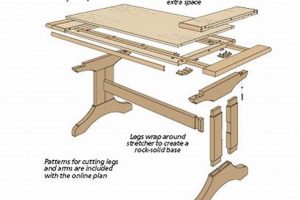
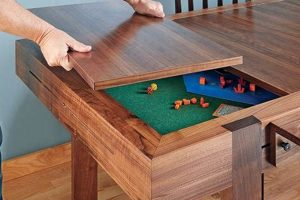
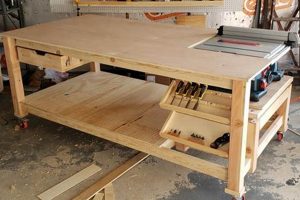
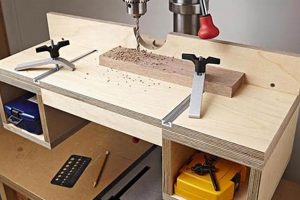
A fundamental component in any woodworking environment, the surface serves as the primary location for project assembly, material preparation, and tool staging. Typically constructed from durable materials like hardwood or laminated particleboard, the unit must offer a stable and level plane to ensure accurate cuts and joinery. Variations exist based on intended use, ranging from portable models for on-site work to heavy-duty, stationary units equipped with vises and dog holes for secure workpiece fixturing.
The presence of a dedicated work surface significantly improves efficiency and precision in woodworking tasks. It provides a safe and organized space, reducing the likelihood of errors and accidents. Historically, woodworkers relied on rudimentary benches; modern iterations, however, incorporate advanced features to enhance functionality and ergonomic comfort. Investing in a quality, appropriately sized unit is a foundational step in establishing a productive workshop.
Subsequent sections will delve into the various types available, explore optimal material choices for construction, and provide practical advice for designing a customized solution tailored to individual needs and workshop limitations. Furthermore, techniques for maintaining its flatness and stability will be addressed, ensuring long-term utility and performance.
Essential Considerations for Shop Work Surfaces
Optimizing the workstation improves workflow and precision in woodworking projects. The following suggestions offer guidance for selecting, setting up, and maintaining a highly functional area.
Tip 1: Prioritize Stability: A solid foundation is paramount. Ensure the unit is constructed from materials resistant to warping and deflection. Reinforce legs and frame connections to minimize movement during operation.
Tip 2: Establish a Flat Plane: Surface trueness is critical for accurate assembly. Use a long straightedge and shims to identify and correct any deviations. Regularly check and adjust as needed.
Tip 3: Integrate Workholding: Incorporate vises, clamps, or dog holes strategically. These allow for secure workpiece fixturing, freeing hands and preventing slippage during critical cuts or joinery.
Tip 4: Optimize Surface Material: Select a material appropriate for the tasks performed. Hardwoods offer durability and resistance to dents. Laminates provide a smooth, easily cleaned surface. Consider a sacrificial top layer for heavy use.
Tip 5: Design for Ergonomics: Adjust the height to promote proper posture. Aim for a height that allows work to be performed comfortably without excessive bending or reaching. Reducing strain minimizes fatigue and improves focus.
Tip 6: Incorporate Storage: Integrate drawers, shelves, or cabinets to keep tools and materials readily accessible. An organized workspace streamlines workflow and reduces clutter, improving efficiency.
Tip 7: Plan for Mobility (If Required): If portability is needed, equip the structure with heavy-duty casters. Ensure locking mechanisms are robust to prevent unwanted movement during operation.
Implementing these strategies enhances usability and accuracy. A carefully planned and maintained workstation becomes an invaluable asset in any woodworking shop.
The next section will address specific design considerations for building a custom solution, along with detailed instructions for constructing a robust and functional unit.
1. Dimensional Stability

Dimensional stability is paramount in the design and construction of a woodworking surface. It directly affects the accuracy and repeatability of woodworking operations. Any changes in dimensions can lead to errors in joinery, assembly, and overall project quality. The selected materials and construction methods must mitigate factors that cause dimensional instability.
- Material Selection and Moisture Content
The choice of material significantly impacts stability. Wood, being hygroscopic, expands and contracts with changes in moisture content. Kiln-dried lumber acclimated to the shop’s environment is essential. Stable hardwoods like maple, oak, or birch are preferred over softer woods. Engineered materials like plywood and MDF exhibit greater stability than solid wood in fluctuating humidity. Understanding the equilibrium moisture content (EMC) of the shop and selecting materials accordingly is crucial for minimizing dimensional changes after construction.
- Construction Techniques and Joinery
Construction methods also influence dimensional stability. Using robust joinery techniques, such as mortise and tenon, dovetails, or rabbets, reinforces structural integrity and minimizes movement. Allowing for wood movement in the design is critical; for example, tabletops can be attached with fasteners that permit expansion and contraction across the grain. Applying a durable finish helps to seal the wood, slowing moisture absorption and reducing dimensional changes.
- Environmental Control and Shop Climate
Maintaining a stable shop environment is vital for preserving dimensional stability. Controlling temperature and humidity fluctuations minimizes the expansion and contraction of wood components. Implementing a dehumidifier or humidifier can help regulate moisture levels. Avoiding direct sunlight and extreme temperature variations reduces stress on the surface and maintains its accuracy over time.
- Influence on Accuracy and Precision
The dimensional stability of the surface directly correlates with the precision achievable in woodworking tasks. An unstable surface compromises the accuracy of measurements, cuts, and joinery. This necessitates frequent recalibration of tools and introduces the potential for cumulative errors. Ensuring the surface remains flat and true is essential for achieving consistent and reliable results.
In conclusion, dimensional stability is a fundamental design consideration for a woodworking station. Careful material selection, robust construction techniques, consistent environmental control, and recognition of material properties are all necessary to maintain its accuracy and functionality over its lifespan. Failure to account for dimensional stability can lead to significant compromises in the quality of work produced.
2. Surface Flatness

Surface flatness is a critical attribute of a woodworking workstation. It directly influences the accuracy of cuts, joinery, and assembly processes. A deviation from a true plane can introduce errors, compromising the integrity and aesthetic appeal of woodworking projects. The following considerations outline the importance of maintaining a flat plane on the work surface.
- Impact on Accurate Cuts
A planar work surface ensures consistent material support during cutting operations, whether using hand tools or power equipment. An uneven surface can cause the material to rock or shift, leading to inaccurate cuts, especially when using precision tools like saws and routers. Maintaining flatness prevents material movement, resulting in cleaner, more precise edges and dimensions.
- Influence on Joinery Precision
Precise joinery relies on accurate mating surfaces. A non-flat surface introduces gaps and misalignments in joints, weakening the structure and affecting the aesthetic quality. Techniques like mortise and tenon, dovetails, or rabbets require flat, consistent contact for optimal strength and alignment. Deviations from flatness necessitate additional corrective measures, increasing project complexity and time.
- Effect on Assembly and Glue-Up
During assembly and glue-up, a flat work surface provides even pressure distribution across the components. This ensures consistent clamping pressure and prevents warping or distortion as the adhesive cures. An uneven surface can cause localized pressure points, leading to uneven glue lines and weakened joints. A flat surface promotes uniform bonding and structural integrity.
- Importance for Tool Calibration and Setup
Many woodworking tools, such as planers, jointers, and measuring devices, require a flat reference surface for accurate calibration and setup. A non-flat workstation compromises the accuracy of these tools, leading to errors in subsequent operations. Maintaining a true plane allows for reliable tool adjustments, ensuring consistent performance and minimizing the risk of inaccurate results.
The aspects of surface flatness on the utility of a woodworking station are substantial. The creation and maintenance of a truly flat surface results in better-crafted projects. Regular inspection and correction of any deviations are essential for ensuring the continued accuracy and reliability of woodworking operations.
3. Workholding Integration

Workholding integration represents a crucial design aspect within the context of a woodworking workstation. Its effectiveness directly determines the stability and security with which a workpiece can be secured for various operations. Inadequate workholding leads to inaccuracies, safety hazards, and reduced efficiency. The selection and implementation of appropriate workholding methods are intrinsically linked to the overall functionality and productivity of the station.
Several workholding mechanisms are commonly integrated. Bench vises, offering robust clamping force, are essential for securing larger workpieces during sawing, planing, or shaping. Dog holes, often arranged in a grid pattern, accommodate bench dogs and other clamping accessories, providing versatility for securing irregularly shaped items. Integrated clamping tracks or T-tracks allow for the use of specialized clamps and jigs, facilitating repetitive or complex operations. Furthermore, specialized vises, such as leg vises or shoulder vises, can cater to specific tasks, such as edge jointing or intricate carving. Proper workholding techniques not only improve precision but also minimize the risk of workpiece slippage or movement, thereby enhancing safety during potentially hazardous operations.
The incorporation of effective workholding systems requires careful consideration of the types of projects undertaken, the available space, and the individual preferences of the woodworker. A well-integrated system enhances accuracy, safety, and efficiency, ultimately contributing to the creation of high-quality woodworking projects. Conversely, a poorly designed or inadequate system can lead to frustration, inaccuracies, and potential injury. The strategic placement and versatility of workholding mechanisms distinguish a truly functional station from a mere surface, transforming it into a precision instrument.
4. Material Durability

The longevity and functionality of a woodworking station are inextricably linked to the durability of its constituent materials. Material selection directly influences the ability of the surface to withstand the rigors of daily use, resist wear and tear, and maintain its structural integrity over extended periods. This facet is critical for ensuring a cost-effective and reliable workspace.
- Resistance to Impact and Abrasion
The workstation is subjected to impacts from tools, workpieces, and accidental drops. Materials must exhibit sufficient hardness and impact resistance to prevent dents, scratches, and other surface damage. Hardwoods like maple or beech, as well as certain engineered materials like phenolic resin panels, offer superior resistance to abrasion compared to softer woods or less durable laminates. The choice of material directly influences the aesthetic appearance and structural integrity of the station over time.
- Resistance to Moisture and Chemical Exposure
Woodworking environments often involve exposure to moisture, adhesives, solvents, and finishes. Materials must resist absorption, swelling, and chemical degradation to maintain dimensional stability and structural integrity. Marine-grade plywood or surfaces treated with moisture-resistant coatings provide enhanced protection against water damage. Similarly, materials resistant to solvents and chemicals prevent staining and degradation of the surface, prolonging its lifespan.
- Structural Integrity and Load-Bearing Capacity
The workstation must possess sufficient structural integrity to support the weight of tools, workpieces, and clamping forces. Materials with high strength-to-weight ratios, such as hardwoods or steel-reinforced composites, are preferable. The frame and legs of the station must be designed to distribute weight evenly and prevent sagging or deformation under load. Inadequate load-bearing capacity compromises safety and accuracy, potentially leading to structural failure.
- Long-Term Stability and Resistance to Creep
Materials should exhibit minimal creep or deformation under sustained load over extended periods. Hardwoods and engineered materials like steel offer superior long-term stability compared to softer woods or plastics. The selection of materials with inherent resistance to creep ensures that the surface maintains its flatness and structural integrity over time, preserving accuracy and functionality.
The interplay of these facets underscores the importance of informed material selection in the construction of a woodworking station. The durability of the selected material directly correlates with the long-term utility and cost-effectiveness of the investment. A well-chosen material minimizes maintenance requirements, enhances safety, and ensures the continued precision and efficiency of woodworking operations.
5. Ergonomic Height

Ergonomic height, in the context of a woodworking station, directly influences the physical well-being and productivity of the woodworker. An improperly sized surface forces unnatural postures, leading to musculoskeletal strain and reduced efficiency. The selection of an appropriate height is therefore a critical consideration in workshop design.
- Posture and Spinal Alignment
An ergonomic height promotes a neutral spinal posture, minimizing stress on the back, neck, and shoulders. A work surface that is too low compels the user to bend forward excessively, while a surface that is too high necessitates reaching and shoulder elevation. Both scenarios contribute to muscle fatigue and potential injury. The goal is to maintain a posture where the elbows are bent at approximately 90 degrees when performing most tasks.
- Shoulder and Arm Strain Reduction
Working at an appropriate height reduces strain on the shoulder and arm muscles. When the surface is too low, the shoulders hunch forward, compressing the chest and restricting arm movement. Conversely, a surface that is too high requires the arms to be elevated for extended periods, leading to muscle fatigue and potential impingement. Maintaining a comfortable arm position allows for greater control and precision during woodworking operations.
- Wrist and Hand Comfort
The height of the work surface affects the angle of the wrists and hands during various tasks. An incorrect height can force the wrists into awkward positions, increasing the risk of carpal tunnel syndrome and other repetitive strain injuries. A neutral wrist position, where the wrist is neither flexed nor extended, minimizes stress on the tendons and nerves, promoting comfort and preventing injuries.
- Overall Productivity and Efficiency
An ergonomic height contributes to increased productivity and efficiency by reducing fatigue and discomfort. When the body is in a comfortable and balanced position, the woodworker can focus more effectively on the task at hand, reducing errors and improving overall quality. Furthermore, minimizing physical strain allows for longer work sessions without experiencing debilitating fatigue.
These interconnected facets underscore the importance of customizing the height of the station to suit the individual woodworker’s physical dimensions and working style. The implementation of adjustable-height mechanisms or the construction of custom-sized units are viable strategies for optimizing ergonomic comfort and promoting long-term health and well-being within the woodworking environment. The consequences of neglecting this element are significant, potentially leading to chronic pain, reduced productivity, and an increased risk of injury.
Frequently Asked Questions
This section addresses common queries regarding the selection, construction, and maintenance of a woodworking surface, providing definitive insights based on established principles.
Question 1: What is the minimum recommended size for the table’s surface?
The minimum recommended surface area depends on the type of projects typically undertaken. A surface of 36 inches by 60 inches is generally adequate for smaller projects. Larger projects, such as furniture construction, may necessitate a surface area of 48 inches by 72 inches or larger.
Question 2: What are the optimal materials for building a durable tabletop?
Hardwoods like maple, beech, or birch offer excellent durability and resistance to wear. Laminate surfaces bonded to a stable core, such as MDF or plywood, provide a smooth, easily cleaned surface. Butcher block construction combines durability with aesthetic appeal.
Question 3: How frequently should the surface be inspected for flatness?
The frequency of inspection depends on the intensity of use and environmental conditions. A visual inspection should be conducted regularly, ideally before each major project. A more thorough inspection with a straightedge is recommended every three to six months to identify and correct any deviations.
Question 4: What is the ideal height for a woodworking surface?
The ideal height is typically between 34 and 38 inches, depending on the individual’s height. The correct height allows for comfortable work with the elbows bent at approximately 90 degrees. Adjustable-height models offer greater flexibility for accommodating different users and tasks.
Question 5: How should workholding devices be integrated into the surface design?
Workholding devices, such as vises, clamps, and dog holes, should be strategically placed to maximize versatility and accessibility. Bench vises should be securely mounted to the frame, while dog holes should be arranged in a grid pattern to accommodate various clamping configurations. Integrated T-tracks offer additional clamping options.
Question 6: What maintenance procedures are essential for prolonging the lifespan of the structure?
Regular cleaning to remove dust and debris is essential. Applying a protective finish, such as varnish or oil, helps to seal the surface and prevent moisture absorption. Periodically inspecting and tightening fasteners ensures structural integrity. Addressing any signs of wear or damage promptly prevents further deterioration.
Adhering to these recommendations contributes to a safe, efficient, and productive woodworking environment.
The subsequent section will explore advanced techniques for customizing the station to meet specific woodworking needs.
Conclusion
This exploration has underscored the significance of the woodworking shop table as a foundational element within any woodworking environment. Key aspects, encompassing dimensional stability, surface flatness, workholding integration, material durability, and ergonomic height, have been examined in detail. These elements collectively determine the precision, safety, and efficiency of woodworking operations. A deficiency in any of these areas compromises the overall functionality of the workstation, leading to diminished results and potential safety hazards.
The commitment to constructing and maintaining a meticulously designed woodworking shop table reflects a dedication to quality craftsmanship and a respect for the inherent demands of the discipline. Its impact extends beyond the immediate tasks performed upon its surface, influencing the overall workflow and the ultimate caliber of finished products. Continued attention to its optimization is a worthwhile investment, ensuring a reliable and productive workspace for years to come.