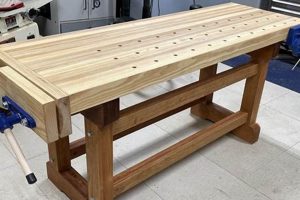
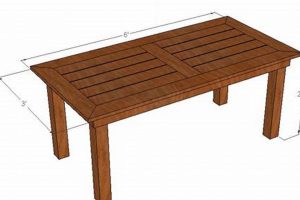
A table designed for woodworking that incorporates a rotating tabletop is a versatile addition to a workshop. This pivoting design allows the user to mount multiple tools, such as a miter saw or bench grinder, on opposing sides of the tabletop. By unlocking and rotating the top, the user can quickly switch between tools as needed, maximizing space and workflow efficiency. This design is particularly useful in smaller workshops where dedicated space for multiple tools is limited.
The advantages of such a table include space optimization, increased workflow efficiency, and cost savings. By combining multiple tools into a single footprint, valuable workshop space is conserved. The rapid tool change capability enhances productivity, reducing the time spent reconfiguring the workspace. Historically, these tables have evolved from simple rotating benches to more sophisticated designs incorporating locking mechanisms, dust collection systems, and integrated power outlets, reflecting a growing demand for adaptable and efficient woodworking solutions.
The following sections will delve into the specific design considerations, material choices, construction techniques, and safety precautions relevant to building or selecting an appropriate pivoting workbench for your woodworking needs. These considerations will help determine the best option for individual workshop requirements and project goals.
Essential Considerations for Flip Top Woodworking Tables
Proper planning and execution are crucial when integrating a pivoting tabletop workbench into a workspace. The following guidelines provide essential considerations for selecting, constructing, and utilizing such a table effectively and safely.
Tip 1: Weight Capacity Assessment: Accurately determine the combined weight of the tools to be mounted and the heaviest workpiece anticipated. The support structure and locking mechanism must be rated to exceed this weight to prevent structural failure and potential injury.
Tip 2: Locking Mechanism Reliability: Investigate the locking mechanism’s design and material. A robust locking system, preferably constructed from steel, is paramount to ensure the tabletop remains securely in position during operation. Regularly inspect the locking mechanism for wear and tear.
Tip 3: Tabletop Material Selection: Prioritize a durable and stable tabletop material, such as hardwood plywood or solid hardwood. The material should resist warping, cracking, and deflection under load. Consider the mounting hardware requirements of the intended tools when choosing the material.
Tip 4: Footprint Optimization: Carefully consider the table’s footprint in both configurations. Ensure adequate clearance for tool operation and user movement. Utilize online resources and CAD software to simulate table usage within the available workspace.
Tip 5: Integrated Power Management: Incorporate a readily accessible power strip or outlet within the table’s frame. Properly secure wiring to prevent entanglement and potential electrical hazards. Adhere to all local electrical codes.
Tip 6: Dust Collection Integration: Design the table to accommodate dust collection. Consider incorporating a dedicated dust port or designing an enclosure around the tools to minimize dust dispersion. Connect the table to a high-efficiency dust collector for optimal performance.
Tip 7: Mobility Considerations: If mobility is required, select heavy-duty casters with a locking mechanism. The casters must be rated to support the fully loaded weight of the table. Ensure the locking mechanism effectively prevents unintended movement during operation.
Adhering to these guidelines will ensure the selected or constructed rotating workbench provides a safe, efficient, and durable solution for woodworking tasks. Proper planning and execution are paramount to maximizing the benefits of this versatile workshop addition.
The subsequent sections will explore specific applications and advanced modifications, providing further insights into optimizing the functionality of pivoting tabletop workbenches.
1. Space Optimization and the Pivoting Tabletop Workstation
Space optimization is an inherent characteristic and primary benefit of the pivoting tabletop woodworking station. In confined workshop environments, dedicating individual workspaces to each tool, such as a miter saw, planer, or drill press, is often impractical. The rotating table addresses this limitation by consolidating multiple tools onto a single platform. By mounting tools on opposing faces of the rotating tabletop, a single floor space accommodates the functionality of several dedicated workstations. The user can switch between tools simply by unlocking and rotating the tabletop, eliminating the need for separate, permanently installed tool stands.
The cause-and-effect relationship is direct: spatial constraints necessitate innovative solutions, and the pivoting table provides a spatially efficient method for managing multiple tools. Consider a typical small garage workshop. Without such a system, a miter saw might occupy a significant portion of a workbench, rendering it unusable for other tasks. The rotating design allows that same miter saw to be stored and accessed on demand, freeing up valuable workspace for other projects. Furthermore, the reduced footprint translates into easier navigation within the workshop, minimizing clutter and potential hazards. The selection or construction of a unit should align closely with the available space.
In summary, the primary advantage of such a workstation lies in its ability to compress multiple functionalities into a compact footprint. It is particularly crucial in environments where space is a premium, offering a practical and efficient solution for woodworkers seeking to maximize their limited workspace. Challenges include ensuring proper weight distribution and stability, but the benefits of space optimization often outweigh these considerations. Understanding this fundamental benefit is essential for effectively integrating and utilizing a pivoting woodworking table.
2. Tool Accessibility
The configuration directly enhances tool accessibility. Without it, tools are either permanently mounted, consuming space and limiting the work area, or stored away, requiring retrieval and setup time before each use. A rotating table resolves these issues by presenting the desired tool at the forefront with minimal effort. The user simply unlocks the table, rotates it to the desired tool, and relocks it. This expedited process reduces the time spent on tool preparation and promotes a smoother workflow, especially in projects requiring frequent tool changes. The design streamlines the transition between different stages of a woodworking project, allowing the craftsman to maintain momentum and improve overall productivity.
Consider the example of a project requiring both miter cuts and precise sanding. If these tools were located on separate benches or stored independently, the user would have to physically move between workstations or retrieve the appropriate tool from storage each time a switch was needed. With a rotating workstation, the transition is instantaneous. A real-world example can be seen in small cabinet shops where space is limited. A single station can house a miter saw and a small drill press, offering immediate access to both tools while minimizing the overall footprint. This accessibility extends beyond just having the tool available; it also facilitates better organization of accessories, such as blades, sanding drums, and measuring tools, close to the point of use.
Ultimately, the heightened access that a pivoting woodworking table affords has a direct impact on efficiency and the quality of work. Tool accessibility becomes more than just convenience; it serves as a key component in optimizing workflow. While challenges such as accurate alignment and robust locking mechanisms must be addressed, the benefits of immediate tool availability significantly contribute to the practical value. The design’s primary purpose is to make the right tool available at the right time, therefore directly correlating and optimizing woodworking applications.
3. Structural Integrity

Structural integrity is a paramount consideration in the design, construction, and utilization of a rotating woodworking table. The ability of the table to withstand applied forces, maintain its shape, and provide a stable platform directly affects user safety, accuracy, and the longevity of the tool. Compromised structural integrity can lead to instability, inaccuracies in cuts and joinery, and potentially catastrophic failure.
- Frame Rigidity and Material Selection
The frame constitutes the primary load-bearing structure of the table. Materials such as steel, thick-gauge plywood, or solid hardwoods are common choices, each offering varying degrees of stiffness and resistance to bending. Insufficient frame rigidity results in deflection under load, impacting the precision of mounted tools. For instance, a miter saw mounted on a flexible table will produce inaccurate cuts due to vibration and movement during operation. Properly designed and constructed frames utilize joinery techniques and bracing to maximize stiffness and minimize deflection.
- Pivot Mechanism Strength and Stability
The pivot mechanism, typically consisting of hinges, bearings, or a rotating plate, is critical for smooth and reliable rotation. The mechanism must withstand the combined weight of the tabletop, mounted tools, and any applied workpieces. Failure of the pivot mechanism can cause the tabletop to sag, bind, or even detach, leading to hazardous conditions. Over-engineering this component, utilizing robust materials and precision machining, is essential for ensuring long-term reliability and preventing premature wear or failure.
- Locking Mechanism Security and Load Capacity
The locking mechanism is responsible for securing the tabletop in a fixed position during tool operation. The locking mechanism must resist the rotational forces generated by the tools and prevent unintended movement. Inadequate locking mechanisms introduce the risk of slippage, causing inaccurate cuts and potential injury. Effective locking mechanisms incorporate features such as spring-loaded pins, cam locks, or clamping systems, ensuring a secure and reliable hold under varying loads. Regular inspection and maintenance of the locking mechanism are crucial for verifying its continued effectiveness.
- Tabletop Deflection and Material Properties
The tabletop serves as the immediate platform for mounting tools and supporting workpieces. The material properties of the tabletop, specifically its stiffness and resistance to bending, directly influence the accuracy and stability of the mounted tools. Excessive tabletop deflection compromises the alignment of tools and introduces inaccuracies in cuts and joinery. Selecting a suitable tabletop material, such as thick hardwood plywood or solid hardwood, and incorporating reinforcing ribs or aprons minimizes deflection and maintains a stable, level surface.
In conclusion, structural integrity is an all-encompassing factor that influences every aspect of the pivoting woodworking table’s performance and safety. Proper material selection, robust construction techniques, and reliable mechanisms are essential for ensuring the table can withstand the rigors of regular use and maintain its functionality over time. Compromises in structural integrity directly translate into diminished accuracy, increased risk of injury, and reduced tool lifespan. Attention to detail during the design and construction phases, coupled with diligent maintenance, safeguards the longevity and performance of the woodworking space-saving table.
4. Locking Reliability
Locking reliability represents a critical safety and performance parameter for pivoting tabletop woodworking stations. A dependable locking mechanism ensures the tabletop remains securely in position during operation, preventing unintended rotation that can result in inaccurate cuts, tool damage, or physical injury. The locking system’s integrity directly impacts the user’s confidence in the table’s stability and contributes to the overall efficiency of woodworking tasks.
- Pin Engagement Depth and Material Strength
The depth of pin engagement within the receiving receptacle and the tensile strength of the pin material are fundamental to locking reliability. Shallow pin engagement, or the use of a low-strength pin material, can lead to shear failure under load. Real-world examples of this are common in cheaply manufactured units, where plastic or low-grade steel pins deform or break, causing the tabletop to become unstable. The implications for a pivoting woodworking table include reduced precision, increased vibration, and the potential for sudden, uncontrolled rotation during use, making pin engagement depth and material selection high priority to mitigate accidents.
- Cam Lock Design and Clamping Force
Cam-style locking mechanisms rely on eccentric rotation to generate clamping force and secure the tabletop. The design of the cam, including its profile and material, determines the holding power of the lock. Insufficient clamping force can result in the tabletop slipping during operation, particularly when working with heavy materials or tools. For instance, if a cam lock is not properly adjusted or is made from a flexible material, the vibration from a running miter saw can cause the tabletop to gradually rotate out of alignment, affecting cut accuracy. This is especially important in flip top woodworking table where heavy tools is mounted.
- Leverage and Mechanical Advantage
The mechanical advantage afforded by the locking lever significantly impacts the ease of use and the applied clamping force. A longer lever arm provides greater mechanical advantage, allowing the user to apply more force with less effort. Conversely, a short or poorly designed lever may require excessive force to engage the lock securely. In flip top woodworking table applications, this translates to user fatigue, especially during prolonged use. If a lever is difficult to operate, the user may be tempted to forgo full engagement, compromising the lock’s reliability.
- Maintenance and Wear Resistance
Locking mechanisms are subject to wear and tear over time, particularly in high-use environments. Factors such as friction, vibration, and exposure to dust and debris can degrade the locking components, leading to reduced reliability. Regular maintenance, including lubrication, cleaning, and inspection for wear, is essential for preserving the locking mechanism’s functionality. The use of wear-resistant materials, such as hardened steel or self-lubricating polymers, can extend the lifespan of the locking mechanism and reduce the need for frequent maintenance. In a pivoting woodworking table, if a locking mechanism is allowed to corrode from rust, it can compromise structural reliability.
In conclusion, locking reliability is a multifaceted attribute that encompasses pin engagement, material selection, cam-locking strength, lever design, and maintenance practices. Neglecting any of these factors can compromise the safety and precision of a pivoting woodworking table, diminishing its overall value and utility. A well-designed and maintained locking system provides the assurance that the tabletop will remain securely in place, allowing the user to focus on the task at hand with confidence.
5. Workflow enhancement

A pivoting woodworking station inherently improves workshop workflow through several key mechanisms. The reduction in physical space occupied by multiple tools streamlines movement and minimizes time wasted transitioning between tasks. Because tools are pre-mounted and readily accessible, the user experiences a significant decrease in setup and breakdown times. This is particularly beneficial in projects requiring frequent use of multiple tools, such as cabinet making or intricate joinery. The cause-and-effect relationship is clear: the inherent space-saving design and easy accessibility directly translate to a more efficient workflow.
Workflow enhancement is not merely a convenience but a critical component influencing project completion time and overall quality. A woodworker, for instance, may be fabricating a series of picture frames. With individual tools set up at separate locations, the time spent walking between workstations and reconfiguring jigs accumulates significantly over the course of the project. A pivoting table consolidates these tools, allowing the worker to execute different cuts quickly and efficiently without leaving a single station. For instance, a flip top woodworking table helps the worker to saw and grind quickly in a table without moving a table. From a practical perspective, the ability to shift between tools with minimal interruption helps maintain focus and reduces the likelihood of errors.
In summary, the contribution to optimized workflow is a primary characteristic. Challenges such as ensuring accurate tool alignment and robust locking mechanisms must be addressed, but the time savings and improved efficiency provided by this space-saving woodworking station greatly enhance the work. Understanding and optimizing this aspect through proper planning and organization is key to fully realizing the potential benefits of this versatile workshop addition.
6. Dust Management

Effective dust management is a critical consideration for any woodworking environment, and its importance is amplified in the context of a pivoting tabletop workstation. The confined space and concentrated tooling associated with such a table necessitate proactive measures to mitigate the health risks and operational inefficiencies caused by airborne particulate matter.
- Localized Dust Collection Integration
Pivoting tables often house tools that generate significant dust, such as miter saws, sanders, and routers. Integrating localized dust collection at each tool station minimizes dust dispersion at the source. This can involve custom-designed hoods, flexible hoses connected to a central dust collector, or self-contained dust extraction systems. For instance, a miter saw station could incorporate a close-fitting shroud connected to a high-efficiency cyclone separator, capturing a substantial portion of the generated dust before it becomes airborne.
- Enclosure Design and Containment
An alternative approach is to enclose the entire work area around the pivoting tabletop, creating a contained environment for dust control. This may involve constructing partial or full enclosures using clear acrylic or polycarbonate panels, allowing for visibility while minimizing dust escape. Such enclosures can be particularly effective when combined with an air filtration system to remove airborne particles and maintain a clean work environment. A specific example would be a downward-draft sanding table integrated into the pivoting setup, where a ventilated surface pulls dust away from the operator’s breathing zone.
- Material Selection for Dust Reduction
The choice of materials used in the construction of the table itself can influence dust generation and accumulation. Smooth, non-porous surfaces are easier to clean and prevent dust from adhering, compared to rough or textured materials. For example, using melamine or laminate surfaces on the tabletop and surrounding structures can minimize dust buildup and facilitate easier cleaning. The design should minimize crevices and corners where dust can collect and become difficult to remove.
- Air Filtration and Circulation
Even with localized dust collection and enclosure strategies, some fine dust will inevitably escape into the surrounding workshop environment. Employing an ambient air filtration system, such as a ceiling-mounted air cleaner or a portable air purifier with a HEPA filter, removes these airborne particles and improves overall air quality. Strategic placement of air filtration units can create airflow patterns that direct dust towards the filters, further enhancing dust control effectiveness. A practical application would be positioning an air filtration unit near the pivoting table to capture fugitive dust generated during sanding or routing operations.
These dust management strategies are not mutually exclusive and can be combined to achieve optimal dust control within the confines of a workshop. Regardless of the specific approach, implementing effective dust management practices is essential for safeguarding the health of the woodworker, preventing equipment damage, and maintaining a clean and efficient working environment when using such a pivoting tabletop woodworking solution.
7. Ergonomic design
Ergonomic design is inextricably linked to the efficacy and safety of the pivoting woodworking station. The repetitive motions and potentially awkward postures inherent in woodworking tasks necessitate careful consideration of the table’s dimensions, adjustability, and overall layout. Failure to prioritize ergonomic principles can lead to musculoskeletal disorders, reduced productivity, and increased risk of accidents. The core tenet is adapting the workstation to fit the user, rather than forcing the user to adapt to an ill-suited setup. For example, a table that is too high or too low requires the user to stoop or reach excessively, placing undue stress on the back, shoulders, and neck.
A practical application of ergonomic design in rotating tabletop woodworking stations lies in the adjustability of the table height. Allowing the user to customize the table height to their individual stature and the specific task at hand minimizes strain and promotes a more natural working posture. This is particularly relevant when switching between different tools or working on projects of varying sizes. Furthermore, the positioning of controls and accessories should be within easy reach, minimizing the need for excessive stretching or twisting. Consider the placement of a power switch for a mounted tool; a conveniently located switch reduces the likelihood of awkward reaching and potential accidental activation. Anti-fatigue mats can also be implemented to increase comfort.
In summary, the integration of ergonomic design principles is not merely an optional add-on, but a fundamental requirement for a safe, efficient, and user-friendly space-saving woodworking station. By optimizing table dimensions, adjustability, and the placement of controls, the user experiences reduced fatigue, improved productivity, and a minimized risk of work-related injuries. Ignoring ergonomic considerations compromises the overall value and utility of the table, diminishing its potential benefits and increasing the likelihood of negative health outcomes. Therefore, the focus on user wellbeing must be a priority during the process of planning and utilizing such a workstation.
Frequently Asked Questions
The following frequently asked questions address common inquiries regarding the selection, construction, and utilization of rotating tabletop woodworking stations. These answers aim to provide clear and concise information for informed decision-making.
Question 1: What is the optimal table size for a rotating workbench in a small workshop?
The optimal size depends on available space and intended tool selection. A common dimension ranges between 24×48 inches to 36×60 inches. Prioritize a size that accommodates the largest tool footprint while allowing sufficient workspace and maneuverability.
Question 2: What type of locking mechanism is most reliable for securing the rotating tabletop?
Pin-locking systems and cam-over latches provide reliable locking. Evaluate the material strength and engagement depth. Steel locking components typically offer superior durability compared to plastic or aluminum.
Question 3: How should dust collection be integrated into such a table?
Implement a combination of localized dust ports connected to a central dust collector and an ambient air filtration system. Consider an enclosure around dust-prone tools to minimize dispersion.
Question 4: What materials offer the best combination of strength and stability for the tabletop?
Hardwood plywood, such as Baltic birch, and solid hardwoods, such as maple or oak, provide a balance of strength, stability, and resistance to warping. Thickness should be appropriate for the anticipated loads.
Question 5: Is it possible to build a rotating table from reclaimed or repurposed materials?
Yes, it is feasible. Ensure that reclaimed materials are structurally sound and free from defects. Thoroughly clean and inspect all materials before incorporation. Prioritize the structural integrity of the frame and locking mechanism.
Question 6: How can the risk of injury be minimized when using a rotating woodworking table?
Always ensure the tabletop is securely locked before operating any mounted tools. Use appropriate personal protective equipment, including eye protection and hearing protection. Maintain a clear and uncluttered workspace. Be aware of potential pinch points during tabletop rotation.
Addressing these fundamental questions provides a solid base for effectively incorporating a rotating bench into a woodworking setup. Careful consideration of these factors ensures safe, efficient, and productive use.
The subsequent section will explore detailed plans and build guides, offering step-by-step instructions for constructing customized table solutions.
Conclusion
This article explored the design, benefits, and crucial considerations surrounding the integration of the flip top woodworking table into a workshop environment. Key aspects, including space optimization, tool accessibility, structural integrity, locking reliability, workflow enhancement, dust management, and ergonomic design, were examined. These elements represent the foundation for maximizing the utility and ensuring the safe operation of this versatile piece of equipment.
The selection or construction of a rotating tabletop workbench necessitates careful planning and execution. A comprehensive understanding of the factors discussed herein will enable woodworkers to create or acquire a solution that enhances productivity, improves safety, and optimizes the use of limited workspace. Continued innovation in design and materials promises even greater functionality and adaptability in future iterations of the flip top woodworking table.

![Best Multi Function Woodworking Table [Guide] + Tips | Step-by-Step Guides, Tools & Inspiration to Build Beautiful Wooden Decor on a Budget](https://woodfromhome.com/wp-content/uploads/2026/04/th-222-300x200.jpg "Best Multi Function Woodworking Table [Guide] + Tips Step-by-Step Guides, Tools & Inspiration to Build Beautiful Wooden Decor on a Budget")
![Best Woodworking Assembly Table Guide - [Your Brand] | Step-by-Step Guides, Tools & Inspiration to Build Beautiful Wooden Decor on a Budget](https://woodfromhome.com/wp-content/uploads/2026/04/th-194-300x200.jpg "Best Woodworking Assembly Table Guide - [Your Brand] Step-by-Step Guides, Tools & Inspiration to Build Beautiful Wooden Decor on a Budget")