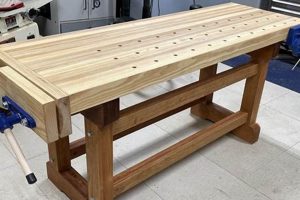
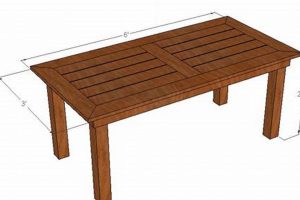
The process of securely affixing a horizontal surface to a supporting structure in woodworking represents a critical step in furniture construction. This involves various techniques employed to join the tabletop to the base or frame, ensuring stability, durability, and aesthetic appeal of the finished piece. A common example is joining a solid wood top to a table’s legs using wood screws and angled pocket holes for a robust and concealed connection.
A secure and well-executed connection between the surface and its support is paramount for the longevity and functionality of any table. This union bears the weight and endures the daily use of the piece. Throughout history, woodworkers have refined methods for this attachment, from simple pegged mortise-and-tenon joints to sophisticated mechanical fasteners, each adapting to the materials and tools available.
Understanding the factors that influence a strong and lasting bond is crucial before proceeding with any specific fastening method. Subsequently, appropriate techniques such as using wood glue, screws, expansion, or metal fasteners become critical. This exploration delves into the diverse approaches and considerations involved in achieving a reliable and visually pleasing union between the horizontal surface and the supporting frame.
Essential Considerations for Surface-to-Base Integration in Woodworking
Effective surface-to-base integration is crucial for creating durable and aesthetically pleasing wooden tables. Careful planning and execution are vital to ensure the longevity and stability of the finished product.
Tip 1: Account for Wood Movement: Solid wood expands and contracts with changes in humidity. Employ methods that allow for this movement, such as using slotted screw holes or table buttons, to prevent warping or cracking. For instance, fastening the tabletop to the base with screws through elongated holes enables the wood to move without stressing the joints.
Tip 2: Select Appropriate Fasteners: The choice of fasteners impacts the strength and appearance of the joint. Wood screws offer good holding power, while bolts provide superior strength for heavier tables. Consider using threaded inserts in the tabletop for a more secure and reusable connection. Select the proper screw length to prevent it from protruding from the wood.
Tip 3: Utilize Wood Glue Effectively: Wood glue enhances the strength and stability of the joint. Apply a thin, even layer of glue to both surfaces and clamp them securely until the glue is fully cured. Ensure the surfaces are clean and free of dust or debris before applying the adhesive. Avoid using excessive glue, as this can weaken the bond.
Tip 4: Employ Pocket Hole Joinery Strategically: Pocket holes offer a concealed and efficient method for joining the surface to the frame. Use a pocket hole jig to drill angled holes into the underside of the tabletop, then secure it to the base with screws. Pocket holes are best suited for apron attachment, not for direct leg attachment to a tabletop.
Tip 5: Consider Breadboard Ends: Breadboard ends provide a traditional and visually appealing way to stabilize a tabletop and minimize warping. These are attached perpendicular to the main surface using mortise-and-tenon joints or sliding dovetails, allowing for wood movement while keeping the surface flat.
Tip 6: Reinforce with Corner Braces: Corner braces add extra support and rigidity to the table frame. These can be made of wood or metal and are attached to the inside corners of the frame, providing additional resistance to racking and movement. Metal braces are generally stronger, while wood braces can be integrated more seamlessly into the design.
Tip 7: Pilot Holes are Essential: Always drill pilot holes before driving screws, especially in hardwoods, to prevent splitting the wood. The pilot hole should be slightly smaller than the screw’s shank diameter. This is particularly crucial near the edges of the material.
Mastering these techniques ensures a secure, durable, and aesthetically pleasing surface-to-base connection. Attention to detail and proper execution are vital for achieving a high-quality finished piece.
These considerations provide a solid foundation for achieving success during construction. Further discussion on advanced techniques and design considerations may be explored to enhance the final result.
1. Joint Strength

Joint strength is a foundational requirement when securing a tabletop to its base. The method of attachment directly influences the table’s structural integrity and long-term durability. Insufficient joint strength can lead to instability, racking, or complete failure of the assembly. For example, a poorly executed mortise and tenon joint, characterized by loose tolerances or inadequate glue surface, will compromise the table’s ability to withstand load, potentially resulting in wobbly legs or separation of the tabletop. The choice of joint, therefore, must be commensurate with the table’s intended use and the materials employed.
Several factors contribute to achieving adequate joint strength. These include the inherent properties of the wood, the surface area of the joined surfaces, the type of adhesive utilized, and the mechanical fasteners employed. For example, hardwoods generally provide greater joint strength compared to softwoods, assuming all other variables are constant. Similarly, a larger glue surface allows for a stronger bond. The selection of an appropriate adhesive, specifically formulated for wood and the intended application, is crucial. When screws are implemented, the screw length, diameter, and thread pattern significantly influence holding power. Pocket screws combined with adhesive could be the ideal combination for an apron to tabletop joint.
In summary, joint strength is a critical determinant of a successful and lasting connection of a surface to its support. Understanding the interplay between material selection, joint design, adhesive properties, and fastener characteristics is essential for any woodworker. Addressing potential weaknesses in joint strength through careful planning and execution can significantly extend the lifespan and usability of a wooden table. The consequences of neglecting this fundamental principle range from minor inconveniences, such as a wobbly table, to catastrophic structural failure.
2. Wood Movement

Wood movement, the dimensional change in lumber due to fluctuations in moisture content, presents a significant challenge in woodworking, particularly when joining a tabletop to its base. Ignoring this phenomenon can result in warping, cracking, or joint failure, thereby compromising the structural integrity and aesthetic appeal of the finished piece. Understanding and accommodating wood movement is therefore essential for successful surface-to-base integration.
- Tangential vs. Radial Movement
Wood shrinks and expands more along its tangential axis (around the circumference of the growth rings) than along its radial axis (toward the center of the tree). This differential movement means a wide solid wood tabletop will change width considerably with humidity shifts. Therefore, fastening methods must allow for this greater expansion and contraction across the width to prevent stress build-up and potential cracking. Breadboard ends, for instance, must be attached in a way that allows the main surface to move freely within them.
- Seasonal Humidity Changes
Wood’s moisture content fluctuates with seasonal humidity changes. In dry winter months, wood shrinks, and in humid summer months, it expands. A tabletop rigidly attached to its base without accounting for this change will experience significant stress. This is especially critical in regions with extreme seasonal variations. Designing for seasonal movement involves using techniques like slotted screw holes or table buttons that allow the top to expand and contract without putting pressure on the base.
- Construction Methods
Construction methods must accommodate wood movement to prevent structural problems. Traditional techniques, such as mortise-and-tenon joints with floating tenons, allow for wood movement while maintaining structural integrity. Modern techniques, such as using metal fasteners in conjunction with slotted holes, achieve a similar result. Avoid rigidly gluing a wide tabletop to a frame, as this will inevitably lead to cracking or joint failure. Consider that solid tabletops made of multiple boards glued side-by-side (edge glued) will exhibit less total movement if the grains are alternated.
- Material Selection and Acclimation
Different wood species exhibit varying degrees of movement. Dimensionally stable species, such as quartersawn lumber, are less prone to significant changes in size and shape compared to plain-sawn lumber. Proper acclimation of the lumber to the environment where the finished table will reside is crucial before beginning construction. This allows the wood to reach its equilibrium moisture content, minimizing subsequent movement. Properly dried and acclimated lumber will still move, but much less, and this can be accounted for more easily.
The interplay of tangential and radial movement, seasonal humidity changes, construction methods, and material selection dictates the success of any table. Careful consideration and proper execution are required to create a durable, beautiful piece that withstands the test of time. Choosing appropriate woodworking attach table top method that respects and accommodates wood movement is paramount. Neglecting these can result in aesthetically unpleasing or structurally unsound furniture.
3. Fastener Selection

Fastener selection directly influences the strength, stability, and longevity when completing woodworking attach table top. The choice of fastener, whether screws, bolts, lag screws, or specialized connectors, dictates the mechanical bond between the surface and its support structure. Inadequate fastener selection may lead to joint failure under stress, compromising the table’s structural integrity. For instance, employing short wood screws in a heavy dining table’s apron may result in the screws pulling out of the wood over time, causing the tabletop to loosen or detach entirely. Proper fastener selection ensures the surface remains securely connected, even under the weight of objects or incidental forces.
The type of wood, the thickness of the materials being joined, and the expected load bearing all influence fastener selection for attaching table tops. For solid wood tops, fasteners must allow for wood movement due to seasonal changes in humidity. Methods such as using slotted screw holes or specialized table buttons enable the wood to expand and contract without putting undue stress on the fasteners or the wood itself. This avoids cracking or warping of the surface. Additionally, aesthetics play a role, as visible fasteners can detract from the overall appearance of the piece. Consequently, hidden fastener methods, such as pocket screws or mortise-and-tenon joints, are often favored for their clean visual outcome. The right selection ensures both a secure bond and a pleasing aesthetic.
Appropriate fastener selection in woodworking attach table top is critical. It affects the table’s structural integrity, durability, and visual appeal. Consideration of material properties, environmental factors, and aesthetic preferences guides the selection. Failure to select fasteners correctly can lead to structural issues and a reduction in the lifespan of the piece. Selecting the right fasteners is a key element in a successful woodworking attach table top project.
4. Glue Application

Effective adhesive application plays a critical role in the successful and durable attachment of a table’s surface to its supporting structure. It augments mechanical fasteners, providing a robust bond that withstands stress and contributes to the overall stability of the table. Proper technique is essential to realize the full potential of the adhesive.
- Surface Preparation
Adequate surface preparation is paramount for optimal adhesive performance. Surfaces must be clean, dry, and free from contaminants such as dust, oil, or old finish. Sanding the surfaces to be joined increases the surface area and provides a mechanical key for the adhesive to grip. Failure to properly prepare the surfaces will result in a weak bond. For example, applying glue to an oily surface prevents proper adhesion, potentially leading to joint failure over time.
- Adhesive Selection
Choosing the appropriate adhesive is essential for a strong and lasting joint. Different adhesives possess varying properties, making them suitable for specific applications. Polyvinyl acetate (PVA) glues are commonly used for general woodworking due to their ease of use and good bond strength. Polyurethane glues offer excellent water resistance and are suitable for outdoor applications or areas prone to moisture exposure. Epoxy adhesives provide exceptional strength and gap-filling capabilities, making them suitable for demanding applications. Careful selection, based on the type of wood, environmental conditions, and desired strength, will result in the optimal bond.
- Application Technique
The method of application affects the strength and durability of the glued joint. A thin, even layer of adhesive should be applied to both surfaces being joined. Excessive glue application can weaken the bond, as it creates a “glue-starved” joint where the wood fibers are not in direct contact. Conversely, insufficient glue application results in a weak bond. Applying the adhesive with a brush, roller, or glue spreader ensures consistent coverage. Clamping the pieces together during the curing process ensures intimate contact between the surfaces and promotes maximum bond strength. For instance, using too little glue or uneven glue could result in the table top not being correctly attached.
- Clamping Pressure and Curing
Adequate clamping pressure and proper curing time are crucial for achieving a strong and lasting adhesive bond. Clamping pressure ensures that the surfaces are in intimate contact during the curing process, allowing the adhesive to properly penetrate the wood fibers. The appropriate clamping pressure varies depending on the type of adhesive and the wood species. Insufficient clamping pressure results in a weak bond. Allow the adhesive to cure for the recommended time, as specified by the manufacturer, before removing the clamps and subjecting the joint to stress. Premature removal of clamps compromises the bond strength.
The interplay of surface preparation, adhesive selection, application technique, and clamping pressure dictates the success of gluing a tabletop to its base. Attention to detail and adherence to best practices in glue application are essential components for creating a durable, aesthetically pleasing, and structurally sound piece of furniture, enhancing the effectiveness of efforts towards completing woodworking attach table top. Ignoring these considerations results in potential long term issue.
5. Alignment Accuracy

Achieving precise alignment between a tabletop and its supporting structure is paramount for the structural integrity and visual appeal of any woodworking project. In the context of woodworking attach table top, inaccuracy in alignment can manifest as a warped surface, uneven overhangs, or a structurally unstable assembly. Such misalignments often necessitate extensive rework or, in severe cases, render the entire project unusable. For instance, if the apron of a table is not perfectly aligned with the tabletop during attachment, the resulting gaps or unevenness will compromise both the table’s aesthetic quality and its load-bearing capacity. Therefore, ensuring exact alignment is not merely an aesthetic concern, but a functional necessity.
Several factors contribute to the challenge of maintaining accuracy. The precision of joinery, such as mortise-and-tenon joints or the placement of screws, directly impacts the final alignment. The use of jigs and measuring tools is indispensable in achieving and maintaining precise angles and dimensions. Furthermore, clamping pressure, if unevenly applied, can distort components during glue-up, leading to misalignment. To mitigate these challenges, woodworkers often employ techniques such as dry fitting, where the components are assembled without glue to verify alignment before final assembly. The use of cauls, boards used to distribute clamping pressure evenly, is also common practice. A practical example of this is using a straight edge and shims to confirm the flatness of a large surface before clamping it to its frame.
In conclusion, alignment accuracy is an indispensable component of completing woodworking attach table top effectively. The consequences of neglecting precise alignment range from minor aesthetic imperfections to critical structural weaknesses. A commitment to accuracy, employing appropriate tools and techniques, is therefore central to successful woodworking and the creation of durable, aesthetically pleasing furniture. This attention to detail distinguishes a well-crafted piece from one that is merely functional, ultimately reflecting the woodworker’s skill and dedication to quality.
6. Surface Finish

The treatment applied to a wooden surface post-construction significantly impacts the aesthetic appeal, tactile experience, and functional durability of the completed table. The quality of the surface finish is particularly relevant to woodworking attach table top, as it complements or detracts from the craftsmanship evident in the joinery and overall design.
- Protection Against Environmental Factors
A well-executed surface finish acts as a barrier against moisture, ultraviolet radiation, and physical abrasion. This protection is critical for preserving the wood’s integrity and preventing warping, cracking, or discoloration. For instance, a polyurethane finish applied to a tabletop can shield it from water rings caused by beverage condensation, thereby extending its lifespan. In the context of woodworking attach table top, the finish protects the meticulously crafted joints and prevents them from being compromised by environmental stressors.
- Enhancement of Aesthetic Qualities
The surface finish can accentuate the natural grain and color of the wood, enhancing its visual appeal. Stains, dyes, and clear coats can be employed to achieve a desired aesthetic effect. For example, a tung oil finish brings out the depth and warmth of walnut wood, creating a rich, lustrous appearance. This enhancement is particularly important where the attachment of the table’s surface to its base is designed to be a visible feature, as the finish draws attention to the craftsmanship involved.
- Tactile Considerations
The surface finish influences the tactile experience of using the table. A smooth, even finish provides a pleasant feel and enhances the overall user experience. Rough or uneven finishes can be unpleasant to the touch and may detract from the table’s functionality. For example, a properly sanded and lacquered surface offers a smooth, almost glass-like feel, while a poorly applied finish may be gritty or sticky. Considering touch is important since the table is used by people and they must be able to have a pleasant experience. To improve the user experience a high quality surface finish must be carefully considered.
- Durability and Maintenance
The durability of the surface finish determines how well the table withstands wear and tear over time. A durable finish resists scratches, stains, and other forms of damage, reducing the need for frequent maintenance. For example, a catalyzed varnish finish is highly resistant to chemicals and abrasion, making it suitable for tabletops that are subjected to heavy use. The ease of maintenance is also an important consideration. Certain finishes, such as oil-based finishes, require periodic reapplication to maintain their protective properties. Thus, the appropriate surface finish and appropriate maintenance must be considered to keep the longevity of the product.
The interaction between the surface treatment and the attachment of the table’s surface to its frame is vital for the final product. A well-executed finish not only protects and enhances the beauty of the wood but also complements the structural integrity achieved through proper joinery techniques. The choice and application of the finish, therefore, is an integral part of the design of woodworking attach table top, contributing to a final piece that is both aesthetically pleasing and functionally robust.
Frequently Asked Questions
This section addresses common inquiries and misconceptions regarding the process of joining table surfaces to their support structures. Clear, concise answers offer guidance for achieving durable and aesthetically pleasing results.
Question 1: What is the most common mistake when attaching a tabletop, and how can it be avoided?
Failure to account for wood movement is a pervasive error. Wood expands and contracts with changes in humidity, potentially causing warping or cracking if rigidly fixed. Employ techniques that allow for movement, such as slotted screw holes or expansion joints.
Question 2: How does the type of wood influence the attachment method?
Hardwoods generally require more robust fastening methods due to their density and resistance to screw penetration. Softwoods, while easier to work with, may necessitate careful pilot hole drilling to prevent splitting. The wood’s grain direction also impacts joint strength and stability.
Question 3: What is the optimal spacing for screws when attaching a tabletop to an apron?
Screw spacing depends on the tabletop material, thickness, and the expected load. A general guideline is to space screws every 6 to 12 inches along the apron. Closer spacing may be necessary for heavier tops or softer woods. Ensure screws are appropriately sized to prevent pull-out.
Question 4: Is glue always necessary when attaching a tabletop with screws?
While screws provide mechanical fastening, glue enhances joint strength and stability. Adhesive fills gaps, prevents racking, and distributes stress more evenly. High-quality wood glue is highly recommended for most tabletop attachments, and allows for a much sturdier table top.
Question 5: How can one ensure the tabletop is perfectly flush with the base after attachment?
Careful measurement and marking are essential. Use a combination square or marking gauge to ensure consistent overhangs and alignment. Dry-fitting the components before applying glue allows for adjustments. Clamping cauls can distribute pressure evenly during glue-up, preventing warping.
Question 6: What alternative attachment methods exist beyond screws and glue?
Other options include mortise-and-tenon joints, dovetail joints, and specialized metal fasteners. Each method offers unique advantages in terms of strength, aesthetics, and ease of construction. The selection depends on the design and the woodworker’s skill level.
Proper planning, material selection, and execution are crucial for securely attaching a tabletop. Understanding these factors contributes to a durable and aesthetically pleasing finished product.
The next article section will elaborate on various design considerations to enhance final product.
Conclusion
The preceding exploration emphasizes the multifaceted nature of woodworking attach table top. Considerations of joint strength, wood movement, fastener selection, glue application, alignment accuracy, and surface finish each contribute to the structural integrity and aesthetic quality of the completed table. Diligence in each area mitigates potential long-term issues.
Attaching a tabletop remains a critical juncture in woodworking. Mastery of relevant techniques ensures enduring quality and aesthetic appeal. Continued refinement of these skills advances woodworking practice, enriching furniture design and production.

![Best Multi Function Woodworking Table [Guide] + Tips | Step-by-Step Guides, Tools & Inspiration to Build Beautiful Wooden Decor on a Budget](https://woodfromhome.com/wp-content/uploads/2026/04/th-222-300x200.jpg "Best Multi Function Woodworking Table [Guide] + Tips Step-by-Step Guides, Tools & Inspiration to Build Beautiful Wooden Decor on a Budget")
![Best Woodworking Assembly Table Guide - [Your Brand] | Step-by-Step Guides, Tools & Inspiration to Build Beautiful Wooden Decor on a Budget](https://woodfromhome.com/wp-content/uploads/2026/04/th-194-300x200.jpg "Best Woodworking Assembly Table Guide - [Your Brand] Step-by-Step Guides, Tools & Inspiration to Build Beautiful Wooden Decor on a Budget")