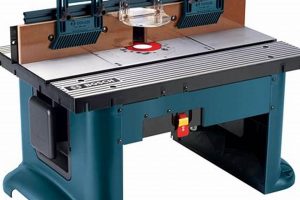
A stationary woodworking tool, it enhances the functionality of a handheld router by providing a stable, level surface. This allows for more precise and controlled routing operations, particularly when working with smaller or irregularly shaped pieces. The device typically includes a flat surface, a fence for guiding workpieces, and a mechanism for mounting and adjusting the router’s position. Its primary purpose is to transform a portable tool into a bench-mounted unit, offering increased stability and accuracy for various woodworking tasks.
The use of this apparatus offers several advantages, including improved safety, enhanced precision, and greater versatility in woodworking projects. By securing the router, it reduces the risk of kickback and provides a safer working environment. The ability to accurately guide workpieces against a fence or template allows for consistent and repeatable cuts. Historically, it represents an evolution in woodworking techniques, adapting a handheld tool for more complex and controlled applications, contributing significantly to efficiency and precision in joinery and shaping.
The following sections will delve into specific aspects such as selecting the appropriate model, essential accessories, techniques for maximizing precision, and safety considerations for effective operation. Further discussion will explore various applications within different woodworking projects and maintenance procedures to ensure longevity and optimal performance.
Router Table Optimization
The following provides essential guidance on optimizing the use of a woodworking accessory to achieve superior results and enhance workshop safety.
Tip 1: Material Selection for the Tabletop: Prioritize high-density materials such as MDF or phenolic resin for the tabletop. These materials offer superior flatness and stability, crucial for precision routing. Avoid materials prone to warping or deflection, which compromise accuracy.
Tip 2: Fence Alignment and Adjustment: Regularly check fence alignment using a precision square. A misaligned fence leads to inaccurate cuts and potential safety hazards. Invest in a micro-adjuster for the fence to facilitate incremental adjustments with greater precision.
Tip 3: Router Mounting Plate Considerations: Select a mounting plate made of durable material like aluminum or phenolic. Ensure it sits flush with the table’s surface to prevent snags and maintain a smooth work surface. Routinely inspect the plate for any signs of wear or damage that could affect router stability.
Tip 4: Dust Collection Integration: Implement an effective dust collection system. Connect a dust collector to both the fence and the router enclosure to minimize airborne particles. Adequate dust extraction improves visibility and reduces the risk of respiratory issues.
Tip 5: Bit Selection and Speed Control: Choose appropriate router bits based on the material and the desired cut profile. Utilize a variable-speed router and adjust the speed according to the bit’s specifications and the material’s properties. Excessive speed can lead to burning and reduced cut quality.
Tip 6: Featherboard Implementation: Incorporate featherboards to maintain consistent pressure against the fence during routing. This reduces the risk of kickback and ensures uniform cut depth. Securely mount featherboards both horizontally and vertically for optimal workpiece control.
Tip 7: Accurate Height Adjustment: Employ a router lift or precise height adjustment mechanism for incremental bit height adjustments. Fine-tuning the bit height ensures accurate cut depths and minimizes errors. Periodically calibrate the height adjustment mechanism for optimal precision.
Adhering to these techniques promotes efficient utilization, accurate results, and a safer working environment when employing this specialized woodworking apparatus. Prioritize proper setup and consistent maintenance for optimal performance.
The subsequent sections will explore specific applications and safety guidelines in greater detail.
1. Stability

Stability is paramount to the effective and safe operation of a router table. It directly influences the precision of cuts and minimizes the risk of workpiece movement during the routing process. Inadequate stability can lead to inaccuracies, material waste, and potential injury.
- Tabletop Rigidity
The tabletop must resist deflection under the weight of the router and the pressure applied during routing. Materials like MDF or cast iron provide the necessary rigidity to maintain a consistent plane. A tabletop that flexes introduces inconsistencies in cut depth and profile.
- Base Construction
The base of the table provides foundational support. A sturdy base, whether constructed from steel, wood, or composite materials, prevents wobbling and vibration. Cross-bracing and adjustable feet enhance stability, particularly on uneven surfaces. An unstable base transmits vibrations to the workpiece, affecting cut quality.
- Router Mounting System
The system that secures the router to the table must be robust and free from play. A secure mount prevents the router from shifting or vibrating during operation. Solid mounting plates and secure locking mechanisms are essential for maintaining router position and consistent cutting performance.
- Vibration Dampening
Excessive vibration compromises accuracy and can lead to operator fatigue. Vibration-dampening materials or techniques can be incorporated into the table’s design to minimize the transmission of vibrations from the router motor to the workpiece. This can be achieved through the use of rubber feet, dense base materials, or internal bracing.
Collectively, these facets of stability contribute to a controlled and predictable routing environment. A stable apparatus enables the woodworker to execute intricate cuts with confidence, reduce material waste, and prioritize safe operating practices. The absence of adequate stability negates many of the advantages offered by the equipment.
2. Precision

The degree of accuracy achievable in woodworking projects is significantly influenced by the utilization of the specialized tool. Precision, in this context, refers to the ability to consistently replicate cuts and profiles within specified tolerances. The apparatus facilitates precise routing operations by providing a stable platform and controlled guidance for the workpiece, thereby mitigating the inherent variability associated with handheld routing.
The attainment of accuracy with this equipment is directly attributable to several factors. A flat, rigid table surface ensures uniform support for the material being routed. A well-aligned fence system provides a reliable reference point for guiding the workpiece, enabling straight and parallel cuts. Furthermore, the ability to precisely adjust the router bit height allows for controlled depth of cut. Consider, for example, the creation of precisely fitted dovetail joints, a task greatly facilitated by the accuracy of this specialized equipment. Similarly, the production of consistent edge profiles on cabinet doors relies on the ability to maintain a uniform relationship between the workpiece and the router bit. The lack of such precision can result in ill-fitting joinery, uneven profiles, and compromised structural integrity of the finished product.
In summary, the level of achievable accuracy is a primary benefit. Challenges in achieving optimal precision often stem from inadequate setup, poorly maintained equipment, or operator error. However, when properly calibrated and operated, this tool offers a marked improvement in accuracy compared to freehand routing techniques, contributing to the production of high-quality woodworking projects with consistent and repeatable results.
3. Versatility

The versatility afforded by a router table significantly expands the range of woodworking tasks achievable compared to using a handheld router alone. The capacity to perform diverse operations stems from the router’s fixed position, which enables controlled manipulation of workpieces against the rotating bit. This configuration permits a wider spectrum of cuts, including edge profiling, jointing, shaping, and molding, all executed with greater precision and consistency. The absence of a table necessitates more complex jigs and fixturing for many of these operations, reducing efficiency and increasing the potential for error.
Consider the creation of raised panel doors. A router table equipped with appropriate bits and fences facilitates the efficient production of the panel profile and the mortise and tenon joinery necessary for door construction. Without the table, creating the raised panel profile consistently and safely would be considerably more challenging. Similarly, producing accurate and repeatable moldings for trim work benefits from the table’s fence system and stable work surface. The adaptability to accept various router bits and accessories, such as featherboards and coping sleds, further enhances its utility. The impact of this flexibility is a significant reduction in the number of specialized tools required in a woodworking shop, consolidating multiple functions into a single, adaptable piece of equipment.
In conclusion, the operational breadth of a router table is a defining characteristic, allowing it to address an extensive array of woodworking tasks with precision and efficiency. While specialized tools may offer advantages in specific scenarios, the versatility of the router table provides a cost-effective and space-saving solution for many woodworking applications. The inherent limitations in this flexibility relate primarily to the physical size of the workpieces that can be accommodated and the complexity of certain intricate cuts, which may necessitate specialized jigs or alternative machinery.
4. Dust Collection

Effective dust collection is an indispensable component of the router table setup. Routing operations inherently generate substantial quantities of fine particulate matter, posing risks to both operator health and equipment performance. The high-speed rotation of the router bit pulverizes wood fibers, creating airborne dust that can be inhaled, leading to respiratory issues over prolonged exposure. Furthermore, this dust can accumulate on machinery, potentially interfering with the operation of moving parts and increasing wear. Integrating a dedicated dust collection system directly addresses these concerns, contributing to a safer and more efficient woodworking environment. For instance, during the shaping of complex moldings, a router table without adequate dust collection will quickly become obscured by accumulating dust, impairing visibility and potentially leading to inaccurate cuts.
The practical application of dust collection in a router table context involves several key elements. A dust port, strategically located near the router bit, captures the majority of the airborne particles at the source. This port is then connected to a dust collector, typically a shop vacuum or a dedicated dust collection system, which provides the necessary airflow to draw the dust away from the cutting area. Additionally, an enclosed router table base can further contain dust, enhancing the effectiveness of the collection system. The choice of dust collector depends on the volume of dust generated and the frequency of router table use. High-volume systems are generally preferred for professional settings where the tool is used extensively. An example: a small cabinet shop using router table will implement this system for their daily operation.
In conclusion, prioritizing dust collection is not merely an optional add-on but a fundamental requirement for safe and efficient router table operation. Failing to address dust management can result in health hazards, compromised cut quality, and increased maintenance demands. The integration of a well-designed dust collection system mitigates these risks, fostering a cleaner and more productive woodworking environment. The challenge lies in selecting a dust collection system that effectively captures the fine dust particles generated by routing operations, while also being compatible with the physical constraints of the router table setup. Understanding the relationship between these two elements is essential for maximizing the benefits of this valuable woodworking tool.
5. Fence Adjustment

Precise fence adjustment constitutes a critical element in the effective utilization of a router table. The fence serves as a guide, dictating the path of the workpiece relative to the rotating router bit. Accurate and repeatable adjustments are essential for achieving desired cut profiles and ensuring dimensional accuracy in woodworking projects. Improper fence alignment or adjustment leads to inconsistencies, material waste, and potential safety hazards.
- Parallelism and Squareness
The fence must be precisely parallel to the router bit to achieve uniform cut depths. Deviation from parallelism results in cuts that are deeper on one side than the other, compromising accuracy. Furthermore, the fence must be square to the table surface to ensure that edges are routed at a 90-degree angle. A miter gauge or precision square is typically used to verify and adjust fence alignment. An example of misalignment effects can be seen in a molding operation, resulting in an uneven profile.
- Micro-Adjustment Mechanisms
Micro-adjustment mechanisms facilitate incremental fence adjustments with a high degree of precision. These mechanisms allow for fine-tuning the fence position in small increments, often measured in thousandths of an inch. This is particularly important for operations requiring precise dimensional control, such as creating dados or rabbets for joinery. Without micro-adjustments, achieving such precision becomes significantly more challenging, requiring repeated trial-and-error adjustments.
- Fence Material and Stability
The material composition and structural integrity of the fence influence its stability and resistance to deflection. A rigid fence, constructed from materials like aluminum or phenolic, minimizes flex and vibration during routing operations. An unstable fence can shift or vibrate, resulting in inconsistent cut quality. Furthermore, the fence should be designed to resist deformation under clamping pressure, ensuring that it remains aligned during extended routing sessions. Inferior materials can be susceptible to warpage and flex which leads to inaccurate measurements.
- Adjustable Fence Faces and Support
Many router tables incorporate adjustable fence faces, allowing for zero-clearance setups and enhanced dust collection. Adjustable faces can be positioned close to the router bit, minimizing tear-out and improving cut quality. Furthermore, adjustable supports can be used to accommodate larger workpieces, providing additional stability and preventing bowing or flexing. The adjustability helps in adapting different work piece shapes and sizes which makes it versatile.
In conclusion, precise and stable fence adjustment is integral to the functionality of a router table. Proper alignment, robust construction, and micro-adjustment capabilities contribute to accurate and repeatable routing operations. Neglecting these aspects compromises the quality of the finished product and increases the risk of operational errors. A well-maintained and properly adjusted fence system is essential for realizing the full potential of this woodworking tool.
6. Bit Selection

The correct bit is crucial when utilizing a router table for woodworking. Bit selection directly influences the achievable cut profile, material removal rate, and overall quality of the finished workpiece. Incompatibility between the bit type and the intended operation results in unsatisfactory outcomes, ranging from tear-out and burning to inaccurate dimensions. A small round-over bit used for easing sharp edges might be an example. Selecting the correct bit is therefore a fundamental element of this process.
Different bit designs cater to specific applications. Straight bits are employed for creating grooves, dados, and rabbets. Round-over bits are used to soften edges, while chamfer bits create angled profiles. Ogee and Roman ogee bits produce decorative edges for furniture and moldings. The material of the bit, typically carbide or high-speed steel, also affects its performance and longevity. Carbide bits offer superior durability and are better suited for machining hardwoods and abrasive materials. Improper selection, such as using a small-diameter bit for a large material-removal operation, overloads the router motor and results in a poor cut quality.
Effective utilization mandates a thorough understanding of bit geometry, material properties, and safe operating practices. Incorrect speeds or feed rates, coupled with an unsuitable bit, cause safety issues. Choosing the right tool is paramount for optimizing the capabilities of woodworking with a router table. The careful choice of the bit is thus the cornerstone for achieving precise, clean, and safe routing operations. The challenges in mastering bit selection are often related to the sheer variety of available options and the complexity of matching specific bit characteristics to the demands of a particular project.
7. Safety

Safety is an overarching concern in any woodworking environment, assuming heightened importance when operating a router table. The tool’s high-speed rotating bit presents inherent hazards requiring strict adherence to safety protocols. This section details critical safety facets, emphasizing their relevance in mitigating risks associated with router table operation.
- Eye and Ear Protection
Eye protection, in the form of safety glasses or a face shield, is essential to guard against flying debris generated during routing. Ear protection, such as earplugs or earmuffs, mitigates the risk of hearing damage from the tool’s high-decibel operation. Failure to utilize appropriate eye and ear protection can result in serious injury, particularly from ejected wood chips or prolonged exposure to noise. In a professional setting, consistent enforcement of eye and ear protection protocols is paramount for worker safety.
- Featherboards and Push Sticks
Featherboards and push sticks are indispensable safety aids for maintaining control over the workpiece and keeping hands safely away from the router bit. Featherboards exert consistent pressure, preventing kickback and ensuring uniform cuts. Push sticks provide a safe means of advancing the workpiece, eliminating the need to position hands near the rotating bit. The absence of these aids increases the risk of injury from loss of control or contact with the bit. A professional might consider different types of push sticks in order to deal with the cutting process.
- Router Speed and Bit Selection
Operating the router at the correct speed for the selected bit and material is critical for both safety and cut quality. Excessive speed can cause the bit to overheat, shatter, or kick back, posing a significant hazard. Conversely, insufficient speed can result in poor cut quality and increased strain on the router motor. Consulting bit manufacturer recommendations and utilizing variable-speed routers are essential for safe and effective operation. It is essential to adjust speed according to the manufacturer’s directions and material.
- Dust Collection and Respiratory Protection
Router tables generate substantial amounts of fine dust, posing a respiratory hazard. Effective dust collection systems, coupled with the use of a respirator, minimize exposure to airborne particles. Prolonged inhalation of wood dust can lead to respiratory problems, including asthma and other lung diseases. Integrating dust collection and respiratory protection into router table operations is essential for maintaining a healthy working environment. An enclosed base will help collect the dust for later cleaning.
The interconnected nature of these safety facets underscores the importance of a holistic approach to router table operation. Neglecting any one element increases the risk of accidents and injuries. By prioritizing safety protocols, woodworking professionals and hobbyists can harness the capabilities of the router table while minimizing the potential for harm. The ongoing education on safety is therefore essential.
Frequently Asked Questions
This section addresses common inquiries regarding the selection, operation, and maintenance of a router table for woodworking. The information provided aims to offer clarity on relevant considerations for both novice and experienced woodworkers.
Question 1: What are the primary advantages of using one of these devices compared to a handheld router?
The apparatus offers enhanced stability, precision, and safety. Securing the router provides a stable work platform, reducing the risk of kickback and facilitating consistent cuts. The use of a fence enables repeatable operations, unattainable with handheld routing.
Question 2: What factors should be considered when selecting a router table?
Key considerations include the tabletop material (MDF, cast iron, phenolic), fence adjustability, router mounting mechanism, dust collection capabilities, and overall stability. Assess project requirements and available workspace to determine the appropriate size and features.
Question 3: How can optimal precision be achieved?
Precision is achieved through careful fence alignment, precise bit height adjustment, and the use of featherboards to maintain consistent workpiece pressure. Regularly calibrate the fence and bit height adjustment mechanisms.
Question 4: What safety precautions must be observed during operation?
Mandatory safety measures include wearing eye and ear protection, utilizing push sticks and featherboards to keep hands away from the bit, and ensuring effective dust collection. Never operate the router with loose clothing or jewelry.
Question 5: What types of router bits are suitable for use on a router table?
A wide range of bits can be used, including straight bits, round-over bits, chamfer bits, and decorative profile bits. Select bits appropriate for the material being routed and the desired cut profile. Carbide bits are generally preferred for their durability.
Question 6: How should the router table be maintained to ensure optimal performance and longevity?
Regular maintenance includes cleaning the tabletop, inspecting the fence for alignment, lubricating moving parts, and ensuring that the router is securely mounted. Replace worn or damaged components promptly.
The preceding questions and answers provide a foundation for understanding essential aspects of the woodworking apparatus. Proper implementation of these considerations fosters efficient and safe operation.
The subsequent section will delve into advanced techniques and troubleshooting tips.
Conclusion
The preceding exploration of the router table for woodworking underscores its significance as a pivotal tool within both professional and hobbyist woodworking environments. The analysis of stability, precision, versatility, dust collection, fence adjustment, bit selection, and safety highlights interconnected factors crucial for effective utilization. Each element contributes to the tool’s capacity to enhance the quality, efficiency, and safety of woodworking operations.
The information presented herein serves as a foundation for informed decision-making and responsible operating practices. The ongoing refinement of techniques and adherence to safety protocols are essential for maximizing the potential of this powerful tool. Continued awareness of evolving technologies and best practices ensures the router table for woodworking remains a valuable asset in shaping the future of the craft.
![Jefferson Woodworking Slide Table: [Benefits] & [Uses] | Step-by-Step Guides, Tools & Inspiration to Build Beautiful Wooden Decor on a Budget](https://woodfromhome.com/wp-content/uploads/2026/05/th-35-300x200.jpg "Jefferson Woodworking Slide Table: [Benefits] & [Uses] Step-by-Step Guides, Tools & Inspiration to Build Beautiful Wooden Decor on a Budget")