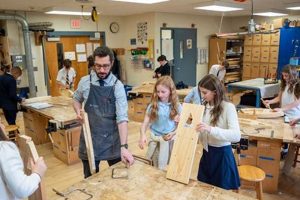
Instructional programs designed to introduce young individuals to the craft of shaping and constructing items from wood are commonly available. These structured learning environments provide foundational knowledge and practical skills in woodworking techniques, tool usage, and project completion. For example, a program might guide participants in building a birdhouse, a small wooden toy, or a simple piece of furniture.
Participation in these activities offers multiple advantages. Developing competence in woodworking fosters creativity, problem-solving abilities, and fine motor skills. Historically, woodworking skills were essential for numerous trades and crafts, contributing significantly to community development and individual self-sufficiency. Modern iterations maintain these benefits while also instilling an appreciation for craftsmanship and material sustainability.
The subsequent sections will elaborate on the specific pedagogical approaches employed in these programs, the types of projects typically undertaken, the safety protocols implemented, and the resources available for establishing or enhancing access to this form of experiential learning.
Guidance for Effective Woodworking Instruction for Young People
The following guidelines are intended to optimize the delivery of woodworking education to younger demographics, ensuring both safety and effective skill development.
Tip 1: Prioritize Safety Training: Comprehensive instruction on tool safety protocols is paramount. Demonstrate proper usage of each tool, emphasizing potential hazards and preventative measures. Regular reinforcement of safety rules is crucial.
Tip 2: Start with Simple Projects: Introduce basic woodworking concepts through accessible projects. Examples include building small boxes, simple toys, or birdhouses. Gradual progression to more complex designs prevents discouragement.
Tip 3: Emphasize Tool Maintenance: Educate participants on the importance of tool maintenance. Instruction on cleaning, sharpening, and proper storage prolongs the lifespan of tools and ensures optimal performance.
Tip 4: Incorporate Hands-On Learning: Maximize practical application. Minimize theoretical instruction and emphasize hands-on engagement with the materials and tools. Active participation fosters skill retention.
Tip 5: Foster a Supportive Environment: Create a learning atmosphere that encourages experimentation and acknowledges mistakes as learning opportunities. Constructive feedback promotes growth and confidence.
Tip 6: Provide Clear Instructions: Present instructions in a concise and readily understandable format. Visual aids, diagrams, and step-by-step demonstrations enhance comprehension.
Tip 7: Supervise Closely: Maintain vigilant supervision throughout all activities. Proximity and attentiveness enable timely intervention and minimize the risk of accidents.
Implementation of these strategies promotes a secure and effective learning environment, enabling young individuals to develop valuable woodworking skills. The establishment of foundational knowledge and the development of practical abilities are key outcomes.
The subsequent sections will explore available resources and further avenues for enhancing the learning experience.
1. Safety Protocols

Adherence to rigorous safety protocols is paramount in woodworking education programs designed for young people. The inherent risks associated with woodworking tools and machinery necessitate comprehensive and consistently enforced safety measures.
- Personal Protective Equipment (PPE)
Mandatory use of appropriate PPE, including safety glasses, hearing protection, and dust masks, is crucial. Safety glasses safeguard against flying debris, hearing protection minimizes noise-induced hearing loss, and dust masks mitigate respiratory hazards from airborne particles generated during sanding and sawing. The consistent and correct application of PPE minimizes the potential for injury and long-term health consequences.
- Tool-Specific Training
Before operating any woodworking tool, participants must receive thorough instruction on its safe and proper usage. This includes understanding the tool’s operational mechanisms, potential hazards, and recommended safety procedures. Demonstrations, supervised practice, and competency assessments are essential components of effective tool-specific training. Lack of proper training significantly increases the risk of accidents and injuries.
- Machine Guarding and Safety Devices
All woodworking machinery must be equipped with appropriate guards and safety devices to prevent accidental contact with moving parts. These devices, such as blade guards, push sticks, and feather boards, provide a physical barrier or assist in maintaining a safe distance between the operator and the cutting edge. Regular inspection and maintenance of these safety features are essential for their continued effectiveness.
- Workshop Organization and Housekeeping
Maintaining a clean and organized workshop environment is critical for preventing accidents. Work surfaces must be kept clear of clutter, tools should be stored properly when not in use, and sawdust and other debris should be removed regularly. A well-organized workspace minimizes tripping hazards and facilitates safe and efficient movement within the workshop.
Effective implementation and consistent enforcement of these safety protocols are integral to creating a safe and productive learning environment. Prioritizing safety minimizes the risk of injury, fosters confidence among participants, and promotes a positive attitude toward woodworking practices.
2. Skill-based progression

In the context of woodworking instruction for young people, skill-based progression serves as a foundational pedagogical strategy. This approach structures the curriculum to introduce woodworking concepts and techniques in a sequence that aligns with the cognitive and physical development of the learner. This staged learning process allows participants to build upon previously acquired knowledge and abilities, progressively advancing toward more complex woodworking projects. The absence of skill-based progression can result in frustration, discouragement, and potentially unsafe handling of tools and materials.
A practical example illustrates the importance of this methodology. A program might initiate instruction with the construction of a simple wooden block. This initial project familiarizes participants with basic tool usage, such as measuring, sawing, and sanding. Upon mastering these fundamentals, subsequent projects may involve assembling pre-cut pieces to form a birdhouse, thereby introducing the concept of joinery. This incremental increase in complexity allows the young woodworker to develop confidence and proficiency before undertaking more intricate designs, such as small furniture pieces. The selection of age-appropriate projects is thus intrinsically linked to the principle of skill-based progression.
The effectiveness of skill-based progression in youth woodworking programs hinges on careful curriculum design and experienced instructors who can assess individual learning paces. Challenges may arise from diverse skill levels within a group, necessitating individualized instruction or differentiated projects. However, by adhering to a structured progression, youth woodworking classes can provide a safe, engaging, and ultimately rewarding experience, fostering a lifelong appreciation for craftsmanship.
3. Project Complexity

Project complexity, within the context of woodworking education designed for young individuals, denotes the level of technical challenge, skill requirements, and the number of steps involved in completing a specific woodworking endeavor. The careful consideration of project complexity is crucial to ensure an effective and engaging learning experience.
- Cognitive Load and Skill Acquisition
The selected project must align with the cognitive capabilities and existing skill set of the participant. Overly complex projects can lead to frustration and a sense of inadequacy, hindering skill acquisition. Conversely, projects lacking sufficient challenge may result in boredom and disengagement. The optimal level of complexity provides a balance, fostering skill development while maintaining motivation. For instance, constructing a simple birdhouse would be a more appropriate initial project than attempting to build a complex piece of furniture.
- Developmental Appropriateness
Projects should be tailored to the physical and cognitive developmental stage of the learners. Younger participants with limited fine motor skills may benefit from projects involving larger pieces of wood and simpler assembly techniques. Older participants, possessing more refined skills and greater attention spans, can undertake projects requiring more intricate cuts, precise joinery, and detailed finishing. The developmental appropriateness of a project directly impacts the safety and success of the learning experience.
- Time Commitment and Project Scope
The time required to complete a project must be manageable within the constraints of the class schedule and the attention span of the participants. Overly ambitious projects that cannot be completed within the allotted time may lead to a sense of failure. The scope of the project, encompassing its size and the number of individual components, should be carefully considered to ensure completion within a reasonable timeframe. Breaking down a large project into smaller, more manageable stages can mitigate this issue.
- Tool Usage and Safety Implications
Project complexity directly influences the types of tools required and the potential safety risks involved. Simpler projects may only necessitate hand tools, while more complex projects may require the use of power tools. The appropriate level of tool training and supervision must be provided based on the tools being used. Projects involving advanced techniques, such as using a lathe or a router, require a higher level of expertise and stricter adherence to safety protocols.
The strategic selection of projects based on their complexity, considering cognitive load, developmental appropriateness, time commitment, and tool usage, is fundamental to the success of youth woodworking instruction. A well-calibrated approach fosters skill development, promotes engagement, and instills a sense of accomplishment, thereby encouraging continued participation and fostering a lifelong appreciation for the craft.
4. Tool Proficiency

Tool proficiency constitutes a cornerstone element of effective woodworking education for young individuals. It encompasses a comprehensive understanding of hand tools and power tools, encompassing their proper operation, maintenance, and associated safety protocols. The absence of adequate tool proficiency invariably leads to diminished project quality, increased risk of injury, and an overall negative learning experience. Therefore, youth woodworking programs must prioritize the development of tool proficiency through structured instruction and supervised practice.
The causal relationship between tool proficiency and successful woodworking outcomes is demonstrable. For instance, inaccurate measurements or improper saw handling result in misaligned joints and structurally unsound projects. Conversely, individuals with well-developed tool skills produce higher-quality work and experience a greater sense of accomplishment. Real-world examples include youth crafting precise dovetail joints for a small box or efficiently using a lathe to create intricate spindle designs, both of which demonstrate the tangible benefits of tool mastery. Furthermore, enhanced tool skills translate into improved problem-solving abilities and increased confidence in tackling increasingly complex woodworking challenges.
The practical significance of this understanding lies in the design and implementation of youth woodworking curricula. Programs must incorporate dedicated instruction on tool identification, function, and safe handling procedures. Supervised practice sessions, allowing participants to hone their skills under expert guidance, are essential. Assessment methods should evaluate not only project completion but also the participant’s ability to demonstrate safe and effective tool usage. By emphasizing tool proficiency as a central objective, woodworking programs can empower young individuals with valuable skills, fostering creativity, problem-solving abilities, and a lifelong appreciation for the craft. Challenges remain in ensuring access to well-maintained tools and qualified instructors, yet the benefits of prioritizing tool proficiency far outweigh the obstacles.
5. Creative Expression
Creative expression, within the framework of youth woodworking classes, represents the opportunity for young individuals to translate their ideas, emotions, and perspectives into tangible forms through the medium of wood. It is not merely about replicating existing designs, but rather about fostering individuality and innovative thinking through the application of woodworking techniques.
- Design Conceptualization and Personalization
The initial stage of creative expression involves conceptualizing a design, which could range from a functional object to an abstract sculpture. Youths are encouraged to personalize their projects by incorporating unique elements, such as specific wood types, carved details, or custom finishes. This phase allows for the development of problem-solving skills as individuals navigate design challenges and translate their visions into practical plans. For example, a participant might design a birdhouse with an unconventional roofline or a toy car with custom-shaped wheels, reflecting their individual aesthetic preferences.
- Material Exploration and Manipulation
Woodworking provides a platform for exploring the inherent properties of wood, including its texture, grain, and color. Youths learn to manipulate the material through various techniques, such as carving, shaping, and joinery, to achieve desired aesthetic effects. The hands-on experience of working with wood fosters an appreciation for natural materials and encourages experimentation with different methods of transforming raw materials into finished products. This may involve using different carving techniques to create varied surface textures or combining different wood species to achieve contrasting visual effects.
- Technical Skill as a Medium for Expression
The acquisition of woodworking skills serves as a tool for creative expression. As youths develop proficiency in using various hand and power tools, they gain greater control over the material and are able to execute more complex and nuanced designs. Mastery of techniques such as joinery, carving, and finishing expands their creative vocabulary, allowing them to express themselves through the craftsmanship evident in their work. The precision and attention to detail involved in woodworking can become an avenue for expressing personal values such as diligence and craftsmanship.
- Project Ownership and Self-Esteem
The completion of a woodworking project, particularly one that reflects the individual’s creative vision, instills a sense of accomplishment and ownership. Youths take pride in their ability to transform raw materials into functional or artistic objects. This sense of achievement contributes to increased self-esteem and fosters a belief in their capacity to create and innovate. Displaying or gifting their creations can further reinforce this positive feedback loop, encouraging continued engagement with woodworking and other creative pursuits.
In conclusion, creative expression in youth woodworking classes is not simply an adjunct to technical instruction, but rather an integral component that enhances the learning experience and promotes individual growth. By providing opportunities for design conceptualization, material exploration, skill development, and project ownership, woodworking programs can empower young individuals to express themselves creatively, develop valuable skills, and cultivate a lifelong appreciation for craftsmanship.
Frequently Asked Questions
The following section addresses common inquiries regarding instructional programs designed to introduce woodworking skills to young individuals. The information provided aims to clarify aspects related to safety, curriculum, and suitability.
Question 1: What age range is typically appropriate for participation in these programs?
The suitable age range varies depending on the specific program and the complexity of the projects undertaken. Generally, programs are available for individuals as young as 8 years old, with upper age limits extending to the late teens. Some programs may offer specialized classes tailored to distinct age groups.
Question 2: What are the primary safety considerations in woodworking instruction for youth?
Safety is paramount. Programs typically incorporate mandatory use of personal protective equipment, such as safety glasses and hearing protection. Instruction on the safe operation of tools and machinery is provided, and close supervision is maintained throughout all activities.
Question 3: What types of projects are commonly undertaken in youth woodworking classes?
Projects typically begin with simple designs that introduce fundamental woodworking techniques. Examples include building small boxes, birdhouses, or simple toys. As skills progress, participants may undertake more complex projects, such as small furniture pieces.
Question 4: What prior experience, if any, is required for participation?
Most youth woodworking programs are designed for beginners and do not require any prior experience. Instructors provide comprehensive instruction and guidance to participants with varying skill levels.
Question 5: What are the key benefits of engaging in woodworking activities for young individuals?
Participation in woodworking fosters creativity, problem-solving abilities, and fine motor skills. It also instills an appreciation for craftsmanship and can contribute to the development of valuable practical skills.
Question 6: What are the expected costs associated with participation in woodworking classes?
The cost of participation varies depending on the program duration, location, and the materials provided. Some programs may offer scholarships or financial aid to eligible participants. It is advisable to inquire directly with the program provider regarding specific fees and available assistance.
The information presented herein provides a general overview of frequently asked questions concerning youth woodworking classes. Specific details may vary depending on the individual program and its objectives.
The subsequent section will explore available resources and avenues for locating appropriate woodworking instruction for young people.
Conclusion
This exploration has detailed various facets of youth woodworking classes, underscoring the importance of safety protocols, skill-based progression, and the cultivation of creative expression. The information presented provides a comprehensive overview of the instructional strategies and resources available to facilitate woodworking education for younger individuals. Effective youth woodworking classes contribute significantly to the development of practical skills and critical thinking abilities, shaping well-rounded individuals.
The sustained promotion and support of youth woodworking classes are essential to ensure the continued transmission of valuable craftsmanship skills to future generations. By fostering an environment that encourages creativity, problem-solving, and the safe handling of tools and materials, these programs play a crucial role in preparing young people for success in a variety of fields. Future efforts should focus on expanding access to these opportunities, particularly in underserved communities, to ensure that all young individuals have the chance to benefit from the enriching experience of working with wood.


![Learn Woodworking: Classes in Fort Collins [Skills!] | Step-by-Step Guides, Tools & Inspiration to Build Beautiful Wooden Decor on a Budget](https://woodfromhome.com/wp-content/uploads/2026/04/th-267-300x200.jpg "Learn Woodworking: Classes in Fort Collins [Skills!] Step-by-Step Guides, Tools & Inspiration to Build Beautiful Wooden Decor on a Budget")