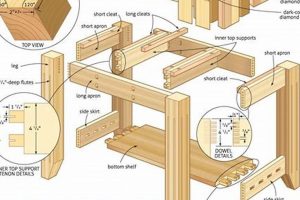
A systematic tool, whether physical or digital, assists woodworkers in organizing and managing the various stages of crafting wooden objects. It typically incorporates elements such as design specifications, material lists, cutting diagrams, budget tracking, and timelines. For example, an individual embarking on a cabinet-making endeavor may use such a tool to detail the dimensions of each component, calculate the board footage of lumber required, schedule the assembly process, and monitor associated expenses.
Effective pre-planning offers several advantages. It minimizes material waste by optimizing cutting layouts and ensuring accurate dimensioning. It facilitates cost control by providing a clear overview of projected expenses and enabling informed purchasing decisions. Furthermore, it improves project efficiency by establishing a structured workflow and anticipating potential challenges. Historically, rudimentary forms of such guides were employed by master craftsmen, passed down through apprenticeships. Today, various software applications and templates offer sophisticated functionalities for hobbyists and professionals alike.
The subsequent sections will delve into the essential features found within these planning aids, exploring their application in different woodworking scenarios and providing guidance on selecting the most suitable option based on individual needs and project complexity. Detailed consideration will be given to the role of design software, resource management tools, and scheduling methodologies.
Essential Planning Guidance
Adhering to a structured methodology improves the likelihood of successful woodworking outcomes. This section offers specific strategies to enhance the planning process.
Tip 1: Document Initial Design Specifications. Prior to procuring materials, generate comprehensive drawings or models. Precise dimensions, joinery details, and finishing specifications must be clearly articulated. This minimizes ambiguity during execution.
Tip 2: Develop a Comprehensive Material List. Meticulously enumerate all required materials, including lumber, fasteners, adhesives, and finishing products. Quantities should account for potential waste and unforeseen contingencies.
Tip 3: Optimize Cutting Layouts. Implement software tools or manual techniques to maximize material yield from lumber stock. Efficient nesting strategies significantly reduce waste and associated costs.
Tip 4: Establish a Realistic Timeline. Decompose the project into discrete tasks and assign realistic time estimates for each. Account for drying times, potential delays, and periods of inactivity.
Tip 5: Implement a Budget Tracking System. Maintain a detailed record of all expenditures, including materials, tools, and supplies. Regularly compare actual costs against projected expenses to identify potential overruns.
Tip 6: Incorporate Risk Assessment. Identify potential hazards and develop mitigation strategies. Prioritize safety protocols throughout the project lifecycle.
Tip 7: Plan for Workspace Organization. A well-organized workspace promotes efficiency and reduces the risk of accidents. Designate areas for cutting, assembly, and finishing.
Diligent pre-project preparation not only conserves resources but also fosters a more streamlined and predictable woodworking process, ultimately leading to superior craftsmanship.
The ensuing discussion will explore strategies for effectively executing the planned stages and achieving the desired finished product.
1. Design Blueprint

The design blueprint serves as the foundational element within a comprehensive woodworking project planner. It articulates the visual and dimensional parameters of the envisioned piece. The absence of a detailed blueprint invariably precipitates inaccuracies in material quantification, compromises structural integrity, and prolongs the construction timeline. The design blueprint establishes a precise visual and dimensional reference. A blueprint for a dining table, for instance, specifies the dimensions of the tabletop, legs, and apron, alongside joinery techniques. This design data informs the creation of accurate material lists and cutting diagrams, streamlining subsequent phases of the woodworking project.
Furthermore, the design blueprint facilitates informed decision-making related to material selection and cost estimation. Different joinery methods influence material requirements. Complex mortise and tenon joints necessitate greater material allowances for waste than simpler butt joints. Design blueprints that carefully incorporate joinery detail also permit accurate cost estimations. A well-executed design blueprint communicates the project’s intent, ensuring clarity and efficiency throughout the entire construction process. A design blueprint showing the dimensions of a desk will show how much material you will need and give you a picture of the outcome.
In summary, the design blueprint serves as the critical precursor to all subsequent stages within a woodworking project. Its accuracy and completeness directly correlate with the overall success of the endeavor. The absence of a well-defined design leads to increased material waste, diminished structural integrity, and escalated project costs. It is, therefore, imperative to allocate sufficient time and resources to developing a comprehensive and meticulously detailed design blueprint as the first step in any woodworking project.
2. Material Estimation

Accurate material estimation constitutes a cornerstone of effective woodworking project planning. It involves quantifying the necessary raw materials, such as lumber, hardware, and finishing supplies, to complete a given project. Precise calculations directly influence project cost, minimize waste, and ensure sufficient resources are available throughout the build process.
- Determining Board Footage
Calculating board footage involves converting dimensions of lumber into a standardized unit of volume. A woodworking project planner facilitates accurate board footage calculation based on project drawings. For example, building a bookcase necessitates calculating board footage for shelves, sides, top, and bottom. Inaccurate board footage calculation results in material shortages or excess inventory, impacting the overall project budget.
- Hardware Quantification
Beyond lumber, accurate quantification of fasteners, hinges, knobs, and other hardware is essential. Woodworking project planners include sections for detailing hardware requirements based on joinery methods and design specifications. A cabinet project requires an exact count of hinges, screws, and drawer slides. Overlooking hardware requirements disrupts workflow and delays project completion.
- Finishing Supplies
Material estimation encompasses finishing supplies like stains, sealants, and topcoats. Woodworking project planners incorporate areas to specify the type and quantity of finishing materials needed. Refinishing an antique table requires estimating the volume of stain, sealant, and varnish. Insufficient finishing supplies compromise the aesthetic quality and durability of the final product.
- Waste Allowance
Material estimation should include a buffer for waste generated during cutting, shaping, and fitting. Woodworking project planners often provide guidelines for calculating waste based on project complexity and skill level. Complex projects involving intricate cuts necessitate a higher waste allowance than simpler projects. Failure to account for waste leads to material shortages and project delays.
Therefore, material estimation functions as an integral element within the woodworking project planner framework. Accurate quantification of lumber, hardware, and finishing supplies contributes to effective budget management, reduced waste, and streamlined project execution. By carefully assessing material requirements at the outset, woodworkers can minimize risks and optimize project outcomes.
3. Cutting Optimization

Cutting optimization is inextricably linked to the success of any woodworking project. The woodworking project planner provides a framework for this optimization, ensuring efficient material usage and minimizing waste. This process enhances cost-effectiveness and promotes environmental responsibility.
- Nesting Algorithms and Material Yield
Nesting algorithms, often incorporated into woodworking project planner software, strategically arrange pattern pieces on a given stock sheet to minimize waste. For example, when constructing multiple components for a cabinet, the software positions these shapes to maximize the number that can be cut from a single sheet of plywood. Improved material yield directly translates to lower raw material costs and reduces the volume of discarded material.
- Grain Matching and Visual Harmony
Cutting optimization also addresses aesthetic considerations, such as grain matching. A woodworking project planner allows the user to pre-arrange cuts to ensure consistent grain patterns across adjacent pieces. This is particularly relevant in furniture construction, where maintaining a uniform aesthetic is crucial. Failure to account for grain matching leads to visually disjointed pieces and a reduction in the overall quality of the finished product.
- Defect Avoidance and Quality Control
Woodworking project planners can integrate features to identify and avoid defects in lumber. By mapping the locations of knots, cracks, or other imperfections, the planner guides the user in strategically positioning cuts to exclude these areas. This proactive approach enhances the structural integrity and visual appeal of the final piece. Neglecting defect avoidance results in weaker joints and aesthetic compromises.
- Sequential Cutting and Assembly Efficiency
An effective cutting optimization strategy considers the sequence of cuts to facilitate efficient assembly. The woodworking project planner can organize cuts to produce components in the order they are needed for assembly. This streamlines the construction process and reduces the risk of misplacing or damaging parts. A disorganized cutting approach adds unnecessary time and complexity to the assembly phase.
In conclusion, cutting optimization is an indispensable aspect of woodworking, seamlessly integrated into the comprehensive woodworking project planner. By leveraging nesting algorithms, prioritizing grain matching, avoiding defects, and streamlining the cutting sequence, woodworkers can achieve superior results while conserving resources and minimizing expenses.
4. Budget Allocation

Effective budget allocation is a linchpin in successful woodworking projects. A woodworking project planner facilitates this allocation by providing a structured approach to estimating and managing project costs, minimizing financial risks and maximizing resource utilization.
- Material Cost Estimation
This facet encompasses the process of determining the expenses associated with acquiring raw materials, such as lumber, fasteners, adhesives, and finishing products. A woodworking project planner incorporates tools for calculating material quantities based on project dimensions and joinery requirements. For instance, a cabinet project necessitates estimating the cost of lumber for the frame, doors, and shelves. Inaccurate material cost estimation leads to budget overruns and potential project delays.
- Tool and Equipment Expenses
Woodworking projects often require specialized tools and equipment. Budget allocation must account for both the initial purchase of new tools and the maintenance or replacement of existing ones. A woodworking project planner aids in assessing the necessity of specific tools and forecasting their associated costs. For example, a complex carving project may demand the acquisition of specialized chisels and gouges. Neglecting tool and equipment expenses significantly distorts the overall project budget.
- Contingency Funds
Unexpected issues inevitably arise during woodworking projects. Prudent budget allocation includes a contingency fund to cover unforeseen expenses, such as material defects, construction errors, or design modifications. A woodworking project planner incorporates a buffer for contingency funds based on the project’s complexity and risk factors. Allocating 10-15% of the total budget for contingencies provides a financial safety net against unforeseen problems.
- Labor Costs (if applicable)
For projects involving hired labor, budget allocation must encompass compensation for woodworking professionals. A woodworking project planner allows for the incorporation of labor costs based on hourly rates or project-based fees. For instance, outsourcing complex joinery work necessitates including the cost of a skilled carpenter in the budget. Overlooking labor expenses leads to inaccurate project cost assessments and potential financial strain.
In summary, budget allocation is an integral function of the woodworking project planner, impacting financial viability and resource management. By encompassing material costs, tool expenses, contingency funds, and labor considerations, this facet contributes to informed decision-making and improved project outcomes. Neglecting proper budget planning increases the likelihood of overspending, compromising quality, and jeopardizing project success. The woodworking project planner promotes a proactive approach to financial oversight, contributing to a more predictable and controlled woodworking experience.
5. Timeline Creation
Timeline creation, as an integral component of a woodworking project planner, establishes a sequence of tasks, durations, and dependencies, crucial for project efficiency. The absence of a well-defined timeline frequently results in resource misallocation, scheduling conflicts, and project completion delays. Project planners are often characterized by milestones or deadlines; a cabinet-making project necessitates distinct phases such as design, material acquisition, cutting, assembly, sanding, and finishing, each requiring specific time allotments. The planner provides a framework for estimating task durations and allocating resources appropriately. Accurate timeline creation enables woodworkers to foresee potential bottlenecks and proactively mitigate their impact.
Effective timeline creation encompasses task breakdown, duration estimation, and dependency mapping. Task breakdown entails segmenting the overall project into smaller, more manageable tasks. Duration estimation requires accurately assessing the time needed to complete each task, accounting for skill level, tool availability, and potential interruptions. Dependency mapping identifies relationships between tasks, specifying which tasks must be completed before others can commence. For example, the assembly phase cannot begin until all components have been cut and sanded. The project planner incorporates visual representations of the timeline, such as Gantt charts or critical path diagrams, to facilitate progress monitoring and resource allocation. A failure to create or utilize this timeline efficiently leads to schedule slippage, requiring resource reallocation and potentially compromising project quality.
Timeline creation is an indispensable component within the woodworking project planner framework. By establishing a structured sequence of tasks, estimating durations, and mapping dependencies, the project becomes more predictable. The result is an improvement in the efficiency of the woodworking endeavor. Challenges may arise when unforeseen circumstances disrupt the timeline, requiring adaptability. By incorporating a contingency buffer into the timeline, these minor set backs will have little impact on the end result. Overall, the practice of timeline creation is indispensable to good woodworking and a useful aid to woodworkers.
6. Joinery Specification
Joinery specification within a woodworking project planner dictates the methods by which individual components are interconnected to form a unified structure. Precise specification contributes significantly to structural integrity, aesthetic appeal, and overall project longevity. Its absence compromises the structural soundness and visual consistency of the finished piece.
- Joint Selection and Structural Load
The selection of appropriate joinery techniques directly correlates with the anticipated structural load and stress distribution within the woodworking project. A woodworking project planner necessitates the specification of joints, accounting for factors such as material type, component dimensions, and anticipated weight-bearing capacity. For example, constructing a bookcase necessitates selecting robust joints, such as mortise and tenon or dovetail, to withstand the weight of books. Failure to consider structural load during joint selection results in joint failure and potential structural collapse.
- Dimensional Accuracy and Assembly Precision
Accurate joinery specification incorporates precise dimensional measurements and tolerances to ensure seamless component integration during assembly. The woodworking project planner enables the detailing of joint dimensions, angles, and offsets, facilitating the creation of tight-fitting and visually appealing joints. In cabinet construction, precise joinery ensures flush surfaces, square corners, and consistent gaps between doors and drawers. Deviation from dimensional accuracy compromises the aesthetic quality and functionality of the woodworking project.
- Material Compatibility and Adhesion Properties
Joinery specification necessitates consideration of material compatibility and adhesion properties to ensure durable and long-lasting connections. A woodworking project planner facilitates the selection of appropriate adhesives and fasteners based on the type of wood being used and the specific joint configuration. For instance, bonding hardwoods requires adhesives with high shear strength and gap-filling properties. Neglecting material compatibility leads to weakened joints and premature failure.
- Aesthetic Considerations and Visual Integration
Joinery specification can contribute significantly to the aesthetic appeal of the woodworking project. The woodworking project planner enables the incorporation of decorative joints, such as exposed dovetails or mitered corners, to enhance the visual interest of the finished piece. In furniture construction, carefully executed joinery elevates the aesthetic and demonstrates craftsmanship. Disregarding aesthetic considerations during joint selection diminishes the visual impact of the woodworking project.
In conclusion, joinery specification constitutes a fundamental element within the woodworking project planner framework. By accounting for structural load, dimensional accuracy, material compatibility, and aesthetic considerations, woodworkers can ensure the creation of robust, visually appealing, and long-lasting woodworking projects. A detailed plan, in all considerations, will lead to the best possible outcome.
7. Finishing Schedule

The finishing schedule constitutes a critical phase within a comprehensive woodworking project planner, delineating the steps involved in protecting and enhancing the aesthetic qualities of the wooden surface. It is often the final stage of a woodworking project.
- Surface Preparation Protocols
Effective finishing begins with meticulous surface preparation. A finishing schedule within the project planner outlines specific sanding grits, filling techniques for imperfections, and cleaning procedures. This ensures a smooth, uniform substrate for subsequent coating applications. For example, the schedule might specify sanding with 120-grit followed by 220-grit sandpaper, application of wood filler to nail holes, and a final wipe-down with a tack cloth. Neglecting proper surface preparation results in adhesion issues, uneven color, and a compromised final finish.
- Coating Selection and Application Methods
The finishing schedule details the choice of appropriate coatings, such as stains, sealers, and topcoats, along with the specific application methods. This section considers factors such as wood type, desired aesthetic, and intended use. For instance, a schedule might specify applying a penetrating oil stain to highlight the grain of walnut, followed by several coats of polyurethane for durability. Specifying inappropriate coatings or using incorrect application techniques leads to finish failures, such as cracking, peeling, or discoloration.
- Drying Times and Environmental Controls
Adequate drying time between coats is essential for proper film formation and adhesion. The finishing schedule incorporates precise drying times for each coating layer, taking into account environmental conditions like temperature and humidity. A typical schedule might require 24 hours of drying time between coats of varnish in a well-ventilated area. Ignoring recommended drying times results in soft, tacky finishes that are prone to damage.
- Curing and Buffing Procedures
Complete curing ensures the coating achieves its maximum hardness and durability. The finishing schedule outlines any necessary curing periods and buffing procedures to enhance the final appearance. This might include a curing period of several days for lacquer, followed by buffing with a polishing compound. Proper curing and buffing result in a smooth, lustrous finish that is resistant to scratches and wear.
These facets of the finishing schedule highlight its relevance to the overall woodworking project planner. By systematically addressing surface preparation, coating selection, drying times, and curing procedures, woodworkers can achieve professional-quality finishes that protect and enhance their creations. Detailed planning and the adherence to the finishing schedule guarantees a satisfying completion to any woodworking project.
Frequently Asked Questions
The following addresses common inquiries concerning the implementation and utility of project planning in woodworking endeavors.
Question 1: What are the fundamental components of a comprehensive woodworking project planner?
A robust planner typically incorporates design specifications, material lists, cutting diagrams, budget allocations, timelines, joinery specifications, and finishing schedules. These components are interdependent and contribute to streamlined project execution.
Question 2: How does a woodworking project planner contribute to cost savings?
Effective planning minimizes material waste through optimized cutting layouts, enables accurate material procurement, and facilitates efficient resource allocation, thereby reducing overall project expenses.
Question 3: Is a woodworking project planner essential for experienced woodworkers?
While experience is valuable, a structured approach benefits woodworkers of all skill levels. Even seasoned professionals can leverage planning tools to enhance efficiency, manage complex projects, and mitigate potential errors.
Question 4: What software options are available for digital woodworking project planning?
Numerous software applications cater to woodworking project planning needs, ranging from general-purpose CAD programs to specialized tools designed for furniture design and material optimization. Selection depends on individual requirements and technical proficiency.
Question 5: How does a well-defined timeline contribute to project success?
A realistic timeline establishes a structured workflow, facilitates resource scheduling, and enables proactive identification of potential bottlenecks. Adherence to a timeline promotes efficient project completion and minimizes delays.
Question 6: Can a woodworking project planner assist with intricate joinery techniques?
Yes. A detailed planner allows for the specification of joinery methods, dimensional accuracy calculations, and material compatibility assessments, ensuring robust and visually appealing connections.
In summary, a woodworking project planner serves as a valuable asset for individuals seeking to optimize their woodworking processes, reduce costs, and enhance the quality of their finished products.
The subsequent section will explore best practices for selecting and implementing a project planner that aligns with specific project requirements and skill levels.
Conclusion
The preceding analysis has illuminated the multifaceted aspects of the woodworking project planner, emphasizing its utility in organizing, optimizing, and executing woodworking endeavors. The strategic implementation of design blueprints, material estimations, cutting optimization strategies, budget allocations, timeline creation, joinery specifications, and finishing schedules was presented as essential for successful project completion.
As such, diligent employment of a comprehensive woodworking project planner remains a critical determinant of efficiency, cost-effectiveness, and overall project success in the pursuit of woodworking excellence. Prioritizing thorough pre-project planning proves invaluable in achieving desired outcomes and maximizing the potential of every woodworking undertaking.



![Profitable Small Woodworking Projects to Sell Ideas [Easy!] | Step-by-Step Guides, Tools & Inspiration to Build Beautiful Wooden Decor on a Budget](https://woodfromhome.com/wp-content/uploads/2026/04/th-355-300x200.jpg "Profitable Small Woodworking Projects to Sell Ideas [Easy!] Step-by-Step Guides, Tools & Inspiration to Build Beautiful Wooden Decor on a Budget")