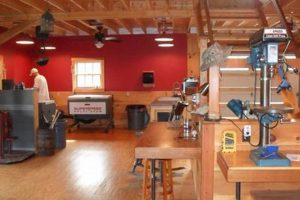
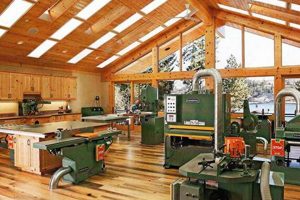
The instruments employed within a dedicated workspace for crafting items from timber are essential for shaping, joining, and finishing wood. These implements range from manually-operated devices, such as hand saws and chisels, to powered machinery including table saws and routers. They provide the means to create furniture, structures, and decorative objects from raw lumber.
Proficiency in utilizing such instruments yields numerous advantages. Precision, efficiency, and the ability to execute complex designs are all enhanced. Furthermore, employing a well-equipped and organized work area promotes safety and contributes to the longevity of projects. Historically, the development of woodworking depended on the availability and refinement of these essential items. Early tools, crafted from stone and bronze, evolved into the steel implements commonly used today, reflecting ongoing technological advancement and its impact on the woodworking craft.
The following discussion will delve into the specific categories of instruments, encompassing cutting, shaping, and measuring implements, as well as safety considerations and best practices for their selection and maintenance within a modern woodworking environment.
Essential Guidelines for Equipping a Woodworking Space
The careful selection and proper maintenance of implements are paramount for achieving quality results and ensuring safety in woodworking. These guidelines provide essential insights for establishing and maintaining an effective woodworking workspace.
Tip 1: Prioritize Safety Equipment. Invest in essential safety gear, including eye protection, hearing protection, and dust masks. Consistent use of these items mitigates the risk of injury and long-term health issues associated with woodworking activities.
Tip 2: Select Quality Cutting Implements. Opt for high-carbon steel blades and chisels. Superior materials retain their sharpness longer and deliver cleaner, more precise cuts, ultimately improving the quality of finished projects.
Tip 3: Invest in Accurate Measuring Instruments. Precision is critical. Acquire a reliable combination square, measuring tape, and digital level. Consistent and accurate measurements form the foundation for successful woodworking.
Tip 4: Establish a Dust Collection System. Integrate a dust collector or shop vacuum into the workspace. Effective dust management enhances visibility, protects respiratory health, and minimizes cleanup efforts.
Tip 5: Maintain Sharp Cutting Edges. Regularly sharpen blades, chisels, and plane irons. Sharp implements require less force, reducing fatigue and improving control, leading to safer and more efficient woodworking.
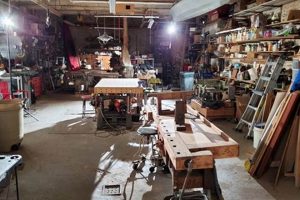
Tip 6: Organize Implements for Efficiency. Implement a system for storing and organizing implements. Clear categorization and accessibility minimize downtime and contribute to a more productive workflow.
Tip 7: Implement Regular Maintenance Schedules. Establish a schedule for cleaning and inspecting all machinery. Routine maintenance prolongs equipment lifespan and ensures optimal performance.
Adhering to these guidelines optimizes efficiency, promotes safety, and enhances the overall quality of woodworking projects. The deliberate investment in appropriate tools and a structured approach to their maintenance are fundamental to achieving consistent and professional results.
With these fundamental practices established, one may advance to exploring advanced techniques and specialized applications within the broader field of woodworking.
1. Cutting Implements

Cutting implements form the core of any collection of shop woodworking tools. The effectiveness of sawing, shaping, and joining operations is directly contingent upon the quality, type, and maintenance of these instruments. A dull saw, for example, not only demands greater physical exertion but also compromises the precision of the cut, potentially leading to material waste and structural instability in the final product. Conversely, a sharp, well-maintained chisel allows for the creation of intricate joinery, enhancing both the aesthetic and structural integrity of the finished piece. Thus, the selection and upkeep of these instruments is critical to the success of any woodworking endeavor.
The relationship between cutting implements and other shop woodworking tools extends beyond simple functionality. For instance, a bandsaw, categorized as a cutting implement, necessitates a suitable work table for material support and precise cuts. Similarly, a router, also a cutting tool, relies on jigs and fences for controlled shaping. Therefore, the selection of specific cutting instruments often dictates the acquisition of supplementary shop woodworking tools to facilitate their effective and safe operation. The interdependence of these items highlights the importance of a holistic approach to shop equipment acquisition.
In summary, the impact of cutting implements on the overall capabilities of a woodworking area is substantial. Neglecting their quality or maintenance can lead to diminished precision, increased risk of injury, and ultimately, compromised project outcomes. Understanding the interplay between various cutting implements and the broader range of woodworking items is essential for any serious woodworker aiming for professional results. Choosing the right tool for the right job improves safety and results in a better product.
2. Shaping Devices

Shaping devices are integral components within the broader context of woodworking. These implements, designed to modify the form and contours of wood, represent a diverse category of equipment that significantly influences the final aesthetics and functionality of woodworking projects.
- Planers: Achieving Smooth Surfaces and Consistent Thickness
Planers, both hand-operated and powered, serve to create smooth, level surfaces on timber. Hand planes are utilized for fine adjustments and achieving a traditional finish, while powered planers rapidly reduce material and establish consistent thickness across a board. In furniture making, planers ensure that adjoining pieces fit together seamlessly, creating strong and visually appealing joints.
- Routers: Versatile Shaping and Detailing Capabilities
Routers, often handheld or mounted in a table, employ rotating bits to shape edges, create decorative grooves, and cut intricate patterns. The router’s versatility makes it indispensable for edge profiling, joinery (such as creating dadoes and rabbets), and producing custom moldings. Its precision depends on the selection of appropriate router bits and the use of guiding fences or templates.
- Spindle Sanders: Refinement of Curved Forms and Contours
Spindle sanders, featuring a rotating vertical spindle covered in abrasive material, are specifically designed for smoothing curved edges and internal contours. These devices are invaluable for shaping chair components, creating flowing lines in decorative pieces, and refining the profiles of musical instruments. Their effectiveness lies in their ability to remove small amounts of material precisely, leaving a smooth and consistent surface.
- Woodturning Lathes: Creating Cylindrical and Conical Forms
Woodturning lathes rotate a piece of wood while the operator uses specialized cutting implements to shape it into a cylindrical or conical form. Lathes are employed to create furniture legs, bowls, spindles, and other round or symmetrically shaped objects. Skillful use of a lathe requires a combination of technique, sharp implements, and an understanding of wood grain and material properties.
The effective application of shaping devices fundamentally enhances the visual appeal, structural integrity, and overall quality of woodworking projects. These instruments, when combined with appropriate cutting implements and measuring devices, empower craftspeople to transform raw lumber into refined and functional objects. The choice of shaping devices directly influences the range of design possibilities and the level of precision achievable in the final product.
3. Measuring Accuracy

The precision of woodworking is directly correlated to the accuracy of measurement. Without reliable measurement, the cutting, shaping, and joining processes are compromised, leading to misaligned components, structural weaknesses, and aesthetically displeasing results. Measuring accuracy, therefore, is not merely a desirable attribute but a fundamental requirement for successful woodworking outcomes.
- Dimensional Stability and Material Yield
Accurate measurement minimizes material waste. Precise dimensions ensure that cuts are made correctly the first time, reducing the need for corrective actions that consume additional material. Furthermore, dimensional stability, achieved through careful measurement, contributes to the long-term structural integrity of finished pieces. Components that are precisely measured and fitted are less likely to warp, crack, or fail over time. This is particularly critical in projects involving large panels or load-bearing elements.
- The Role of Measuring Instruments
Various shop woodworking tools are designed for specific measurement tasks. The combination square ensures perpendicularity and accurate marking for cuts. Measuring tapes and rules provide linear measurements, essential for determining overall dimensions. Digital calipers offer precise measurements of thickness and depth. Each instrument plays a critical role in achieving the desired level of accuracy. Investment in high-quality instruments and proficiency in their use is indispensable for precise woodworking.
- Impact on Joinery
Joinery, the process of connecting wood components, is heavily reliant on accurate measurement. Whether creating mortise and tenon joints, dovetails, or rabbets, precise measurements are necessary to ensure tight, strong, and aesthetically pleasing connections. Even slight inaccuracies in measurement can result in weak joints that compromise the structural integrity of the piece. Proper measurement ensures components fit together seamlessly, creating durable and visually appealing joints.
- The Importance of Calibration and Maintenance
Even the highest quality measuring instruments can lose accuracy over time due to wear, damage, or environmental factors. Regular calibration and maintenance are essential to ensure continued reliability. Calibration involves comparing instrument readings to a known standard and making adjustments as necessary. Cleaning, proper storage, and careful handling prevent damage that can affect accuracy. A well-maintained set of measuring instruments is a prerequisite for accurate woodworking.
In essence, measuring accuracy underpins all aspects of woodworking. From the initial layout of a project to the final assembly, precise measurement is essential for achieving quality results. Neglecting this fundamental aspect can lead to wasted materials, compromised structural integrity, and aesthetically disappointing outcomes. A commitment to measuring accuracy, coupled with the use of appropriate shop woodworking tools, is a hallmark of skilled craftsmanship.
4. Power Efficiency

The integration of power efficiency within shop woodworking tools represents a critical intersection of economic viability and environmental responsibility. Energy consumption directly impacts operational costs, and by extension, the profitability of woodworking endeavors, whether conducted as a hobby or a commercial enterprise. The selection of tools exhibiting optimized power usage directly correlates with reduced electricity bills and a smaller carbon footprint. Consider the comparative energy demands of a traditional induction motor versus a modern, variable-speed motor in a table saw. The latter, often equipped with electronic controls, can significantly decrease power consumption during periods of reduced load, contributing to substantial long-term savings.
Moreover, power efficiency extends beyond the immediate consumption of electricity. The lifespan of woodworking equipment is intrinsically linked to its energy management. Tools that operate with less strain and heat generation, characteristics often associated with efficient designs, typically exhibit prolonged operational lifecycles. This, in turn, reduces the frequency of replacements, minimizing both capital expenditure and the environmental burden associated with manufacturing and disposal processes. The use of light-emitting diode (LED) lighting in a workshop, instead of incandescent bulbs, is another example of power efficiency. LED lighting consumes significantly less power and generates less heat, thereby reducing the cooling load on the workspace during warmer months.
In conclusion, power efficiency is an indispensable consideration in the selection and utilization of shop woodworking tools. It is more than merely a financial advantage; it is a commitment to sustainable practices within the craft. Understanding the energy consumption profiles of different tools, coupled with implementing strategies for energy conservation, contributes to a more economically sound and environmentally responsible woodworking practice. The initial investment in energy-efficient tools often yields substantial returns in the form of lower operating costs, extended equipment lifespan, and reduced environmental impact.
5. Safety Provisions
The integration of safety provisions within the context of shop woodworking tools is paramount, directly mitigating the inherent risks associated with the operation of potentially hazardous equipment. The absence of, or deficiency in, these provisions can lead to severe injuries, ranging from minor cuts to permanent disabilities. Therefore, the consideration of safety is not ancillary but rather a core component in the selection, operation, and maintenance of all woodworking tools. For example, the presence of blade guards on saws prevents accidental contact with the cutting surface, while the utilization of push sticks ensures that hands remain a safe distance from the blade during operation. These safety measures, integrated directly into the tool design or implemented as procedural protocols, significantly reduce the likelihood of accidents.
The relationship between safety provisions and tool efficacy extends beyond mere injury prevention. Tools equipped with effective dust collection systems, for instance, not only protect the operator from respiratory hazards but also enhance visibility, thereby improving the precision and quality of work. Similarly, vibration-dampening features in power tools reduce operator fatigue, contributing to sustained focus and control, which further minimizes the risk of errors and accidents. Moreover, proper training in the safe operation of each tool, complemented by consistent adherence to safety guidelines, is crucial for maximizing the effectiveness of safety provisions. A well-maintained shop environment, free from clutter and with adequate lighting, also plays a significant role in minimizing hazards and promoting a safe working environment.
In summary, safety provisions are not merely accessories but integral elements of shop woodworking tools, fundamentally impacting both operator well-being and project outcomes. Recognizing the importance of these provisions, adhering to established safety protocols, and consistently maintaining equipment are essential for fostering a safe and productive woodworking environment. The challenge lies in continually reinforcing the importance of safety and ensuring that all users are adequately trained and equipped to operate woodworking tools responsibly.
Frequently Asked Questions Regarding Shop Woodworking Tools
This section addresses common inquiries and clarifies prevalent misconceptions concerning implements and machinery used in woodworking environments.
Question 1: What constitutes a foundational set of implements for initiating woodworking activities?
A foundational set encompasses a measuring tape, combination square, hand saw, chisel set, block plane, and a selection of sandpaper grits. These implements facilitate basic cutting, shaping, and finishing tasks.
Question 2: How frequently should blades on power implements be sharpened?
Blade sharpening frequency depends on usage intensity and the type of material being processed. Diminished cutting performance or increased resistance during operation indicates the necessity for sharpening.
Question 3: What are the essential safety precautions when operating a table saw?
Essential precautions include utilizing blade guards, employing push sticks for small pieces, maintaining a safe distance between hands and the blade, and wearing appropriate eye and ear protection.
Question 4: How does the selection of wood type influence the choice of tools?
Harder wood species necessitate implements with greater cutting power and durability. Specialized blades designed for hardwoods minimize tear-out and improve cut quality.
Question 5: What maintenance procedures are critical for prolonging the lifespan of power tools?
Critical maintenance procedures include regular cleaning, lubrication of moving parts, inspection of power cords for damage, and replacement of worn brushes in motors.
Question 6: What considerations are paramount when selecting a dust collection system?
Paramount considerations include the system’s airflow capacity (measured in cubic feet per minute), filter efficiency, hose diameter, and the size of the woodworking area.
In summary, selecting appropriate woodworking implements, adhering to stringent safety protocols, and implementing consistent maintenance procedures are critical for achieving high-quality results and ensuring a safe working environment.
The subsequent section will address strategies for optimizing workspace organization and maximizing efficiency within the woodworking shop.
Concluding Remarks on Shop Woodworking Tools
The preceding discussion has examined various facets related to shop woodworking tools, encompassing their selection, maintenance, safe operation, and their impact on project outcomes. The importance of accurate measurement, the efficiency of power utilization, and the criticality of safety provisions have been consistently emphasized. Proper implementation of these principles ensures both the longevity of the tools and the quality of the finished product. Furthermore, a well-equipped and maintained shop contributes to a safer and more productive woodworking environment.
The commitment to quality instruments and rigorous safety standards is paramount. As woodworking continues to evolve, staying informed about advancements in both tools and techniques will be essential for practitioners seeking to achieve excellence. Continued learning and dedication to best practices will yield superior craftsmanship and a safer working environment for all involved. The future of woodworking hinges on the responsible and skillful application of its fundamental instruments.