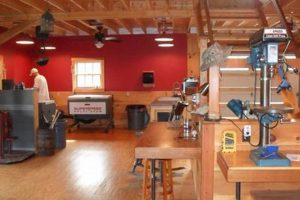
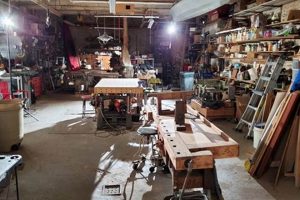
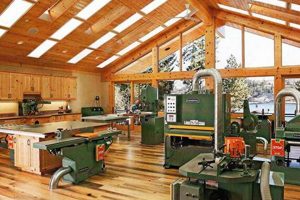
Selecting the optimal equipment for a compact woodworking environment involves prioritizing functionality and space efficiency. This encompasses instruments that deliver precision, versatility, and ease of storage. For instance, a benchtop table saw offers cutting capabilities comparable to larger models while occupying significantly less floor space, thus epitomizing this balance.
The appropriate apparatus enhances project quality, accelerates workflow, and improves overall safety within the workshop. Historically, woodworking relied on hand tools, demanding significant skill and time. The introduction of power tools revolutionized the craft, enabling faster production and greater accuracy. Modern compact workshops benefit from tools reflecting this evolution, minimizing physical strain and maximizing output.
The subsequent discussion will categorize essential equipment for a limited-area woodworking setting, exploring specific tool types, performance characteristics, and considerations for efficient organization. This will cover sawing, joinery, shaping, and finishing processes, providing a foundation for informed tool selection.
Essential Strategies for Optimizing a Woodworking Workspace
The following strategies offer guidance in selecting and arranging implements within a confined woodworking area to enhance efficiency and maximize usable space.
Tip 1: Prioritize Multi-Functionality: Opt for tools capable of performing multiple operations. A combination sander/grinder, for example, reduces the need for separate single-purpose machines. This minimizes tool count and saves valuable space.
Tip 2: Implement Vertical Storage Solutions: Utilize wall-mounted cabinets, pegboards, and shelving units to store tools and supplies. Vertical storage frees up floor space and keeps frequently used items readily accessible. Consider French cleats for versatile tool mounting.
Tip 3: Invest in Compact Power Tools: Choose benchtop models and smaller versions of essential power tools. A compact table saw, bandsaw, or planer delivers adequate performance for many projects without consuming excessive space. Research models specifically designed for portability and storage.
Tip 4: Optimize Workbench Design: Select a workbench with built-in storage, such as drawers or cabinets. Folding or mobile workbenches offer flexibility for space management, allowing the workspace to be reconfigured as needed.
Tip 5: Streamline Dust Collection: Employ a small, portable dust collector or shop vacuum with effective filtration. Minimizing dust accumulation not only improves air quality but also reduces clutter and maintenance requirements.
Tip 6: Regularly Assess Tool Usage: Periodically evaluate the frequency with which each tool is used. Tools that are rarely employed may be candidates for storage outside the primary workspace or, if necessary, disposal. This ensures that the most essential equipment remains readily available.
Effective implementation of these approaches will create a productive and organized woodworking environment, regardless of physical size constraints.
The concluding section will explore specific tool recommendations based on the aforementioned strategies, further clarifying the optimal choices for woodworking in constrained settings.
1. Functionality

The core element of optimal equipment selection is functionality. In the context of a constrained woodworking area, each implement must demonstrably contribute to the completion of essential woodworking tasks. Determining functionality begins with identifying the range of projects anticipated within the shop. For instance, a shop specializing in cabinetry requires tools suited for precise joinery, dimensioning stock, and applying finishes, while a shop focused on carving necessitates instruments capable of detailed shaping and material removal. The absence of essential functionalities in selected equipment directly impacts project scope and efficiency.
To illustrate, a compact table saw lacking the necessary fence system for accurate rip cuts undermines its intended function, regardless of its size advantage. Similarly, a small router without variable speed control restricts its versatility in handling different wood types and bit sizes. Functionality extends beyond basic operation to include considerations such as dust collection compatibility, ease of adjustment, and reliability under sustained use. Therefore, an assessment of functionality must consider not only the tool’s primary purpose but also its auxiliary capabilities and impact on the overall workflow.
Prioritizing functionality ensures that each device actively contributes to the shop’s output, effectively justifying its presence within the limited space. By focusing on instruments that directly address the identified project needs and offer a practical range of capabilities, the woodworking environment becomes more productive and manageable. A comprehensive understanding of functionality, therefore, is paramount in selecting the equipment for woodworking.
2. Space efficiency

Space efficiency is a critical determinant in selecting optimal equipment for a small woodworking environment. The physical dimensions of tools directly impact the utilization of available workspace. Inadequate consideration of space constraints results in a cluttered shop, impeding workflow, increasing the risk of accidents, and ultimately reducing overall productivity. Conversely, selecting tools designed with space efficiency in mind maximizes usable area, facilitating smoother operations and a safer working environment. A benchtop jointer, for instance, offers comparable functionality to a floor-standing model while occupying significantly less horizontal space, thereby enhancing space efficiency.
Space efficiency is not solely defined by the tool’s footprint; it also encompasses storage considerations. Tools that can be easily stored or reconfigured contribute to overall space optimization. Mobile tool stands, wall-mounted storage systems, and folding workbenches are examples of solutions that address both operational and storage requirements. Further, tools with integrated storage compartments or those designed for modular integration with other equipment enhance space efficiency. For example, a contractor table saw equipped with folding legs and onboard accessory storage demonstrates a holistic approach to space management.
The strategic integration of space-efficient tools is fundamental to the functionality and safety of a small woodworking shop. Prioritizing compact designs, versatile storage solutions, and modular equipment configurations is essential for maximizing usable space and creating a productive work environment. Ignoring space efficiency leads to operational inefficiencies and compromised safety, highlighting its significance in equipment decisions.
3. Versatility

Versatility assumes a pivotal role in determining optimal tool selection for a constrained woodworking area. Given limited space and budget, the capacity of a single tool to perform multiple functions significantly enhances overall shop capability and efficiency. The ability to adapt to varied project demands minimizes the need for numerous specialized implements, thereby maximizing usable space and reducing capital expenditure.
- Multi-Functional Capacity
The degree to which a tool can perform disparate operations is a primary indicator of its versatility. A combination belt and disc sander, for example, offers both aggressive material removal and fine finishing capabilities within a single unit. This contrasts with dedicated sanders, which require separate purchase and storage, increasing spatial and financial burdens. This multi-functional characteristic translates directly to expanded project possibilities within the confines of a compact shop.
- Adaptability to Materials
A versatile instrument demonstrates the capacity to effectively process a range of materials, including hardwoods, softwoods, and manufactured composites. A variable-speed router, for instance, allows precise control over cutting speeds, enabling optimal performance across diverse wood types and preventing burning or tear-out. This adaptability reduces the necessity for specialized tools tailored to specific material properties, contributing to space and cost savings.
- Attachment and Accessory Compatibility
The availability of compatible attachments and accessories expands a tool’s functional range. A drill press equipped with mortising attachments, sanding drums, or routing capabilities transforms into a multi-purpose workstation. Similarly, a table saw adaptable to dado blades or miter gauges facilitates a wider array of cuts and joinery techniques. These modular additions enhance versatility without significantly increasing the tool’s footprint.
- Adjustability and Precision
The ability to finely adjust settings and maintain consistent precision is essential for versatility. A miter saw with precise angle adjustments and a reliable laser guide allows for accurate cuts on various materials and angles, eliminating the need for multiple saws or jigs. This level of control ensures that the tool can adapt to diverse project requirements while maintaining a high standard of accuracy.
The selection of woodworking tools with a strong emphasis on versatility directly addresses the constraints of a limited workspace and budget. By prioritizing instruments that offer multi-functional capacity, material adaptability, accessory compatibility, and precise adjustability, a compact shop can achieve a level of operational efficiency and project diversity comparable to larger, more extensively equipped facilities. The strategic integration of versatile tools, therefore, is fundamental to maximizing the potential of a small woodworking shop.
4. Precision
Precision is paramount in woodworking, particularly within the confines of a small shop where efficiency and accuracy are critically intertwined. The selection of instruments directly impacts the attainable level of precision, influencing project quality and minimizing material waste. The instruments employed dictate the achievable degree of accuracy, which in turn determines the suitability of the finished product.
- Cutting Accuracy and Stability
Cutting accuracy is a function of blade quality, machine stability, and fence system precision. For instance, a high-quality table saw featuring a solid cast-iron top and a micro-adjustable fence ensures straight and consistent cuts. The saw’s stability minimizes vibration, contributing to more accurate results. In contrast, an unstable saw with a flimsy fence introduces errors that compromise precision, leading to ill-fitting joints and substandard final products. Such considerations are essential when selecting a smaller-scale saw appropriate for a limited workspace.
- Measuring and Marking Instruments
Accurate measurements are fundamental to precision woodworking. Instruments such as precision squares, calipers, and measuring tapes are critical for transferring dimensions and ensuring accurate layouts. For example, a digital caliper allows for precise measurements down to fractions of a millimeter, enabling the creation of tight-fitting joints and intricate details. The use of inaccurate measuring tools introduces cumulative errors that negatively impact the overall precision of a woodworking project. Ensuring instruments are calibrated and maintained to a high standard is a prerequisite for achieving precise results.
- Joinery and Alignment
Precise joinery is essential for creating strong and aesthetically pleasing woodworking projects. Tools such as dovetail jigs, mortise and tenon jigs, and accurate drilling guides facilitate the creation of tight-fitting joints with minimal gaps or misalignment. A well-designed dovetail jig, for instance, ensures consistent and precise dovetail joints, enhancing the structural integrity and visual appeal of a piece. Conversely, relying on freehand methods for joinery increases the risk of errors, compromising the strength and appearance of the final product.
- Finishing and Surface Preparation
Achieving a flawless finish requires precise surface preparation techniques. Tools such as random orbital sanders, scrapers, and planes facilitate the removal of imperfections and the creation of smooth, even surfaces. A random orbital sander with variable speed control allows for precise sanding without leaving swirl marks, ensuring a uniform finish. Imprecise surface preparation leads to uneven finishes and visible defects, detracting from the overall quality of the woodworking project. Attention to the nuances of preparation ensures a superior outcome.
The inherent relationship between precision and equipment selection dictates the success of woodworking endeavors, particularly in confined areas. Careful consideration of cutting accuracy, measuring instruments, joinery methods, and finishing tools ensures the attainment of optimal results. The selection of devices offering a combination of accuracy, stability, and adjustability directly contributes to enhanced product quality and minimized material waste, underscoring the importance of precision in woodworking.
5. Storage solutions
Effective storage solutions are inextricably linked to the utility of equipment in a compact woodworking environment. The limited square footage characteristic of small shops necessitates a strategic approach to tool organization, directly impacting workflow efficiency and safety. Inadequate storage leads to a cluttered workspace, hindering access to tools, increasing the risk of accidents, and reducing overall productivity. Consequently, the “best tools for small woodworking shop” are only truly effective when paired with complementary storage arrangements.
The integration of appropriate storage directly influences the functionality and accessibility of equipment. Wall-mounted tool organizers, for example, free up valuable benchtop space while ensuring that frequently used instruments are readily available. Mobile tool carts provide flexibility, allowing equipment to be positioned precisely where needed and then stored away when not in use. Consider a scenario where a compact bandsaw, otherwise ideal for a small shop, lacks a designated storage location. Without a suitable space, it occupies valuable workspace, impeding movement and hindering the use of other tools. In contrast, a similar bandsaw situated on a mobile base with integrated storage for blades and accessories enhances both its functionality and the overall organization of the shop.
The selection of optimal equipment necessitates the concurrent consideration of storage solutions. Vertical storage systems, mobile bases, and integrated storage compartments maximize usable space and ensure that tools remain accessible and organized. Ignoring the relationship between equipment and storage undermines the effectiveness of the tools themselves, negating the benefits of their compact design and versatility. Therefore, storage constitutes an integral component of determining the best equipment choices for a small woodworking facility, directly affecting productivity, safety, and the overall quality of work.
Frequently Asked Questions
The following questions address common concerns regarding optimal equipment choices for confined woodworking environments, providing clarity on critical selection criteria.
Question 1: How does one determine the absolute minimum set of tools required for a small woodworking shop?
The minimum toolset is dictated by the scope of anticipated projects. At a base level, a table saw (or circular saw with guide), a drill/driver, a measuring tape, a combination square, and basic hand tools are essential. This foundation enables rudimentary cutting, fastening, and measuring tasks. Additional tools are added as project complexity increases.
Question 2: What are the trade-offs between purchasing a combination machine versus individual tools for a small shop?
Combination machines offer space savings but may compromise performance compared to dedicated tools. Set-up time between operations can also be a factor. The decision depends on project priorities and the acceptable balance between space constraints and operational efficiency.
Question 3: How important is dust collection in a small woodworking shop, and what are the most effective options?
Dust collection is paramount due to the health hazards associated with wood dust inhalation and the fire risk posed by accumulated debris. A portable dust collector or a shop vacuum with a HEPA filter are effective options for small shops. Implementing source capture at each tool is ideal.
Question 4: Is it advisable to invest in cordless power tools to minimize clutter in a small shop?
Cordless tools offer increased mobility and eliminate cord clutter, but battery life and power output should be considered. For high-demand applications, corded tools may be preferable. A hybrid approach, utilizing cordless tools for convenience and corded tools for heavy-duty tasks, can be optimal.
Question 5: How can one effectively organize tools within a small woodworking space?
Vertical storage solutions, such as wall-mounted cabinets, pegboards, and shelving units, maximize usable space. Mobile tool carts offer flexibility, allowing for the relocation of equipment as needed. Clear labeling and a designated location for each tool are essential for maintaining organization.
Question 6: What are the key considerations when selecting a workbench for a small woodworking shop?
A workbench should be appropriately sized for the available space, offer sufficient work surface, and incorporate storage solutions. A folding or mobile workbench provides added flexibility. The workbench should also be stable and robust enough to withstand the forces applied during woodworking operations.
Prioritizing functionality, space efficiency, versatility, and precision is critical when selecting equipment. Effective storage solutions are necessary to maximize the utility of these tools within a confined area. Careful consideration of these factors contributes to a productive and safe working environment.
The subsequent section will provide actionable strategies for implementing the aforementioned principles in the creation of an efficient compact woodworking setup.
Selecting Optimal Equipment for Compact Woodworking Environments
This exploration of “best tools for small woodworking shop” underscores the importance of prioritizing functionality, space efficiency, versatility, and precision. Effective equipment selection directly impacts productivity, safety, and the quality of finished projects within a limited workspace. Integrated storage solutions are essential for maximizing usable space and maintaining an organized environment.
Adopting a strategic approach to tool acquisition, coupled with diligent space management, enables the creation of a productive and efficient woodworking facility, irrespective of size constraints. A well-equipped and organized small shop facilitates the realization of diverse woodworking projects, demonstrating that spatial limitations need not hinder craftsmanship.