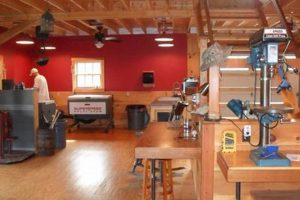
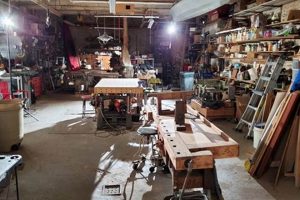
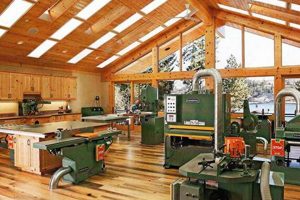
The spatial footprint allocated for a woodworking workspace represents the smallest area deemed functionally adequate to accommodate essential equipment, material storage, and safe operator movement. As an illustration, a compact workshop might measure 10 feet by 12 feet, accommodating a workbench, a small table saw, and limited lumber storage.
Adequate spatial allocation within a woodworking environment directly influences safety, efficiency, and project scope. A confined space can lead to increased risk of accidents, restricted workflow, and limitations on the size and complexity of projects that can be undertaken. Historically, woodworking was often conducted in larger, dedicated spaces, but contemporary constraints often necessitate optimization of smaller areas.
The following sections will explore factors influencing the determination of suitable dimensions for a woodworking area, including equipment considerations, workflow optimization, and storage solutions.
Optimizing the Footprint
Efficient utilization of the allocated area is paramount, especially when space is limited. The following guidelines assist in maximizing functionality within a smaller woodworking setting.
Tip 1: Prioritize Essential Equipment: Carefully select equipment based on anticipated project types and frequency of use. Combination machines offer multiple functionalities in a single unit, conserving space compared to individual machines.
Tip 2: Maximize Vertical Storage: Employ wall-mounted shelving, pegboards, and overhead racks to store materials and tools. This reduces the need for floor-standing storage units, freeing up valuable workspace.
Tip 3: Implement a Mobile Workbench: A workbench equipped with casters allows for reconfiguration of the workspace as needed. The bench can be moved out of the way when not in use, creating more open space.
Tip 4: Optimize Dust Collection: An efficient dust collection system is crucial for maintaining air quality and preventing the accumulation of debris. Consider a compact, portable dust collector for smaller shops.
Tip 5: Plan Workflow Strategically: Arrange equipment and storage to facilitate a logical workflow. Minimize unnecessary movement and ensure easy access to frequently used tools and materials.
Tip 6: Utilize Fold-Away Surfaces: Incorporate fold-down tables or work surfaces that can be stowed away when not needed. These provide temporary workspace without permanently occupying floor space.
Tip 7: Regular Decluttering: Maintaining a clean and organized workspace is essential. Regularly remove scrap materials, unused tools, and accumulated debris to prevent clutter and improve efficiency.
Adhering to these recommendations facilitates a functional and safe woodworking environment, regardless of the specific spatial constraints.
The subsequent sections will delve into specific layout examples and considerations for adapting woodworking to limited spaces.
1. Equipment Footprint

The aggregate spatial requirement of woodworking machinery directly determines the floor space prerequisite. A larger equipment footprint necessitates a corresponding increase in overall shop dimensions. For instance, a shop incorporating a full-size cabinet saw, jointer, planer, and bandsaw demands significantly more area than one utilizing only a benchtop model table saw and a drill press. Consequently, specifying “Equipment Footprint” is an initial and critical stage in estimating “minimum size for a woodworking shop”.
The practical significance of understanding the equipment footprint extends beyond simply accommodating the machinery. It directly influences workflow efficiency and safety. Insufficient clearance around equipment can impede movement, increase the risk of accidents, and limit the size of workpieces that can be handled. A constrained environment may force compromises in project design or lead to unsafe operating practices. Real-world examples include workshops where operators are forced to contort themselves to feed lumber into a machine or where dust collection is rendered ineffective due to spatial limitations. Therefore, calculating the combined surface area needed for both stationary equipment and adequate movement around it is paramount.
In summation, the “Equipment Footprint” is a foundational element in establishing the “minimum size for a woodworking shop.” Inadequate consideration of this factor can lead to spatial constraints that negatively impact safety, efficiency, and project scope. Accurately assessing equipment dimensions and accounting for sufficient operating space is crucial for creating a functional and productive woodworking area. Addressing the equipment footprint is a preliminary step in assessing the overall dimension of the shop.
2. Material Storage Needs

The volume and types of materials to be stored are a primary determinant of the necessary spatial allocation for a woodworking shop. Insufficient consideration of material storage requirements leads to workspace congestion, increased material handling difficulties, and potentially compromised material integrity, all of which directly impact the determination of an appropriate workspace dimension.
- Raw Lumber Inventory
Raw lumber constitutes a significant portion of material storage requirements. The quantity and dimensions of lumber stock dictate the necessary rack or floor space. Example: A woodworker primarily using dimensional lumber may require only a small lumber rack, whereas one working with larger hardwood slabs will necessitate a substantially larger storage area, influencing the overall shop size. Incorrect lumber storage can warp or twist lumber. The larger the lumber, the more important to have proper storage methods.
- Sheet Goods Accommodation
Sheet goods, such as plywood and MDF, present unique storage challenges due to their size and potential for warping if improperly supported. Vertical storage is often favored, but requires adequate ceiling height and floor space to accommodate the sheets. Neglecting to account for sheet good storage needs will result in inefficient space utilization, increased material handling difficulties, and potential damage to the materials. Example: vertical supports and large area.
- Hardware and Fastener Organization
Hardware and fasteners, while individually small, accumulate into a substantial storage requirement. Efficient organization using bins, drawers, and containers is essential to minimize space consumption and facilitate easy access. A disorganized hardware inventory not only wastes space but also leads to project delays and potential material waste. Example: bolt bins.
- Finishing Supplies and Chemicals
Finishing supplies, including paints, stains, and adhesives, require dedicated storage that is often governed by safety regulations. Proper ventilation and temperature control are often necessary, adding to the spatial requirements. Failure to adequately accommodate finishing supplies can create safety hazards and compromise the integrity of the materials. Example: a sealed cabinet with ventilation.
The spatial requirements for material storage are inextricably linked to the establishment of a minimum area for a woodworking shop. Inadequate planning in this area leads to inefficiencies, safety hazards, and limitations on project scope. Careful consideration of the types and quantities of materials to be stored is therefore critical in determining a realistic and functional dimension for the woodworking environment. All factors must be considered to have the “minimum size for a woodworking shop”.
3. Safe Operator Clearance

Adequate operator clearance represents a non-negotiable component of woodworking shop dimensions. The establishment of a “minimum size for a woodworking shop” inherently necessitates the provision of sufficient free space surrounding equipment to facilitate safe and unencumbered operation. Failure to provide adequate clearance results in increased risk of injury, reduced operational efficiency, and limitations on the types of projects that can be undertaken.
The causation is direct: inadequate space leads to compromised safety. For instance, insufficient clearance around a table saw increases the likelihood of kickback-related injuries, as the operator may be unable to maintain a stable stance or react effectively. Similarly, restricted movement around a lathe or bandsaw can lead to entanglement hazards. Real-world examples abound in workshops where operators are forced to adopt awkward postures or navigate constricted spaces, significantly increasing the potential for accidents. Consider a woodworker maneuvering a large board through a jointer in a cramped space the lack of maneuverability elevates the risk of losing control of the workpiece, potentially resulting in serious injury. Proper clearance allows for controlled movements, stable footing, and the ability to react swiftly to unforeseen circumstances, thus mitigating risk.
In conclusion, the concept of “Safe Operator Clearance” is not merely a desirable attribute but a fundamental requirement in the determination of a woodworking area’s “minimum size.” Neglecting this factor directly compromises operator safety, undermines efficiency, and restricts the overall functionality of the workshop. Therefore, thorough consideration of operator clearance is paramount in establishing a workspace that is both productive and safe. The bigger the project, the greater space required to work on it.
4. Project Assembly Area

The availability of a designated project assembly area is inextricably linked to establishing the “minimum size for a woodworking shop”. The absence of sufficient assembly space directly impacts project feasibility, workflow efficiency, and overall quality. A confined assembly area necessitates compromises in project design, restricts the ability to handle large components, and increases the risk of damage to partially completed workpieces. Consider a furniture maker attempting to assemble a large dining table in a cramped workshop. The restricted space hinders maneuverability, making it difficult to align components accurately and securely. This can lead to structural weaknesses, cosmetic flaws, and an overall reduction in the quality of the finished product. A woodworking area must accommodate the assembly of projects that can be made in the shop.
The allocation of adequate assembly space also influences workflow efficiency. A dedicated area allows for the organized staging of components, facilitating a smoother and more streamlined assembly process. Conversely, a lack of space forces the operator to constantly rearrange components, leading to wasted time and increased frustration. Examples can be observed in shops where the assembly area doubles as a storage area, requiring constant clearing and re-organization before assembly can commence. This directly reduces productivity and increases the likelihood of errors. Dedicated and prepped areas lead to better, faster results. An assembly area should be free of clutter and debris.
In summary, the “Project Assembly Area” is a critical component in determining the “minimum size for a woodworking shop.” It is not merely a supplementary space but an essential element that directly impacts project quality, workflow efficiency, and overall feasibility. Therefore, meticulous consideration of assembly requirements is paramount in establishing a functional and productive woodworking environment. Shops must be large enough to build the projects they intend to produce.
5. Dust Collection System

The implementation of a “Dust Collection System” represents a critical factor in determining the “minimum size for a woodworking shop”. Effective dust management is essential for maintaining air quality, minimizing health hazards, and preventing equipment malfunctions. Consequently, the spatial requirements of the dust collection system directly influence the overall area needed for a functional woodworking environment.
- System Components and Placement
A dust collection system typically comprises a collector unit, ductwork, and specialized fittings. The physical dimensions of the collector, along with the routing requirements of the ductwork, necessitate dedicated floor space and potentially wall or ceiling space. For example, a cyclone separator-style collector requires more area than a portable dust extractor, influencing shop layout. Inadequate planning for system component placement can result in constricted workspaces and inefficient airflow, impacting overall shop functionality.
- Ductwork Routing and Space Consumption
The efficient removal of airborne particles requires strategic ductwork routing to connect woodworking machinery to the central collection unit. Duct runs consume space, both horizontally and vertically, and must be factored into shop layout planning. Poorly planned ductwork can create obstructions, impede movement, and reduce usable workspace. An example is the implementation of overhead ducting to minimize floor space impact, which necessitates sufficient ceiling height, impacting the overall spatial requirements.
- Airflow Requirements and System Sizing
The size and capacity of the dust collection system must be commensurate with the volume of dust generated by the woodworking equipment. Undersized systems result in inadequate dust removal, while oversized systems consume unnecessary space and energy. System sizing dictates the physical dimensions of the collector unit and the diameter of the ductwork, both of which contribute to the spatial footprint. Insufficient airflow can lead to dust accumulation, creating health hazards and potential fire risks. Adequate space for the equipment must be a consideration for the shop size.
- Maintenance Access and Filter Replacement
Routine maintenance, including filter cleaning and replacement, is essential for maintaining optimal dust collection system performance. The layout must provide adequate access to the collector unit for servicing and component replacement. Insufficient access can impede maintenance procedures, leading to neglected systems and reduced effectiveness. An example is the need for clear space around the collector for filter removal and disposal, which contributes to the overall spatial demands of the system.
The spatial requirements associated with the “Dust Collection System” are inextricably linked to the determination of the “minimum size for a woodworking shop”. A comprehensive understanding of system components, airflow requirements, and maintenance procedures is essential for optimizing shop layout and ensuring a safe and efficient working environment. Careful planning in this area leads to improved air quality, reduced health risks, and enhanced operational productivity. Dust mitigation is essential for a safe shop.
6. Workflow Optimization

Workflow optimization is intrinsically linked to the determination of a suitable dimension for a woodworking shop. Effective workflow minimizes unnecessary movement, reduces material handling, and streamlines project progression, all of which directly impact the required area. A well-optimized workflow allows for efficient operation within a smaller space, whereas a poorly planned workflow necessitates a larger area to compensate for inefficiencies.
- Equipment Placement and Proximity
Strategic positioning of equipment based on process flow is crucial. Machines used in sequence should be placed in close proximity to minimize material transport. Example: Placing a jointer adjacent to a planer allows for efficient processing of rough lumber. Failure to optimize equipment placement results in unnecessary movement, increasing the effective space required for operation. A compact setup for frequently used tools allows for space optimization.
- Material Staging and Organization
Designating specific areas for material staging, both raw and in-process, improves workflow. Organized storage reduces search time and minimizes handling. Example: A lumber rack positioned near the initial breakdown station facilitates easy access to stock. Inadequate material staging leads to clutter and impedes efficient movement within the shop. Proper planning enables the ability to work within a smaller space. A place for everything, and everything in its place is essential.
- Task-Specific Workstations
Creating dedicated workstations for specific tasks, such as cutting, assembly, and finishing, optimizes workflow. Each workstation should be equipped with the necessary tools and materials. Example: A finishing station with proper ventilation and lighting improves the quality and efficiency of the finishing process. Lack of task-specific workstations results in constant re-organization and inefficient use of space. Specialization leads to efficiency.
- Traffic Flow and Clearance
Minimizing obstructions and ensuring clear traffic flow throughout the shop is essential for safe and efficient operation. Adequate clearance around equipment and workstations prevents congestion and reduces the risk of accidents. Example: Wide aisles between machines allow for easy passage of materials and operators. Restricted traffic flow leads to bottlenecks and increases the overall space required for operation. Safe passage must be considered for the “minimum size for a woodworking shop”.
In conclusion, “Workflow Optimization” significantly influences the required area for a woodworking shop. Effective planning and implementation of optimized workflows allow for efficient operation within a smaller footprint, maximizing productivity and minimizing wasted space. Conversely, a poorly planned workflow necessitates a larger shop to compensate for inefficiencies, highlighting the critical importance of workflow considerations in determining the “minimum size for a woodworking shop”. The more efficient the shop, the more effective the use of space.
7. Future Expansion
Consideration of future expansion is a significant factor in determining the appropriate dimensions for a woodworking shop. The initial “minimum size for a woodworking shop” should account for potential growth in equipment, project scope, and operational complexity. Failure to anticipate future needs can lead to spatial constraints that hinder development and necessitate costly renovations or relocations.
- Anticipating Equipment Additions
Woodworking operations often evolve, necessitating the acquisition of additional machinery. The initial shop layout should incorporate provisions for accommodating new equipment without compromising existing workflow or safety. Example: Allocating space for a future wide-belt sander or CNC router, even if not immediately required, prevents disruptive alterations later. Not enough room is detrimental to the work.
- Accommodating Increased Project Scale
As woodworking skills and clientele grow, project size and complexity may increase. The initial shop layout should allow for the assembly and finishing of larger pieces without spatial limitations. Example: Planning for a dedicated assembly area capable of handling full-size furniture components ensures future project feasibility. Size limitation restricts project options.
- Adapting to Evolving Workflow Requirements
Workflow processes may require adaptation as the scale of operations expands. The initial shop layout should be flexible enough to accommodate changes in equipment placement and material flow. Example: Designing a modular shop layout that allows for easy reconfiguration of workstations as needs evolve. Adaptable spaces are preferable to static ones.
- Incorporating Storage Expansion
Material and tool inventories typically increase over time. The initial shop layout should include provisions for expanding storage capacity without encroaching on valuable workspace. Example: Utilizing vertical storage solutions and planning for additional shelving or racking systems. As more tools and materials are required, shops must adapt.
In summary, the projected trajectory of a woodworking operation directly influences the determination of the “minimum size for a woodworking shop”. A forward-thinking approach that considers potential expansion in equipment, project scope, and operational complexity ensures a sustainable and adaptable woodworking environment. Planning ahead can save time and money in the future.
Frequently Asked Questions
The following addresses common inquiries and misconceptions regarding the determination of appropriate dimensions for a functional and safe woodworking environment.
Question 1: What constitutes the single most critical factor in determining the “minimum size for a woodworking shop?”
Equipment footprint, encompassing machinery dimensions and necessary operational clearance, represents the foundational element. Insufficient allowance for equipment leads to compromised safety and reduced operational efficiency.
Question 2: How does material storage directly influence the “minimum size for a woodworking shop?”
The volume and type of materials to be stored dictate spatial requirements. Adequate storage prevents workspace congestion and ensures material integrity. Lumber, sheet goods, hardware, and finishing supplies all contribute to storage needs.
Question 3: Why is operator clearance considered a non-negotiable aspect of the “minimum size for a woodworking shop?”
Operator clearance is paramount for safety. Insufficient space increases the risk of accidents and restricts maneuverability, compromising the operator’s ability to react effectively and maintain a stable working posture.
Question 4: In what manner does the anticipated scale of woodworking projects affect the “minimum size for a woodworking shop?”
The dimensions of the largest projects to be undertaken determine the necessary assembly area. Sufficient space is required for staging components, maneuvering large pieces, and ensuring accurate assembly.
Question 5: How does the inclusion of a dust collection system factor into the “minimum size for a woodworking shop?”
Dust collection systems require dedicated space for the collector unit, ductwork, and maintenance access. Effective dust management is essential for maintaining air quality and preventing equipment malfunctions.
Question 6: Is it advisable to consider future expansion when determining the “minimum size for a woodworking shop,” and if so, why?
Planning for future expansion is prudent. Anticipating potential growth in equipment, project scope, and operational complexity prevents spatial constraints that hinder long-term development.
These considerations highlight the multifaceted nature of determining the appropriate dimensions for a woodworking environment, emphasizing the importance of careful planning and comprehensive assessment.
The subsequent section will delve into specific examples of shop layouts and their respective spatial requirements.
Conclusion
The preceding analysis underscores the multifaceted considerations involved in determining a functional “minimum size for a woodworking shop.” Factors such as equipment footprint, material storage, safe operator clearance, project assembly area, dust collection system, workflow optimization, and future expansion collectively define the necessary spatial parameters. A deficiency in any of these areas compromises safety, efficiency, and project scope.
Therefore, prospective woodworkers are urged to meticulously evaluate their specific needs and anticipated growth when establishing a workspace. A well-planned shop, appropriately sized for its intended purpose, fosters both productivity and safety, contributing to a more fulfilling and sustainable woodworking practice. Thoughtful consideration of these parameters is crucial for establishing a conducive and enduring woodworking environment.