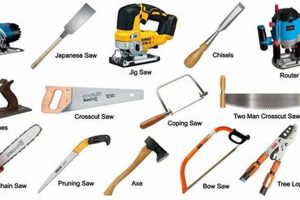
Hand tools employed in woodworking represent a tradition of craftsmanship spanning centuries. These implements, often characterized by their simple yet effective designs, rely on manual power for shaping and manipulating wood. Examples include planes for smoothing surfaces, chisels for detailed carving, saws for cutting stock to size, and measuring devices for accuracy.
The enduring value of these tools lies in their ability to provide the user with direct control over the woodworking process. This control allows for nuanced adjustments and a deep understanding of the material being worked. Furthermore, many older tools, properly maintained, offer exceptional durability and can be considered heirloom pieces. Their historical significance underscores the evolution of woodworking techniques and the ingenuity of past artisans.
The following discussion will delve into the specific attributes of essential hand tools used in traditional woodworking, exploring their proper usage and highlighting the advantages they offer in creating fine woodworking projects.
Tips for Utilizing Traditional Woodworking Hand Tools
Effective utilization of hand tools demands practice, patience, and a foundational understanding of woodworking principles. The following guidelines outline best practices for employing these implements safely and efficiently.
Tip 1: Sharpening is Paramount: A dull tool is not only inefficient but also dangerous. Maintain a keen edge on all cutting tools through regular sharpening using stones, strops, or specialized sharpening systems. A sharp tool requires less force, reducing the risk of slippage and injury.
Tip 2: Proper Grip and Stance: Adopt a stable stance and grip the tool firmly but not excessively. Allow your body weight to assist in the cutting action, rather than relying solely on brute force. This reduces fatigue and enhances control.
Tip 3: Wood Grain Awareness: Understand the direction of the wood grain. Cutting with the grain (planing with the grain) yields smooth surfaces. Cutting against the grain can result in tear-out. Adjust technique accordingly.
Tip 4: Accurate Marking and Layout: Precise layout is essential for accurate cuts. Utilize marking gauges, squares, and knives to establish clear and precise layout lines. Careless marking leads to inaccurate joinery and compromised results.
Tip 5: Practice on Scrap Material: Before committing to a final cut on valuable material, practice the technique on scrap wood of similar species and thickness. This allows for refinement of technique and reduces the risk of errors.
Tip 6: Tool Maintenance is Crucial: Regularly clean and lubricate tools to prevent rust and ensure smooth operation. Store tools in a dry environment to protect them from moisture damage. Proper maintenance extends tool life and preserves their accuracy.
Tip 7: Safety First: Always wear appropriate safety gear, including eye protection, when using any tool. Secure workpieces firmly in a vise or on a workbench to prevent movement during cutting or shaping operations.
Mastering these tips will significantly improve the efficiency and accuracy of woodworking projects. Diligent application of these principles will result in refined craftsmanship and a deeper appreciation for the art of traditional woodworking.
The following section provides guidance on sourcing high-quality traditional woodworking hand tools and establishing a well-equipped workshop.
1. Material Quality

The durability and functionality of traditional woodworking implements are intrinsically linked to the quality of the materials from which they are constructed. The grade of steel used for blades, the type of hardwood chosen for handles, and the precision of the metal casting all have a direct bearing on a tool’s lifespan and performance. Higher quality materials translate to tools that hold an edge longer, resist wear and tear, and provide a more satisfying and controlled user experience. For example, a hand plane with a blade forged from high-carbon steel, properly hardened and tempered, will maintain its sharpness far longer than one made from inferior steel, resulting in cleaner cuts and reduced sharpening frequency. Similarly, a chisel with a handle made from a dense, stable hardwood like rosewood or ebony will be less prone to splitting or cracking under the stress of repeated mallet blows, ensuring user safety and tool longevity.
The selection of appropriate materials often reflects the specific demands placed upon a given implement. Saws, for instance, may benefit from blades made from spring steel, which offers the necessary flexibility and resistance to bending. Conversely, tools designed for heavy stock removal, such as axes or adzes, necessitate the use of high-impact steel alloys to withstand the forces involved. The crafting of these instruments must also consider material compatibility to mitigate potential issues. A brass fitting improperly paired with a steel component could accelerate corrosion or introduce unintended weaknesses. A lack of care in material choices can lead to tools that are not only ineffective, but also potentially dangerous to use.
In summary, the material quality of implements is a critical factor in determining their overall value and utility. The choice of materials impacts not only the tools’ durability and performance, but also the safety and efficiency of the woodworking process. Neglecting this fundamental aspect compromises the long-term investment in tools and can ultimately detract from the quality of finished work. Careful consideration and selection of implements crafted from high-grade materials are essential for any serious woodworker seeking to create lasting and aesthetically pleasing pieces.
2. Blade Geometry

Blade geometry constitutes a critical determinant of a woodworking implement’s effectiveness. The angle of the cutting edge, the shape of the blade’s profile, and the presence of bevels directly influence how the tool interacts with the wood. Incorrect geometry hinders cutting efficiency, increases the force required, and can lead to undesirable results such as tear-out or uneven surfaces. A plane iron with an improper bevel angle, for instance, may chatter or dig into the wood rather than producing a smooth, shaving-like cut. Similarly, a chisel with a poorly shaped cutting edge will struggle to cleanly sever wood fibers, resulting in a ragged or crushed surface.
Variations in blade geometry are deliberately designed to suit specific tasks. A low-angle block plane, characterized by a bevel-up blade with a shallow cutting angle, excels at smoothing end grain due to its ability to shear rather than split the fibers. Conversely, a bench plane with a steeper cutting angle is more suited for working with the grain and removing larger amounts of material. Similarly, the geometry of saw teeth varies depending on whether the saw is intended for ripping (cutting with the grain) or crosscutting (cutting across the grain). Rip saws feature teeth with a more aggressive rake angle, optimized for efficiently removing material along the grain. Crosscut saws, on the other hand, possess teeth with a more acute angle and a knife-like action, designed to sever fibers cleanly.
Understanding blade geometry enables woodworkers to select and maintain tools best suited for their intended purposes. Proper sharpening techniques are essential for preserving the designed geometry and ensuring optimal performance. Skilled sharpening involves not only creating a keen edge but also accurately replicating the original bevel angles and blade profile. Neglecting this aspect compromises the tool’s effectiveness and can lead to frustration and wasted effort. Ultimately, the connection between blade geometry and cutting performance underscores the importance of a thoughtful and informed approach to tool selection and maintenance in traditional woodworking.
3. Ergonomic Design

Ergonomic design, while a relatively modern term, has a deep connection to the evolution and enduring appeal of implements employed in woodworking. The effective and sustained use of hand tools necessitates designs that minimize physical strain and maximize user comfort. While not always explicitly labeled as “ergonomic,” the gradual refinement of tool shapes, sizes, and materials over centuries reflects an implicit understanding of human biomechanics and the need for tools to fit the hand and body effectively. The cause-and-effect relationship is clear: poor design leads to fatigue, injury, and reduced efficiency, while well-designed tools enhance productivity and reduce the risk of repetitive strain injuries.
The importance of ergonomic considerations in implements is particularly evident in tools requiring repetitive motions or sustained force. The shape of a hand plane, for instance, has evolved over time to provide a comfortable and secure grip, allowing the user to exert consistent pressure without excessive strain on the wrist or hand. Similarly, the handles of chisels and mallets are often crafted from hardwoods with specific grain orientations to absorb shock and minimize vibrations. Consider the design of a drawknife; its two handles allow for even distribution of force and precise control over the cutting action, reducing the strain on the user’s forearms and shoulders. These examples highlight how an intuitive grasp of ergonomic principles has been integral to the development of implements.
Ultimately, the incorporation of ergonomic design principles in implements is not merely a matter of comfort; it is a practical consideration that directly impacts the quality and efficiency of woodworking. While modern materials and manufacturing techniques offer new possibilities for improving tool ergonomics, the fundamental principles remain the same: a well-designed tool should feel like an extension of the user’s hand, allowing for precise control, reduced fatigue, and a more enjoyable and sustainable woodworking experience. Recognizing the connection between design and user well-being is key to appreciating the enduring value of classic woodworking tools.
4. Sharpening Technique

The ability to consistently achieve and maintain a keen edge on cutting tools is fundamental to woodworking. The performance of classic woodworking tools hinges directly on the skill and precision applied during the sharpening process. A dull edge renders even the most finely crafted tool ineffective, while a properly sharpened tool enhances control, reduces effort, and improves the quality of the finished work.
- Establishing a Primary Bevel
The primary bevel defines the main angle of the cutting edge. Its consistency and flatness are crucial for creating a durable and predictable edge. Techniques such as using a honing guide ensure that this bevel remains uniform across the entire width of the blade. An uneven primary bevel will result in a cutting edge that is prone to chipping or rolling over, requiring frequent re-sharpening. Examples include setting the correct bevel angle on a plane iron for smooth stock removal, or on a chisel for precise paring.
- Honing and Polishing the Edge
Honing refines the cutting edge by removing microscopic imperfections left by coarser sharpening stones. Polishing further refines the edge, creating a razor-sharpness essential for fine woodworking. Progression through increasingly finer grits of sharpening stones is critical. Skipping grits can lead to an edge that is sharp but fragile. For instance, using a leather strop after honing polishes the edge, enhancing its ability to cleanly sever wood fibers.
- Maintaining Edge Geometry
Sharpening technique must preserve the original geometry of the implement. Altering the angle of the bevel or rounding the cutting edge diminishes the tool’s intended function. Careful attention to maintaining the proper angles and curves is essential for preserving the tool’s performance characteristics. For example, a skewed rabbet plane requires specialized sharpening to maintain the skew angle of the blade, ensuring it cuts cleanly into corners.
- Assessing Sharpness
Determining sharpness involves both visual inspection and practical testing. Visual inspection reveals any nicks, burrs, or irregularities in the cutting edge. Practical testing involves assessing the tool’s ability to cleanly sever wood fibers without tearing or crushing. The “hair shaving test” and the “fingernail test” are common methods for evaluating sharpness. A properly sharpened chisel, for example, should be able to pare a thin shaving of end grain cleanly, without requiring excessive force.
The success of any woodworking project relies on the woodworker’s mastery of sharpening. The connection between a sharp cutting edge and the ability to execute precise joinery, create smooth surfaces, and achieve desired aesthetics is undeniable. Proper sharpening technique not only enhances the performance of classic woodworking tools but also extends their lifespan, ensuring that these valuable implements remain reliable partners in the craft for generations to come.
5. Historical Provenance

The historical provenance of implements contributes significantly to the value and understanding of tools used in woodworking. Tracing a tool’s origin provides insights into manufacturing techniques, regional variations, and the evolution of design. This history informs the context in which an implement was created and used, enhancing appreciation for its functionality and craftsmanship.
- Dating and Authentication
Establishing the age of an implement is crucial for understanding its place in the history of woodworking. Marks from toolmakers, patent dates, and construction methods offer clues. Authentication helps determine whether a tool is a genuine antique or a reproduction. Knowing the age and authenticity informs its intended use, cultural value, and collectibility.
- Toolmaker Identification and Influence
Identifying the toolmaker reveals the standards of quality, innovative techniques, and design philosophies prevalent at the time of manufacture. Certain toolmakers, such as Stanley or Mathieson, were known for specific designs or manufacturing innovations. Their influence shaped the trajectory of tool development. Tracing the lineage and impact of individual toolmakers provides a deeper appreciation for the craftsmanship invested in these tools.
- Regional Variations and Adaptations
Implements often exhibit regional variations adapted to local materials, woodworking traditions, and specific tasks. These adaptations reflect the ingenuity of craftsmen in different geographic locations. For instance, plane designs vary across Europe, reflecting different woodworking styles and timber types. Recognizing these regional variations adds to the understanding of how tools were adapted to diverse needs.
- Evolution of Design and Functionality
Examining implements reveals the progression of design and functionality over time. Early tools often served multiple purposes, evolving into specialized implements with enhanced efficiency and precision. Comparing early and later versions of tools highlights the impact of technological advancements and changing woodworking practices. Analyzing this evolution provides a historical perspective on the ongoing refinement of woodworking techniques.
The historical provenance extends beyond mere identification; it connects each tool to a larger narrative of innovation, skill, and cultural heritage. Understanding this history deepens the appreciation for classic woodworking tools and provides valuable insights into the evolution of woodworking as a craft.
6. Proper Maintenance

The longevity and effectiveness of woodworking implements are inextricably linked to the diligence with which they are maintained. The principles of proper upkeep, consistently applied, ensure these precision instruments function optimally and endure through generations. Neglecting regular maintenance compromises performance and accelerates deterioration, diminishing their value and utility.
- Cleaning and Rust Prevention
The removal of accumulated debris, such as sawdust and pitch, is essential for preserving implement integrity. Abrasive particles can cause friction and wear, diminishing cutting efficiency and leading to premature failure. Application of rust inhibitors, such as paste wax or oil, protects metal surfaces from oxidation. Rust compromises structural integrity, dulls cutting edges, and impedes smooth operation. Regular cleaning and rust prevention safeguard against these detrimental effects.
- Edge Preservation and Sharpening
Sharp cutting edges are paramount for efficient woodworking. Regular honing and sharpening maintain these edges, optimizing performance and minimizing effort. Dull edges require increased force, leading to imprecise cuts and potential injury. Sharpening should adhere to established techniques to preserve the original geometry. Neglecting edge maintenance diminishes the tool’s capacity to perform its intended function effectively.
- Handle Care and Protection
Handles, typically constructed from hardwoods, require periodic maintenance to prevent cracking and splintering. Application of protective finishes, such as oil or varnish, safeguards against moisture absorption and wear. Loose handles compromise control and increase the risk of accidents. Regular inspection and timely repairs ensure a secure and comfortable grip, contributing to safe and efficient operation.
- Storage and Environmental Control
Proper storage minimizes exposure to environmental factors that accelerate deterioration. Tools should be stored in a dry, climate-controlled environment to prevent rust and wood damage. Organization within storage facilitates easy access and prevents accidental damage. Neglecting these considerations accelerates corrosion, warping, and overall degradation.
Consistent adherence to these maintenance practices sustains the performance and extends the lifespan of woodworking tools. These are not mere commodities but precision instruments whose enduring utility depends on conscientious care. Proper maintenance is an investment in their continued function.
Frequently Asked Questions about Implements
The following addresses common inquiries regarding the selection, usage, and maintenance of implements used in woodworking. The information provided aims to clarify best practices and address misconceptions.
Question 1: Are vintage implements inherently superior to modern tools?
Vintage tools frequently possess qualities unattainable in modern mass-produced equivalents, particularly concerning the quality of steel used in blades and the craftsmanship evident in their construction. However, not all vintage tools are superior. Condition, prior use, and subsequent maintenance significantly affect their functionality. A well-maintained tool, regardless of age, outperforms a neglected one. Modern tools often incorporate ergonomic improvements and innovative designs that may enhance efficiency for certain tasks. The “superiority” is contingent upon specific requirements and individual preferences.
Question 2: What constitutes a basic starter set?
A foundational set comprises a smoothing plane, a selection of chisels, a marking gauge, a combination square, a hand saw (both rip and crosscut), and sharpening equipment. These implements enable basic stock preparation, joinery, and finishing. Additional tools can be acquired as project complexity increases.
Question 3: How frequently should sharpening be performed?
Sharpening frequency depends on the tool’s usage, the hardness of the wood being worked, and the desired level of precision. A tool should be sharpened whenever its cutting action diminishes or requires excessive force. Regular honing, performed between sharpening sessions, maintains edge sharpness and extends the interval between more involved sharpening procedures.
Question 4: What is the best method for removing rust from metal surfaces?
Several methods are effective for rust removal. Light surface rust can often be removed with a rust eraser or fine steel wool and oil. More severe rust may require chemical rust removers or electrolytic rust removal. Care should be taken to avoid damaging the underlying metal during the rust removal process. After rust removal, protective coatings should be applied to prevent recurrence.
Question 5: Are wooden handles superior to synthetic handles?
Both wooden and synthetic handles offer advantages and disadvantages. Wooden handles provide a traditional feel and can absorb shock effectively. However, they are susceptible to moisture damage and cracking. Synthetic handles are generally more durable and resistant to environmental factors but may lack the tactile qualities of wood. Handle selection depends on individual preferences and working conditions.
Question 6: Is it necessary to thoroughly disassemble an implement for cleaning?
Complete disassembly is not always required for routine cleaning. However, periodic disassembly allows for a more thorough cleaning and inspection of internal components. Disassembly should be performed carefully, following any manufacturer’s instructions. Reassembly should be done with precision to ensure proper function.
This FAQ provides a general overview of common inquiries related to woodworking tools. Continued learning and practical experience are essential for developing proficiency in their selection, usage, and maintenance.
The following section presents guidance on establishing an efficient and ergonomic workspace.
Classic Woodworking Tools
This exploration has examined the enduring relevance and practical considerations surrounding classic woodworking tools. From material quality and blade geometry to ergonomic design, sharpening techniques, historical provenance, and proper maintenance, a multifaceted understanding of these implements is essential. Mastery of these elements directly impacts project outcomes and fosters a deeper appreciation for the craft.
Continued investment in knowledge and diligent application of these principles will sustain the legacy of fine woodworking. The informed utilization of classic implements remains a cornerstone of quality craftsmanship and a vital link to time-honored traditions. Further study and dedicated practice are encouraged to unlock the full potential of these essential instruments.

![Essential Specialist Woodworking Tools [Guide] | Step-by-Step Guides, Tools & Inspiration to Build Beautiful Wooden Decor on a Budget](https://woodfromhome.com/wp-content/uploads/2026/04/th-309-300x200.jpg "Essential Specialist Woodworking Tools [Guide] Step-by-Step Guides, Tools & Inspiration to Build Beautiful Wooden Decor on a Budget")
![Smart & Clever Woodworking Tools: [Your Woodworking Goals] | Step-by-Step Guides, Tools & Inspiration to Build Beautiful Wooden Decor on a Budget](https://woodfromhome.com/wp-content/uploads/2026/04/th-305-300x200.jpg "Smart & Clever Woodworking Tools: [Your Woodworking Goals] Step-by-Step Guides, Tools & Inspiration to Build Beautiful Wooden Decor on a Budget")