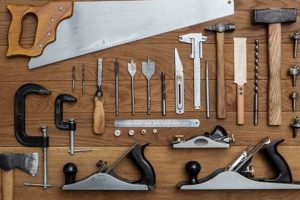
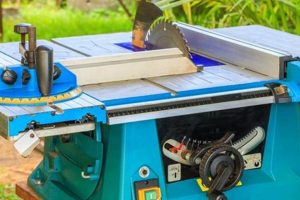
An instrument employed in woodworking for the precise determination of angular dimensions is essential for accurate construction. This category encompasses devices ranging from simple protractors to sophisticated digital angle finders, all designed to facilitate the creation of joints, bevels, and other angled cuts required in various woodworking projects. An example is a sliding bevel, which allows for the transfer of a specific angle to a workpiece for marking or cutting.
The ability to establish and replicate angles accurately is crucial for the structural integrity and aesthetic appeal of finished wood products. Precision in angular measurements reduces errors, minimizes material waste, and ensures that components fit together seamlessly. Historically, craftsmen relied on basic tools and developed keen visual estimation skills; contemporary tools offer enhanced precision and efficiency, reducing reliance on guesswork and accelerating the woodworking process.
Subsequent discussion will explore specific types of these instruments, their functionalities, and selection criteria based on the demands of particular woodworking tasks. Further examination will consider best practices for their use and maintenance, ensuring prolonged accuracy and reliability in woodworking operations.
Tips for Using Woodworking Tools for Angle Measurement
Accurate angle measurement is paramount in woodworking. These tips aim to improve precision and efficiency when using instruments designed for this purpose.
Tip 1: Select the Appropriate Instrument. Consider the specific task. A simple protractor suffices for rough measurements, while a digital angle finder is preferable for high-precision work. Ensure the chosen tool’s range and resolution meet the project’s demands.
Tip 2: Calibrate Digital Instruments Regularly. Digital angle finders require periodic calibration to maintain accuracy. Refer to the manufacturer’s instructions for the calibration procedure and frequency. Deviations from calibration standards introduce errors.
Tip 3: Maintain Cleanliness of Measuring Surfaces. Dust, debris, or adhesive residue on the tool’s measuring surfaces or the workpiece can impede accurate measurement. Clean both surfaces thoroughly before taking readings.
Tip 4: Apply Consistent Pressure. When using a sliding bevel or similar manual instrument, apply consistent, moderate pressure against the workpiece to ensure proper contact. Excessive pressure can distort readings.
Tip 5: Verify Readings with Multiple Measurements. Take several measurements of the same angle and compare the results. Discrepancies indicate potential errors in technique or tool malfunction. Recalibrate or replace the tool if inconsistencies persist.
Tip 6: Use a Sharp Marking Implement. When transferring angles to the workpiece, employ a sharp marking implement such as a precision knife or a fine-point mechanical pencil. A dull or wide marking tool introduces inaccuracies.
Tip 7: Secure the Workpiece. Ensure the workpiece is securely clamped or held in place to prevent movement during measurement and marking. Movement introduces errors, especially when working with small or irregularly shaped pieces.
Adhering to these guidelines will enhance the accuracy and repeatability of angular measurements in woodworking, leading to improved project outcomes and reduced material waste.
The subsequent section will address common errors encountered during angle measurement and strategies for their avoidance.
1. Accuracy
The correlation between accuracy and instruments utilized to determine angular dimensions in woodworking is foundational to the quality and structural soundness of finished pieces. An instrument’s capacity to provide precise measurements directly influences the accuracy of cuts, joints, and overall geometric relationships within a project. Errors in angular measurement propagate throughout the construction process, potentially leading to misaligned components, weakened joints, and a compromised aesthetic outcome. A sliding bevel gauge that deviates by even a fraction of a degree, when used repetitively, can result in cumulative errors that render a cabinet door unable to fit its frame properly.
Digital angle finders, while offering potentially higher degrees of precision, are also susceptible to inaccuracies if not properly calibrated or if subjected to environmental factors such as extreme temperatures. The selection of a suitable instrument, therefore, must consider not only its inherent accuracy but also the required precision of the specific woodworking task. For instance, furniture making, which often demands tight tolerances and visually seamless joints, necessitates instruments with a higher degree of accuracy compared to rough carpentry applications. The investment in accurate measuring tools is an investment in the overall quality and longevity of the woodworking project.
In conclusion, accuracy is an intrinsic property of instruments intended for angle measurement in woodworking, and its importance cannot be overstated. The pursuit of accuracy mandates careful selection, calibration, and maintenance of these instruments, coupled with meticulous work practices. Overlooking accuracy during the measurement phase invites complications that manifest later in the construction process, ultimately affecting the integrity and aesthetic value of the final product. Addressing this vital element of accuracy contributes directly to producing high-quality results in woodworking.
2. Calibration

Calibration represents a critical factor in the effective application of woodworking instruments designed to determine angular dimensions. The process involves verifying and adjusting the instrument’s readings against a known standard to ensure accuracy. Absence of proper calibration introduces systematic errors, leading to inaccuracies in cuts, joinery, and ultimately, the overall geometry of the woodworking project. The cause and effect relationship is straightforward: uncalibrated tools produce inaccurate measurements, resulting in flawed finished products. Calibration of digital angle finders, for example, ensures the electronic sensor outputs readings consistent with established angular references. The omission of this step renders the tool unreliable for tasks demanding precise angles.
The practical significance of calibration extends beyond individual components to the integrity of the entire woodworking project. A miter saw protractor used to cut framing elements for a cabinet, if not calibrated, can cause compounding angular errors that accumulate across multiple cuts. These errors manifest as gaps in joints, uneven surfaces, and a structurally unsound finished piece. Furthermore, calibration practices are not limited to digital instruments. Mechanical tools, such as bevel gauges, require periodic inspection and adjustment to ensure the blade and stock are aligned correctly and that the locking mechanism maintains a consistent angle setting. Neglecting this maintenance introduces inaccuracies comparable to those found in uncalibrated digital tools.
In summary, calibration constitutes an indispensable component of woodworking instruments intended for angle measurement. Its importance stems from the direct link between accurate readings and the quality, precision, and structural integrity of finished woodworking projects. Implementing regular calibration protocols and adhering to manufacturer guidelines minimize errors, reduce material waste, and contribute to professional woodworking outcomes. Calibration, when consistently applied, transcends mere tool maintenance and becomes an integral part of the woodworking process, fostering a culture of precision and accuracy.
3. Versatility

The concept of versatility, as it relates to instruments employed for determining angular dimensions in woodworking, signifies the range of applications and adaptability of a given tool to diverse tasks and materials. A versatile instrument reduces the need for multiple specialized tools, streamlines workflows, and expands the capabilities of the woodworker.
- Angle Replication Across Materials
A versatile angle-measuring tool should accurately transfer angles between different materials, such as wood, metal, or plastic. For example, a digital protractor capable of zeroing at any angle allows for the consistent replication of complex angles from a template onto the workpiece, irrespective of material composition. This minimizes errors introduced by transferring measurements using separate tools.
- Adaptability to Various Joint Types
Instruments with the capacity to measure and transfer angles for a wide range of joint types, including miter, bevel, dovetail, and compound angles, are highly versatile. A universal bevel gauge, featuring adjustable arms and a locking mechanism, facilitates the creation of precise angles for complex joinery, eliminating the need for specialized jigs or fixtures.
- Compatibility with Different Scale Systems
A versatile angle-measuring tool should ideally accommodate multiple scale systems, such as degrees, radians, or decimal angles. Instruments with switchable scale units simplify calculations and allow for seamless integration with various design software or technical drawings. For instance, a digital angle finder offering both degree and radian measurements eliminates the need for manual conversions.
- Use in Confined Spaces
Versatile tools are designed to be useful in confined areas. Examples include tools designed with shorter arm spans, folding mechanisms, or digital displays that retain values when line of sight is lost. This ensures accuracy, for example, in cabinetmaking during installations within already constructed interior spaces where typical angle-measuring tools do not fit.
The integration of these versatile attributes within a single instrument enhances efficiency, reduces the potential for error, and empowers woodworkers to tackle a broader spectrum of projects with greater confidence. Instruments that offer these diverse capabilities represent a valuable investment for any woodworking professional or enthusiast.
4. Durability

The longevity and reliability of an instrument employed to determine angular dimensions in woodworking are fundamentally intertwined with its durability. A durable instrument withstands the rigors of a workshop environment, maintaining its accuracy and functionality over extended periods. Investment in a durable tool translates directly into cost savings and consistent performance.
- Material Composition and Construction
The materials used in the construction of an angle-measuring tool significantly impact its ability to endure physical stress. Instruments crafted from hardened steel or high-impact polymers resist bending, chipping, and breaking. A protractor with a cast aluminum body, for instance, offers greater resistance to deformation compared to a similar tool made from thin plastic, ensuring accurate measurements even after accidental drops or impacts.
- Resistance to Environmental Factors
Woodworking environments often expose tools to dust, moisture, and temperature fluctuations. Durable angle-measuring instruments are designed to resist these elements. A digital angle finder with sealed electronic components is less susceptible to damage from sawdust or humidity, maintaining its accuracy and operational integrity over time. Similarly, a bevel gauge with a corrosion-resistant finish prevents rust and ensures smooth operation in damp conditions.
- Joint Integrity and Fastener Security
The robustness of the joints and the security of fasteners within an angle-measuring tool are critical for its durability. Riveted or welded joints provide greater strength and stability compared to glued or press-fit connections. A sliding bevel with a securely fastened locking mechanism maintains its angle setting under pressure, preventing slippage and ensuring consistent measurements even during repetitive use. Similarly, the fastener thread type is important.
- Protection of Measuring Surfaces and Components
Durability extends to the protection of critical measuring surfaces and internal components. Hardened scales resist wear and scratching, maintaining their legibility over time. Digital angle finders with recessed displays are less prone to damage from impacts. A bevel gauge with a protective sheath for its blade prevents accidental bending or damage during storage.
These multifaceted aspects of durability contribute directly to the long-term value and reliability of woodworking angle-measuring instruments. Investing in tools designed with these considerations in mind reduces the need for frequent replacements and ensures consistent, accurate performance throughout the tool’s service life, which improves efficiency in any wood working operation.
5. Ergonomics
Ergonomics, the science of designing tools and environments to fit the user, plays a crucial role in the efficacy of instruments employed for determining angular dimensions in woodworking. The correlation between ergonomic design and a tool’s usability directly impacts operator comfort, reduces fatigue, and minimizes the risk of repetitive strain injuries. Non-ergonomic designs lead to awkward postures, increased muscle exertion, and potential long-term health problems, directly impacting the precision and accuracy of woodworking operations. A bevel gauge with a poorly shaped handle, for example, necessitates excessive grip strength, leading to hand fatigue and diminished control, resulting in inaccurate angle measurements.
The practical application of ergonomic principles in the design of woodworking tools for angle measurement translates to several tangible benefits. Instruments featuring comfortable handles, intuitive controls, and clear visual displays enhance ease of use and minimize the potential for user error. Digital angle finders with lightweight construction and balanced weight distribution reduce strain on the wrist and forearm. Protractor heads with smooth, easily adjustable mechanisms allow for precise angle setting without requiring excessive force. Furthermore, ergonomically designed tools contribute to increased productivity. Reduced fatigue and improved comfort enable woodworkers to work for longer periods with sustained accuracy, ultimately leading to higher-quality finished products and reduced material waste. For example, a sliding t-bevel which sits comfortably in the hand will yield greater accuracy than one which requires significant finger strength.
In summary, ergonomic considerations are paramount in the design and selection of instruments for measuring angles in woodworking. The incorporation of ergonomic principles enhances user comfort, reduces fatigue, minimizes the risk of injury, and improves the overall accuracy and efficiency of woodworking tasks. Recognizing and prioritizing ergonomic design when choosing tools is an investment in the long-term health and productivity of the woodworker. Ultimately, ergonomic design enhances productivity by allowing for a comfortable and natural working environment.
6. Maintenance

The operational lifespan and accuracy of instruments employed for determining angular dimensions in woodworking are inextricably linked to consistent maintenance practices. Neglecting proper care introduces systematic errors and accelerates tool degradation, undermining the precision essential for quality woodworking. The direct relationship is evident: inadequate maintenance leads to inaccurate measurements and compromised project outcomes. A digital angle finder left exposed to moisture, for example, experiences corrosion of internal components, leading to inaccurate readings and eventual tool failure. The consequence is flawed joinery and wasted materials.
Practical significance arises from extending the service life of these instruments while upholding their accuracy. Regular cleaning removes dust, debris, and adhesive residue that can impede smooth operation and affect measurement accuracy. Lubricating moving parts, such as the blade pivot on a sliding bevel, reduces friction and prevents wear. Proper storage in a dry environment protects against corrosion and damage. Calibration, as part of routine maintenance, ensures that digital instruments retain their accuracy over time. A miter saw protractor, if not regularly calibrated, can produce compounding angular errors across multiple cuts, resulting in gaps in joints and a structurally unsound finished product. In this way, calibration as a part of maintenance contributes to structural integrity.
In summary, maintenance constitutes an indispensable element in ensuring the long-term accuracy and reliability of woodworking instruments used for angle measurement. Adherence to consistent cleaning, lubrication, proper storage, and regular calibration protocols minimizes errors, reduces material waste, and contributes to professional woodworking outcomes. The proactive implementation of maintenance transcends basic tool care and becomes an integral component of the woodworking process, promoting a culture of precision and efficiency. Ignoring this critical aspect compromises tool functionality, jeopardizes project quality, and ultimately increases operational costs due to frequent repairs or replacements. In woodworking, regular maintenance ensures that tools are ready and reliable.
Frequently Asked Questions
The following addresses common inquiries regarding the selection, application, and maintenance of instruments used to determine angular dimensions in woodworking.
Question 1: What is the acceptable tolerance for angle measurement in fine woodworking?
The acceptable tolerance varies based on the specific project requirements. Generally, tolerances within 0.5 degrees are considered acceptable for fine woodworking projects, such as cabinetry and furniture making. However, critical joints may necessitate tighter tolerances, approaching 0.1 degrees.
Question 2: How frequently should a digital angle finder be calibrated?
Calibration frequency depends on usage intensity and environmental conditions. It is recommended to calibrate digital angle finders at least every six months for regular use or more frequently if exposed to temperature extremes or physical shocks. Refer to the manufacturer’s instructions for specific calibration guidelines.
Question 3: What are the primary advantages of using a digital angle finder versus a traditional bevel gauge?
Digital angle finders offer greater precision, digital displays provide unambiguous readings, and many feature the ability to zero at any angle, which is useful in replicating complex angles. Bevel gauges are less expensive, do not require batteries, and are more robust in demanding workshop environments. The choice depends on the projects precision requirements.
Question 4: Can instruments used for angle measurement be employed for other purposes in woodworking?
Certain angle-measuring instruments, such as combination squares with protractor heads, can serve multiple purposes, including measuring length, depth, and marking parallel lines. However, it is crucial to ensure that the tool is properly calibrated and appropriate for the specific task to maintain accuracy.
Question 5: What are the potential sources of error when using a sliding bevel gauge?
Potential sources of error include loose or worn locking mechanisms, inaccurate reference surfaces, parallax error when reading the angle against a scale, and inconsistent pressure applied during measurement. Regular inspection and maintenance are essential to minimize these errors.
Question 6: How does wood movement affect the accuracy of angular measurements in completed woodworking projects?
Wood movement due to changes in humidity and temperature can alter the angles of joints and components in completed projects. Careful wood selection, proper joint design, and appropriate finishing techniques minimize the impact of wood movement on angular stability.
Accuracy, calibration, and proper technique are of utmost importance for woodworking instruments used for angular measurements. A suitable measuring tool, used correctly, is an asset to woodworking.
The subsequent discussion will shift towards common pitfalls in the use of woodworking tools used to measure angles, and methods to avoid these mistakes.
Conclusion
The preceding discourse has illuminated the multifaceted nature of the woodworking tool to measure angles. Accuracy, calibration, versatility, durability, ergonomics, and maintenance have been identified as critical attributes governing the efficacy of these instruments. Precise angle determination is paramount for structural integrity and aesthetic quality in woodworking endeavors. Inattention to any of these factors can lead to diminished outcomes.
Continued vigilance in the selection, application, and upkeep of woodworking tools designed for angle measurement is essential for achieving consistent, professional-grade results. A commitment to precision serves as the cornerstone of successful woodworking practice, ensuring lasting quality in crafted objects. The integration of informed technique with reliable instrumentation represents a hallmark of skilled craftsmanship.