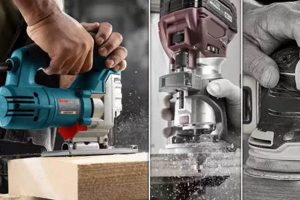
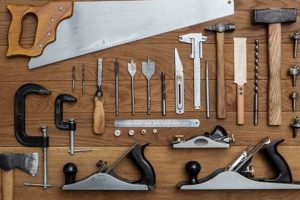
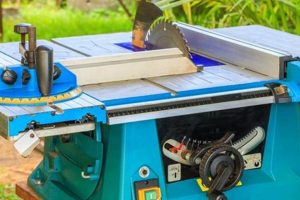
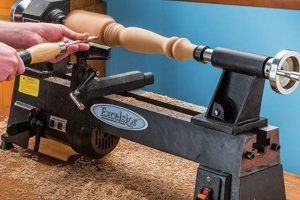
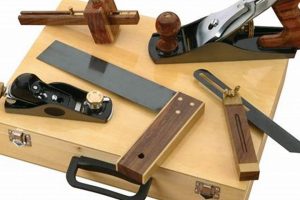
The act of creating implements specifically purposed for shaping and manipulating wood forms the backbone of skilled craftsmanship. This involves a spectrum of processes, ranging from forging metal blades to shaping wooden handles, all tailored to achieve precise functionality. For instance, crafting a hand plane requires meticulous attention to the sole’s flatness and the blade’s sharpness to ensure smooth and even cuts.
Historically, the ability to produce implements for manipulating timber has been fundamental to societal development. From constructing shelters and furniture to creating intricate artwork, these capabilities have been essential. The quality and precision of these devices directly influence the efficiency, accuracy, and overall aesthetic of finished wooden products. Furthermore, the creation process fosters a deeper understanding of materials, mechanics, and the principles of engineering.
Subsequent sections will explore various facets of this practice, including the selection of appropriate materials, the techniques involved in shaping and hardening metal components, the design considerations for ergonomic handles, and the calibration processes necessary to achieve optimal performance.
Guidance on Fabrication of Woodworking Instruments
The following guidelines offer focused advice on the processes involved in the creation of implements intended for woodworking. Adherence to these principles will promote enhanced precision, durability, and overall utility.
Tip 1: Material Selection: Exercise diligence in the selection of materials. High-carbon steel is preferable for blades due to its ability to maintain a sharp edge. Dense hardwoods, such as maple or beech, are appropriate for handles, providing both durability and comfortable grip.
Tip 2: Forging Techniques: Employ proper forging techniques to shape metal components. Controlled heating and hammering are crucial to avoid compromising the steel’s integrity. Repeated heating and quenching cycles refine the metals grain structure.
Tip 3: Hardening and Tempering: Implement appropriate hardening and tempering processes. Hardening increases the steels strength, while tempering reduces brittleness. These steps are critical for creating durable and functional cutting edges.
Tip 4: Precision Grinding: Practice precision grinding techniques to achieve accurate bevel angles on blades. Utilize jigs or fixtures to maintain consistent angles. Finer grits are required for achieving a polished, sharp edge.
Tip 5: Handle Ergonomics: Prioritize ergonomic design in handle construction. Contoured shapes that conform to the hand reduce fatigue and enhance control. Smooth finishes prevent blisters and improve grip.
Tip 6: Calibration and Adjustment: Implement rigorous calibration procedures to ensure accuracy. Squares, levels, and measuring instruments are vital for verifying alignment and parallelism. Regular adjustments may be needed to compensate for wear.
Tip 7: Secure Fastenings: Ensure robust fastenings between components. Dovetail joints, mortise-and-tenon joints, or high-strength adhesives provide secure connections between handles and blades. Consider mechanical fasteners for added security.
Following these guidelines will contribute to the production of durable, accurate, and ergonomic woodworking instruments. Skillful application of these principles will lead to enhanced efficiency and satisfaction in woodworking endeavors.
The subsequent discussion will delve into the evaluation and maintenance of self-fabricated implements.
1. Material Selection

Material selection is paramount in the creation of implements for woodworking, dictating the tool’s durability, performance, and suitability for specific tasks. Choosing appropriate materials is not merely a matter of preference, but a critical decision that impacts the tool’s long-term utility.
- Steel Composition for Blades
The type of steel selected for blades directly affects its hardness, edge retention, and resistance to wear. High-carbon steels, such as O1 or A2, are frequently chosen due to their capacity to achieve and maintain a keen edge. Conversely, stainless steel, while corrosion-resistant, typically does not offer the same level of hardness. Therefore, the intended use of the tool dictates the appropriate steel composition.
- Hardwood Selection for Handles
The choice of hardwood for handles influences the tool’s comfort, grip, and structural integrity. Dense, close-grained hardwoods like maple, beech, or walnut are preferred for their strength and resistance to splitting. The grain orientation is also critical, with long grain running parallel to the handle’s length for maximum strength. Less dense woods may be more prone to cracking or splintering under stress.
- Fastener Materials
The fasteners that secure the blade to the handle, or join different parts of the tool, must be compatible with the other materials and offer sufficient strength. Brass or steel rivets, for example, are commonly employed. The choice of fastener material must consider potential corrosion and galvanic reactions with other metallic components.
- Abrasives for Sharpening
While not a direct component of the woodworking implement itself, the abrasive material used for sharpening plays a significant role in maintaining its performance. Natural stones, ceramic stones, and diamond plates each offer varying levels of abrasive power and are selected based on the type of steel and the desired degree of sharpness. Consistent sharpening with appropriate abrasives ensures the tool remains effective.
The careful selection of materials is an indispensable aspect of the tool-making process. The properties of these materials dictate the tool’s potential, influencing its lifespan, efficiency, and the quality of work it can produce. Therefore, thorough consideration of material properties is essential for the creation of durable and effective implements for woodworking.
2. Forging Techniques
The efficacy of woodworking implements is intrinsically linked to the forging techniques employed during their creation. Forging, the process of shaping metal through localized compressive forces, significantly alters the metal’s microstructure, thereby dictating its strength, toughness, and wear resistance. The application of forging techniques in creating tools for woodworking is not merely an aesthetic consideration, but a functional necessity that influences the longevity and performance of the final product. An inadequately forged blade, for example, may be prone to chipping or premature dulling, rendering it unsuitable for precise woodworking operations.
Specific forging techniques, such as drawing out, upsetting, and bending, are applied to achieve the desired shape and properties of the tool. Drawing out, the process of lengthening a piece of metal while reducing its cross-sectional area, is frequently used to create the elongated shape of a chisel blade. Upsetting, conversely, increases the cross-sectional area of a section of metal, often used to form the head of a hammer. Bending manipulates the metal’s form to create curves or angles, essential for shaping tools like gouges or drawknives. Careful control of temperature and force during these operations is crucial to prevent defects such as cracks or inclusions, which compromise the metal’s integrity.
Mastery of forging techniques represents a critical skill for those involved in producing high-quality woodworking instruments. The proper application of these techniques leads to tools that are not only functional but also durable and reliable, capable of withstanding the rigors of repeated use. Challenges in forging often stem from inconsistencies in heating, inadequate control of hammering force, or insufficient knowledge of the metal’s response to deformation. Overcoming these challenges requires a thorough understanding of the material properties and a commitment to refining forging skills. In conclusion, forging techniques are an indispensable component in the creation of effective and durable woodworking implements, forming a direct link between the craft of blacksmithing and the art of woodworking.
3. Heat Treatment

Heat treatment is a critical process in the fabrication of woodworking instruments, directly influencing the mechanical properties of the metal components, particularly the blades and cutting edges. This process involves controlled heating and cooling cycles to alter the metal’s microstructure, optimizing its hardness, toughness, and wear resistance. Improper heat treatment renders even the most precisely forged blade unusable, leading to premature failure or inadequate cutting performance. A chisel, for instance, improperly hardened, might chip or deform upon impact, while one not tempered sufficiently may be too brittle for practical use. Consequently, understanding the principles and practical applications of heat treatment is fundamental to the successful manufacture of durable and effective woodworking implements.
The specific heat treatment regimen varies depending on the type of steel used. Common practices include hardening, tempering, and annealing. Hardening involves heating the steel to a critical temperature followed by rapid quenching, typically in water or oil, to create a martensitic structure that is exceptionally hard but also brittle. Tempering follows hardening, involving reheating the steel to a lower temperature to reduce brittleness and increase toughness. Annealing, conversely, involves heating the steel to a specific temperature and allowing it to cool slowly, relieving internal stresses and making it more machinable. The precise temperatures and cooling rates are crucial; deviations can lead to undesired metallurgical transformations, negatively impacting the tool’s performance. For example, over-tempering a plane blade results in a loss of hardness, causing the edge to dull rapidly, while insufficient tempering leaves the blade vulnerable to shattering.
In summary, heat treatment is not merely a supplementary step in creating woodworking tools but an essential process that determines their ultimate functionality and longevity. The success of hardening, tempering, and annealing depends on a thorough understanding of the specific steel’s properties and careful control of temperature and cooling rates. Recognizing the practical significance of heat treatment allows tool makers to produce instruments that meet the rigorous demands of woodworking, ensuring both precision and durability in the crafted product.
4. Ergonomic Design

Ergonomic design, in the context of crafting implements for woodworking, is a critical consideration that directly influences user comfort, safety, and efficiency. The design principles aim to minimize physical strain and fatigue by tailoring the tool to the human form and its natural movements. Proper ergonomic design is not merely an aesthetic enhancement; it is an essential factor determining the long-term usability and effectiveness of the tool.
- Handle Shape and Size
The shape and size of the handle are paramount for a comfortable and secure grip. Handles should be contoured to fit the hand, distributing pressure evenly and reducing stress on specific points. For instance, a handle that is too small can cause cramping, while one that is too large may be difficult to control. The circumference, length, and overall shape must be optimized to accommodate a range of hand sizes and grip styles. A well-designed handle facilitates precise control and reduces the risk of slippage, improving safety and accuracy.
- Material Selection for Handles
The material chosen for the handle affects both comfort and grip. Hardwoods like maple or beech offer durability and can be shaped to ergonomic contours. However, the surface finish is equally important; a smooth, polished finish reduces friction and prevents blisters, while a textured surface enhances grip, particularly in humid conditions. The selected material should also be resistant to wear and tear, maintaining its ergonomic properties over time. The material properties will influence force required to hold the tool.
- Weight and Balance
The overall weight and balance of the tool significantly impact user fatigue and control. A tool that is too heavy requires more effort to use, leading to quicker exhaustion. Conversely, a tool that is too light may lack the necessary momentum for certain tasks. The balance point should be positioned to minimize wrist strain, allowing the user to maintain a stable and controlled grip. A balanced tool enhances precision and reduces the risk of accidental movements.
- Vibration Dampening
For power tools, vibration dampening is a crucial ergonomic consideration. Excessive vibration can lead to hand-arm vibration syndrome (HAVS), a debilitating condition affecting blood vessels, nerves, and joints. Ergonomic designs incorporate vibration-dampening materials and mechanisms to minimize the transmission of vibrations to the user’s hands and arms. Proper vibration dampening improves user comfort, reduces the risk of injury, and allows for prolonged use without significant discomfort.
These ergonomic considerations are integral to the successful creation of tools for woodworking. Integrating these design principles into the manufacturing process enhances tool usability, promotes user safety, and ultimately contributes to higher-quality workmanship. Ergonomically designed tools become extensions of the craftsmans hand, enabling precise and efficient manipulation of wood.
5. Sharpening Proficiency

Sharpening proficiency represents an indispensable element in the successful creation and maintenance of woodworking implements. The act of fabricating a cutting tool is rendered incomplete without the ability to establish and maintain a keen edge. Sharpness directly influences the tool’s ability to cleanly sever wood fibers, impacting the precision and quality of the finished product. A dull blade, for instance, tears and crushes the wood, resulting in a rough surface and inaccurate dimensions. Sharpening proficiency, therefore, is not merely a complementary skill but an integral component of effective tool creation and utilization.
The connection between the creation and maintenance of woodworking tools is also paramount in this context. The initial creation process dictates the tool’s geometry and steel quality, factors that directly influence the sharpening process. Complex bevels, for instance, require specialized sharpening techniques, while the steel’s hardness and composition determine the appropriate abrasive materials. Regular maintenance sharpening is essential to preserve the tool’s intended geometry and cutting performance, extending its lifespan and ensuring consistent results. A meticulously crafted plane iron, without periodic sharpening, will rapidly degrade in performance, necessitating frequent regrinding or replacement. This reinforces the cyclical relationship between crafting and maintaining edged woodworking instruments. The tool’s steel is also a factor. Some steel will not hold the edge as long as other steels.
In summary, the proficiency in sharpening directly affects the tool’s utility and longevity, and therefore, the ultimate quality of the woodworking outcome. The skill is interwoven with both the initial crafting and ongoing maintenance phases of a tool’s lifecycle. Recognizing the central role of sharpening in the creation and maintenance of woodworking implements provides a comprehensive understanding of the entire process. This recognition emphasizes the need for continuous skill development to achieve optimum performance of woodworking cutting instruments.
Frequently Asked Questions
The following addresses common inquiries concerning the design, fabrication, and maintenance of woodworking tools, providing information intended to clarify prevalent misconceptions and impart useful knowledge.
Question 1: What type of steel is most suitable for woodworking blades?
High-carbon steel alloys, such as O1, A2, or tool steel, are generally preferred for blades due to their ability to achieve and retain a sharp edge. These steels can be hardened and tempered to provide a balance of hardness, toughness, and wear resistance. Specific alloy composition influences resistance to abrasion.
Question 2: How does heat treatment affect the performance of a woodworking chisel?
Heat treatment, including hardening and tempering, significantly influences the chisel’s hardness, toughness, and ability to hold an edge. Hardening increases the steel’s hardness, while tempering reduces brittleness, preventing chipping. Precise temperature control during heat treatment is essential to achieve optimal mechanical properties.
Question 3: What are the key ergonomic considerations for designing a woodworking tool handle?
Ergonomic design focuses on handle shape, size, material, and surface finish. The handle should conform to the hand, distributing pressure evenly. Hardwoods such as maple or beech are commonly used for handles, and a smooth finish prevents blisters. The overall weight and balance of the tool are also ergonomic factors.
Question 4: What is the importance of consistent sharpening in woodworking?
Consistent sharpening is essential for maintaining the tool’s cutting efficiency, precision, and safety. A sharp blade severs wood fibers cleanly, producing smooth surfaces and accurate dimensions. Regular sharpening also reduces the force required to use the tool, minimizing fatigue and the risk of accidents.
Question 5: How does the geometry of a cutting edge impact its performance in woodworking?
The angle and shape of the cutting edge determine its aggressiveness and suitability for different wood types and tasks. A steeper angle provides a more durable edge, while a shallower angle creates a sharper but more delicate edge. The edge geometry must be appropriate for intended task and the wood’s characteristics.
Question 6: What considerations should be made when selecting materials for tool components besides the blade and handle?
Materials for fasteners, adjustment mechanisms, and other components should be chosen based on durability, corrosion resistance, and compatibility with other materials. Brass or steel are common choices for fasteners. Proper material selection ensures the long-term reliability and functionality of the entire instrument.
In summary, effective tool making involves a comprehensive understanding of materials, heat treatment, ergonomic design, sharpening techniques, and edge geometry. These elements collectively determine the tool’s performance and longevity.
The subsequent section will delve into advanced techniques and specialized processes related to the creation of tools for woodworking.
Conclusion
The preceding discussion examined varied aspects of the creation of implements intended for woodworking. The areas of focus included material selection, forging methods, heat treatment, ergonomic design, sharpening techniques, and crucial considerations for material compatibility, all of which are integral to the creation of reliable tools. A detailed understanding of these elements allows for the construction of instruments suitable for diverse woodworking activities.
Further research and practical experimentation are encouraged to refine existing techniques and explore new methodologies for tool creation. The ongoing pursuit of innovation and mastery within this field will contribute to improvements in craftsmanship, accuracy, and efficiency in woodworking practices. A dedication to excellence in this field will advance the standards and capabilities of the craft.