



Implements employed in the shaping, cutting, and joining of wood are essential for various construction and artistic endeavors. These instruments range from hand-operated devices requiring manual force to sophisticated power tools that automate and expedite the woodworking process. Examples include saws for cutting, planes for smoothing, chisels for shaping, and drills for creating holes.
The proper selection and skilled application of these instruments are crucial for achieving precision, efficiency, and safety in woodworking projects. The historical evolution of these instruments reflects advancements in metallurgy, engineering, and manufacturing, impacting both the quality and scale of woodworking production. Mastery of these tools unlocks the ability to create durable structures, intricate designs, and functional objects.
This discussion will explore a range of equipment essential for the woodworker, categorized by their primary function. Categories will include tools for measuring and marking, cutting and shaping, joining, and finishing, providing a detailed overview of their uses and applications within the craft.
Guidance on Equipment for Woodworking
The selection and maintenance of woodworking equipment can significantly impact project quality and longevity. This section provides essential guidance for both novice and experienced woodworkers.
Tip 1: Prioritize Safety Equipment. Prior to operating any machinery, ensure the availability and proper use of safety glasses, hearing protection, and dust masks. Accidents can be minimized through proactive measures.
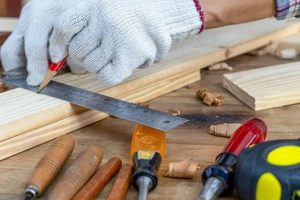
Tip 2: Invest in Quality Measuring Instruments. Accurate measurements are fundamental. A quality steel rule, combination square, and marking gauge will ensure precision in layout and cutting.
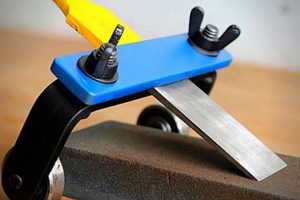
Tip 3: Sharpening is Paramount. Dull blades and chisels compromise control and increase the risk of injury. Regularly hone and sharpen cutting edges to maintain optimal performance.
Tip 4: Choose the Right Saw for the Task. Different saws are designed for specific cuts. A rip saw is suited for cutting with the grain, while a crosscut saw is designed for cutting against it. Selecting the appropriate saw improves efficiency and reduces splintering.
Tip 5: Understand Wood Grain. The direction of wood grain affects cutting and finishing. Work with the grain to minimize tear-out and ensure a smooth surface.
Tip 6: Proper Tool Storage. Organize equipment in a designated area to prevent damage and ensure easy access. A well-organized workspace enhances productivity.
Tip 7: Regularly Inspect Power Cords. Frayed or damaged power cords pose a significant safety hazard. Inspect cords before each use and replace them immediately if damage is detected.
Adhering to these recommendations will enhance the safety, accuracy, and efficiency of woodworking endeavors.
The following sections will delve into more specific applications of this advice within various woodworking processes.
1. Cutting Instruments

The category of cutting implements forms a core component within the broader set of devices employed in woodworking. Saws, chisels, knives, and axes all fall under this designation, each designed for specific material removal tasks. The effectiveness of the woodworking process is intrinsically linked to the quality and appropriate selection of these implements. Cause and effect is evident: dull or improperly selected instruments lead to inaccurate cuts, splintering, and increased project completion time. The sharp edge of a chisel, properly applied, yields clean joints. A dull saw blade results in uneven cuts and requires excessive force, thereby compromising safety and precision.
The practical significance of understanding cutting tools extends beyond mere usage. Different saw types (rip, crosscut, coping) address distinct cutting requirements relative to wood grain direction and shape. Chisels, available in various sizes and edge profiles, cater to refining joints, carving details, or removing waste material. Power saws, such as circular saws and jigsaws, enhance cutting speed and accuracy for larger projects but require adherence to strict safety protocols. The proper maintenance, including sharpening and blade selection, directly affects cut quality and worker safety. Selecting the right tool for the cut is as crucial as the cutting itself.
In summary, cutting instruments represent a vital component of this practice, with their effectiveness directly influencing project outcomes. Challenges in woodworking often stem from inadequate or improperly maintained tools. Understanding the capabilities and limitations of various cutting implements and selecting the appropriate device ensures accuracy, efficiency, and safety. The interrelation between these tools and overall woodworking quality emphasizes their central role.
2. Shaping Instruments

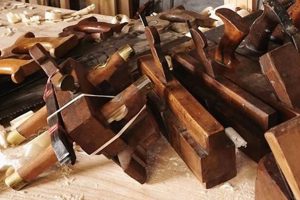
The term “shaping instruments” denotes a subset of devices dedicated to refining the form and surface characteristics of wood, forming a crucial element within the broader category of “woodworking equipment.” These instruments facilitate the removal of material in a controlled manner, enabling the creation of specific profiles, curves, and surface textures. The operational effectiveness of these instruments has a direct causal relationship with the final aesthetic and functional qualities of a woodworking project. For instance, a hand plane, when skillfully applied, generates surfaces with exceptional smoothness and flatness, properties difficult to achieve through other means. Conversely, improperly maintained or incorrectly selected shaping instruments will invariably result in substandard surface finishes and dimensional inaccuracies.
Practical applications of shaping instruments span a wide range of woodworking disciplines. In furniture making, spokeshaves are employed to create curved elements such as chair legs and spindles. Carving chisels, possessing various edge profiles, are used to sculpt intricate decorative details. Surform tools and rasps are valuable for rapidly removing stock to establish a rough form before employing finer shaping instruments. The selection of an appropriate shaping implement is predicated on factors such as the wood species, the desired degree of precision, and the complexity of the intended shape. For example, shaping harder wood species like maple requires tools with sharper cutting edges and robust construction to prevent premature wear or breakage. Examples like this support the idea that the skill-based knowledge in selection process has direct impact to the final outcome.
In summary, shaping instruments are integral to achieving refined forms and surfaces in woodworking. Their impact extends beyond mere material removal, influencing the aesthetic and functional properties of the final product. Challenges associated with their use, such as tear-out and dimensional inaccuracies, can be mitigated through proper tool selection, maintenance, and application techniques. Thus, a thorough understanding of shaping instruments is essential for any woodworker striving for high-quality craftsmanship.
3. Measuring Instruments

Precision in woodworking is directly predicated upon the accurate use of measuring instruments. These tools are indispensable for establishing dimensions, marking cutting lines, and ensuring the proper alignment of components during assembly. Their role is fundamental, influencing the dimensional accuracy and structural integrity of any woodworking project.
- Rules and Measuring Tapes
These linear measurement devices provide a direct indication of length, width, and height. They are used for establishing overall project dimensions and transferring measurements from plans to the workpiece. Inaccuracy in using these devices results in dimensional errors that accumulate throughout the project.
- Squares and Bevels
Squares, including combination squares and try squares, are essential for ensuring right angles and perpendicularity. Bevels, both fixed and adjustable, allow for the precise transfer and replication of angles. Ensuring accurate angles is crucial for structural stability and aesthetic appeal.
- Calipers
Calipers, both digital and dial, offer precise measurements of thickness, diameter, and internal dimensions. They are used to ensure consistency in material thickness and to create tight-fitting joints. Their precision is vital for intricate projects requiring exacting tolerances.
- Marking Gauges
Marking gauges are specialized tools for scribing parallel lines at a set distance from an edge. They are used for marking mortise and tenon joints, rabbets, and other edge details. Consistent, accurate marking ensures that joinery fits correctly and that edge details are uniform.
The examples above demonstrate that these instruments are integral to this process. Precision, accuracy, and quality of construction rely significantly on proper selection and use of these instruments.
4. Fastening Instruments

Fastening instruments represent a critical subset within woodworking implements. These instruments facilitate the secure joining of wooden components, influencing the structural integrity and longevity of finished projects. The proper selection and application of these tools are paramount to successful woodworking outcomes.
- Screwdrivers and Drills
Screwdrivers, both manual and powered, drive screws into wood, creating a mechanical bond. Drills create pilot holes to ease screw insertion and prevent splitting. The compatibility of screw type, pilot hole size, and driving force is crucial for joint strength. Inadequate pilot holes or excessive torque can lead to screw breakage or wood damage, compromising the integrity of the assembly.
- Hammers and Mallets
Hammers are used to drive nails and brads, providing a quick and efficient fastening method. Mallets, constructed from wood or rubber, deliver controlled blows for assembling joints or shaping wood without causing damage. The choice between a hammer and a mallet depends on the fastening material and the delicacy of the workpiece. Improper hammering can result in bent nails or marred surfaces.
- Clamps
Clamps exert pressure to hold components together while adhesives cure or mechanical fasteners are installed. Various clamp types, including bar clamps, pipe clamps, and spring clamps, cater to different workpiece shapes and sizes. Consistent clamping pressure ensures tight joints and prevents warping during the bonding process. Insufficient clamping can lead to weak joints or gaps in the assembly.
- Nail Guns and Staplers
Pneumatic nail guns and staplers rapidly drive nails or staples, increasing efficiency in large-scale woodworking projects. These tools require careful adjustment to ensure proper fastener depth and prevent damage to the workpiece. Over-driving fasteners can weaken the wood, while under-driving them compromises the holding power of the joint.
The effectiveness of these fastening instruments directly impacts the stability and durability of woodworking creations. Understanding the nuances of each instrument and applying them appropriately is essential for achieving professional-quality results. The strategic use of fastening instruments, in conjunction with other woodworking tools, enables the creation of complex and enduring structures.
5. Finishing Instruments

Finishing instruments constitute a crucial category within the broader spectrum, influencing the final appearance and protective qualities of woodworking projects. These implements are employed to prepare surfaces, apply coatings, and enhance the aesthetic appeal of wooden objects.
- Sanders and Abrasives
Sanders, available in various types (orbital, belt, detail), remove imperfections, smooth surfaces, and prepare wood for coatings. Abrasives, such as sandpaper and sanding pads, range in grit size, determining the level of surface refinement. The careful selection and progressive use of abrasives are essential for achieving a flawless finish. Improper sanding can result in scratches, uneven surfaces, and compromised coating adhesion.
- Brushes and Applicators
Brushes apply coatings such as paints, stains, varnishes, and sealers. Brush type (natural bristle, synthetic) and applicator material (foam, cloth) influence the consistency and uniformity of the finish. Proper brush care and application techniques are vital for avoiding brush marks, drips, and uneven coverage. The choice of applicator must be aligned with the coating material to ensure optimal performance.
- Sprayers
Sprayers, including airless and HVLP (High Volume Low Pressure) systems, atomize coatings into a fine mist, enabling rapid and uniform application on complex surfaces. Sprayers require careful adjustment of pressure, nozzle size, and viscosity to achieve optimal atomization and prevent runs or orange peel texture. Proper ventilation and safety precautions are essential when using sprayers due to the potential for inhalation hazards.
- Polishing Compounds and Buffing Wheels
Polishing compounds and buffing wheels enhance the gloss and clarity of coated surfaces. Polishing compounds contain abrasive particles that remove fine scratches and swirl marks, while buffing wheels distribute the compound and create a smooth, reflective finish. The selection of appropriate compounds and buffing wheels depends on the type of coating and the desired level of gloss. Over-buffing can generate excessive heat, damaging the finish.
These implements contribute significantly to the overall quality and durability of woodworking projects. The skillful application of these instruments, coupled with a thorough understanding of coating materials, is essential for achieving professional-grade results. The selection and utilization of finishing instruments is thus integral to this practice and reflects in the final product.
Frequently Asked Questions About Essential Woodworking Instruments
This section addresses common inquiries regarding instruments used in this domain, providing objective information for both novice and experienced practitioners.
Question 1: What constitutes a fundamental set of instruments for commencing woodworking projects?
A foundational collection typically includes a measuring tape, combination square, hand saw, set of chisels, smoothing plane, and various clamps. This selection enables basic cutting, shaping, and joining operations, providing a starting point for developing skills.
Question 2: How does one determine the appropriate saw for a specific cutting task?
Saw selection hinges on the type of cut required. Rip saws are designed for cutting parallel to the wood grain, while crosscut saws are intended for perpendicular cuts. Coping saws facilitate curved cuts, and backsaws offer precision in joinery. The choice depends on the orientation and complexity of the cut.
Question 3: What are the essential safety precautions to observe when operating power instruments?
Safety protocols mandate the use of eye protection, hearing protection, and dust masks. Workpieces must be securely clamped to prevent movement. Power cords should be inspected for damage. Operators should maintain focus and avoid distractions, adhering to manufacturer guidelines.
Question 4: What is the recommended method for maintaining the sharpness of cutting edges?
Sharpening frequency depends on usage and material. Chisels and plane irons benefit from regular honing with a fine-grit sharpening stone. Dull edges increase the risk of injury and compromise cut quality. Power saw blades should be replaced or professionally sharpened when performance diminishes.
Question 5: How should one approach the selection of wood finishes for different projects?
Finish selection is influenced by the desired aesthetic, the intended use of the object, and the wood species. Interior projects often employ varnish, lacquer, or oil finishes. Exterior applications necessitate weather-resistant coatings. Consider the drying time, durability, and VOC content of the chosen finish.
Question 6: What are the critical factors in selecting instruments for intricate woodworking projects?
Intricate work requires instruments capable of precise control and fine detail. Small chisels, detail knives, and carving tools are essential. Magnifying devices may aid in visual accuracy. Proper lighting and a stable workbench contribute to successful execution.
This overview provides clarity on key aspects of equipment within this domain. Mastery of techniques and equipment ensures successful outcomes.
The following article section explores advanced strategies.
Conclusion
This exploration has detailed a range of implements employed in woodworking, encompassing cutting, shaping, measuring, fastening, and finishing processes. Each category contains a variety of instruments designed for specific tasks, with the selection dependent on project requirements and desired outcomes. Maintenance and correct application of these devices are integral to achieving precision, safety, and structural integrity.
Proficient utilization of these instruments enables the creation of functional and aesthetically pleasing wooden objects. Continued development in woodworking technologies ensures ongoing refinement of the craft, prompting practitioners to remain abreast of advancements and refine their skills. Woodworking remains a practice where skillful application of these tools enables both functional and artistic ends.

![Best Multi Tool Woodworking Station [Guide] | Step-by-Step Guides, Tools & Inspiration to Build Beautiful Wooden Decor on a Budget](https://woodfromhome.com/wp-content/uploads/2026/04/th-259-300x200.jpg "Best Multi Tool Woodworking Station [Guide] Step-by-Step Guides, Tools & Inspiration to Build Beautiful Wooden Decor on a Budget")