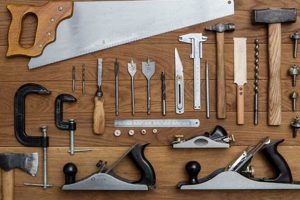
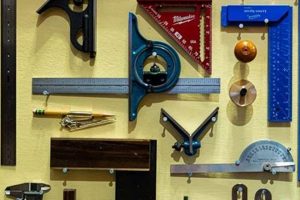
Implements employed in dimensional assessment, layout, and verification during the fabrication of items from lumber are fundamental to the craft. These instruments allow for precise cuts, accurate joinery, and consistent reproduction of design specifications in wood-based projects. Examples include rulers, squares, levels, marking gauges, and calipers, each serving a distinct purpose in ensuring accuracy.
The accuracy afforded by these instruments is paramount for structural integrity, aesthetic appeal, and overall project success. Historically, advancements in these instruments have directly correlated with increased complexity and sophistication in joinery and woodworking techniques. The use of precise instruments minimizes material waste, reduces errors, and contributes to the longevity of finished products. From simple furniture construction to intricate carving, accurate measurement is essential.
The subsequent sections will explore specific categories of these instruments, detailing their individual functions, optimal usage, and maintenance considerations. This will include an overview of linear measurement devices, angle measurement tools, and instruments used for marking and layout, providing a comprehensive understanding of their application in various woodworking scenarios.
Guidance on Precision in Lumber Fabrication
The following points emphasize practices to ensure accuracy and efficiency when employing dimensional assessment instruments during lumber fabrication.
Tip 1: Prioritize Calibration. Regularly verify the accuracy of instruments against known standards. Even high-quality devices can drift over time, affecting project outcomes.
Tip 2: Employ the Correct Instrument. Utilize specialized tools for specific tasks. A combination square is superior to a ruler for establishing perpendicular lines, while a marking gauge ensures consistent parallel lines.
Tip 3: Maintain Consistent Pressure. When using a ruler or straightedge, apply uniform pressure to prevent slippage or bowing, ensuring accurate readings.
Tip 4: Consider Parallax Error. Position the eye directly perpendicular to the scale when taking measurements to avoid distortion caused by viewing angles.
Tip 5: Account for Kerf. Precisely measure and consider the width of saw blades when cutting to ensure components meet exact dimensions.
Tip 6: Store Instruments Properly. Protect devices from physical damage and environmental factors. Proper storage prolongs instrument life and maintains accuracy.
Tip 7: Regular Cleaning. Wipe down tools, especially after marking with pencils or pens. A clean tool yields clearer marks and reduces wear.
Adhering to these guidelines promotes precision, minimizes material waste, and contributes to the creation of high-quality, dimensionally accurate lumber projects.
The article will now transition to a detailed exploration of specific instruments and their applications in various lumber fabrication techniques.
1. Accuracy Verification

Accuracy verification constitutes a critical process in woodworking, ensuring that instruments used for measurement provide reliable and consistent readings. This process directly influences the precision of cuts, joinery, and overall dimensional consistency in woodworking projects. The integrity of the finished product hinges on the accurate application of these instruments.
- Standard Measurement Comparison
This involves comparing the readings of instruments against known standards, such as certified gauge blocks or precision rulers. Discrepancies indicate the need for calibration or replacement of the instrument. For instance, a ruler can be checked against a steel rule known to be accurate. If the ruler consistently deviates, it is unreliable for precision applications. This verification minimizes cumulative errors in complex projects requiring multiple measurements.
- Regular Calibration Intervals
Establishing a routine for calibration is crucial. The frequency depends on the tool’s usage and environmental conditions. Tools subjected to heavy use or exposed to temperature fluctuations should be calibrated more frequently. Calibration involves adjusting the instrument to align with known standards. For example, a digital caliper may have a zeroing function that needs periodic adjustment to ensure readings start from absolute zero. This proactive approach prevents systematic errors that can compromise project quality.
- Environmental Influence Assessment
Environmental factors such as temperature and humidity can impact the accuracy of instruments. Wood expands and contracts with changes in moisture content, and metal components in tools can also be affected by temperature. Ideally, measurements should be taken in a controlled environment, or adjustments should be made to compensate for environmental effects. For example, using a steel ruler on a cold day may result in slightly different readings compared to a warm day, requiring a correction factor for extreme cases.
- Instrument Maintenance and Handling
Proper maintenance and handling significantly affect the long-term accuracy of tools. Cleanliness is essential, as debris can interfere with precise measurements. Tools should be stored in a manner that protects them from physical damage and environmental exposure. For example, storing a precision square improperly can lead to warping, rendering it inaccurate. Regular inspection and care ensure sustained reliability.
These facets of accuracy verification directly impact the quality and longevity of woodworking projects. The consistent application of these practices minimizes errors, reduces material waste, and ensures the structural integrity and aesthetic appeal of finished items. The reliability of instruments forms the foundation of precise woodworking.
2. Tool Calibration
Tool calibration, in the context of dimensional assessment in woodworking, constitutes a fundamental process for ensuring the reliability and accuracy of instruments. It directly impacts the precision of measurements, affecting the fit and finish of woodworking projects. Uncalibrated instruments introduce systematic errors, potentially leading to inaccuracies that compromise structural integrity and aesthetic quality.
- Standardization Against Known References
Calibration involves comparing instrument readings against established standards. These standards may include gauge blocks, certified rulers, or laser distance measures with documented traceability. This process identifies deviations and allows for adjustments to align the instrument with accepted norms. For instance, a dial caliper is calibrated by verifying its readings against a set of gauge blocks of known dimensions. Any discrepancies are corrected through mechanical adjustments or digital recalibration. The application of established benchmarks minimizes variability, leading to consistent and reliable results.
- Frequency and Environment
The regularity of calibration depends on tool usage and environmental conditions. High-use instruments, or those exposed to fluctuations in temperature and humidity, require more frequent checks. Environmental factors can affect the physical properties of tools, leading to measurement drift. A metal ruler, for example, expands slightly with increasing temperature. Calibration schedules should account for these variables. Documented procedures ensure adherence to calibration protocols, maintaining consistent quality over time.
- Calibration Procedures and Documentation
Calibration protocols typically involve a series of measurements taken at various points along the instrument’s range. These measurements are compared to known standards, and any deviations are recorded. Adjustments are then made to correct for these errors. Detailed documentation of the calibration process, including dates, standards used, and adjustments made, is essential for traceability and quality control. This documentation provides a historical record of instrument performance, allowing for the identification of trends and potential issues.
- Impact on Project Accuracy
The cumulative effect of uncalibrated tools can be significant, particularly in projects requiring precise joinery or complex assemblies. Seemingly minor errors in individual measurements can compound, leading to misaligned components and structural weaknesses. For instance, an inaccurate miter saw resulting from poor calibration can produce angled cuts deviating from the design specifications, which results in gaps and instability in the final structure. Accurate calibration, therefore, serves as a preventative measure, reducing the risk of errors and ensuring the overall integrity of finished pieces.
The facets of tool calibration, ranging from standardization and frequency considerations to procedural rigor and project-specific implications, collectively emphasize the importance of maintaining instrument accuracy in woodworking. Consistent application of calibration protocols minimizes error accumulation and fosters confidence in the dimensional fidelity of lumber projects.
3. Material Precision

Material precision, in the context of lumber fabrication, fundamentally depends on accurate dimensional assessment. The relationship is causative: tools designed for dimensional assessment directly influence the degree of precision achieved in the final materials. Without accurate measurement instruments, achieving consistent material dimensions is impossible. For instance, crafting a perfectly square tabletop requires a precise square and measuring tape to ensure each board is cut to the exact length and angle. Deviations, introduced by inaccurate instruments, lead to imperfect joins and a compromised final product.
The importance of material precision extends beyond aesthetics. Accurate dimensions contribute to structural integrity, especially in complex woodworking projects. Consider the construction of a dovetail joint. Each tail and pin must be precisely dimensioned using marking gauges and calipers. Inaccurate measurements can result in weak or ill-fitting joints, compromising the stability of the entire piece. Consistent material dimensions also reduce material waste. Precise cuts minimize errors, reducing the need to discard unusable pieces. This efficiency translates to cost savings and reduced environmental impact. Furthermore, material precision ensures compatibility and interchangeability of parts within larger assemblies. Without it, projects become complex and time-consuming.
In summary, material precision is inextricably linked to accurate instruments. Consistent and correct measurement is not merely a desirable trait; it is a fundamental requirement for successful lumber fabrication. The challenges lie in selecting appropriate instruments for each task, maintaining their calibration, and adhering to rigorous measurement protocols. Investing in accurate measurement instruments and emphasizing precision ensures efficiency, reduces waste, and guarantees the quality, durability, and aesthetic appeal of the finished products.
4. Dimensional Stability
Dimensional stability in lumber-based fabrication refers to the ability of a wooden component or assembly to maintain its intended dimensions over time, despite changes in environmental conditions such as temperature and humidity. The achievement of dimensional stability is intrinsically linked to the accurate application of tools designed for dimensional assessment. These instruments enable precise cuts and joinery, mitigating the potential for warping, swelling, or shrinking that can compromise structural integrity and aesthetic appeal.
Without the use of accurate devices, the achievement of dimensional stability is problematic. For example, if a table leg is cut slightly shorter than its counterparts due to an imprecise measuring tape, the resulting instability can manifest as uneven weight distribution, premature wear, or even structural failure. Likewise, improperly aligned mortise and tenon joints, resulting from inaccurate marking gauges or squares, can weaken over time, diminishing the stability of a cabinet or frame. The implementation of calibrated instruments ensures that each component conforms to design specifications, minimizing internal stresses and external influences.
Therefore, understanding the relationship between dimensional stability and the accurate utilization of instruments is critical for woodworking professionals. Selection of tools must align with project requirements, calibration routines should be rigorously maintained, and precise measurement practices must be diligently observed. While wood’s inherent nature presents inevitable challenges to long-term stability, accurate instruments and careful craftsmanship provide the best opportunity to create durable, dimensionally sound pieces that endure the test of time.
5. Layout Design

Layout design, in lumber fabrication, depends fundamentally on the precision afforded by instruments used for dimensional assessment. The accuracy with which a design is transferred onto raw material directly influences the success of subsequent operations, ranging from cutting to joinery. Instruments such as rulers, squares, and marking gauges are essential for translating design plans into tangible markings on wood, dictating the form and function of the final product. Without their precise application, designs become distorted or flawed, leading to inefficiencies and potential structural weaknesses.
Consider the creation of a complex piece of furniture incorporating curved elements. The initial design, often represented in a drawing or digital model, requires accurate transfer onto the lumber. Templates, generated using compasses and dividers, must adhere to the design’s specifications. Any deviation at this stage, whether due to an inaccurate compass or improper use of a ruler, will propagate through the entire fabrication process, resulting in misaligned curves and compromised aesthetics. Similarly, constructing a cabinet with multiple drawers demands precise layout for the drawer fronts and openings. Accurate measurements ensure proper spacing, alignment, and smooth operation of the drawers. Lack of precision at this stage leads to uneven gaps, binding drawers, and overall functional impairment.
Consequently, the effective integration of layout design hinges on the informed selection and skilled application of dimensional assessment instruments. Attention to detail during the layout phase, coupled with consistent instrument verification and calibration, is critical. Accurate layout design minimizes errors, reduces material waste, and enhances the quality and durability of finished woodworking projects. The initial investment in precise instruments and meticulous layout practices yields long-term dividends in terms of efficiency and product quality.
6. Joinery Integrity

The durability and longevity of woodworking projects depend significantly on joinery integrity, which, in turn, is inextricably linked to the accurate application of instruments designed for dimensional assessment. These instruments serve as the foundation for creating tight-fitting, structurally sound joints, preventing premature failure and ensuring the overall stability of the assembled piece. The connection is causative; improper use or inaccurate instruments invariably lead to compromised joints and diminished structural performance. For example, constructing a mortise and tenon joint requires precise measurements of both components using marking gauges and calipers. Inaccurate measurements result in loose-fitting tenons or mortises that are too tight, both compromising the joint’s strength.
The importance of this precision is particularly evident in complex joinery such as dovetails, where the interlocking shapes demand a high degree of accuracy. The slightest deviation in measurement or marking can render the joint structurally weak and aesthetically unappealing. Beyond structural considerations, accurate joinery also affects the functionality of components such as drawers and doors. Precise measurements are essential for creating smooth-gliding drawers and doors that swing freely without binding or rubbing. This level of accuracy requires a keen understanding of instrument usage and a commitment to regular calibration. The selection of instruments must also align with the specific demands of the project, recognizing that certain joint types require specialized tools or techniques.
In summary, the integrity of joinery in woodworking is not merely a matter of aesthetic preference, but rather a critical factor in ensuring the long-term performance and structural reliability of the finished product. It is directly dependent on the precise application of dimensional assessment instruments. By prioritizing accuracy in measurement, adhering to established calibration protocols, and employing the correct tools for the task, woodworking professionals can significantly enhance joint strength, improve product functionality, and extend the lifespan of their creations. The challenges of maintaining accurate instrument application highlight the need for ongoing education and a steadfast commitment to quality craftsmanship.
Frequently Asked Questions
This section addresses prevalent inquiries regarding the selection, utilization, and maintenance of instruments crucial for dimensional assessment in woodworking.
Question 1: What constitutes the minimum set of instruments required for basic woodworking projects?
A basic set includes a measuring tape (at least 25 feet), a combination square, a 6-inch ruler, a marking gauge, and a level. These provide essential linear measurement, angle verification, and parallel marking capabilities.
Question 2: How frequently should instruments be calibrated?
Calibration frequency depends on usage intensity and environmental exposure. High-use instruments and those subjected to temperature fluctuations require more frequent calibration, ideally every three to six months. Infrequently used instruments can be calibrated annually.
Question 3: What distinguishes a combination square from a speed square?
A combination square features an adjustable head that slides along a graduated blade, enabling precise measurements and angle marking. A speed square is a triangular tool used primarily for marking right angles quickly and efficiently, often used in framing and construction.
Question 4: What are the advantages of digital calipers over dial calipers?
Digital calipers offer ease of reading with a numerical display, reducing the risk of parallax error. They often include features like zeroing at any point and conversion between metric and imperial units. However, they rely on battery power, which can be a limitation.
Question 5: How does humidity affect the accuracy of measuring tools?
High humidity can cause wooden components of instruments to swell, leading to inaccurate readings. Metal instruments are less affected by humidity but can be influenced by temperature changes. Maintaining a stable environment is essential for accurate measurement.
Question 6: What are the best practices for storing these instruments?
Instruments should be stored in a clean, dry environment, protected from dust and physical damage. Precision tools, such as squares and calipers, should be stored in dedicated cases or racks to prevent warping or misalignment. Regularly cleaning instruments after use prevents buildup that can affect accuracy.
The consistent application of accurate measurement principles and proper instrument maintenance are paramount for achieving high-quality woodworking results.
The following section will offer guidance on advanced techniques.
Conclusion
This article has explored the fundamental role of instruments in lumber fabrication, emphasizing their impact on precision, structural integrity, and the overall quality of finished projects. The accurate application of these instruments, coupled with consistent calibration and meticulous technique, directly influences the dimensional stability, joinery strength, and aesthetic appeal of woodworking creations. A thorough understanding of instrument selection, usage, and maintenance is therefore paramount for woodworking professionals.
Proficiency in these tools is not merely a mechanical skill, but an intellectual engagement with the materials and processes of the craft. Continued refinement of technique and a commitment to precision represent essential investments toward achieving consistently high-quality results in woodworking. The meticulous application of appropriate dimensional assessment, along with unwavering dedication, remains the hallmark of quality craftsmanship.

![Shop Antique Japanese Woodworking Tools Today - [Era Name] Gems! | Step-by-Step Guides, Tools & Inspiration to Build Beautiful Wooden Decor on a Budget](https://woodfromhome.com/wp-content/uploads/2026/04/th-350-300x200.jpg "Shop Antique Japanese Woodworking Tools Today - [Era Name] Gems! Step-by-Step Guides, Tools & Inspiration to Build Beautiful Wooden Decor on a Budget")