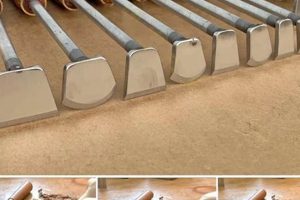
A collection of implements specifically designed for shaping wood through controlled material removal, catering to the demands of experienced artisans. Such an assortment generally includes a variety of gouges, chisels, knives, and sharpening devices, all selected for their quality, durability, and precision. For example, a comprehensive set might contain straight, bent, and V-shaped gouges in various sizes, allowing for a wide range of carving techniques.
The availability of a suitable selection of instruments is critical for achieving detailed and intricate woodworking projects. The precision offered by high-quality instruments contributes directly to the final appearance and longevity of the carved object. Historically, the development and refinement of these tools have been integral to advancements in woodworking, enabling the creation of increasingly complex and aesthetically pleasing designs. Benefits include enhanced control, reduced risk of errors, and the ability to execute sophisticated carving techniques.
The remainder of this exploration will focus on specific aspects related to selecting and maintaining these essential instruments. Topics include the types of steel used in their construction, handle ergonomics, sharpening techniques, and criteria for choosing the optimal assortment for various carving applications. Attention will also be given to storage solutions and safety considerations.
Guidance for Selecting and Maintaining a Wood Shaping Implements Assortment
The following points highlight key considerations for individuals seeking to assemble or maintain a high-quality collection of wood carving instruments suitable for professional applications. Proper selection and care are vital for achieving optimal results and ensuring longevity of the tools.
Tip 1: Prioritize High-Carbon Steel: Opt for instruments crafted from high-carbon steel. This material offers superior edge retention and durability compared to stainless steel alternatives. A tool’s ability to maintain sharpness directly influences the precision and efficiency of carving operations.
Tip 2: Evaluate Handle Ergonomics: Assess the handle design for comfort and control. Handles should be appropriately sized for the user’s hand and constructed from durable materials like hardwood. A comfortable grip reduces fatigue and enhances precision during prolonged use.
Tip 3: Invest in a Comprehensive Sharpening System: Acquiring a complete sharpening system, including various grit whetstones or diamond stones, is crucial. Regular sharpening is essential for maintaining a keen edge and preventing damage to the instruments. Dull tools require more force, increasing the risk of accidents.
Tip 4: Consider the Range of Carving Tasks: Select tools based on the intended carving projects. Different gouge shapes and sizes are required for various techniques, such as roughing out material, creating detailed features, or executing fine surface finishing. A diverse selection allows for greater versatility.
Tip 5: Implement Proper Storage Practices: Store instruments in a manner that protects the cutting edges from damage. Tool rolls, fitted boxes, or magnetic racks are effective storage solutions. Protecting the edges prevents corrosion and accidental injury.
Tip 6: Learn to Recognize Steel Tempering: Different tempering levels are suited to distinct tasks. A softer temper resists chipping but loses its edge faster, while a harder temper retains its edge for longer but is more brittle. Understand and select the correct tempering for individual instruments.
Tip 7: Regularly Inspect and Clean Instruments: Establish a routine for inspecting instruments before and after each use. Clean them with a dry cloth to remove wood shavings and moisture. Occasional application of a rust preventative oil will extend their lifespan.
These guidelines underscore the importance of investing in high-quality materials, prioritizing ergonomics, and adhering to diligent maintenance practices. Such measures ultimately contribute to enhanced carving performance, improved safety, and the longevity of valuable woodworking implements.
The subsequent sections will delve into advanced techniques and considerations for specialized woodworking applications.
1. Steel Composition

The selection of steel for a professional woodworker’s implement assortment directly influences the tool’s performance, durability, and overall suitability for intricate carving tasks. The steel’s inherent properties dictate its ability to hold an edge, resist wear, and withstand the stresses encountered during prolonged use. Therefore, understanding steel composition is paramount when assembling a collection intended for professional application.
- Carbon Content and Hardness
The proportion of carbon in the steel alloy significantly affects its hardness and ability to maintain a sharp cutting edge. High-carbon steels, typically containing 0.6% to 1.5% carbon, can be hardened to a greater degree through heat treatment, resulting in superior edge retention. However, increased hardness can also lead to increased brittleness if not properly tempered. For example, a carving knife made with high-carbon steel will require less frequent sharpening than one made with lower-carbon steel, but it may be more prone to chipping if subjected to excessive force or improper use.
- Alloying Elements and Toughness
The addition of alloying elements, such as chromium, vanadium, tungsten, and molybdenum, enhances various properties of the steel. Chromium improves corrosion resistance, while vanadium refines the grain structure, increasing toughness and wear resistance. Tungsten and molybdenum contribute to red hardness, allowing the steel to retain its hardness at elevated temperatures generated during grinding and sharpening. For instance, the presence of vanadium in a carving gouge can significantly extend its lifespan by making it less susceptible to abrasive wear.
- Heat Treatment and Tempering
The heat treatment process, including hardening and tempering, is crucial for optimizing the steel’s mechanical properties. Hardening involves heating the steel to a specific temperature and then rapidly cooling it to achieve maximum hardness. Tempering then reduces the brittleness introduced during hardening by reheating the steel to a lower temperature. The specific temperatures and durations used in these processes significantly affect the final characteristics of the implement. Improper heat treatment can result in a tool that is either too brittle and prone to breakage or too soft and unable to hold an edge.
- Grain Structure and Edge Stability
The microscopic grain structure of the steel plays a critical role in its ability to form and maintain a stable cutting edge. Fine-grained steels, typically achieved through careful alloying and heat treatment, exhibit superior edge stability compared to coarse-grained steels. A fine grain structure minimizes the risk of micro-chipping and allows for the creation of a keener, more durable edge. Professional woodworkers often prefer tools made from fine-grained steels because they provide greater precision and control during intricate carving operations.
The interconnectedness of these facets highlights the critical importance of steel composition to the performance and longevity of wood carving instruments. Professional woodworkers must consider these factors when selecting their implements to ensure optimal results and a sustained ability to produce high-quality work. The steel’s inherent properties, refined through careful alloying and heat treatment, ultimately determine the tool’s suitability for the demands of professional carving applications.
2. Edge Retention

Edge retention constitutes a critical attribute of any instrument within a professional woodworker’s collection. It describes the tool’s ability to maintain a sharp cutting edge during prolonged use, directly impacting carving efficiency, precision, and the overall quality of the finished piece. An assessment of instruments with differing edge retention characteristics is essential when considering an investment in implements.
- Steel Hardness and Wear Resistance
The hardness of the steel used in manufacturing a tool directly correlates to its edge retention capabilities. Harder steels, typically achieved through specific heat treatment processes, resist deformation and wear more effectively than softer steels. For instance, a chisel forged from high-speed steel (HSS) will maintain its sharpness longer when working with hardwoods compared to a chisel made from a softer carbon steel. However, excessive hardness can also increase brittleness, requiring a balance to be struck during the manufacturing process.
- Grain Structure and Micro-chipping
The microscopic grain structure of the steel influences the integrity of the cutting edge at a microscopic level. Fine-grained steels exhibit greater resistance to micro-chipping, the process by which tiny fragments break away from the cutting edge during use. A carving knife with a fine-grained steel blade will retain its sharpness longer and produce cleaner cuts compared to one with a coarser grain structure, especially when working with intricate details. This is because the finer grain provides more support for the cutting edge at the molecular level.
- Alloy Composition and Abrasive Resistance
The specific alloying elements present in the steel impact its resistance to abrasive wear, a common cause of edge dulling. Certain elements, such as vanadium and tungsten, form hard carbides within the steel matrix, enhancing its ability to resist abrasion from hard or abrasive materials. For example, a gouge with a high vanadium content will maintain its edge sharpness longer when carving resinous woods compared to a similar gouge without vanadium. This is because the vanadium carbides resist the abrasive effects of the resin.
- Heat Treatment and Tempering Consistency
Consistent and precise heat treatment and tempering processes are essential for optimizing edge retention. Inconsistent or improper heat treatment can result in variations in hardness and grain structure along the length of the blade, leading to uneven wear and premature dulling. A carving chisel subjected to precise heat treatment will exhibit uniform hardness and edge retention along its entire cutting edge, ensuring consistent performance and predictable sharpening requirements. This highlights the importance of reputable manufacturers who prioritize quality control throughout the manufacturing process.
These intertwined aspects, encompassing steel composition, microstructure, and manufacturing processes, directly dictate the edge retention characteristics of instruments found in a professional collection. Understanding these elements allows the experienced artisan to make informed selections, optimizing tool performance, and minimizing the frequency of sharpening, thus contributing to enhanced productivity and the execution of superior woodworking artistry. The economic benefit and ease of use combined ensure a better level of craftsmanship.
3. Handle Ergonomics

The design and configuration of handles significantly influence the usability and effectiveness of any professional’s implement assortment. The term ergonomics describes the science of designing equipment and work environments to fit the user. Within the context of professional woodworking instruments, handle ergonomics directly impact user comfort, control, and the potential for repetitive stress injuries.
- Grip Diameter and Hand Size
Handle diameter must be appropriately sized to accommodate the user’s hand. A handle that is too large can cause hand fatigue and reduce dexterity, while a handle that is too small may lead to a cramped grip and decreased control. Different handle profiles are often preferred based on hand size and carving style. For example, a user with smaller hands might prefer a slender handle for intricate detail work, whereas a user with larger hands might require a thicker handle for power carving.
- Handle Material and Texture
The material and surface texture of the handle contribute to grip security and user comfort. Hardwoods, such as maple or walnut, are frequently used for handles due to their durability and aesthetic qualities. Surface texture, whether achieved through carving, stippling, or the application of a non-slip coating, enhances grip security, especially in humid or sweaty conditions. A well-textured handle prevents slippage and improves tool control, reducing the risk of accidents.
- Handle Shape and Carving Style
The shape of the handle can influence the user’s carving style and the types of cuts that can be effectively executed. Straight handles are suitable for general-purpose carving, while curved or angled handles may be preferred for specific techniques, such as paring or deep gouging. The handle’s shape should allow for a natural and comfortable grip, facilitating precise movements and reducing strain on the wrist and forearm. The selection of handle shape often reflects personal preference and the demands of particular carving tasks.
- Vibration Dampening and Impact Absorption
Handles designed to dampen vibration and absorb impact are particularly important for power carving tools. Excessive vibration can lead to hand-arm vibration syndrome (HAVS), a debilitating condition that affects the nerves and blood vessels in the hands and fingers. Materials such as rubber or specialized polymers can be incorporated into the handle design to reduce vibration transmission. Similarly, impact-absorbing features can minimize the jarring effect of repetitive strikes, reducing fatigue and the risk of injury.
The aspects of handle ergonomics are intricately linked, impacting comfort, safety, and performance. A well-designed handle can enhance a woodworker’s control, reduce fatigue, and prevent long-term injuries. Therefore, careful consideration of handle ergonomics is a necessity when selecting tools, ensuring that the implements facilitate, rather than hinder, the pursuit of woodworking artistry.
4. Sharpening Methods

Maintaining a keen edge on each implement within a professional woodworker’s collection is not merely a matter of upkeep, but a fundamental requirement for achieving precise cuts, intricate detailing, and safe operation. Effective techniques are crucial for preserving instrument geometry and maximizing their operational lifespan.
- Whetstone Grinding
The use of whetstones, either oil-based or water-based, represents a traditional and widely adopted method for sharpening wood carving instruments. This process involves honing the cutting edge against a series of progressively finer grit stones to remove material and refine the edge geometry. For example, a woodworker may begin with a coarse grit stone to remove nicks or reshape the bevel, followed by medium and fine grit stones to achieve a polished, razor-sharp edge. The selection of appropriate grit levels and consistent honing angles is critical for achieving optimal results. Failure to maintain consistent angles can lead to a rounded or skewed edge, compromising cutting performance.
- Diamond Stone Sharpening
Diamond stones offer an alternative sharpening method, employing a substrate coated with industrial diamonds. These stones are known for their aggressive cutting action and ability to rapidly remove material, making them particularly useful for repairing damaged edges or sharpening hardened steel instruments. While diamond stones can expedite the sharpening process, they also require a more delicate touch to prevent over-sharpening or damage to the cutting edge. For instance, applying excessive pressure when using a diamond stone can result in microscopic chipping or the formation of a wire edge, necessitating further honing to correct the issue.
- Stropping Techniques
Stropping involves drawing the cutting edge across a leather surface, often impregnated with a polishing compound, to refine the edge and remove any remaining burrs or imperfections. This technique does not remove significant amounts of material but serves to align the microscopic teeth of the cutting edge, resulting in a smoother, sharper, and more durable finish. A woodworker might strop an instrument after sharpening it on whetstones or diamond stones to achieve a final level of sharpness and polish. Consistent stropping also helps to prolong the time between more aggressive sharpening sessions, extending the lifespan of the implement.
- Powered Sharpening Systems
Powered sharpening systems, such as bench grinders or belt sanders equipped with specialized honing attachments, offer a faster and more automated approach to sharpening. However, these systems also pose a greater risk of overheating the steel, which can alter its temper and compromise its hardness. Careful attention must be paid to controlling the speed and pressure applied to the instrument during powered sharpening to prevent damage. For example, using a slow-speed grinder with a water-cooled wheel can minimize heat buildup and preserve the steel’s integrity. These systems can be highly effective when used correctly, but they require a thorough understanding of sharpening principles and careful technique.
The diverse methods underscore the significance of maintaining sharp instruments within the professional woodworking domain. Understanding the nuances of each technique, along with their respective advantages and limitations, enables practitioners to preserve the cutting performance of their implement sets, ensuring optimal results and safe working conditions. Effective sharpening contributes directly to the quality of the finished product and the longevity of the tools, further emphasizing its critical role in professional woodworking practice.
5. Storage Solutions
Effective preservation of a woodworker’s instrument collection is paramount to maintaining edge integrity, preventing corrosion, and ensuring worker safety. Appropriate storage is not merely an organizational preference but an essential component of a professional’s equipment inventory. The absence of suitable storage arrangements can lead to tool damage, increased sharpening frequency, and potential injury. For example, unrestrained instruments in a toolbox are prone to impact damage, dulling the edges and rendering them less effective. Therefore, the selection and implementation of optimal storage solutions constitute a critical aspect of professional woodworking practice.
Varied storage approaches cater to different needs and workspaces. Wall-mounted racks offer easy access and allow for quick inventory assessment. Fitted toolboxes, with custom compartments for each instrument, provide secure transport and prevent tool-on-tool contact. Rolls, constructed from canvas or leather, offer a compact solution for mobile operations, protecting cutting edges and facilitating organization. A real-world example involves a master craftsman who, after years of damaging instruments due to improper storage, invested in a custom-built cabinet with individual slots for each gouge and chisel. This resulted in a significant reduction in tool damage and sharpening requirements, ultimately saving time and resources.
In conclusion, appropriate protection and orderliness represent a direct correlation with productivity, safety, and the long-term viability of implements intended for professional woodworking. Challenges involve selecting storage solutions that balance accessibility with protection, accommodating diverse instrument sizes, and adapting to evolving workspace configurations. Ignoring this essential aspect can lead to compromised tool performance, increased expenses, and a reduction in overall efficiency. Therefore, storage is not peripheral but integral to the concept of a professional woodworker’s carving instrument collection.
6. Application Specificity

The composition of a comprehensive instrument collection for experienced artisans directly reflects the range of tasks the artisan intends to undertake. This relationship, known as application specificity, suggests that the contents of an implement collection are carefully selected to address the demands of particular carving styles, wood types, and project scales. Neglecting this facet results in a kit that is either overly broad and inefficient or too narrow and limiting. The intended use informs the choice of instrument types, sizes, and configurations. For instance, a professional specializing in relief carving will require a different assortment of gouges and chisels compared to one focusing on three-dimensional sculpture or architectural woodworking. Consequently, a collection tailored to the specific application enables efficiency, precision, and a higher quality of finished work.
Consider the example of a professional creating musical instruments. This application demands specialized instruments, such as purfling knives for inlay work, small carving knives for shaping soundboards, and specialized scrapers for fine-tuning tonal qualities. Conversely, a professional restoring antique furniture will necessitate a different set of instruments, including detail carving tools for replicating original designs and larger gouges for removing damaged wood. Failure to match tools to the application will invariably lead to compromised results, increased effort, and potential damage to the workpiece. Application specificity also extends to the selection of appropriate sharpening devices and safety equipment, further highlighting its importance in professional practice.
In summary, the principle of application specificity ensures that an artisan’s collection contains the right instruments for the job, contributing to enhanced performance, efficiency, and overall quality. Addressing this critical parameter involves careful consideration of the types of projects undertaken, the properties of the materials being worked, and the specific techniques employed. While a degree of versatility is beneficial, the core of the collection should be meticulously selected to address the primary focus of the artisan’s practice. Recognizing this essential consideration optimizes the investment in implements and maximizes the potential for achieving superior craftsmanship.
Frequently Asked Questions
This section addresses common inquiries and clarifies misunderstandings regarding instrument sets designed for professional carving applications. The following questions and answers provide essential information to inform selection and maintenance decisions.
Question 1: What constitutes a “professional” grade carving instrument collection?
A collection categorized as “professional” typically includes instruments constructed from high-quality materials, such as high-carbon steel, and designed for sustained use. It also encompasses a comprehensive range of shapes and sizes to accommodate varied carving techniques. Furthermore, the collection often integrates a robust sharpening system and suitable storage solutions.
Question 2: Is a large number of instruments always preferable?
Quantity does not necessarily equate to quality or effectiveness. A smaller, carefully curated collection of high-quality instruments may prove more useful than a larger set containing inferior or redundant tools. Instrument selection should align with specific carving styles and project requirements.
Question 3: How frequently should carving instruments be sharpened?
Sharpening frequency depends on factors such as the type of wood being carved, the duration of use, and the quality of the steel. Instruments should be sharpened as soon as a noticeable decrease in cutting performance is observed. Regular stropping between sharpening sessions can prolong edge life.
Question 4: Can any type of sharpening stone be used for carving instruments?
The type of sharpening stone should be appropriate for the steel composition and hardness of the instrument. High-speed steel instruments, for example, may require diamond stones or specialized grinding wheels. Coarse stones are suitable for initial shaping, while finer stones are necessary for achieving a polished edge.
Question 5: Is handle material merely an aesthetic consideration?
Handle material plays a significant role in comfort, control, and vibration dampening. Hardwoods such as maple or walnut are common choices due to their durability and ergonomic properties. Proper handle design minimizes hand fatigue and enhances precision.
Question 6: What are the most common mistakes when starting with a “professional woodworker carving tool kit”?
Common errors include neglecting proper sharpening techniques, using excessive force, and failing to store instruments correctly. A lack of understanding regarding wood grain direction and instrument geometry can also lead to suboptimal results.
In summary, selecting and maintaining such a collection requires informed decisions based on factors such as material quality, sharpening techniques, and intended applications. Diligent care and proper technique are paramount for achieving optimal results and extending the lifespan of the implements.
The subsequent section will explore advanced carving techniques and specialized applications.
Conclusion
This exploration has detailed the multifaceted considerations inherent in assembling and maintaining a comprehensive professional woodworker carving tool kit. The core elements, encompassing steel composition, edge retention, handle ergonomics, sharpening methods, storage solutions, and application specificity, collectively define the efficacy and longevity of such a collection. These interdependent factors require meticulous assessment to ensure optimal performance and safety.
The informed application of these principles allows the skilled artisan to elevate their craft and realize intricate designs with precision and control. Continued exploration of advanced techniques and innovative materials remains crucial for advancing the art of woodworking. The diligent application of these principles constitutes an investment in both the tools and the enduring legacy of skilled craftsmanship.