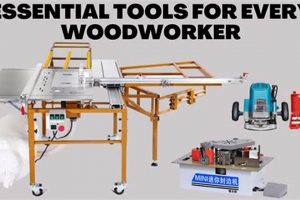
These devices represent a class of equipment designed for shaping and cutting wood that remains fixed in one location during operation. Characterized by their stability and power, these tools are essential for producing accurate and consistent results. Examples include table saws for ripping lumber, jointers for creating flat surfaces, planers for thicknessing stock, drill presses for precise hole drilling, and bandsaws for curved cuts.
The utilization of such machinery increases efficiency and precision in woodworking projects. Their inherent stability allows for safer and more controlled cuts compared to handheld alternatives. Historically, these tools evolved from hand-operated versions, dramatically increasing the speed and accuracy with which wood can be processed, enabling mass production and complex designs. The investment in these tools provides long-term benefits through increased productivity and the capability to undertake more ambitious projects.
The following sections will delve into the specific types of machinery commonly found in woodworking shops, their applications, safety considerations for their operation, and the maintenance required to ensure their longevity and optimal performance. An overview of factors to consider when selecting appropriate tools for specific woodworking needs will also be presented.
Operational Tips for Efficient Wood Processing
Effective utilization requires adherence to specific guidelines and a focus on safety protocols. Optimizing machine performance contributes to the overall quality and efficiency of woodworking projects.
Tip 1: Optimize Blade Selection. Choosing the appropriate blade for each specific cutting task is crucial. Employ blades with fewer teeth per inch (TPI) for ripping tasks along the grain, and blades with higher TPI for crosscutting against the grain. This minimizes tear-out and maximizes cutting efficiency.
Tip 2: Maintain Proper Blade Tension. Insufficient blade tension on bandsaws can lead to inaccurate cuts and premature blade failure. Use a blade tension gauge or consult the manufacturer’s recommendations to ensure proper tension is maintained.
Tip 3: Implement Dust Collection Systems. Effective dust collection is essential for maintaining a clean and safe working environment. Connect each machine to a dedicated dust collector or a centralized system to minimize airborne particulate matter.
Tip 4: Conduct Regular Maintenance Checks. Regularly inspect all components for wear and tear, including belts, bearings, and blades. Lubricate moving parts as needed, following the manufacturer’s recommendations. This proactive maintenance extends the lifespan of the equipment and ensures consistent performance.
Tip 5: Calibrate Machine Settings. Periodically calibrate machine settings, such as the fence alignment on table saws and the infeed/outfeed table alignment on jointers. This ensures accurate cuts and prevents material waste.
Tip 6: Utilize Push Sticks and Push Blocks. Always use push sticks or push blocks when feeding material through table saws and jointers, especially when working with small or narrow pieces. This keeps hands safely away from the cutting blade.
Tip 7: Prioritize Personal Protective Equipment (PPE). Always wear appropriate PPE, including safety glasses, hearing protection, and a dust mask or respirator. This minimizes the risk of injury from flying debris, loud noise, and airborne particles.
Adherence to these operational tips enhances the performance, safety, and longevity. A disciplined approach to maintenance and utilization maximizes the return on investment in these tools and fosters a more productive woodworking environment.
The subsequent sections will expand on specific safety considerations and explore advanced techniques for maximizing the capabilities of each machine.
1. Precision
In the realm of woodworking, the term “Precision” signifies the degree of accuracy and conformity to specified dimensions or requirements. The attainment of precision is paramount, directly impacting the quality, functionality, and aesthetic appeal of finished woodworking projects. Woodworking stationary power tools play a pivotal role in achieving this level of accuracy, providing the stability and controlled power necessary for consistent results.
- Calibrated Settings and Accuracy
Stationary power tools are equipped with adjustable settings and gauges that enable precise control over cutting depth, angle, and fence positioning. This level of control allows for repeatability and accuracy in creating identical components, which is essential for complex joinery and assembly. For instance, a calibrated miter saw allows for consistent and repeatable angle cuts for creating precise frames and moldings.
- Blade Selection and Sharpness
The type and condition of the cutting blade significantly influence precision. Using the appropriate blade for the specific wood type and cutting task is crucial. Sharp blades minimize tear-out and produce clean, accurate cuts. Regular blade sharpening and replacement are essential maintenance practices that directly contribute to precision. A dull blade on a table saw can lead to inaccurate cuts and potentially dangerous kickback.
- Stability and Vibration Reduction
Stationary power tools, by their very nature, offer greater stability compared to handheld tools. This stability minimizes vibration and movement during operation, resulting in cleaner and more accurate cuts. Features such as cast-iron tables and vibration-dampening mounts further enhance stability, particularly important for delicate operations such as creating dadoes or rabbets.
- Jigs and Fixtures for Repeatability
Many stationary power tools can be used in conjunction with jigs and fixtures to enhance precision and repeatability. These devices provide a stable and consistent platform for workpiece positioning, ensuring that each cut is made with the same accuracy. Examples include using a tenoning jig on a table saw to create precise tenons for mortise-and-tenon joinery.
The integration of calibrated settings, appropriate blade selection, stable tool platforms, and the use of jigs and fixtures collectively contributes to the attainment of precision in woodworking. These elements, intrinsically linked to stationary power tools, enable woodworkers to achieve a higher level of accuracy and consistency, ultimately resulting in superior finished products and more efficient workflows.
2. Safety

Operating stationary power tools in woodworking environments inherently involves risks that necessitate strict adherence to established safety protocols. The power and capabilities of this equipment demand a comprehensive understanding of potential hazards and the implementation of preventative measures to mitigate accidents and injuries.
- Personal Protective Equipment (PPE)
The consistent use of appropriate PPE is paramount. Safety glasses protect eyes from flying debris, hearing protection mitigates noise-induced hearing loss, and dust masks or respirators prevent inhalation of wood dust, a known respiratory irritant. Failure to utilize PPE can result in immediate and long-term health consequences. For example, operating a jointer without eye protection can lead to severe eye injury from ejected wood chips.
- Machine Guarding and Safe Operation
All machines are equipped with safety guards designed to prevent contact with moving blades or cutters. These guards must be properly installed and maintained. Safe operating procedures, including the use of push sticks and feather boards, are crucial for keeping hands away from blades. Removing or bypassing safety guards significantly increases the risk of injury. Utilizing a push stick when feeding material through a table saw is an example of adhering to safe operational practices.
- Emergency Procedures and Power Disconnection
Knowledge of emergency shutdown procedures is essential. The ability to quickly disconnect power in the event of an accident can minimize injury. Clearly labeled emergency stop buttons should be readily accessible. Furthermore, ensuring machines are disconnected from power during maintenance or blade changes prevents accidental activation. Knowing the location and proper use of the emergency shut-off is crucial in preventing escalation of incidents.
- Training and Competency
Proper training on the safe operation of each machine is fundamental. Understanding the capabilities and limitations of the equipment, as well as recognizing potential hazards, is crucial for preventing accidents. Lack of adequate training can lead to misjudgments and unsafe practices. Certification programs and apprenticeship opportunities are examples of ways to receive formal training.
The integration of PPE usage, diligent machine guarding, awareness of emergency procedures, and comprehensive training forms a robust framework for safe woodworking practices. Emphasizing these elements promotes a safer working environment and minimizes the potential for accidents associated with stationary power tools.
3. Maintenance

The consistent functionality and longevity of woodworking stationary power tools are directly contingent upon the implementation of a rigorous and proactive maintenance regimen. Such a regimen encompasses a spectrum of activities, from routine cleaning to the replacement of worn components, each contributing to the preservation of operational integrity and adherence to safety standards.
- Lubrication of Moving Parts
Consistent lubrication is critical to reduce friction and prevent premature wear on moving components, such as bearings, gears, and slides. Without proper lubrication, these parts can overheat, seize, or experience accelerated degradation, leading to diminished performance and potential equipment failure. Application of appropriate lubricants, as specified by the manufacturer, at recommended intervals is essential. An example includes lubricating the lead screw of a drill press to ensure smooth and consistent vertical movement of the spindle.
- Blade Sharpening and Replacement
The sharpness of cutting blades directly impacts the quality of cuts and the efficiency of the equipment. Dull blades necessitate increased force to achieve desired results, placing undue stress on the motor and other components. Regular sharpening or replacement of blades is therefore essential. Carbide-tipped blades, while more durable, eventually require professional sharpening. A table saw with a dull blade will produce rough cuts and increase the risk of kickback.
- Inspection and Adjustment of Alignment
Maintaining proper alignment of critical components, such as fences, tables, and blades, is crucial for accurate and consistent cuts. Misalignment can lead to inaccurate dimensions, uneven surfaces, and potential safety hazards. Periodic inspection and adjustment are required to ensure these components are within specified tolerances. For example, a jointer’s infeed and outfeed tables must be coplanar to produce flat, square edges on lumber.
- Cleaning and Dust Removal
Wood dust accumulation can impede the performance of woodworking stationary power tools by obstructing moving parts, interfering with cooling systems, and posing a fire hazard. Regular cleaning to remove dust and debris is essential for maintaining optimal functionality and preventing potential damage. Implementing a dust collection system in conjunction with manual cleaning efforts provides a comprehensive approach to dust management. For instance, dust buildup within the motor housing of a bandsaw can lead to overheating and premature motor failure.
These maintenance facets, executed diligently and consistently, are indispensable for preserving the operational integrity, extending the lifespan, and ensuring the safe utilization of woodworking stationary power tools. A proactive approach to maintenance minimizes downtime, reduces the likelihood of costly repairs, and contributes to a productive and safe woodworking environment.
4. Applications

The utility of woodworking stationary power tools is fundamentally defined by the breadth and precision of their applications. These tools, designed for specific tasks within the woodworking process, offer capabilities that are unattainable through manual methods or handheld power tools. The direct correlation between tool design and its intended application is a key determinant of its value within a woodworking environment. For example, the primary application of a table saw is the accurate and efficient ripping and crosscutting of lumber, facilitating the creation of dimensionally precise components. Similarly, a jointer’s function is the creation of perfectly flat and square edges on boards, a prerequisite for subsequent joinery operations. The consequence of neglecting the designed application is often substandard results or even damage to the workpiece and the tool itself.
Further illustrating this connection, consider the drill press. Its application extends beyond simple hole drilling to include tasks such as mortising, shaping, and sanding, through the use of specialized attachments. This versatility stems from the tool’s inherent stability and controlled speed, enabling precise execution of various operations. Another example is the bandsaw, capable of executing intricate curved cuts that are impractical with other types of saws. The effectiveness of these tools is contingent upon understanding their specific applications and employing them within their designated parameters. Attempting to perform operations for which a tool is not designed often leads to inefficiency, reduced accuracy, and increased safety risks. The selection of appropriate tooling for specific applications is therefore a critical skill for any woodworker.
In summary, the value of woodworking stationary power tools lies in their tailored applications, providing solutions to specific challenges in the woodworking process. Understanding the intended application of each tool is crucial for maximizing its potential and achieving optimal results. The challenge lies in effectively integrating these individual tools into a cohesive workflow, optimizing efficiency and minimizing material waste. This coordinated approach underscores the interconnectedness of applications within the broader context of woodworking.
5. Power

The concept of “Power,” in the context of woodworking stationary power tools, transcends a mere numerical specification; it represents the capacity of a machine to perform work efficiently and effectively. Adequate power is not merely desirable but essential for achieving consistent results, handling diverse materials, and ensuring the longevity of the equipment.
- Motor Capacity and Material Hardness
The motor’s horsepower rating directly correlates with the tool’s ability to process materials of varying density and hardness. Lower-powered machines may struggle with hardwoods like oak or maple, leading to reduced cutting speed, increased blade wear, and potential motor overheating. Higher horsepower ratings enable these tools to handle demanding tasks without compromising performance. For example, a table saw with a 1.5 horsepower motor may suffice for softwood projects, while a 3 horsepower model is better suited for hardwood applications and thicker stock.
- Torque and Cutting Resistance
Torque refers to the rotational force exerted by the motor, influencing its ability to overcome resistance during cutting. Insufficient torque results in stalling, blade binding, and increased kickback potential, compromising safety. High-torque motors maintain consistent cutting speed, especially when encountering knots or dense grain patterns. The benefit is observed in the operation of a bandsaw, where a high-torque motor ensures consistent blade speed even when cutting through thick, irregular stock, improving cut quality and safety.
- Voltage and Electrical Load
Voltage requirements determine the electrical compatibility of the tool. Operating a machine at the incorrect voltage can lead to damage to the motor or other electrical components. Furthermore, the amperage draw of the tool influences the overall electrical load on the circuit, potentially requiring dedicated circuits for high-power equipment. Utilizing a 120-volt machine on a 240-volt circuit, or vice versa, will invariably result in equipment failure, highlighting the importance of electrical compatibility.
- Duty Cycle and Continuous Operation
The duty cycle refers to the amount of time a tool can operate continuously before requiring a cool-down period. Exceeding the duty cycle can lead to overheating and premature motor failure. Heavy-duty machines are designed for continuous operation, while lighter-duty models are intended for intermittent use. A planer used continuously for several hours may overheat if its duty cycle is exceeded, whereas a machine designed for continuous use can maintain operation without issue.
In essence, understanding the power specifications of woodworking stationary power tools is paramount for selecting the appropriate equipment for specific tasks and ensuring its long-term reliability. The aspects of motor capacity, torque, voltage, and duty cycle are intertwined, each contributing to the overall performance and suitability of the tool for various woodworking applications. Selecting a machine with adequate power not only enhances productivity but also contributes to a safer and more efficient working environment.
6. Stability

In the context of woodworking stationary power tools, stability denotes the resistance to unintended movement or vibration during operation. This attribute is paramount, directly influencing precision, safety, and the overall quality of woodworking projects. The inherent mass and fixed positioning of these tools are designed to minimize deviations during material processing.
- Vibration Dampening and Material Composition
The composition and construction of the tool’s frame and base are critical for absorbing vibrations generated during operation. Cast iron, due to its density and damping properties, is a commonly utilized material for tables and bases, providing a stable platform that minimizes tool chatter and ensures smoother, more accurate cuts. For example, a cast iron table on a table saw significantly reduces vibration compared to a stamped steel table, leading to cleaner and more precise cuts, especially when working with hardwoods.
- Fixed Positioning and Secure Mounting
Stationary power tools are designed to be securely mounted to a workbench or the floor, preventing movement during operation. This fixed positioning allows the operator to maintain precise control over the workpiece and minimizes the risk of accidental movement that could compromise accuracy or lead to injury. Anchoring a drill press to a sturdy workbench prevents it from tipping or moving during drilling, ensuring accurate hole placement and improved safety.
- Weight Distribution and Center of Gravity
The distribution of weight within the tool and the placement of the center of gravity are engineered to enhance stability. A low center of gravity minimizes the risk of tipping, while balanced weight distribution reduces vibrations and improves overall control. For example, the design of a jointer typically incorporates a wide base and a low center of gravity to prevent it from rocking or moving during planing operations.
- Operational Stability and Precision Cutting
The aforementioned facets coalesce to facilitate operational stability, which directly correlates with the ability to execute precise cuts. The absence of unwanted movement allows for finer control over the workpiece, resulting in improved accuracy and reduced material waste. This stability is particularly crucial when performing intricate operations, such as creating dadoes or rabbets, where even slight deviations can compromise the final result. For example, a stable bandsaw allows for the creation of intricate curves and shapes with a higher degree of accuracy compared to a handheld jigsaw.
In conclusion, the stability of woodworking stationary power tools is not merely a design consideration but a fundamental requirement for achieving precision, ensuring safety, and maximizing the efficiency of woodworking operations. The interplay between vibration dampening, fixed positioning, weight distribution, and operational stability collectively contributes to the superior performance and utility of these tools.
7. Versatility
The versatility of woodworking stationary power tools manifests in their capacity to perform a range of functions, often exceeding the initial purpose for which they were designed. This multi-functionality stems from adaptable design, available accessories, and the inherent capabilities of the machine platform. A table saw, for example, is not limited to ripping and crosscutting; with appropriate jigs and blades, it can execute dadoes, rabbets, and even molding profiles. This adaptability reduces the need for multiple specialized machines, maximizing space and minimizing capital expenditure, offering cost-efficiency and enhanced productivity. Another instance of versatility is the drill press, which, beyond drilling precise holes, can be adapted for sanding, mortising, and shaping operations, significantly expanding its utility within a woodworking shop. The effect of such adaptability is a more dynamic and efficient workflow, enabling complex projects to be undertaken with a streamlined set of equipment.
The importance of versatility lies in the economic and practical benefits it provides to the woodworker. A single machine that performs multiple functions represents a lower initial investment and reduces the spatial footprint in a workshop, which is often a limited resource. Furthermore, the ability to adapt a tool to various tasks fosters creativity and problem-solving skills, encouraging woodworkers to explore innovative applications and techniques. This adaptability promotes a more resource-efficient approach to woodworking, minimizing waste and maximizing the utilization of existing equipment. The use of a router table, often constructed around a standard handheld router, illustrates this point. The router table transforms a handheld tool into a precision shaping and jointing device, capable of creating intricate profiles and joinery that would be difficult or impossible to achieve with the router alone.
In summary, versatility is a defining characteristic that enhances the value of woodworking stationary power tools. This adaptability allows these tools to be employed across a broader spectrum of woodworking tasks, creating a more efficient and resourceful workshop environment. While specialization remains important, the ability of a single tool to perform multiple functions contributes significantly to the economic viability and creative potential of woodworking endeavors. The challenge lies in understanding the full range of capabilities inherent in each tool and exploring innovative ways to expand their functionality through accessories, jigs, and well-informed techniques.
Frequently Asked Questions
The subsequent questions address common inquiries and misconceptions regarding the selection, operation, and maintenance of woodworking stationary power tools.
Question 1: What factors should be considered when selecting stationary power tools for a small workshop?
Space constraints are a primary consideration, necessitating tools with compact footprints and potential for multi-functionality. Power requirements must align with available electrical capacity. Furthermore, prioritize tools that address the most frequent woodworking tasks and consider future project needs.
Question 2: How frequently should blades on stationary power tools be sharpened?
Sharpening frequency depends on usage intensity, material hardness, and blade type. Visual indicators include burning during cuts, increased feed force, and rough cut surfaces. Regular inspection and maintenance logs assist in establishing optimal sharpening schedules.
Question 3: What safety precautions are most critical when operating a table saw?
The utilization of appropriate personal protective equipment, including eye and ear protection, is mandatory. Employ push sticks and feather boards to maintain safe distances from the blade. Ensure proper blade alignment and fence parallelism. Never bypass or disable safety guards.
Question 4: How can vibration be minimized when using stationary power tools?
Securely mount tools to a stable workbench or floor. Employ vibration-dampening materials beneath the machine. Ensure all components are properly tightened and lubricated. Replace worn bearings or belts as needed.
Question 5: What is the appropriate method for cleaning stationary power tools?
Disconnect power prior to cleaning. Utilize compressed air to remove dust and debris from internal components. Wipe down surfaces with a clean cloth. Apply appropriate lubricants to moving parts. Avoid using abrasive cleaners or solvents that could damage finishes.
Question 6: How can the lifespan of woodworking stationary power tools be extended?
Adherence to a consistent maintenance schedule, including lubrication, blade sharpening, and component inspection, is essential. Protect tools from moisture and extreme temperatures. Utilize appropriate voltage and amperage. Avoid overloading the machines beyond their rated capacity.
The information provided herein aims to clarify aspects of stationary power tool utilization. It is imperative to consult the manufacturer’s guidelines for specific operational and maintenance recommendations.
The subsequent sections will explore advanced techniques for maximizing the capabilities of each machine and delve into specific safety considerations.
Conclusion
This exploration of woodworking stationary power tools has underscored their indispensable role in achieving precision, efficiency, and safety within woodworking endeavors. The discussion has encompassed critical aspects, including optimal operation, rigorous maintenance, versatile applications, and the fundamental importance of stability and adequate power. A comprehensive understanding of these elements is crucial for realizing the full potential of this equipment.
Continued adherence to established safety protocols and proactive engagement in ongoing education remain paramount. Mastery of woodworking stationary power tools facilitates the creation of high-quality, enduring projects, thereby contributing to both professional craftsmanship and personal fulfillment within the art of woodworking.