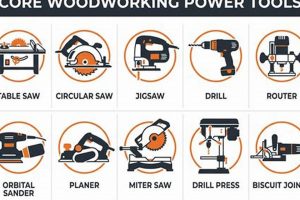
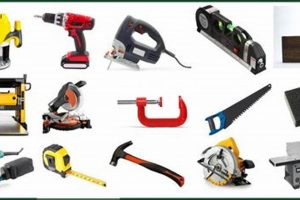
This collection encompasses implements designed for shaping, cutting, and joining wood. Items within this set include clamps, measuring devices, and material supports utilized in various construction and crafting activities. As an example, consider the use of a parallel clamp to securely hold two pieces of lumber while adhesive dries, or the application of a speed square to ensure precise angle cuts.
Such implements play a pivotal role in achieving accuracy, efficiency, and safety within woodworking projects. Historically, advancements in these tools have corresponded directly with enhanced construction methods and design capabilities. The quality and precision afforded by these implements contribute to both the structural integrity and aesthetic appeal of finished wooden products.
The subsequent sections will delve into specific categories and applications, examining the features and benefits associated with different types, and providing guidance on selecting the appropriate instruments for particular woodworking tasks.
Effective Woodworking Practices
The following guidelines aim to enhance precision, safety, and efficiency in woodworking through the proper utilization of specialized instruments.
Tip 1: Prioritize Stable Material Support: Employ sturdy sawhorses or workbenches when cutting large pieces of lumber. Adequate support minimizes vibration and ensures accurate cuts.
Tip 2: Secure Workpieces Firmly: Utilize parallel clamps or bar clamps to hold components tightly during assembly or gluing. Consistent clamping pressure contributes to strong, durable joints.
Tip 3: Emphasize Precise Measurement: Incorporate measuring tapes, combination squares, and digital levels to guarantee dimensional accuracy. Precise measurements are critical for tight fits and structurally sound assemblies.
Tip 4: Implement Dust Collection Systems: Integrate dust collectors or shop vacuums to remove sawdust and debris. A clean workspace promotes safer breathing conditions and improves visibility.
Tip 5: Maintain Sharp Cutting Edges: Regularly sharpen hand saws, chisels, and plane blades. Sharp tools require less force and produce cleaner cuts, reducing the risk of injury.
Tip 6: Use Appropriate Protective Gear: Wear safety glasses, hearing protection, and a dust mask to mitigate potential hazards. Personal protective equipment minimizes the risk of eye injuries, hearing damage, and respiratory problems.
Tip 7: Calibrate Measuring Instruments Periodically: Verify the accuracy of squares, levels, and measuring tapes regularly. Calibration ensures reliable readings and prevents errors in dimensioning.
These practices emphasize the importance of accuracy, safety, and cleanliness in woodworking, ultimately contributing to higher-quality finished products.
The next section will explore advanced techniques and applications, building upon the foundational principles outlined above.
1. Precision Measurement

The effectiveness of woodworking relies significantly on accuracy. Instruments designed for this trade must deliver precise measurements to guarantee successful project outcomes. A direct correlation exists between the quality of woodworking tools and the achievable level of precision. Accurate layout and dimensioning are fundamental prerequisites for the creation of structurally sound and aesthetically pleasing wooden objects. The ability to measure correctly before cutting or joining directly impacts the final product’s dimensions, alignment, and overall stability. Examples include using a high-precision square to ensure 90-degree angles or a digital caliper to verify material thickness to within fractions of a millimeter. Without instruments capable of delivering accurate measurements, woodworking projects are susceptible to errors, leading to wasted materials, increased labor, and structurally unsound results.
The implementation of precise measurement techniques extends to various woodworking processes. Accurate measurements enable the creation of tight-fitting joints, a critical factor in the structural integrity of wooden furniture. For instance, when creating a mortise and tenon joint, precise measurements are essential to ensure a snug fit. Similarly, accurately measuring and cutting lumber to the correct dimensions is essential for assembling cabinetry. Precision measurement also affects the appearance of the finished product. Accurate layouts contribute to straight lines, even spacing, and symmetrical designs. Such visual refinements require that the instruments used consistently deliver reliable and repeatable results.
In summary, precision measurement is an indispensable element of woodworking. Implements incapable of delivering accurate measurements render woodworking tasks significantly more challenging and prone to failure. Achieving high levels of precision requires both the use of quality tools and a thorough understanding of measurement principles. Investing in instruments that provide accurate and reliable measurements is an investment in project success and professional craftsmanship.
2. Secure Clamping

Clamping represents a fundamental operation within woodworking. Its efficacy hinges directly on the instruments employed to exert and maintain pressure. A secure clamping system, whether integrated within a workbench or employed as a standalone device, ensures components are held firmly in place during cutting, joining, or adhesive setting. The consequence of inadequate clamping is misalignment, weakened joints, or unsafe operation. Implements, engineered to deliver and sustain consistent pressure, minimize these risks. For example, consider the assembly of a cabinet frame. Parallel clamps distribute force evenly across the mating surfaces, promoting optimal adhesive bond formation. If clamping is insufficient, gaps may form, compromising the structural integrity of the cabinet and resulting in a product that is not square. The selection of appropriate clamping solutions is, therefore, directly correlated to the quality and longevity of woodworking projects.
The relationship between clamping systems and project success extends beyond adhesive bonding. Accurate cutting frequently requires that materials be securely anchored to a workbench or cutting jig. Miter saws, for instance, often feature integrated clamps that prevent material slippage during the cutting process. Similarly, when routing a profile or creating a mortise, clamps are essential to hold the workpiece firmly, mitigating the risk of tool chatter or uncontrolled movement. Furthermore, specialized clamps, such as edge clamps, are used to apply pressure when attaching edge banding or veneer. The uniformity of the bond between the edge banding and the substrate is directly dependent on the even distribution of clamping pressure. In each of these scenarios, clamping provides stability and control, thereby contributing to safer and more precise woodworking operations.
In summary, secure clamping is not merely an ancillary step in woodworking; rather, it constitutes a critical element integral to the integrity and precision of the craft. The choice of clamping instruments directly influences the quality of adhesive bonds, the accuracy of cuts, and overall safety. Addressing the challenges associated with inadequate or inappropriate clamping demands a thorough understanding of clamping principles and the selection of implements engineered to meet the specific demands of each woodworking task. The investment in quality clamps yields tangible dividends in the form of structurally sound and aesthetically pleasing finished products.
3. Stable Material Support

The provision of secure and unwavering support for materials undergoing woodworking processes is a fundamental prerequisite for precision and safety. The integrity of cuts, joinery, and shaping operations is directly contingent upon the stability of the workpiece. Vibration, movement, or inadequate support can compromise accuracy, leading to flawed dimensions, misaligned joints, and potentially hazardous operating conditions. The relationship between the support structure and the outcome of woodworking tasks cannot be overstated; it represents a foundational principle influencing the quality and safety of the craft. Failure to ensure firm and constant support is a primary contributor to errors and accidents within the woodworking environment.
The category encompasses various implements designed to maintain stability during different woodworking activities. Sawhorses, workbenches, and specialized support stands are all components that contribute to this. For instance, when cutting a long piece of lumber, sawhorses positioned at appropriate intervals prevent sagging or bending, thereby ensuring a straight and accurate cut. Workbenches, equipped with integrated clamping systems, provide a stable platform for planing, routing, and other shaping operations. In the context of power tool usage, specifically designed material supports enhance stability and reduce the risk of kickback or workpiece displacement. These support structures are designed to counteract the forces generated by power tools, maintaining the workpiece in a controlled position.
In conclusion, stable material support is an indispensable element of safe and effective woodworking. The investment in robust support structures, such as sawhorses and workbenches, is a critical measure for preventing errors, minimizing the risk of accidents, and achieving high-quality results. Recognizing the significance of stable support, and employing appropriate implements, is fundamental to the practice of sound and professional woodworking.
4. Dust Collection

The management of particulate matter generated during woodworking activities is a critical aspect of both health and operational efficiency. Effective dust collection systems, frequently employed in conjunction with various woodworking implements, mitigate the risks associated with airborne wood dust, contributing to a safer and cleaner work environment.
- Health and Safety Implications
Prolonged exposure to wood dust can result in respiratory ailments, allergic reactions, and other health complications. Dust collection systems, integral to many power-driven tools, capture airborne particles at their source, minimizing inhalation risks. The Occupational Safety and Health Administration (OSHA) mandates specific exposure limits for wood dust in the workplace, necessitating the use of effective dust collection methods.
- Operational Efficiency
Accumulated dust on machinery and work surfaces can impede performance, reduce visibility, and increase the risk of fire. Dust collection systems maintain cleaner equipment and work areas, optimizing efficiency and productivity. Clean tools operate more smoothly and require less maintenance, contributing to long-term cost savings.
- Tool Longevity
The abrasive nature of wood dust can accelerate wear and tear on woodworking tools. Internal components, such as motors and bearings, are particularly susceptible to damage from dust accumulation. Dust collection systems prevent dust from entering critical tool mechanisms, prolonging tool lifespan and reducing repair costs.
- Improved Finish Quality
Dust particles settling on freshly finished surfaces can compromise the quality of the final product. Dust collection systems minimize airborne particles, preventing contamination of finishes and resulting in smoother, more aesthetically pleasing results. This is particularly important in applications requiring high-gloss or flawless finishes.
The integration of dust collection systems with woodworking tools represents a multifaceted approach to mitigating health risks, enhancing operational efficiency, prolonging tool life, and improving finish quality. The selection and implementation of appropriate dust collection methods are essential considerations for any woodworking operation.
5. Ergonomic Design
Ergonomic design, the science of fitting workplace conditions and job demands to the capabilities of the worker, is a critical consideration in the development and implementation of woodworking instruments. Its importance stems from the physically demanding nature of woodworking, which often involves repetitive motions, awkward postures, and prolonged periods of standing. The integration of ergonomic principles in the design of these devices aims to minimize the risk of musculoskeletal disorders, enhance user comfort, and improve overall productivity.
- Handle Design and Grip
The design of handles on hand tools such as saws, planes, and chisels directly affects the amount of force required to perform tasks and the strain placed on the user’s hands and wrists. Ergonomic handles are typically contoured to fit the natural shape of the hand, distributing pressure evenly and reducing the risk of carpal tunnel syndrome or other repetitive strain injuries. An example is a saw with a pistol-grip handle that minimizes wrist flexion and extension during cutting. The application of non-slip materials further enhances grip and control, reducing the risk of slippage and injury.
- Height and Reach Considerations
Workbenches and material support systems should be designed with adjustable heights to accommodate workers of different statures. An appropriately sized workbench minimizes the need to bend excessively or reach awkwardly, reducing strain on the back and shoulders. Power tool stands should also be positioned at a comfortable height to avoid unnecessary fatigue. An example is a workbench with adjustable legs, allowing the user to set the height to match their individual needs. Furthermore, the placement of tools and materials within easy reach reduces the need for excessive stretching or twisting.
- Weight and Balance
The weight and balance of hand tools and power tools directly affect the effort required to use them and the level of control that can be maintained. Lightweight tools reduce fatigue during prolonged use, while balanced tools minimize the risk of tipping or wobbling, improving accuracy and safety. For instance, a power drill with a balanced center of gravity is easier to control and less likely to cause wrist strain than a drill that is top-heavy. Similarly, a hand plane with a low center of gravity is more stable and requires less effort to guide across the workpiece.
- Vibration Reduction
Power tools such as sanders, routers, and planers generate significant levels of vibration, which can contribute to hand-arm vibration syndrome (HAVS) or other nerve damage. Ergonomic designs incorporate vibration-dampening materials and mechanisms to reduce the transmission of vibration to the user’s hands. Examples include sanders with rubberized grips or routers with vibration-isolated handles. Regular breaks and the use of anti-vibration gloves can further minimize the risk of vibration-related injuries.
These facets illustrate the importance of ergonomic design in mitigating the physical demands of woodworking. Implements that prioritize user comfort and safety not only reduce the risk of injury but also enhance productivity and the quality of finished projects. The application of ergonomic principles in the design and selection represents a commitment to worker well-being and the creation of a sustainable woodworking environment.
Frequently Asked Questions About Woodworking Implements
The subsequent queries address common points of consideration regarding implements utilized within woodworking practices. These are intended to provide clarity and insight into the functionality, selection, and proper application of these instruments.
Question 1: What constitutes essential measuring implements for initiating woodworking projects?
Accurate measurement is paramount. A measuring tape, a combination square, and a marking gauge are fundamental. These instruments facilitate precise dimensioning, layout, and marking of lumber, ensuring accuracy in subsequent cutting and joinery operations. Their calibration should be verified routinely.
Question 2: How does clamping contribute to the structural integrity of wooden assemblies?
Clamping exerts consistent pressure during adhesive setting. This ensures tight joints and optimal bonding strength. Implementations include parallel clamps, bar clamps, and pipe clamps, each suited for specific joint configurations and material thicknesses. Even pressure distribution is critical for preventing gaps and ensuring structural soundness.
Question 3: What support systems are recommended for safely processing large lumber dimensions?
Sawhorses and workbenches constitute the primary support systems. Sawhorses provide elevated support, enabling efficient cutting operations. Workbenches, often equipped with clamping mechanisms, offer a stable platform for various woodworking tasks. The stability of these systems directly impacts the safety and accuracy of material processing.
Question 4: What strategies exist for mitigating dust particle dispersal during woodworking activities?
Dust collection systems, integrated with power tools or employed as standalone units, capture airborne dust particles. These systems typically utilize vacuum technology to extract dust from the point of origin, minimizing inhalation hazards and maintaining a cleaner work environment. Respirators or dust masks provide supplemental protection.
Question 5: How do ergonomic considerations factor into the selection of implements?
Ergonomic designs minimize strain and fatigue during prolonged use. Implement features such as contoured handles, adjustable heights, and vibration dampening mechanisms. The selection of ergonomic implements reduces the risk of musculoskeletal disorders and enhances user comfort, promoting long-term well-being.
Question 6: What maintenance practices prolong the operational lifespan of implements?
Regular cleaning, lubrication, and sharpening are essential. Dust accumulation should be removed promptly. Cutting edges require periodic sharpening to maintain efficiency and precision. Proper storage protects implements from environmental damage and physical wear, extending their functional lifespan.
These responses highlight the critical role that appropriate implements play in ensuring accuracy, safety, and efficiency within woodworking operations. Knowledge of these aspects is crucial for achieving consistently high-quality results.
The subsequent section will explore advanced applications and techniques, building upon the foundational knowledge presented herein.
Conclusion
This exploration has underscored the indispensable role woodworking implements play in achieving precision, safety, and efficiency within the craft. From accurate measurement to secure clamping and stable material support, each facet contributes directly to the structural integrity and aesthetic quality of finished wooden products. The integration of dust collection systems further addresses critical health and safety concerns, while ergonomic design principles enhance user comfort and reduce the risk of injury.
The continued advancement of these instruments, coupled with a thorough understanding of their proper application, remains paramount for both professional woodworkers and hobbyists alike. Investing in quality tools and adhering to sound woodworking practices ensures not only the creation of durable and aesthetically pleasing objects but also the preservation of a time-honored craft. It is therefore incumbent upon practitioners to remain informed about best practices and to prioritize the responsible use and maintenance of these essential instruments.