



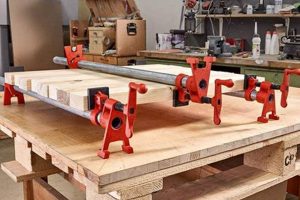
A specific type of fastening tool used in carpentry and related trades utilizes threaded metal tubing, typically with a one-inch nominal diameter. This tool consists of two adjustable heads that slide onto the tubing and tighten against the wood pieces being joined, applying pressure to hold them securely during gluing or assembly. These devices are commonly employed when project dimensions require greater clamping spans than those achievable with other types of fasteners.
The utility of this clamping method lies in its adaptability and cost-effectiveness. By varying the length of the tubing, the user can create a clamping setup of nearly any desired span. Furthermore, the relatively low cost of the tubing, combined with the reusability of the heads, makes this a practical option for both hobbyists and professional woodworkers. This clamping approach has been used for many years, providing a stable and reliable means of joining wood components in a range of projects, from furniture construction to cabinetmaking.
The subsequent sections will delve into the selection criteria for the clamping heads, the preparation and maintenance of the tubing used, and specific techniques for employing these tools effectively in various woodworking applications. These applications include edge joining, frame construction, and assembling larger casework projects.
Tips for Optimal Utilization
Maximizing the effectiveness of this clamping method requires attention to several key aspects. Following these guidelines will contribute to more secure and accurate assemblies.
Tip 1: Tubing Preparation: Clean the tubing thoroughly before each use. Residue from glue or previous projects can inhibit the sliding action of the heads, reducing clamping pressure and potentially marring the wood surface.
Tip 2: Head Selection: Choose heads constructed from durable materials, such as cast iron. The heads should exhibit minimal flex under pressure to ensure uniform clamping force across the entire joint.
Tip 3: Parallel Alignment: Maintain parallel alignment of the tubing to the work surface. Angled pressure can distort the workpiece or cause the joint to fail during the drying process.
Tip 4: Even Pressure Distribution: Use multiple tools along the length of the joint to distribute pressure evenly. Concentrated force in one area can lead to bowing or misalignment.
Tip 5: Protective Barriers: Employ softwood cauls or pads between the clamping heads and the workpiece. This protects the wood surface from indentation and prevents glue squeeze-out from adhering to the metal.
Tip 6: Thread Lubrication: Apply a light lubricant to the threads of the tightening mechanism. This ensures smooth operation and prevents seizing, prolonging the lifespan of the tool.
Tip 7: Gradual Tightening: Tighten the clamps incrementally, alternating between each one to apply pressure gradually. This minimizes stress on the joint and allows for adjustments as needed.
Adhering to these guidelines will improve the reliability and accuracy of woodworking projects that rely on this type of clamping system. Consistent application of proper techniques ensures strong, well-aligned joints.
The subsequent section will address common issues encountered when using this type of clamp and present troubleshooting strategies for resolving these issues effectively.
1. Threaded Pipe Selection

The selection of threaded pipe is a foundational consideration in the context of the described fastening method. The structural integrity of the clamping system, and consequently the success of the woodworking project, is directly contingent upon the quality and specifications of the chosen pipe. A one-inch nominal diameter pipe is typically utilized, but variations in wall thickness and material composition significantly impact performance. Thinner-walled pipes, while lighter, are more susceptible to bending or deformation under pressure, potentially leading to uneven clamping force and compromised joint integrity. Conversely, thicker-walled pipes offer greater rigidity and resistance to bending, but increase the overall weight and cost of the system. Material selection, commonly black iron or galvanized steel, also plays a critical role. Black iron is less expensive but prone to rust, requiring protective coatings to prevent corrosion. Galvanized steel offers superior corrosion resistance but at a higher initial cost. Therefore, the proper selection of threaded pipe is not merely a convenience, but a critical factor directly affecting the structural integrity and longevity of the woodworking project.
Consider, for example, the construction of a large tabletop requiring edge-glued boards. Using undersized or low-quality pipe could result in bowing of the tabletop during the clamping process, leading to an uneven surface and weakened joints. Similarly, in frame construction, inadequate pipe rigidity can cause misalignment and distortion of the frame. Professional woodworkers often invest in higher-quality, thicker-walled pipe to ensure consistent and reliable clamping performance across a range of projects. They might also choose galvanized pipe in humid environments to prevent rust and maintain the integrity of the clamping system over time. The type of threading is also significant; poorly cut or damaged threads can make it difficult to tighten the clamping heads properly, reducing clamping force and potentially damaging the workpiece. Careful inspection of the threads before use is therefore essential.
In summary, the selection of threaded pipe is an inextricable component of the overall clamping system, directly influencing its strength, stability, and longevity. Choosing appropriate pipe dimensions, material, and thread quality is paramount for achieving successful and durable woodworking results. Ignoring these considerations can lead to compromised joints, distorted workpieces, and ultimately, project failure. Therefore, a well-informed decision regarding threaded pipe selection is a fundamental aspect of sound woodworking practice.
2. Clamping Head Design

The design of the clamping heads significantly influences the effectiveness of any system based on the described fastening tool. The heads, responsible for transmitting and distributing pressure to the wood surfaces, must possess specific characteristics to ensure proper functionality and prevent damage to the materials being joined. Critical design aspects include the material composition, the surface area of contact with the wood, the geometry of the clamping faces, and the mechanical mechanism for tightening and releasing pressure. Inadequate design in any of these areas can lead to uneven clamping force, slippage, indentations, or even complete failure of the joint. For instance, if the clamping faces are too small, the concentrated pressure can mar the wood surface, particularly on softer species. Similarly, if the tightening mechanism is poorly designed or constructed, it may be difficult to apply and maintain adequate pressure, resulting in a weak or misaligned joint. Therefore, the clamping head design forms an integral part of the described fastening approach, directly impacting its practical utility and the quality of the finished product.
Consider the example of constructing a large frame. Clamping heads with a broad, flat contact surface will distribute pressure more evenly across the mitered joints, minimizing the risk of slippage or misalignment during glue-up. In contrast, heads with a narrow or uneven surface can create localized pressure points, potentially crushing the wood fibers or distorting the frame. Furthermore, the type of threading and the ease of adjustment on the head are paramount. Coarse threads allow for rapid tightening, but fine threads provide more precise control over the applied pressure. A clamping head that is difficult to adjust or prone to slippage can significantly increase the time and effort required to assemble a project, and may even compromise the accuracy of the final result. Manufacturers often employ different designs to address specific needs, such as quick-release mechanisms for rapid adjustments or pivoting heads for clamping irregular shapes. The choice of clamping head design should, therefore, be informed by the specific requirements of the woodworking task at hand.
In conclusion, the clamping head design is not merely an ancillary feature of the described fastening tool, but a critical determinant of its overall performance and reliability. Effective design principles, encompassing material selection, contact surface geometry, and mechanical functionality, are essential for ensuring consistent and accurate clamping force, minimizing the risk of damage to the workpiece, and ultimately contributing to the success of the woodworking project. Challenges in clamping head design relate to balancing cost-effectiveness with durability and precision. Understanding the practical implications of different design choices is crucial for any woodworker seeking to optimize their clamping techniques.
3. Optimal Clamping Pressure
Optimal clamping pressure represents a critical variable in woodworking, especially when employing threaded metal tubing based clamping systems. The application of insufficient force compromises the integrity of the glue bond, resulting in weakened joints prone to failure over time. Conversely, excessive pressure can crush wood fibers, leading to distorted assemblies and structurally unsound joints. This balance is particularly crucial when using the specified devices, as the leverage they provide can easily generate substantial force if improperly managed. Failure to maintain adequate clamping pressure can manifest as gaps in joints, misalignment of components, or even complete separation of glued surfaces after the clamps are removed. For instance, when edge-joining boards for a tabletop, inadequate clamping pressure can result in visible seams and a structurally weak surface.
Achieving optimal clamping pressure is not solely dependent on the mechanical advantage of the tool itself. Factors such as the wood species, the type of adhesive used, and the joint configuration all influence the ideal pressure range. Softer woods require less force than hardwoods to achieve a strong bond without crushing the fibers. Different adhesives also have varying pressure requirements to ensure proper adhesion. For example, polyvinyl acetate (PVA) glues typically require moderate clamping pressure, while epoxy resins can tolerate higher pressure levels. Complex joint configurations, such as mortise and tenon or dovetail joints, often require more clamping pressure than simple butt joints to ensure complete engagement of the mating surfaces. Precise determination of the optimal pressure is often a matter of experience and careful observation. Woodworkers frequently use cauls or protective pads to distribute pressure evenly and prevent surface damage, while also monitoring for signs of glue squeeze-out, an indicator of adequate adhesive coverage.
The attainment of optimal clamping pressure, when using the specified clamping system, represents a critical element in the fabrication of durable and aesthetically pleasing wooden structures. Failure to appreciate this crucial aspect can lead to structurally unsound projects. Successfully managing clamping pressure demands a comprehensive understanding of material properties, adhesive characteristics, and joint mechanics. The utilization of appropriate clamping techniques and protective measures mitigates the risk of damage and ensures the creation of robust, high-quality woodworking projects. Future studies might focus on developing pressure-indicating devices that can be integrated into clamping systems, providing a more objective and quantifiable means of achieving optimal clamping pressure across different woodworking scenarios.
4. Surface Protection Methods

The intersection of surface protection methods and the specified clamping tool usage highlights a crucial aspect of quality woodworking. The inherent design of pipe clamps, while providing significant clamping force, presents a potential risk of damage to wood surfaces. The metal clamping faces, often unfinished or roughly cast, can leave indentations, scratches, or pressure marks, particularly on softer wood species. Therefore, surface protection methods become indispensable in mitigating these risks and preserving the aesthetic and structural integrity of the workpiece. The direct relationship lies in the cause-and-effect scenario: direct contact between the clamp’s metal components and the wood surface causes damage; implementation of protective measures prevents this damage. The importance of these methods stems from the need to distribute clamping force evenly and prevent localized pressure points, which can lead to irreversible surface imperfections. Examples include the use of wooden cauls, cork padding, or even layers of heavy paper between the clamping faces and the wood. These materials act as a buffer, distributing the force and preventing direct contact with the potentially damaging metal.
Practical application of these methods varies depending on the nature of the woodworking project and the sensitivity of the wood being used. For instance, when clamping delicate veneer, multiple layers of soft material may be necessary to prevent impressions. In situations involving curved surfaces, custom-shaped cauls can be fabricated to conform to the contours and distribute pressure evenly across the entire area. The selection of appropriate surface protection materials also depends on the type of adhesive being used. Certain adhesives, particularly those with high squeeze-out, can adhere to unprotected metal surfaces, making removal difficult and potentially damaging the wood in the process. In these cases, a non-stick barrier, such as polyethylene sheeting, may be used in conjunction with other protective materials. The effectiveness of surface protection methods can be assessed by visually inspecting the workpiece after clamping and removing the clamps. Any signs of indentation, scratching, or discoloration indicate that the protection was inadequate and needs to be adjusted in future applications. Proper execution of these methods contributes directly to the professional quality of the finished product.
In summary, surface protection methods form an essential component of responsible and skilled woodworking practice when employing metal tubing-based clamping systems. They represent a proactive approach to minimizing the risk of damage and ensuring the preservation of both the aesthetic and structural qualities of the wood. Successfully integrating these methods requires a thoughtful consideration of the materials involved, the clamping forces being applied, and the potential for adhesive interaction. Overlooking these considerations can lead to compromised results and diminished value of the finished workpiece. Attention to surface protection complements the effectiveness of the clamping system. The clamping setup should always include steps to protect the workpiece.
5. Parallel Joint Alignment
Parallel joint alignment is a critical prerequisite for successful wood bonding, and the described fastening tool serves as a mechanism to achieve and maintain this alignment. If the surfaces being joined are not parallel during the clamping process, the resulting bond will be structurally compromised. This misalignment introduces stress concentrations within the joint, leading to premature failure. The described tools facilitate the application of even pressure across the joint surfaces, which is essential for achieving and preserving parallel alignment. Without this alignment, adhesive films will vary in thickness, creating weak points and compromising the overall strength of the assembly. The clamping device’s adjustable heads provide the means to correct minor misalignments and maintain parallelism throughout the curing process. If alignment is ignored, the clamping force becomes ineffective, and the resultant joint will not meet structural requirements.
Consider, for example, the construction of a large bookcase. The shelves must be precisely aligned to ensure that the unit stands square and that the doors fit properly. The use of the specified clamping devices, when carefully adjusted, allows the woodworker to ensure that the shelves are perfectly parallel to each other and to the top and bottom of the bookcase. This precision is not attainable with simpler clamping methods. Conversely, in the construction of a frame, if the corners are not perfectly square and the sides not parallel, the resulting frame will be distorted and aesthetically unpleasing. Skilled woodworkers use the adjustable nature of the clamps to fine-tune the alignment of the frame members before the adhesive fully cures, ensuring a precise and professional result. Parallel alignment also facilitates easier trimming of the joined material after the glue dries.
In conclusion, the relationship between parallel joint alignment and the specified clamping tools is one of essential interdependence. The clamps provide the force necessary to bring and hold the joint surfaces together, while the precise alignment of these surfaces is paramount for achieving a strong, durable, and aesthetically pleasing bond. The adjustable nature of the clamping heads allows for fine-tuning of the alignment, compensating for minor imperfections in the wood or the joint preparation. Without parallel alignment, the clamping force is rendered ineffective, and the resulting joint will be structurally compromised. Future research might focus on integrating alignment aids into the clamping heads to further enhance the accuracy and ease of achieving parallel joints.
6. Glue Application Techniques
Successful utilization of threaded metal tubing-based clamping systems is intrinsically linked to effective glue application techniques. The strength and longevity of any wood joint depend not only on adequate clamping pressure but also on the proper application of adhesive to the surfaces being joined. Suboptimal glue application can negate the benefits of even the most precisely applied clamping force, resulting in weak or failing joints.
- Uniform Adhesive Distribution
Ensuring a uniform layer of adhesive across the entire mating surface is paramount. Gaps or dry spots within the glue line will act as points of weakness, reducing the overall bond strength. This is especially critical when using threaded metal tubing clamps, where the applied pressure will only be effective in areas where the adhesive is present. Techniques such as using a notched spreader or applying multiple coats can help achieve uniform distribution. In the context of large panels clamped with these devices, uneven adhesive leads to potential delamination.
- Appropriate Adhesive Quantity
Applying the correct amount of adhesive is essential. Too little glue will result in a starved joint, while too much can lead to excessive squeeze-out and a weakened bond. The quantity of adhesive should be sufficient to coat both surfaces thoroughly but not so excessive that it impedes the clamping action. The pressure exerted by the clamps should aim to achieve a thin, consistent glue line, not to displace large amounts of adhesive. Excess adhesive can also contaminate the surrounding wood, hindering finishing processes. The correct amount ensures a full, not starved, joint.
- Open Time Management
Open time refers to the period between glue application and the exertion of clamping pressure. Exceeding the recommended open time for a particular adhesive can significantly reduce its bonding strength. The surface of the glue can begin to skin over, preventing proper adhesion to the mating surface. It’s imperative to apply the glue and engage the clamps within the specified open time window, especially in complex assemblies that require multiple joints to be glued simultaneously. This timing factor directly impacts the bond quality of the clamps.
- Surface Preparation
Proper surface preparation is integral to effective glue application. The wood surfaces must be clean, dry, and free from contaminants such as dust, oil, or old finish. These contaminants can impede the adhesion of the glue, weakening the joint. Sanding or otherwise preparing the surfaces prior to glue application ensures a strong and reliable bond, maximizing the effectiveness of the clamping system. The glue can adhere better when the surfaces are well prepared.
These glue application facets, when properly implemented, contribute significantly to the success of woodworking projects utilizing the threaded metal tubing clamps. The interaction between these techniques and the mechanical force applied by the clamps determines the quality and durability of the resulting wood joints. The clamp alone cannot compensate for poor glueing practice. An informed application strategy is crucial.
7. Dimensional Stability Control
Dimensional stability control, in the context of woodworking, refers to maintaining the original dimensions of wood components throughout the manufacturing process and the lifespan of the finished product. Wood, a hygroscopic material, expands and contracts in response to changes in moisture content. This dimensional instability can lead to warping, cracking, joint failure, and other structural defects. When employing threaded metal tubing-based clamping systems, dimensional stability control becomes paramount. Clamping, while essential for bonding, can exacerbate the effects of moisture-induced dimensional changes if not properly managed. The relationship is characterized by a cause-and-effect dynamic: uncontrolled dimensional variations during clamping introduce stress into the wood structure, which then manifests as defects in the finished piece. The fastening system described herein plays a role, not only in the bonding of components but also in temporarily restraining dimensional changes during the adhesive curing phase. For instance, in panel construction, where multiple boards are edge-glued, variations in the moisture content of individual boards can result in uneven clamping pressure and subsequent warping after the clamps are removed. A real-world example is seen in cabinetmaking, where door frames, if constructed from wood with inconsistent moisture content, will likely warp over time, leading to misalignment and functional problems. Effective dimensional stability control, therefore, is an inextricable element of successful woodworking outcomes when utilizing these clamps, as it directly impacts the long-term structural integrity and aesthetic appeal of the finished project.
Practical applications of dimensional stability control methods within the fastening system framework involve several key strategies. Wood acclimatization, the process of allowing wood to reach equilibrium with the ambient humidity, is a critical first step. This minimizes differential expansion and contraction during the clamping process. Moisture meters can be used to monitor the moisture content of wood components and ensure consistency prior to assembly. Another strategy involves the use of properly kiln-dried lumber, which has been processed to reduce moisture content and internal stresses. In situations where acclimatization is not fully achievable, applying controlled clamping pressure can help to restrain minor dimensional changes during glue curing. However, excessive pressure can lead to crushing or deformation of the wood, so careful monitoring is essential. Woodworkers can utilize clamping cauls rigid boards placed between the clamping heads and the wood to distribute pressure evenly and prevent localized distortions. Furthermore, selection of appropriate adhesives that accommodate some degree of wood movement can mitigate the stresses induced by dimensional changes. Understanding the seasonal moisture variations is also a key tool for builders.
In summary, dimensional stability control is not an isolated consideration but an integrated aspect of woodworking when utilizing threaded metal tubing-based clamping systems. The primary challenge lies in balancing the need for strong clamping pressure with the potential for exacerbating moisture-induced dimensional changes. Key insights include the importance of wood acclimatization, the use of moisture meters, and the application of controlled clamping techniques. Effective dimensional stability control ensures that the benefits of clamping strong joints and precise alignment are not undermined by subsequent warping, cracking, or joint failure. Addressing this multifaceted relationship ensures the production of high-quality woodworking projects that maintain their structural integrity and aesthetic appeal over time. Ignoring the impact of moisture content can cause any project’s integrity to suffer, rendering the time, effort and materials useless.
Frequently Asked Questions About Clamping
The following section addresses common inquiries and clarifies prevalent misconceptions regarding the application of threaded metal tubing-based clamping systems in woodworking.
Question 1: What constitutes the optimal tubing length for a versatile clamping setup?
The selection of tubing length depends directly upon the typical scale of projects undertaken. A range of lengths, from 24 inches to 72 inches, provides adaptability for small to medium-sized assemblies. Longer lengths may be necessary for larger panels or casework, but should be balanced against storage and handling constraints.
Question 2: Can galvanized pipe substitute for black iron pipe in this clamping method?
Galvanized pipe is a suitable alternative to black iron. The zinc coating offers enhanced corrosion resistance, particularly in humid environments. However, galvanized pipe typically exhibits a slightly higher cost. The choice is generally determined by environmental conditions and budget considerations.
Question 3: What is the recommended maintenance procedure for the clamping heads?
Regular maintenance involves cleaning the threads and clamping faces with a wire brush to remove accumulated glue residue and debris. Applying a light lubricant to the threads ensures smooth operation and prevents seizing. Heads should be inspected periodically for signs of wear or damage, such as cracks or stripped threads, and replaced as needed.
Question 4: How can surface indentations from the clamping heads be prevented?
Surface indentations are mitigated through the use of cauls or pads between the clamping heads and the wood surface. Softwood cauls, cork padding, or even layers of heavy paper distribute pressure evenly and prevent direct contact between the metal and the wood. The selection of material depends upon the wood species and the desired level of protection.
Question 5: Is it necessary to use multiple clamps along the length of a joint?
Employing multiple clamps is generally recommended, particularly for longer joints. Distributing clamping pressure evenly along the entire length of the joint minimizes the risk of bowing or misalignment. The spacing between clamps depends on the stiffness of the wood and the applied clamping force; closer spacing is required for flexible materials or higher pressure.
Question 6: How can one ensure parallel alignment of the clamping system relative to the workpiece?
Parallel alignment is achieved through careful positioning of the clamps and visual inspection. The tubing should be oriented parallel to the surface being clamped, and the clamping heads should be aligned to apply pressure evenly across the joint. Shims can be used to correct minor misalignments. Accurate alignment minimizes stress on the joint and prevents distortion of the workpiece.
The provided answers offer clarification on key aspects of utilizing this method. Adherence to these principles contributes to improved woodworking outcomes.
The following segment explores troubleshooting common challenges encountered with clamping systems.
Conclusion
The preceding discussion has elucidated the multifaceted considerations surrounding the selection, application, and maintenance of the one-inch threaded tubing clamping system in woodworking. Critical aspects include material selection, pressure control, surface protection, and alignment techniques. Understanding and adhering to these principles directly impacts the structural integrity and aesthetic quality of finished woodworking projects.
Continued diligence in refining clamping techniques and exploring innovative methods will further optimize woodworking outcomes. Investment in quality materials, coupled with a commitment to best practices, ensures consistent and reliable results across a range of applications. Further understanding of the best uses of 1 inch pipe clamp woodworking in production techniques should be a priority in continued research for quality results.
![Top-Rated: Best Quick Clamps for Woodworking Projects [2024] | Step-by-Step Guides, Tools & Inspiration to Build Beautiful Wooden Decor on a Budget](https://woodfromhome.com/wp-content/uploads/2026/04/th-264-300x200.jpg "Top-Rated: Best Quick Clamps for Woodworking Projects [2024] Step-by-Step Guides, Tools & Inspiration to Build Beautiful Wooden Decor on a Budget")