



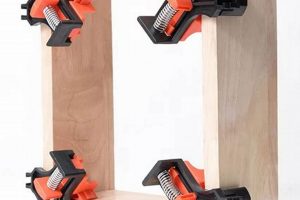
These specialized tools are designed to hold workpieces at a precise right angle during assembly. These tools facilitate the creation of square corners in various woodworking projects. Examples include corner clamps, miter clamps, and frame clamps, each offering unique mechanisms for securing joints. The use of these tools ensures accuracy and stability during gluing, screwing, or fastening operations.
The utilization of such devices is critical for achieving professional-quality results in cabinet making, picture framing, and other applications requiring precise angles. The employment of these angle-securing aids not only improves the structural integrity of finished pieces but also streamlines the assembly process, saving time and minimizing errors. Historically, woodworkers relied on complex jigs and fixtures to achieve similar results; modern clamps offer a more convenient and efficient solution.
The subsequent sections will explore different types, selection criteria, and best practices for effectively integrating these essential woodworking aids into a workshop environment. The discussion will cover considerations such as clamping pressure, material compatibility, and adjustability, providing a comprehensive guide for both novice and experienced woodworkers.
Tips
The following are several key considerations to maximize the effectiveness and longevity when utilizing these angle-securing tools. Attention to these points will contribute to project accuracy and efficient workflow.
Tip 1: Verify Accuracy Before Use: It is imperative to confirm the clamp’s internal angle is precisely 90 degrees. Use a reliable square or protractor to check for deviations before commencing any project. A misaligned clamp can compromise the squareness of the assembly.
Tip 2: Distribute Clamping Pressure Evenly: Avoid over-tightening, which can damage the workpiece or distort the joint. Employ padding between the clamp and the wood surface to distribute pressure and prevent indentation. Gradual, even tightening is recommended.
Tip 3: Select the Appropriate Clamp Type for the Joint: Different joint types necessitate different clamping solutions. Corner clamps are suitable for simple corner joints, while miter clamps are designed for angled connections. Selecting the correct type optimizes holding power and accuracy.
Tip 4: Ensure Proper Alignment Before Clamping: Prior to engaging the clamp, meticulously align the components. Slight misalignments will be amplified when clamping force is applied. Double-check for squareness and flushness before tightening.
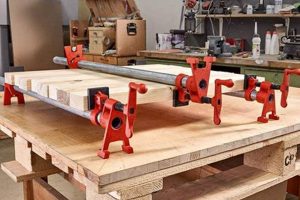
Tip 5: Use Multiple Clamps for Larger Assemblies: For large frames or cabinets, employ multiple clamps strategically placed to ensure uniform pressure distribution and prevent warping. The quantity of clamps should be proportional to the size and complexity of the project.
Tip 6: Maintain Cleanliness: Glue buildup can impede the clamp’s operation and reduce its accuracy. Regularly clean the clamp’s surfaces with appropriate solvents to remove adhesive residue and ensure smooth movement.
Tip 7: Store Properly: Store clamps in a clean, dry environment to prevent rust and corrosion. Avoid stacking them haphazardly, as this can damage the clamping surfaces or mechanisms. Organizing the tools carefully extends their lifespan.
Implementing these guidelines will significantly enhance the precision and efficiency of woodworking projects, resulting in stronger, more aesthetically pleasing finished products. Consistent attention to these principles translates to professional-level craftsmanship.
The next section will address common problems encountered when using these specialized clamps and present solutions for overcoming these challenges.
1. Joint Accuracy

Joint accuracy in woodworking, defined by the precision of angles and alignment in assembled components, is fundamentally linked to the effectiveness of these clamps. Deviations from perfect right angles can compromise structural integrity and aesthetic appeal. These specialized tools serve as a direct means to mitigate such inaccuracies.
- Precise Angle Maintenance
Clamps designed for right-angle joints actively maintain a 90-degree angle during the critical gluing or fastening phase. The clamps counteract the tendency of wood to shift or drift, ensuring the joint remains square. This is exemplified in cabinet construction, where consistent right angles are essential for proper door alignment and overall structural stability.
- Elimination of Cumulative Error
In complex assemblies involving multiple right-angle joints, even small errors can accumulate, leading to significant discrepancies in the final product. These tools mitigate this effect by enforcing accuracy at each joint. Frame construction demonstrates this principle; each corner must be precisely square to ensure the entire frame maintains its intended shape.
- Enhanced Structural Integrity
Accurate joints, achieved through the use of these tools, contribute directly to the overall strength and durability of a woodworking project. A square joint distributes stress evenly, reducing the likelihood of failure under load. This is particularly relevant in load-bearing structures such as tables or shelves, where joint integrity is paramount for safety and longevity.
- Improved Aesthetic Outcome
Beyond structural considerations, accurate joints are critical for achieving a professional aesthetic. Gaps, misalignments, or uneven surfaces resulting from inaccurate joints detract from the visual appeal of the finished piece. Picture frames, for example, demand perfectly square corners to present a clean, visually pleasing appearance.
In conclusion, the relationship between joint accuracy and these clamps is symbiotic. The clamps provide the means to achieve and maintain accurate angles, while the demand for accurate joints necessitates the use of such specialized tools. This synergy ensures both structural integrity and aesthetic quality in woodworking projects.
2. Clamping Force
Clamping force, the pressure exerted by these specialized clamps on workpieces, is a critical factor influencing joint strength and overall project quality. The appropriate application of this force ensures secure bonding without causing damage. Understanding the nuances of clamping force is essential for effective use of these tools.
- Optimal Pressure Application
The ideal clamping force varies depending on the wood species, adhesive type, and joint configuration. Excessive force can crush softer woods, while insufficient pressure may result in a weak bond. For instance, clamping softwood requires a lighter touch compared to hardwoods like oak or maple. The objective is to apply enough pressure to ensure intimate contact between surfaces without deforming the wood fibers.
- Uniform Pressure Distribution
Uneven distribution of clamping force can lead to joint misalignment or localized compression. These tools should be positioned to provide consistent pressure across the entire joint surface. Employing cauls or padding can help distribute force more evenly, particularly when clamping irregular shapes or delicate materials. This ensures the adhesive bonds uniformly, maximizing joint strength.
- Clamp Design and Force Capacity
Different types of clamps offer varying force capacities. Lightweight corner clamps may suffice for small projects, while heavy-duty frame clamps are necessary for larger assemblies. Exceeding a clamp’s rated capacity can result in clamp failure or damage to the workpiece. Selecting clamps with appropriate force capabilities is crucial for project success and operator safety. Specifications should always be consulted prior to use.
- Impact on Adhesive Performance
Clamping force directly affects adhesive performance by influencing bond line thickness and penetration. Adequate pressure ensures the adhesive wets the wood surfaces thoroughly, promoting optimal adhesion. Insufficient pressure can result in starved joints with weak bonds. Proper clamping force, in conjunction with the correct adhesive and joint preparation, is essential for achieving durable and reliable woodworking joints.
The interplay between clamping force and tool selection emphasizes the need for careful consideration in woodworking practices. By understanding the principles governing force application, woodworkers can maximize the effectiveness of these specialized clamps and achieve superior results in their projects. The principles described above are vital for the creation of strong and aesthetically pleasing structures.
3. Material Compatibility
Material compatibility, in the context of these clamps, refers to the suitability of the clamp’s materials and design for use with various wood species, finishes, and adhesives. Incompatible materials can lead to damage, staining, or compromised joint integrity. Therefore, careful consideration of material compatibility is essential for optimal results.
- Clamp Pad Composition
The material composition of the clamp pads, which come into direct contact with the wood surface, is of primary concern. Hard plastic or metal pads can indent softwoods or damage delicate finishes. Over time this can become a major issue. Softer materials, such as rubber or cork, provide cushioning and distribute pressure more evenly, reducing the risk of marring the workpiece. The selection of appropriate pad materials is crucial for preserving the surface quality of the wood. When working with high-end materials, the use of non-reactive padding can avoid unforeseen damage during the project.
- Chemical Reactivity
Certain clamp materials may react chemically with wood finishes or adhesives, resulting in discoloration or weakening of the joint. For example, some metal clamps can cause staining on tannin-rich woods like oak. Likewise, certain adhesives may corrode or degrade clamp components. Thoroughly testing the clamp’s compatibility with the intended finish and adhesive is advisable, particularly when working with unfamiliar materials. This testing can be done in a concealed area of the project material to reduce the risk of damage.
- Clamp Body Material
The material used for the clamp body itself impacts its suitability for different woodworking applications. Metal clamps offer high strength and durability, making them well-suited for heavy-duty tasks. However, metal can be abrasive and may require additional padding to protect delicate surfaces. Plastic clamps are lighter and less likely to damage finishes, but they may lack the strength required for demanding projects. Choosing a clamp body material that balances strength and surface protection is important.
- Adhesive Residue Resistance
Adhesive residue inevitably accumulates on clamps during use. The clamp’s material should be resistant to the adhesive being used. Some plastics are easily cleaned, while other materials may require specific solvents to remove hardened glue. A clamp that is difficult to clean can lead to reduced clamping force and compromised accuracy. The ability to easily remove adhesive residue ensures the clamp remains effective and maintains its intended performance.
In summary, material compatibility encompasses a range of considerations, from clamp pad composition to adhesive residue resistance. Careful attention to these factors ensures that these tools enhance, rather than detract from, the quality and longevity of woodworking projects. Appropriate material selection minimizes the risk of damage, staining, or compromised joint integrity, resulting in professional-grade results.
4. Clamp Type

The efficacy of achieving accurate 90-degree angles in woodworking is directly contingent upon the selection of the appropriate clamp type. These specialized tools are not universally interchangeable; each design possesses inherent strengths and limitations that dictate its suitability for specific applications. Corner clamps, for instance, excel in holding simple corner joints, facilitating the creation of boxes or basic frames. Miter clamps, conversely, are specifically engineered for angled connections, providing the necessary support for joining mitered pieces in picture frames or decorative moldings. The application of an inappropriate clamp type can induce misalignment, compromise joint strength, and ultimately undermine the intended aesthetic and structural integrity of the project. For example, attempting to use a standard bar clamp to secure a mitered corner will inevitably result in slippage and an inaccurate angle.
The practical significance of understanding the connection between clamp type and intended application extends beyond mere accuracy. The appropriate tool selection can significantly streamline the assembly process, reducing the time and effort required to achieve a precise joint. Specialized clamps often incorporate features designed to simplify alignment and minimize the risk of movement during clamping. Frame clamps, for instance, apply pressure simultaneously to all four corners of a frame, ensuring uniform closure and minimizing distortion. Ignoring these specialized features and relying on makeshift clamping solutions can lead to frustration, wasted materials, and ultimately, an inferior finished product. Professionals who specialize in cabinet-making have long understood the value that comes from properly employing these specialized tools.
In conclusion, the selection of the correct clamp type is not merely a procedural detail but a fundamental determinant of success in woodworking projects requiring precise 90-degree angles. The nuanced relationship between clamp design and application demands careful consideration, as mismatched tools can compromise accuracy, efficiency, and structural integrity. Mastering this aspect of woodworking empowers practitioners to achieve consistent, professional-quality results. While there are alternative ways to clamp materials together, there are clear benefits to utilizing this tool for woodworking projects.
5. Adjustability

Adjustability, in the realm of specialized woodworking clamps, defines the capacity of a tool to accommodate variations in workpiece dimensions and joint configurations. This attribute is paramount to the effective and versatile application of these clamps, particularly when dealing with diverse project requirements. The ability to modify clamping pressure, jaw opening, and angular alignment contributes directly to the precision and efficiency of woodworking tasks.
- Variable Jaw Opening
Variable jaw opening is a fundamental aspect of adjustability. Clamps with this feature can accommodate workpieces of varying thicknesses. For example, a clamp with a wide jaw opening can secure both thin veneer edging and thicker frame components. This versatility reduces the need for multiple specialized clamps, streamlining the woodworking process and improving overall cost-effectiveness.
- Adjustable Clamping Pressure
The capacity to regulate clamping pressure is critical for preventing damage to delicate materials or ensuring adequate force for robust joints. Softwoods, such as pine, require less clamping pressure than hardwoods like oak. Over-tightening can crush the wood fibers, while insufficient pressure may result in a weak bond. Adjustable clamping pressure allows the woodworker to tailor the force to the material, ensuring optimal joint integrity without causing deformation. It is especially important when working with sensitive materials.
- Angular Alignment Fine-Tuning
While these clamps are designed to hold 90-degree angles, slight deviations may occur due to material inconsistencies or minor inaccuracies in workpiece preparation. Some specialized clamps offer fine-tuning mechanisms that allow for subtle adjustments to angular alignment. This feature ensures that the joint is precisely square, compensating for imperfections and enhancing the overall accuracy of the assembly. For example, an adjustable corner clamp allows for minor angle corrections to ensure perfectly square corners.
- Adaptable Configurations
Certain clamps offer adaptable configurations, such as the ability to convert from a corner clamp to an edge clamp. This adaptability enhances the clamp’s versatility, allowing it to be used in a wider range of applications. For example, a convertible clamp can secure both corner joints and edge-to-edge joints, eliminating the need for multiple specialized tools. This adaptability contributes to greater efficiency and cost-effectiveness in the workshop.
Adjustability, therefore, is not merely a convenience but a critical determinant of the precision, versatility, and efficiency of these clamps. Clamps that offer a range of adjustability features empower woodworkers to adapt to diverse project requirements, ensuring optimal results with a variety of materials and joint configurations. The principles outlined above are essential for any serious woodworker.
6. Ease of Use
Ease of use, regarding woodworking clamps designed for 90-degree angles, directly influences project efficiency and the realization of intended results. Complex clamping mechanisms or unintuitive designs can impede workflow, increase the likelihood of errors, and ultimately compromise the integrity of the final product. User-friendly clamps, conversely, facilitate rapid and accurate joint assembly. For example, a corner clamp featuring a quick-release mechanism allows for swift adjustments and reduces the time spent securing the workpiece. This direct correlation between ease of use and project outcome underscores the importance of selecting clamps that minimize complexity and maximize efficiency. Time constraints on many projects further amplify this concern.
The practical significance of ease of use extends beyond mere convenience. Clamps that are simple to operate reduce the physical strain on the user, minimizing fatigue and the potential for injury. A clamp with ergonomic handles and smooth-operating threads enables precise adjustments with minimal effort. This is particularly important for repetitive tasks, such as assembling multiple frames or cabinets. The reduction in physical strain translates to increased productivity and a safer working environment. For example, many professionals employ these clamps on large projects to minimize strain.
Therefore, the connection between ease of use and these clamps for woodworking is intrinsically linked to project success. Clamps designed with user-friendliness in mind enhance efficiency, reduce errors, and promote a safer working environment. Selecting clamps that prioritize ease of use is a critical consideration for both amateur and professional woodworkers seeking to achieve consistent and accurate results. While simple in nature, ease of use should be a major consideration when selecting the right tool for your particular project.
7. Durability
Durability, defined as the ability to withstand wear, pressure, or damage, constitutes a critical attribute in woodworking clamps engineered for 90-degree angles. The operational environment inherent to woodworking subjects these tools to significant stress, including repetitive force application, exposure to adhesives and solvents, and potential physical impacts. A lack of durability in such tools translates directly to compromised performance, reduced lifespan, and potential hazards for the operator. For example, a clamp constructed from low-grade steel may deform under pressure, rendering it incapable of maintaining a precise 90-degree angle. Similarly, a plastic clamp exposed to harsh solvents may degrade, weakening its structural integrity. These failures directly impact the accuracy and reliability of the woodworking process.
The selection of materials and construction techniques employed in manufacturing directly influences the durability of these specialized clamps. High-grade steel, known for its strength and resistance to deformation, is frequently utilized in the construction of robust clamps designed for heavy-duty applications. Likewise, heat-treating processes enhance the metal’s hardness and resistance to wear. Furthermore, the design of the clamping mechanism plays a crucial role in ensuring durability. Clamps with robust threads and secure locking mechanisms are less prone to slippage or failure under pressure. Regular maintenance, including cleaning and lubrication, extends the lifespan of even the most durable clamps, preventing corrosion and ensuring smooth operation. In contrast, neglecting these aspects can significantly reduce the tool’s functional longevity. The types of materials often used in construction are the greatest factors when discussing this component.
In conclusion, durability is not merely a desirable feature but a fundamental requirement for these woodworking tools. The capacity to withstand the rigors of the woodworking environment directly impacts the accuracy, reliability, and safety of the tool. Selection of clamps constructed from high-quality materials, coupled with appropriate maintenance practices, ensures long-term performance and minimizes the risk of failure. This understanding is paramount for both amateur and professional woodworkers seeking to achieve consistent and professional-grade results. Without an appropriate level of durability, these tools are essentially worthless.
Frequently Asked Questions about 90 Degree Clamps for Woodworking
The following section addresses common inquiries and clarifies essential aspects regarding the selection, application, and maintenance of these specialized woodworking tools.
Question 1: What distinguishes a 90-degree clamp from a standard clamp?
These specialized clamps are designed to hold workpieces at a precise right angle, ensuring square corners during assembly. Standard clamps typically exert pressure in a linear fashion, without guaranteeing angular accuracy. This makes the specialized tool far more effective for specific applications.
Question 2: Are all 90-degree clamps suitable for every type of woodworking joint?
No. Different joint configurations necessitate specific clamp designs. Corner clamps are appropriate for simple corner joints, while miter clamps are designed for angled connections. Frame clamps apply pressure to all four corners simultaneously, suitable for assembling frames and similar structures.
Question 3: How does clamping pressure affect the integrity of a woodworking joint?
Appropriate clamping pressure ensures intimate contact between joint surfaces, promoting optimal adhesive bonding. Excessive pressure can crush wood fibers, while insufficient pressure results in a weak bond. The ideal pressure varies depending on the wood species and adhesive type.
Question 4: What materials are commonly used in the construction of these tools, and how does this impact performance?
Common materials include steel, aluminum, and reinforced plastics. Steel clamps offer high strength and durability, suitable for heavy-duty applications. Aluminum clamps are lighter and resistant to corrosion, while plastic clamps are less likely to damage delicate surfaces. Each material offers distinct advantages and disadvantages.
Question 5: How should these tools be maintained to ensure optimal performance and longevity?
Regular maintenance includes cleaning adhesive residue, lubricating moving parts, and inspecting for damage. Solvents appropriate for the adhesive being used should be employed to remove buildup. Lubrication prevents corrosion and ensures smooth operation. Damaged components should be repaired or replaced promptly.
Question 6: Can these clamps be used on materials other than wood?
While primarily designed for woodworking, these clamps can be adapted for use with other materials, such as metal or plastic, provided appropriate padding is employed to prevent surface damage. The clamping force should be adjusted accordingly to avoid deformation or breakage.
These answers provide a foundational understanding of these specialized clamps, addressing common concerns and misconceptions.
The subsequent section will offer advanced techniques for maximizing the effectiveness of these tools in complex woodworking projects.
Conclusion
The preceding exploration has elucidated the critical role of 90 degree clamps for woodworking in achieving accurate and structurally sound joints. The correct selection, application, and maintenance of these tools are essential for maximizing their effectiveness. Considerations such as clamp type, clamping force, material compatibility, adjustability, ease of use, and durability must be carefully evaluated to ensure optimal performance in various woodworking scenarios.
The continued advancement in clamp design and materials promises further enhancements in precision and efficiency for woodworking projects. The conscientious application of these principles will contribute to elevated standards of craftsmanship and long-lasting structural integrity in assembled wood products. Skillful employment of these tools is a hallmark of professional-quality work.
![Top-Rated: Best Quick Clamps for Woodworking Projects [2024] | Step-by-Step Guides, Tools & Inspiration to Build Beautiful Wooden Decor on a Budget](https://woodfromhome.com/wp-content/uploads/2026/04/th-264-300x200.jpg "Top-Rated: Best Quick Clamps for Woodworking Projects [2024] Step-by-Step Guides, Tools & Inspiration to Build Beautiful Wooden Decor on a Budget")