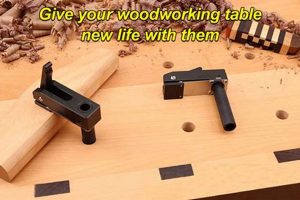
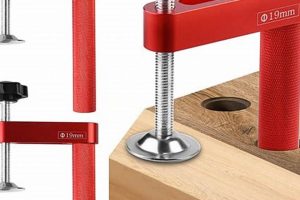
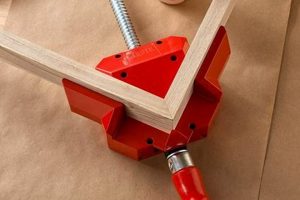
Workholding devices are essential tools in the fabrication of wooden structures. These tools apply pressure to secure components during assembly, gluing, and finishing. Effective examples offer consistent pressure, durability, and ease of use, contributing directly to the quality and longevity of the finished product. For instance, securing mitered corners during glue-up with appropriate pressure ensures a strong, aesthetically pleasing joint.
The use of reliable workholding is crucial for achieving precise and stable woodworking projects. Properly secured components prevent movement that can lead to misaligned joints, weakened bonds, and overall structural instability. Historically, woodworking relied on rudimentary wedges and hand-tightened devices. Modern clamping technology provides enhanced precision, adjustability, and force distribution, significantly improving efficiency and reducing the potential for errors in the woodworking process.
The following sections will explore various types of these devices, examining their specific applications, advantages, and limitations. Considerations will include factors such as clamping force, jaw capacity, material composition, and suitability for different woodworking tasks. This overview will help in selecting the appropriate tools for specific project requirements.
Practical Guidance on Securing Wooden Components
Optimizing the selection and use of these devices significantly enhances woodworking precision and efficiency. Adhering to the following guidelines helps ensure successful project outcomes.
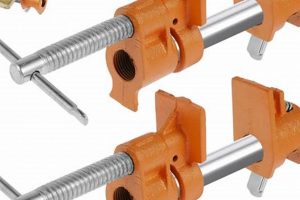
Tip 1: Select Appropriate Type. Consider the specific task. Bar styles are suitable for wide panels, while spring variants are ideal for quick, light-duty applications. Miter styles are designed for corners, and pipe versions provide extended reach.
Tip 2: Determine Adequate Clamping Force. Excessive force can damage the wood, while insufficient pressure compromises joint integrity. Calibrate the force applied based on wood species, joint type, and adhesive used.
Tip 3: Protect Wood Surfaces. Implement cauls or padding between the clamping jaws and the wood to prevent indentation and staining. Cork, leather, or hardwood cauls distribute pressure evenly and protect delicate surfaces.
Tip 4: Ensure Parallel Alignment. Verify that the jaws are parallel to each other and perpendicular to the workpiece. Misalignment can result in skewed joints and uneven pressure distribution.
Tip 5: Distribute Pressure Evenly. When clamping multiple pieces, distribute these tools uniformly along the joint line. This prevents stress concentrations and ensures a consistent bond.
Tip 6: Regular Maintenance. Periodically inspect for damage and lubricate threads and moving parts. Proper maintenance ensures smooth operation and extends the lifespan of the tools.
Tip 7: Dry-fit Before Gluing. Always dry-fit the project and practice the clamping sequence before applying adhesive. This allows for adjustments and prevents errors during the critical glue-up phase.
Proper implementation of these techniques ensures consistent, high-quality results in woodworking projects. Careful selection, calibrated pressure, and protective measures are essential for achieving strong, aesthetically pleasing joints.
The subsequent sections will delve into specific applications and advanced techniques, providing a more comprehensive understanding of how these tools contribute to successful woodworking endeavors.
1. Clamping Force

Clamping force, the measure of pressure exerted by a clamping device, constitutes a crucial determinant of its effectiveness in woodworking. A device’s ability to maintain secure contact between components during glue-up or assembly directly affects joint strength and overall structural integrity. Insufficient force results in gaps, weakened bonds, and potential failure, while excessive force can damage the wood fibers, leading to deformation or crushing. A suitable device delivers appropriate clamping pressure to establish a firm and lasting connection without compromising material integrity.
The impact of clamping force is evident in various woodworking scenarios. For instance, when assembling a cabinet, the application of adequate and evenly distributed clamping force ensures that all joints are tight and aligned. This prevents racking and maintains the cabinet’s structural stability over time. Conversely, utilizing inadequate force during the glue-up of a complex molding profile can lead to poorly bonded sections, resulting in visible seams and a compromised aesthetic. The selection of appropriate devices, calibrated to deliver the necessary force for specific materials and joinery methods, is therefore a critical aspect of woodworking practice.
Effective utilization of clamping force in woodworking requires a nuanced understanding of wood species, joint design, and adhesive properties. The capacity to regulate and distribute pressure evenly is essential to achieving consistent and reliable results. Mastering the art of clamping contributes directly to the creation of durable and aesthetically pleasing woodworking projects. Prioritizing devices that offer precise control over pressure application ensures that woodworking efforts result in structurally sound and visually compelling outcomes.
2. Jaw Capacity

Jaw capacity, referring to the maximum distance between the clamping surfaces, is a critical specification influencing the utility of woodworking securing devices. The adequacy of this dimension dictates the range of workpiece sizes that can be accommodated, thereby directly impacting the versatility and practicality of the tool.
- Material Thickness Accommodation
Jaw capacity determines the maximum thickness of material that can be secured. If a project involves joining boards of substantial thickness, the selected devices must possess sufficient capacity to accommodate the combined dimensions. Failing to account for this can render the tool ineffective, necessitating the use of alternative methods or additional equipment.
- Project Scale Considerations
Large-scale projects, such as furniture construction or cabinet making, often involve components of varying sizes and thicknesses. Adequate jaw capacity ensures that workholding solutions can handle the diverse dimensions encountered throughout the project, streamlining the workflow and preventing the need for multiple devices with differing capabilities.
- Joinery Type Implications
Certain joinery methods, such as mortise and tenon or dovetail joints, may require substantial surface area to be secured during the glue-up phase. The capacity to firmly hold the assembled joint while the adhesive cures is crucial for achieving a strong and durable bond. Insufficient capacity may compromise the integrity of the joint.
- Edge Clamping Applications
Edge clamping, a technique employed to align and secure the edges of boards during the construction of tabletops or panels, demands a device with adequate reach. The clamping surfaces must extend far enough to apply consistent pressure across the entire edge, preventing gaps or misalignments that can compromise the finished product’s appearance and structural stability.
In summary, jaw capacity is a primary consideration in the selection of woodworking securing devices. Matching the jaw capacity to the anticipated workpiece dimensions and project requirements is essential for ensuring effective and efficient workholding, thereby contributing to the successful completion of woodworking endeavors.
3. Material Durability

The service life and reliability of workholding devices in woodworking are directly correlated with their material durability. The capacity of these devices to withstand repeated stress, resist deformation under pressure, and avoid corrosion in typical workshop environments defines their suitability as reliable tools. Construction from robust materials such as hardened steel or high-strength alloys is essential for maintaining clamping force and alignment over prolonged periods. A device fabricated from substandard materials is prone to failure, resulting in compromised project quality and potential safety hazards. For example, threads on a clamp made from soft metal may strip under pressure, rendering the tool useless and potentially damaging the workpiece.
The selection of these tools requires careful consideration of the working environment and the anticipated frequency of use. In high-volume production settings, devices are subjected to constant operation and must exhibit superior wear resistance to minimize downtime and replacement costs. Similarly, woodworking that involves exposure to moisture or corrosive substances necessitates devices with protective coatings or construction from corrosion-resistant materials such as stainless steel. Instances of premature failure due to material degradation underscore the importance of investing in high-quality tools. In contrast, durable tools contribute to consistent project outcomes and long-term cost savings.
In conclusion, material durability is a paramount factor in determining the value and efficacy of woodworking clamping mechanisms. Investing in devices crafted from robust materials ensures sustained performance, reduces the risk of failure, and ultimately contributes to the successful completion of woodworking projects. The initial cost may be higher, but the long-term benefits of reliability and longevity outweigh the short-term savings associated with inferior products.
4. Ease of Adjustment
Efficient operation of workholding devices is significantly influenced by the ease with which they can be adjusted. The ability to quickly and accurately modify clamping pressure and position directly impacts workflow efficiency and reduces the potential for errors in woodworking projects. Devices with cumbersome or imprecise adjustment mechanisms can lead to time-consuming setup processes and inconsistent clamping force, resulting in compromised joint integrity or workpiece damage. In contrast, intuitive and responsive adjustment features enable rapid adaptation to varying material thicknesses and joint configurations, contributing to increased productivity and improved project outcomes. An easily adjustable clamp allows the woodworker to fine-tune pressure without excessive force, thus preventing damage to the wood surface.
The practical significance of easily adjustable securing mechanisms becomes particularly evident in complex woodworking assemblies involving multiple components and intricate joinery. In such scenarios, the ability to incrementally adjust clamping pressure and reposition the devices with minimal effort is essential for achieving precise alignment and uniform bonding. For instance, when assembling a multi-drawer chest, the rapid adjustment of devices allows for fine-tuning of the fit between drawers and the cabinet frame, ensuring smooth operation and a professional finish. Similarly, when working with delicate materials, the ability to modulate clamping force with precision prevents deformation or crushing of the wood fibers. When the operation is simple, the user will use more in the project.
In summary, ease of adjustment constitutes a critical attribute of effective woodworking securing devices. Prioritizing tools with intuitive adjustment mechanisms streamlines the workflow, enhances accuracy, and reduces the risk of errors. This feature contributes directly to improved project quality, increased efficiency, and a more satisfying woodworking experience. Overcomplicated devices can be frustrating to use, and the ease of adjustment can decide on a final choice.
5. Parallel Alignment
The attribute of parallel alignment in workholding devices is directly correlated to the quality and precision of woodworking projects. A device exhibiting parallel alignment ensures that the clamping surfaces are equidistant at all points along their length. Failure to maintain this parallelism results in uneven pressure distribution across the workpiece, leading to skewed joints, weakened bonds, and dimensional inaccuracies. The presence of parallel alignment is, therefore, a fundamental characteristic of a device deemed suitable for woodworking. For example, when assembling a picture frame, a device lacking parallel alignment will apply greater pressure on one corner than another, resulting in a trapezoidal rather than a rectangular frame.
The implications of non-parallel alignment extend beyond simple aesthetic flaws. Skewed joints introduce stress concentrations within the wood structure, compromising the long-term stability of the assembly. In furniture construction, this can manifest as wobbly legs or drawers that bind. Furthermore, non-parallel clamping surfaces can induce twisting forces on the workpiece, distorting its shape and making it difficult to achieve precise dimensions. Consequently, assessing and verifying parallel alignment is an essential step in tool selection and usage. Techniques such as using a precision square or visual inspection against a known flat surface are critical for ensuring that the devices employed maintain the required degree of parallelism. The clamping force is more evenly distributed with a good parallel alignment.
In summary, parallel alignment represents a critical parameter in the evaluation of woodworking securing devices. Its presence ensures uniform pressure distribution, minimizing the risk of skewed joints, structural instability, and dimensional inaccuracies. Woodworkers should prioritize devices that exhibit and maintain parallel alignment, and should implement verification procedures to ensure consistent performance. Neglecting this aspect can lead to compromised project quality and wasted materials. Ultimately, parallel alignment is not merely a desirable feature but a prerequisite for achieving professional-grade results.
6. Surface Protection
Surface protection, concerning woodworking securing devices, directly influences the aesthetic quality and structural integrity of the finished product. These devices, designed to exert substantial pressure, can cause indentation, scratching, or staining on wood surfaces if adequate protective measures are not implemented. The characteristics of effective devices must include features that mitigate the risk of surface damage, ensuring consistent pressure distribution and preventing direct contact between the tool’s metal components and the wood. Failure to protect wood surfaces compromises the visual appeal and market value of the completed piece. Therefore, integral design features of quality devices emphasize surface protection.
Several strategies can mitigate surface damage during the clamping process. Incorporating soft, non-marring materials such as cork, leather, or plastic on the jaws of the securing mechanisms serves as a protective barrier. Additionally, the use of caulsintermediate pieces of wood placed between the securing device and the workpiecedistributes pressure evenly and prevents localized stress concentrations. For example, when clamping a delicate veneer, a hardwood caul backed with cork can prevent the device from crushing the veneer or leaving unsightly marks. Employing these techniques demonstrates a commitment to both the structural soundness and aesthetic presentation of woodworking projects.
In summary, surface protection is an indispensable element of effective woodworking securing mechanisms. By incorporating protective materials and utilizing cauls, woodworkers can minimize the risk of damage to wood surfaces, ensuring the creation of aesthetically pleasing and structurally sound projects. Neglecting surface protection leads to avoidable imperfections and reduced value, underscoring the significance of considering this aspect when selecting and employing woodworking tools. The importance of this is frequently overlooked but can influence the entire project.
7. Application Versatility

Application versatility, as a defining characteristic of effective workholding devices, significantly impacts their overall utility within a woodworking setting. A device capable of adapting to a wide array of tasks represents a more valuable investment compared to specialized tools with limited applicability. The ability to secure components of varying shapes, sizes, and orientations allows for streamlined workflows and reduces the need for extensive tool collections. A device suitable for edge-joining boards, securing mitered corners, and applying pressure to curved surfaces demonstrates enhanced functionality.
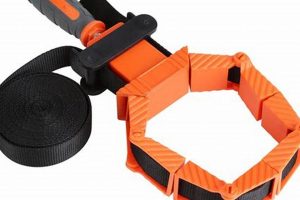
The practical significance of application versatility is evident in numerous woodworking scenarios. Consider the construction of a complex piece of furniture involving both straight and curved elements. A device designed exclusively for straight edges would be inadequate for securing the curved components, necessitating the acquisition of additional, specialized tools. Conversely, a device with adjustable jaws and adaptable pressure points can accommodate both types of elements, simplifying the assembly process and minimizing downtime. For instance, a band clamp, with its adjustable strap, excels at conforming to irregular shapes while maintaining consistent pressure, making it an indispensable tool for varied woodworking projects. This is more important in a woodworking shop environment where space is limited.
Ultimately, the application versatility of a securing device directly contributes to its cost-effectiveness and overall value in a woodworking environment. While specialized tools may excel in specific applications, those that offer adaptability across a broader range of tasks represent a more practical and efficient solution for both hobbyist and professional woodworkers. Prioritizing devices with demonstrated application versatility optimizes resource allocation and contributes to the successful completion of diverse woodworking endeavors. Devices with one-dimensional use is not practical and it adds up to clutter.
Frequently Asked Questions
The following section addresses common inquiries regarding woodworking securing devices, providing clarity on their selection, use, and maintenance.
Question 1: What is the appropriate clamping force for softwood species?
Clamping force for softwoods such as pine or cedar should be moderate, typically ranging from 150 to 250 pounds per square inch (PSI). Excessive force can easily compress the wood fibers, leading to indentation or damage. A lighter touch is preferable to maintain the material’s integrity.
Question 2: How often should securing devices be inspected for damage?
Securing devices should be inspected before each use for signs of wear, deformation, or corrosion. Regular inspection ensures that the device is functioning correctly and prevents unexpected failures that could compromise a project or pose a safety hazard.
Question 3: What is the best method for cleaning adhesive residue from securing device jaws?
Adhesive residue can be removed from securing device jaws using a solvent appropriate for the adhesive type. Mineral spirits or acetone are often effective for removing dried glue. It is essential to thoroughly clean the jaws to maintain a secure grip and prevent residue buildup.
Question 4: Are pipe types suitable for all woodworking applications?
Pipe types are generally suitable for applications requiring long reach and high clamping force. However, their relatively heavy weight and potential for bending under extreme pressure make them less ideal for delicate or precision work. Consider the specific requirements of the project before selecting pipe types.
Question 5: How can one prevent staining of wood from direct contact with a securing device?
Staining of wood can be prevented by using protective pads or cauls between the device jaws and the workpiece. Materials such as cork, leather, or hardwood can effectively shield the wood from direct contact with the metal components of the device.
Question 6: What is the expected lifespan of a high-quality securing device?
The lifespan of a high-quality securing device depends on usage frequency and maintenance. With proper care, a well-constructed device can last for many years. Regular cleaning, lubrication, and inspection are essential for maximizing the lifespan of these tools.
Effective use of workholding tools relies on careful selection, proper technique, and consistent maintenance. Attention to these details ensures successful woodworking outcomes.
The subsequent section explores advanced techniques and specialized devices to further enhance woodworking capabilities.
Conclusion
The preceding exploration has underscored the pivotal role of “good clamps for woodworking” in achieving precise and durable results. Key considerations, including clamping force, jaw capacity, material durability, ease of adjustment, parallel alignment, surface protection, and application versatility, have been examined to provide a comprehensive understanding of their impact on woodworking outcomes. The appropriate selection and utilization of these essential tools directly influence the structural integrity and aesthetic quality of finished projects.
Effective workholding practices, informed by the principles outlined, enable woodworkers to elevate their craft and consistently produce high-quality pieces. Continuous refinement of clamping techniques and diligent attention to tool maintenance remain paramount. As woodworking evolves, informed adoption of these tools will remain a cornerstone of skilled craftsmanship.