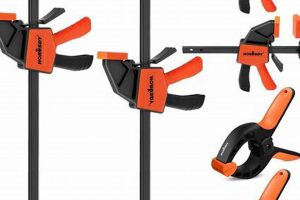
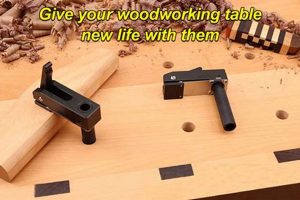
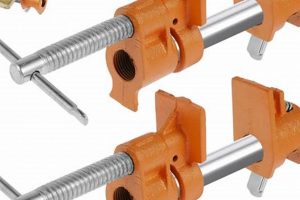
Mechanical fasteners that utilize an over-center locking action to hold workpieces securely are essential in various fabrication processes. These devices exert significant clamping force with minimal operator effort, quickly securing materials for cutting, drilling, or assembly. A common application involves holding wooden components firmly in place during glue-up operations, ensuring precise and consistent results.
Their widespread adoption stems from their efficiency and reliability in repetitive tasks. The robust holding power minimizes workpiece movement, leading to improved accuracy and reduced material waste. Historically, these clamps have evolved from simpler hand-operated mechanisms to sophisticated designs incorporating adjustable pressure settings and ergonomic handles. This evolution reflects the ongoing demand for increased productivity and precision in manufacturing.
The following sections will delve into the different types available, their specific uses within a carpentry environment, and considerations for selecting the optimal model for a given project. Understanding the nuances of these devices is critical for achieving professional-quality outcomes and maximizing efficiency in any woodworking endeavor.
Essential Usage Guidelines
The correct application of mechanical fasteners is critical for safe and effective woodworking. Adhering to established best practices extends the lifespan of the tools, and ensures consistent, high-quality results.
Tip 1: Select Appropriate Size and Capacity: The clamping force of the device must align with the requirements of the project. Over-tightening can damage delicate wood, while insufficient force compromises stability. Examine the specifications of each model and cross-reference it with the material being worked.
Tip 2: Ensure Proper Alignment: Before engaging the locking mechanism, verify that the fastener is positioned squarely against the workpiece. Misalignment introduces stress points that can lead to premature failure of either the clamp or the material being held.
Tip 3: Adjust Pressure Settings Carefully: Many models offer adjustable pressure. Start with a lower setting and gradually increase it until the workpiece is secure. This iterative approach minimizes the risk of over-clamping.
Tip 4: Maintain Regularly: Periodically inspect the components for wear, damage, or corrosion. Lubricate moving parts with appropriate oil or grease to ensure smooth operation and prevent seizing. Replace any damaged parts immediately.
Tip 5: Employ Protective Pads: When working with softwoods or finished surfaces, utilize protective pads between the fastener and the workpiece. These pads distribute the clamping force and prevent indentations or scratches.
Tip 6: Store Properly: Store in a clean, dry environment to prevent rust and corrosion. Avoid storing them in direct sunlight or extreme temperatures, as this can degrade the materials over time.
Tip 7: Consider Clamping Strategy: For larger assemblies, use multiple devices to distribute the clamping force evenly across the workpiece. This ensures that all joints are properly aligned and secured during glue-up.
Consistent application of these guidelines contributes significantly to project success, reduced material waste, and improved safety within the woodworking environment.
The subsequent discussion will address considerations for selecting specific models to meet the demands of different woodworking applications and project scales.
1. Holding Capacity

Holding capacity, in the context of woodworking toggle clamps, represents the maximum size or dimensions of a workpiece that a given clamp can effectively secure. This characteristic is determined by the clamp’s physical dimensions, specifically the distance between the clamping arm and the base, as well as the throat depth. Insufficient holding capacity renders the clamp unsuitable for the intended application, resulting in inadequate workpiece retention and potential inaccuracies during machining or assembly. For instance, attempting to use a small clamp with a limited holding capacity on a large tabletop section would likely lead to slippage and misalignment, compromising the integrity of the finished product.
The relationship between holding capacity and successful woodworking outcomes is direct and consequential. Accurately assessing the dimensions of the material to be clamped is a prerequisite for selecting the appropriate device. Projects involving large panels or complex assemblies necessitate clamps with correspondingly larger holding capacities. Conversely, smaller, more delicate workpieces may be adequately secured with smaller clamps, offering greater maneuverability and reduced risk of damage. Failure to consider holding capacity during the selection process can lead to wasted effort, damaged materials, and compromised project quality. Consider the use of specialized toggle clamps with extended arms for securing workpieces in jig construction. These exemplify the application of holding capacity considerations to specific woodworking needs.
Understanding and prioritizing holding capacity is fundamental to efficient and accurate woodworking. While other factors, such as clamping force and adjustability, are also important, selecting a clamp with adequate holding capacity ensures the basic requirement of secure workpiece retention is met. Proper assessment of the project requirements and a thorough understanding of clamp specifications mitigate the risk of selecting an inadequate tool. Thus, attention to holding capacity enables improved accuracy, reduced material waste, and higher-quality finished projects.
2. Clamping Force
Clamping force, the compressive force exerted by a woodworking toggle clamp, is a critical determinant of its effectiveness. The magnitude of this force directly influences the stability and immobility of the workpiece during various woodworking operations. Understanding and managing clamping force is essential for achieving precise and reliable results.
- Magnitude and Material
The required clamping force varies proportionally with the density and rigidity of the material. Hardwoods such as maple and oak necessitate greater clamping force to ensure secure fixation compared to softwoods like pine or cedar. Applying excessive force, however, can deform or damage the workpiece, particularly in softer woods. The ideal clamping force represents a balance between secure holding and material integrity.
- Force Distribution and Surface Area
The distribution of clamping force across the workpiece’s surface area is a significant factor. Toggle clamps equipped with larger clamping pads or jaws distribute the force more evenly, reducing the risk of localized pressure points and potential damage. Conversely, clamps with smaller contact points concentrate the force, which may be advantageous for specific applications requiring localized pressure, such as edge banding.
- Mechanism and Force Amplification
The over-center locking mechanism inherent in toggle clamps provides significant force amplification. A small amount of manual force applied to the handle translates into a substantially greater clamping force at the clamping point. The mechanical advantage offered by this mechanism enables users to achieve high clamping forces with minimal effort. However, it is crucial to understand the force amplification ratio of a given clamp to avoid over-clamping.
- Dynamic Forces and Vibration
In applications involving power tools, such as routers or sanders, the workpiece is subjected to dynamic forces and vibrations. The clamping force must be sufficient to counteract these forces and maintain workpiece stability. Inadequate clamping force can lead to workpiece movement, resulting in inaccuracies, defects, and potential safety hazards. The selection of a toggle clamp with an appropriate clamping force rating is paramount in such scenarios.
These facets collectively illustrate the intricate relationship between clamping force and successful woodworking outcomes. Selecting a toggle clamp with an appropriate clamping force rating, considering material properties, force distribution, and dynamic forces, ensures workpiece stability, precision, and safety. A thorough understanding of these principles empowers woodworkers to optimize their clamping strategies and achieve superior results.
3. Adjustability

Adjustability, concerning woodworking toggle clamps, refers to the capacity to modify the clamping force or the clamp’s physical configuration to accommodate varying workpiece dimensions and material properties. The presence or absence of adjustability significantly impacts the clamp’s versatility and its suitability for a diverse range of woodworking tasks. A direct correlation exists between the degree of adjustability and the clamp’s adaptability to different project requirements.
The practical significance of adjustability is evident in scenarios involving materials of differing thicknesses or varying degrees of fragility. Clamps lacking adjustability may apply excessive force to thinner materials, leading to indentation or damage, or insufficient force to thicker materials, resulting in insecure holding. Adjustable toggle clamps address these issues by enabling users to fine-tune the clamping pressure to match the material’s characteristics. For example, when securing a thin veneer, a clamp with adjustable force settings allows the user to apply only the necessary pressure to maintain contact without causing damage. Similarly, when clamping a thicker board, the adjustability feature can be used to increase the clamping force, ensuring a secure and stable hold.
Furthermore, adjustability extends beyond clamping force to encompass the physical configuration of the clamp. Some models offer adjustable spindle heights or clamping arm positions, enabling them to accommodate workpieces of irregular shapes or sizes. This feature is particularly valuable when constructing complex assemblies or working with non-uniform materials. In summary, adjustability is a critical attribute of woodworking toggle clamps, enhancing their adaptability, minimizing the risk of material damage, and promoting greater precision and efficiency in woodworking operations. Its absence can significantly limit the clamp’s utility and increase the potential for project failures.
4. Durability
Durability, in the context of woodworking toggle clamps, represents the capacity of these devices to withstand repeated use and exposure to demanding workshop conditions without significant degradation in performance or structural integrity. The inherent connection between durability and the longevity of a toggle clamp directly impacts its cost-effectiveness and overall value proposition. Inferior materials or construction methods invariably lead to premature failure, necessitating frequent replacements and increased operational costs. A durable clamp, conversely, provides years of reliable service, minimizing downtime and contributing to long-term productivity.
The selection of appropriate materials and robust construction techniques are primary determinants of durability. High-carbon steel, treated for corrosion resistance, is commonly employed in the manufacturing of toggle clamp components, offering a balance of strength, hardness, and resistance to environmental degradation. Pivoting joints and locking mechanisms are particularly susceptible to wear and tear, necessitating hardened bushings and precision machining to ensure smooth operation and minimize play over time. Clamps designed for heavy-duty applications often incorporate reinforced frames and oversized components to withstand higher clamping forces and prolonged usage. For instance, toggle clamps used in production environments for cabinet making typically exhibit superior durability characteristics compared to those intended for occasional hobbyist use.
Ultimately, durability is a critical consideration when evaluating woodworking toggle clamps. While initial cost may be a factor, the long-term benefits of a durable clamp outweigh the potential savings associated with cheaper, less robust alternatives. Selecting clamps from reputable manufacturers, known for their commitment to quality materials and construction, is a prudent investment that ensures years of reliable service and contributes to improved efficiency and productivity in any woodworking setting. Compromising on durability invariably leads to increased replacement costs, downtime, and potentially compromised project quality.
5. Ease of Use
Ease of Use, when applied to woodworking toggle clamps, directly impacts the efficiency and safety of woodworking operations. A user-friendly clamp reduces setup time, minimizes the potential for errors, and decreases operator fatigue. Clamps with intuitive designs allow for swift adjustments and secure workpiece retention, contributing to increased productivity and improved project outcomes. The direct consequence of a difficult-to-use clamp is often wasted time, material spoilage, and a heightened risk of injury due to improper handling or insecure workpieces. An illustrative case involves repetitive assembly tasks where frequent clamp adjustments are necessary. A clamp with a quick-release mechanism and easily adjustable pressure settings significantly streamlines the process compared to a clamp requiring multiple steps or specialized tools for adjustment.
Features contributing to Ease of Use include ergonomic handles, clear clamping force indicators, and quick-release mechanisms. Ergonomic handles reduce strain on the operator’s hands and wrists, particularly during prolonged use. Clear clamping force indicators allow for precise pressure settings, preventing over-clamping and material damage. Quick-release mechanisms facilitate rapid workpiece changes, minimizing downtime between operations. Consider the application of edge banding. A toggle clamp with a quick-release feature allows for fast removal of the clamped piece once the adhesive sets, thus saving time and improving throughput. Additionally, clamps with bases designed for easy mounting to jigs and fixtures enhance their overall usability, allowing for customized clamping solutions tailored to specific woodworking needs. Such considerations lead to more efficient and streamlined operations.
In summary, Ease of Use is not merely a convenience but a critical factor influencing the effectiveness and safety of woodworking toggle clamps. Its importance stems from its direct impact on productivity, accuracy, and operator well-being. Understanding the design elements that contribute to Ease of Use empowers woodworkers to select clamps that optimize their workflow and minimize the risk of errors. Despite advancements in clamping technology, ensuring that tools are user-friendly remains a persistent challenge, requiring ongoing attention to ergonomic design and intuitive operation. Prioritizing this aspect translates to tangible improvements in woodworking processes and project quality.
6. Material Compatibility
Material compatibility, in the context of woodworking toggle clamps, pertains to the interaction between the clamp’s components and the workpiece material. This interaction significantly influences the outcome of clamping operations, determining whether the clamp effectively secures the workpiece without causing damage or leaving undesirable marks. Incompatibility arises when the clamp’s contact surfaces mar, stain, or otherwise alter the appearance or structural integrity of the wood. The use of untreated steel clamps on delicate woods, such as cherry or walnut, can result in staining due to tannin reactions with the metal. Therefore, material compatibility becomes a crucial consideration when selecting and utilizing woodworking toggle clamps.
The practical implications of material compatibility manifest in several ways. The selection of appropriate clamping pads or jaw covers is essential for mitigating direct contact between the clamp’s metal components and the wood surface. Materials such as cork, felt, or specialized non-marring plastics serve as protective barriers, distributing the clamping force and preventing indentations or scratches. When working with adhesives, ensuring the clamp’s components are resistant to chemical reactions with the glue is also paramount. Certain adhesives can corrode metal surfaces or degrade plastic components, compromising the clamp’s functionality and lifespan. The effectiveness of edge-gluing operations, for example, relies on clamps that neither react with nor contaminate the adhesive, ensuring a strong and lasting bond.
In conclusion, material compatibility is an indispensable aspect of woodworking toggle clamp selection and usage. Overlooking this factor can lead to irreversible damage to the workpiece, undermining the quality of the final product. Employing appropriate protective measures and selecting clamps constructed from materials compatible with the intended wood species and adhesives are essential practices for preserving the aesthetic and structural integrity of woodworking projects. Proper attention to material compatibility contributes to improved workmanship, reduced material waste, and greater overall project success.
Frequently Asked Questions
The following questions address common concerns and misconceptions regarding the selection and utilization of these mechanical fasteners.
Question 1: What distinguishes a woodworking toggle clamp from other types of clamps?
Woodworking toggle clamps employ an over-center locking mechanism to provide rapid and secure workpiece retention. This mechanism distinguishes them from C-clamps, bar clamps, and spring clamps, which rely on different principles for applying clamping force. The toggle action provides a fixed clamping pressure, making them suitable for repetitive tasks.
Question 2: Can toggle clamps damage delicate wood species?
Yes, excessive clamping force can damage delicate wood species. Employing toggle clamps with adjustable pressure settings and utilizing protective pads between the clamp and the workpiece minimizes the risk of indentation or crushing. Proper pressure calibration is essential to avoid material damage.
Question 3: How is the holding capacity of a toggle clamp determined?
The holding capacity is determined by the clamp’s physical dimensions, specifically the distance between the clamping arm and the base, as well as the throat depth. These dimensions dictate the maximum size of the workpiece that can be securely accommodated. Exceeding the specified holding capacity compromises clamping effectiveness.
Question 4: What maintenance is required for woodworking toggle clamps?
Regular maintenance includes inspecting components for wear, damage, or corrosion. Lubricating moving parts with appropriate oil or grease ensures smooth operation and prevents seizing. Replacing damaged parts promptly maintains the clamp’s functionality and extends its lifespan.
Question 5: Is there a correlation between clamp quality and clamping force?
Yes, a direct correlation exists. Higher-quality clamps, constructed from durable materials and engineered with precision, typically provide greater and more consistent clamping force. Inferior clamps may exhibit reduced force output or premature failure under load.
Question 6: When should a horizontal versus a vertical toggle clamp be used?
The choice between horizontal and vertical toggle clamps depends on the workpiece orientation and accessibility requirements. Horizontal clamps are suitable when the clamping force needs to be applied parallel to the work surface, while vertical clamps are preferred when the force needs to be applied perpendicular. The specific application dictates the optimal orientation.
Proper clamp selection ensures operational efficiency, accuracy, and enhanced safety when working with wood.
The following section will address the types available and how best to use them.
Woodworking Toggle Clamps
This exploration has illuminated the multifaceted nature of these fasteners within a woodworking context. Key considerations include holding capacity, clamping force, adjustability, durability, ease of use, and material compatibility. Understanding these characteristics enables informed selection and proper utilization for optimal woodworking outcomes.
The continued advancement of materials and engineering promises further refinement of these essential tools. A dedication to best practices in tool selection and application will enhance woodworking endeavors, furthering both precision and creative expression within the craft.

![Best Woodworking Clamps on Amazon: [Your Project] Ready! | Step-by-Step Guides, Tools & Inspiration to Build Beautiful Wooden Decor on a Budget](https://woodfromhome.com/wp-content/uploads/2026/04/th-87-300x200.jpg "Best Woodworking Clamps on Amazon: [Your Project] Ready! Step-by-Step Guides, Tools & Inspiration to Build Beautiful Wooden Decor on a Budget")