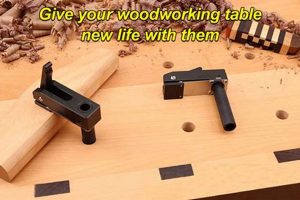
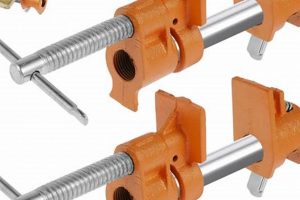
These tools are a category of clamping devices employed in woodworking to apply even pressure across a specific area. They consist of a clamping mechanism attached to threaded pipes, allowing for adjustable lengths to accommodate projects of varying dimensions. One might use this type of clamp, for example, when gluing together large table tops or assembling cabinets.
The availability of these implements enables woodworkers to undertake larger and more complex projects with greater precision. They offer a cost-effective clamping solution, particularly beneficial for hobbyists and small workshops. Their design allows for easy customization of length using standard plumbing pipes, providing flexibility and adaptability. Historically, securing workpieces relied on less consistent methods, but this design offers substantial improvements in terms of force and uniformity.
Subsequent discussion will address the selection criteria, advantages and disadvantages, and maintenance of these items. Further consideration will also be given to the variations in designs and appropriate uses to ensure informed decision-making regarding purchase and application.
Selection and Usage Guidance
This section provides essential guidance for selecting and effectively utilizing these woodworking implements.
Tip 1: Determine Required Length: Prior to acquisition, precisely measure the maximum span needed for typical projects. The pipe length dictates the clamping capacity.
Tip 2: Inspect Thread Quality: Examine the threads on both the clamp heads and the pipe for smoothness and absence of defects. Faulty threads compromise clamping force.
Tip 3: Consider Clamp Head Material: Clamp heads are available in cast iron or steel. Steel heads provide greater durability for high-pressure applications.
Tip 4: Utilize Protective Pads: Employ wood or rubber pads between the clamp jaws and the workpiece. This prevents marring of the wood surface.
Tip 5: Distribute Clamping Pressure Evenly: When clamping large surfaces, use multiple clamps spaced evenly. Uneven pressure can cause warping or joint failure.
Tip 6: Avoid Over-Tightening: Excessive force can damage the wood fibers or the clamp itself. Apply only enough pressure to ensure a tight joint.
Tip 7: Regularly Clean Threads: Keep threads free of glue and debris. This maintains smooth operation and prolongs the clamp’s lifespan.
Tip 8: Store Clamps Properly: Store clamps in a dry environment to prevent rust and corrosion. Periodic lubrication of the threads is also beneficial.
Adhering to these guidelines promotes project accuracy, extends tool longevity, and maximizes the investment in these essential woodworking aids.
The following section will summarize different models and variations.
1. Clamp head material
The composition of clamp heads is a critical determinant in the overall performance and longevity of woodworking pipe clamps. The material directly impacts the clamping force the device can exert, its resistance to deformation under pressure, and its susceptibility to corrosion. Units listed for sale featuring cast iron heads offer a generally more economical choice suitable for lighter-duty applications and occasional use. In contrast, those employing steel heads, particularly those constructed from hardened steel, provide significantly greater strength and resistance to bending or breakage. The latter configuration is essential for projects involving hardwoods, large surface areas, or requiring sustained, high clamping pressure.
For example, consider a woodworker assembling a large dining table from solid maple. Utilizing clamps with inadequate head material, such as a low-grade cast iron, could result in the clamp head flexing or even failing under the necessary pressure, compromising the joint’s integrity. Conversely, clamps with steel heads would maintain their form, ensuring uniform pressure distribution and a strong, durable bond. Likewise, environments with high humidity or potential exposure to moisture necessitate careful consideration of head material. Inferior cast iron is more prone to rust, which weakens the clamp and can stain the wood. Steel, especially when treated with a protective coating, provides enhanced resistance to corrosion, prolonging the tool’s useful life.
Therefore, in the context of woodworking pipe clamps offered for sale, the material of the clamp head must be a primary consideration. The specific requirements of planned projects, environmental conditions, and budget constraints should all inform the selection process. Choosing appropriately based on head material ensures effective clamping, lasting performance, and ultimately, successful woodworking outcomes.
2. Pipe length capacity

Pipe length capacity constitutes a fundamental specification influencing the versatility of woodworking pipe clamps. The capacity, determined by the length of pipe threaded into the clamping mechanism, dictates the maximum dimensions of a workpiece that can be effectively secured. Consequently, “woodworking pipe clamps for sale” are often categorized and priced based on this feature. The capacity constrains the type and scale of projects a woodworker can undertake.
Insufficient pipe length capacity renders a clamp unsuitable for larger assemblies, such as tabletops or cabinet carcasses. Conversely, excessive pipe length adds unnecessary weight and bulk, potentially impeding maneuverability when working with smaller projects. A woodworker constructing picture frames might require clamps with a capacity of only a few inches, while a furniture maker assembling a large dresser could necessitate clamps extending several feet. Failure to consider pipe length capacity before purchase can lead to project limitations and financial inefficiencies. “Woodworking pipe clamps for sale” should clearly state pipe length capacity and the maximum clamping range. The price is directly affected by pipe length capacity, as more material equals higher price points.
In summary, the pipe length capacity is a critical attribute to assess when evaluating “woodworking pipe clamps for sale.” Matching this specification to the anticipated range of projects is crucial for ensuring that the chosen clamps provide adequate clamping force, maintain stability, and contribute to successful woodworking outcomes. Furthermore, this capacity is one of the primary drivers of price within the market, underscoring the importance of careful selection.
3. Thread quality
Thread quality represents a critical, yet often overlooked, attribute influencing the performance and longevity of woodworking pipe clamps. When considering “woodworking pipe clamps for sale”, the integrity and precision of the threads on both the clamp head and the connecting pipe directly impact clamping force, ease of adjustment, and overall lifespan.
- Load-Bearing Capacity
The threads act as the primary load-bearing component, transferring the tightening force into clamping pressure. Poorly formed or damaged threads compromise this force transmission, leading to slippage, reduced clamping effectiveness, and potential joint failure. For example, a clamp with stripped threads is incapable of applying consistent pressure, resulting in weak glue lines and unstable assemblies. High-quality threads, conversely, ensure reliable and consistent clamping, vital for precise woodworking.
- Adjustment Smoothness
Fine, accurately cut threads facilitate smooth and effortless adjustment of the clamp. Irregular or coarse threads cause binding, requiring excessive force to tighten or loosen the clamp. This not only increases user fatigue but also elevates the risk of damaging the workpiece or the clamp itself. In contrast, clamps with precision-cut threads allow for incremental adjustments, crucial for achieving optimal clamping pressure without over-tightening.
- Durability and Lifespan
Thread quality significantly affects the long-term durability of pipe clamps. Inferior threads are prone to wear and tear, particularly under repeated stress. The constant tightening and loosening actions gradually degrade the thread structure, leading to eventual failure. Clamps featuring hardened threads withstand this wear, maintaining their integrity and functionality over prolonged use. This is especially important for professional woodworkers who rely on their tools for daily operations.
- Compatibility and Standardization
Consistent thread standards allow for interchangeability of pipes and clamp heads from different manufacturers. Non-standard or poorly defined threads can create compatibility issues, restricting the user’s ability to customize clamp lengths or replace damaged components. Adherence to recognized thread standards, such as National Pipe Thread (NPT), ensures broader compatibility and simplifies maintenance.
Therefore, thread quality is an indispensable factor to consider when evaluating “woodworking pipe clamps for sale.” The precision, durability, and standardization of the threads directly translate to enhanced clamping performance, ease of use, and extended tool lifespan. Ignoring this attribute can result in diminished clamping effectiveness, increased maintenance costs, and ultimately, compromised woodworking outcomes.
4. Clamping force
Clamping force, the pressure exerted by a clamp on a workpiece, is a paramount consideration when evaluating “woodworking pipe clamps for sale”. The adequacy of this force directly influences the strength and durability of glued joints, the precision of assembled components, and the overall quality of the finished product. Insufficient clamping force results in weak bonds, gaps, and structural instability. Conversely, excessive force risks crushing wood fibers or distorting the workpiece. Therefore, selection requires careful consideration of project requirements and the capabilities of available clamps.
The requisite clamping force varies depending on wood species, adhesive type, and joint configuration. Hardwoods, such as maple or oak, demand greater force than softwoods like pine or cedar. Similarly, certain adhesives necessitate higher pressure for optimal bonding. Complex joints, such as mortise and tenon or dovetail joints, require consistent and substantial clamping pressure to ensure intimate contact between mating surfaces. For example, constructing a solid wood table from kiln-dried maple necessitates pipe clamps capable of delivering hundreds of pounds of force per clamp to achieve tight, gap-free joints. Without sufficient clamping pressure, the resulting table would be structurally unsound and prone to failure.
Therefore, when assessing “woodworking pipe clamps for sale,” it is crucial to determine the clamping force capacity of each option and align it with the intended application. Factors such as clamp head material, thread quality, and pipe diameter contribute to the overall clamping force that can be generated. Understanding these interdependencies enables informed decision-making, ensuring that purchased clamps provide the necessary pressure for strong, lasting, and aesthetically pleasing woodworking projects. The relationship between cost and clamping force must also be considered as it is often directly correlated.
5. Ease of adjustment

Ease of adjustment is a significant factor influencing the efficiency and precision of woodworking tasks utilizing pipe clamps. The design features that facilitate or hinder quick and accurate adjustments impact workflow, project quality, and user satisfaction when selecting “woodworking pipe clamps for sale.”
- Thread Pitch and Handle Design
Thread pitch on the screw mechanism and the design of the tightening handle directly affect adjustment speed and force. A finer thread pitch allows for more precise adjustments, while a handle designed for comfortable gripping and leverage maximizes tightening efficiency. For example, a clamp with coarse threads and a poorly designed handle may require excessive effort to achieve the desired clamping pressure, whereas a clamp with finer threads and an ergonomic handle permits swift and accurate adjustments with minimal exertion. This consideration is important for ensuring a consistent and repeatable process.
- Quick-Release Mechanisms
Certain pipe clamps incorporate quick-release mechanisms that allow for rapid opening and closing of the clamp jaws. These mechanisms are particularly advantageous when working on repetitive tasks or when frequent adjustments are required. Consider a scenario where a woodworker is edge-gluing multiple boards. Clamps equipped with quick-release levers enable swift repositioning and tightening, significantly reducing the overall clamping time compared to clamps that require laborious winding and unwinding of the screw mechanism.
- Clamp Head Stability
The stability of the clamp head during adjustment is crucial for maintaining consistent clamping pressure. Heads that tend to shift or rotate while tightening compromise alignment and necessitate readjustment. A well-designed clamp head that remains stable throughout the adjustment process ensures even pressure distribution and prevents workpiece distortion. This is particularly relevant when clamping delicate or intricate pieces.
- One-Handed Operation
The ability to adjust and tighten a clamp with one hand offers significant convenience, especially when working in confined spaces or when supporting the workpiece with the other hand. Clamps designed for one-handed operation typically feature mechanisms that allow for simultaneous tightening and locking, freeing up the other hand for other tasks. This feature enhances efficiency and reduces the risk of accidentally dislodging the workpiece during clamping.
The considerations mentioned above impact the effectiveness of securing materials when utilizing woodworking pipe clamps. Woodworkers should assess adjustment features to align with project needs for increased productivity and higher-quality results. This contributes directly to the overall workflow and project success when procuring woodworking pipe clamps.
6. Corrosion Resistance
The attribute of corrosion resistance is a significant consideration when evaluating “woodworking pipe clamps for sale.” Woodworking environments frequently involve moisture, adhesives, and wood treatments, all of which can contribute to corrosion of metal components. The degradation of pipe clamps due to corrosion compromises their structural integrity, reduces clamping force, and ultimately shortens their lifespan. The financial implications include premature replacement costs and the potential for project failure due to clamp malfunction. For instance, a clamp heavily corroded may fracture under pressure, resulting in misalignment of glued components, thereby ruining a project.
The materials used in the construction of woodworking pipe clamps directly affect their corrosion resistance. Clamps made from untreated steel are highly susceptible to rust, particularly in humid climates or workshops. Clamps fabricated from stainless steel offer superior corrosion resistance but typically command a higher price. Protective coatings, such as zinc plating or powder coating, provide a cost-effective means of enhancing corrosion resistance in steel clamps. Proper storage practices, including keeping clamps dry and clean, also contribute to preventing corrosion. Inadequate corrosion resistance can lead to inaccurate performance and even the total failure of a project due to slipping or breakage, as well as staining of certain woods with rust. Therefore when considering “woodworking pipe clamps for sale”, an item with adequate corrosion resistance is key.
In summary, corrosion resistance is a critical factor influencing the durability, reliability, and long-term value of “woodworking pipe clamps for sale.” Selection should prioritize materials and coatings that offer adequate protection against corrosion, especially in environments prone to moisture or chemical exposure. The initial investment in corrosion-resistant clamps is offset by reduced replacement costs, minimized project failures, and enhanced safety and efficiency. In essence, corrosion resistance is an indicator of value.
Frequently Asked Questions
The following addresses common inquiries regarding the selection, application, and maintenance of woodworking pipe clamps.
Question 1: What constitutes the ideal pipe length for general woodworking applications?
The optimal pipe length is contingent upon the scope of projects undertaken. A range of lengths, typically spanning from 24 to 48 inches, affords versatility for securing a diverse array of workpieces. Evaluate the dimensions of prospective projects to ascertain the necessary clamping capacity.
Question 2: Are cast iron clamp heads suitable for all woodworking clamping tasks?
Cast iron clamp heads offer adequate strength for many woodworking applications, but may prove insufficient for high-stress situations. Steel clamp heads exhibit superior durability and resistance to deformation under extreme pressure. Consider steel heads for hardwoods or projects requiring significant clamping force.
Question 3: How does thread quality affect the performance of pipe clamps?
Thread quality directly influences clamping force, adjustment smoothness, and clamp longevity. Poorly formed or damaged threads compromise force transmission and may lead to slippage. Precision-cut threads facilitate effortless adjustments and ensure consistent clamping pressure. Examine threads closely prior to purchase.
Question 4: Is it necessary to use protective pads between clamp jaws and the workpiece?
The use of protective pads is strongly recommended to prevent marring or indentation of the wood surface. Wood or rubber pads distribute clamping pressure evenly and safeguard against damage, particularly when working with delicate or easily scratched materials.
Question 5: How can rust and corrosion be prevented on pipe clamps?
Rust and corrosion can be mitigated through proper storage and maintenance. Store clamps in a dry environment to minimize moisture exposure. Periodically apply a thin coat of lubricant to the threads to inhibit corrosion and maintain smooth operation. Promptly remove any glue or adhesive residue to prevent buildup and potential corrosion.
Question 6: What is the procedure for replacing a damaged pipe section on a pipe clamp?
Replacing a damaged pipe section requires disconnecting the clamp heads from the existing pipe and threading them onto a new pipe of the appropriate length and thread type. Ensure the new pipe conforms to the thread standards compatible with the clamp heads. Inspect the threads for damage before reassembly.
Proper selection and maintenance are critical to ensure that pipe clamps continue to function reliably.
The next section is about resources for purchasing woodworking pipe clamps.
Woodworking Pipe Clamps for Sale
This discussion has explored essential aspects pertinent to the selection and utilization of woodworking pipe clamps. Key considerations include material composition of clamp heads, the impact of pipe length on project scope, the significance of thread quality for clamping efficiency, the relationship between clamping force and joint integrity, the convenience of adjustment mechanisms, and the imperative of corrosion resistance for tool longevity. Addressing these elements facilitates informed purchasing decisions and optimized woodworking outcomes.
Careful consideration of the factors outlined ensures investment in equipment aligned with project needs and promotes safe, effective woodworking practices. The judicious application of this knowledge translates into superior craftsmanship and extended tool lifespan, thereby maximizing the value derived from woodworking endeavors.

![Best Woodworking Clamps on Amazon: [Your Project] Ready! | Step-by-Step Guides, Tools & Inspiration to Build Beautiful Wooden Decor on a Budget](https://woodfromhome.com/wp-content/uploads/2026/04/th-87-300x200.jpg "Best Woodworking Clamps on Amazon: [Your Project] Ready! Step-by-Step Guides, Tools & Inspiration to Build Beautiful Wooden Decor on a Budget")