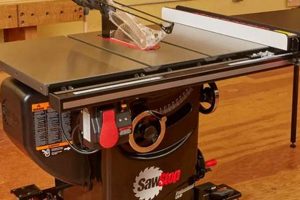
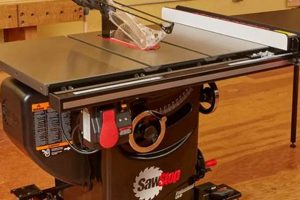
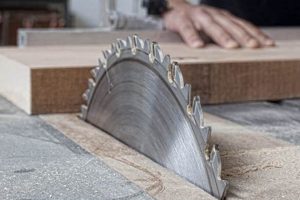
The utilization of a stationary power tool equipped with a circular blade, projecting through a flat surface, in the practice of shaping and cutting wood. This practice enables the creation of various joinery, dimensions, and profiles in wooden materials. Examples include crafting furniture components, building cabinets, and preparing stock for smaller projects.
Employing this technique offers precision, efficiency, and repeatability in woodworking tasks. Its adoption has significantly impacted the industry, allowing for the mass production of standardized components and intricate designs previously unattainable through manual methods. Historically, advancements in power tool technology have paralleled the evolution of construction and design, with this specific tool playing a central role.
The following sections will delve into specific aspects of this practice, including safety protocols, blade selection considerations, techniques for various cuts, and maintenance requirements essential for optimal performance and longevity of the equipment.
Guidance for Optimal Table Saw Operation
The following guidelines address critical aspects of safe and effective operation, intended to maximize precision and minimize risk during woodworking tasks involving a table saw.
Tip 1: Blade Selection. Employ a blade appropriate for the material being cut. A blade with a higher tooth count produces cleaner cuts in hardwood, while a lower tooth count is more suitable for ripping thicker stock. Incorrect blade selection can lead to tear-out, kickback, or damage to the saw.
Tip 2: Fence Alignment. Ensure the fence is parallel to the blade. Misalignment can cause binding, burning, and inaccurate cuts, increasing the risk of kickback. Periodically check alignment with a reliable measuring tool.
Tip 3: Push Stick Utilization. Always use a push stick when cutting narrow pieces. This maintains a safe distance between the operator’s hands and the blade, reducing the risk of injury. Employ push sticks even for seemingly safe cuts, as unexpected movements can occur.
Tip 4: Featherboard Application. Employ featherboards to maintain consistent pressure against the fence or table. This enhances cut quality and provides an additional safeguard against kickback, particularly when ripping long pieces.
Tip 5: Anti-Kickback Pawls and Splitters. Ensure the anti-kickback pawls and splitter are properly installed and functioning. These components are designed to prevent the workpiece from being thrown back towards the operator in the event of binding.
Tip 6: Regular Maintenance. Routinely inspect and maintain the saw. Keep the blade clean and sharp, lubricate moving parts, and check for loose components. A well-maintained saw operates more safely and efficiently.
Tip 7: Power Feed Consideration. For repetitive tasks or working with large volumes of material, consider using a power feed system. Power feeders provide consistent feed rates and enhance operator safety by eliminating manual feeding.
Tip 8: Workspace Illumination. Ensure adequate lighting in the workspace. Proper illumination improves visibility and reduces the risk of errors, contributing to a safer and more accurate cutting experience.
Adhering to these principles promotes precision, minimizes hazards, and extends the lifespan of the tool, contributing to successful and safe woodworking projects.
The following sections will further elaborate on specific techniques and advanced applications related to safe and effective operation.
1. Blade Selection

The selection of an appropriate blade is fundamental to the success and safety of operations. A blade’s characteristics directly influence the quality of the cut, the efficiency of the process, and the potential for material damage or hazardous events. For instance, employing a ripping blade, characterized by a lower tooth count and larger gullets, on hardwood stock results in a faster cut, but may produce a rougher finish compared to a blade designed for crosscutting. Conversely, using a crosscut blade, with its higher tooth count, for ripping thick stock can lead to overheating, binding, and potentially, kickback. Consequently, an understanding of blade geometry, tooth configuration, and material properties is essential for effective utilization.
Real-world examples underscore the practical significance of informed blade selection. Consider the fabrication of cabinet doors. A combination blade, offering a compromise between ripping and crosscutting capabilities, might suffice for initial stock preparation. However, achieving clean, splinter-free edges on delicate materials such as veneered plywood necessitates the use of a specialized blade with a high tooth count and alternate top bevel (ATB) grind. The incorrect choice could lead to tear-out and require extensive remediation. Similarly, when cutting abrasive materials like particleboard or melamine, carbide-tipped blades are essential for maintaining sharpness and extending blade life. The hardness of the carbide resists wear, preserving the cutting edge for a longer duration.
In summary, blade selection is not a mere procedural step but a critical determinant of project outcome. The consequences of mismatched blade and material pairings range from degraded cut quality to increased risk of injury. Thorough consideration of material properties, desired finish, and blade characteristics is essential for achieving precise, efficient, and safe cuts. Ongoing education and experimentation with various blade types are recommended for developing a comprehensive understanding of their individual performance profiles.
2. Fence Alignment
Fence alignment is a foundational element within the practice of using a stationary power tool equipped with a circular blade for shaping and cutting wood. Misalignment of the fence introduces significant errors into the cutting process. Specifically, it causes non-parallel cuts, leading to dimensional inaccuracies in workpieces. This, in turn, compromises the structural integrity and aesthetic appeal of finished projects. An example is the construction of cabinet frames: If the fence is not precisely parallel to the blade, the resulting frame components will not form accurate 90-degree angles, leading to instability and visual defects. Proper fence alignment ensures that cuts are square and consistently dimensioned, directly impacting the final product’s quality.
Beyond dimensional accuracy, correct fence alignment is crucial for operator safety. A misaligned fence can cause the workpiece to bind against the blade, increasing the risk of kickback a hazardous event where the wood is forcefully ejected back towards the operator. Consistent parallel alignment provides a stable and predictable cutting path. Furthermore, when executing repetitive cuts, accurate fence settings contribute to efficiency and reduce material waste. Production environments rely on precise fence adjustments to produce identical components rapidly. Without precise alignment, operators face challenges in replicating dimensions, slowing down the production process and leading to increased scrap rates. Skilled operators frequently employ precision measuring tools such as dial indicators to guarantee the fences parallelism.
In summary, fence alignment represents a crucial factor governing the precision, safety, and efficiency of cutting operations. It directly affects the dimensional accuracy of workpieces, minimizes the risk of dangerous kickback events, and optimizes material usage in woodworking projects. Maintaining proper fence alignment through regular checks and adjustments is essential for achieving high-quality results and ensuring a safe working environment.
3. Safe Practices
Adherence to established safety protocols is paramount when engaging in woodworking activities involving a stationary power tool equipped with a circular blade. The potential for serious injury necessitates a disciplined approach to risk mitigation. The following outlines critical facets of safe operation.
- Personal Protective Equipment (PPE)
Appropriate PPE, including eye protection, hearing protection, and respiratory protection, is non-negotiable. Eye protection shields against projectiles, hearing protection mitigates noise-induced hearing loss, and respiratory protection reduces inhalation of hazardous dust particles. Failure to consistently use PPE can lead to irreversible health consequences. An example includes the development of respiratory illnesses from prolonged exposure to fine wood dust without a properly fitted respirator.
- Kickback Prevention
Kickback, the rapid and forceful ejection of material back toward the operator, represents a significant hazard. Mitigating this risk involves utilizing anti-kickback pawls, splitters, and featherboards. Additionally, maintaining a firm grip on the workpiece and avoiding freehand cutting are crucial. Kickback can result in severe injuries, including lacerations and broken bones. One scenario involves cutting warped lumber without adequate support, which can lead to binding and subsequent kickback.
- Blade Guard Usage
The blade guard serves as a physical barrier between the operator and the rotating blade. While it may seem cumbersome, its consistent use significantly reduces the risk of accidental contact. Removing or bypassing the blade guard increases the likelihood of severe lacerations or amputations. An example includes attempting to make intricate cuts without the guard, prioritizing convenience over safety, and potentially incurring a serious injury as a result.
- Machine Maintenance
Regular maintenance ensures optimal machine performance and identifies potential safety hazards. This includes inspecting the blade for sharpness and damage, lubricating moving parts, and verifying the functionality of safety mechanisms. Neglecting maintenance can lead to malfunctions and increased risk of injury. A dull blade, for instance, requires more force to cut, increasing the likelihood of kickback or loss of control.
Integrating these safe practices into every instance of using a stationary power tool equipped with a circular blade is crucial for maintaining a safe working environment and preventing injuries. A proactive approach to safety, coupled with ongoing education and awareness, is essential for minimizing the inherent risks associated with such activities.
4. Material Support

Adequate material support constitutes a critical aspect of safe and accurate operation when using a stationary power tool equipped with a circular blade. Proper support mitigates the risk of workpiece instability, binding, and subsequent hazards, while also contributing to improved cut quality and dimensional accuracy.
- Outfeed Support
Outfeed support, typically in the form of rollers or extension tables, provides continuous support to the workpiece as it exits the blade. This prevents the cut piece from dropping or tilting, which can lead to binding and kickback. Ripping long boards without adequate outfeed support can result in the board pivoting around the blade, creating a dangerous pinch point. In professional settings, powered outfeed rollers are commonly employed to handle very long or heavy stock.
- Infeed Support
Infeed support ensures the workpiece is presented to the blade in a stable and controlled manner. This can involve using extension tables, roller stands, or even a simple flat surface. Insufficient infeed support can cause the workpiece to wobble or deflect, leading to inaccurate cuts and potential for operator error. When cutting large panels, infeed support is essential to prevent the material from flexing and binding against the blade.
- Lateral Support
Lateral support maintains the workpiece’s stability along its width, preventing it from twisting or rocking during the cut. Featherboards and hold-downs are common devices used to provide lateral support. Without such support, the workpiece may vibrate, leading to uneven cuts and increased risk of kickback. When making bevel cuts, lateral support becomes even more critical to ensure the workpiece remains stable at an angle.
- Auxiliary Fences
An auxiliary fence attached to the primary fence can greatly improve material support, especially when processing narrow or oddly shaped stock. This provides a wider bearing surface, preventing the material from tilting or tipping during the cut. The auxiliary fence can be customized with zero-clearance inserts to reduce tearout and improve cut quality. Such a fence is vital for operations where a high degree of accuracy and smoothness is required.
The effective integration of these material support strategies enhances the precision and safety of cutting operations. Regardless of the project scale, ensuring proper support contributes to consistent results and minimizes the potential for accidents. Neglecting material support introduces unnecessary risk and compromises the quality of the finished product.
5. Cut Precision

Cut precision is a fundamental attribute of skilled woodworking involving a stationary power tool equipped with a circular blade. Its attainment is not merely aesthetic; it dictates the structural integrity, functional reliability, and overall quality of the finished product. Attaining precise cuts necessitates a thorough understanding of the tool’s mechanics, material properties, and appropriate techniques.
- Blade Selection and Condition
The selection of a blade appropriate for the material and type of cut directly impacts precision. A dull or incorrectly chosen blade induces tear-out, burning, and dimensional inaccuracies. For example, a fine-toothed blade is critical for achieving clean, splinter-free cuts in hardwood, whereas a ripping blade is optimized for efficient material removal along the grain. Regular maintenance and sharpening are equally crucial for sustaining consistent performance. The blade becomes a primary driver of cut quality in woodworking projects involving this kind of tool.
- Fence and Miter Gauge Accuracy
The fence and miter gauge serve as guiding references for achieving accurate cuts. Misalignment or looseness in either component compromises the precision of both rip cuts and crosscuts. Periodic calibration and adjustment are essential. An example is the construction of a perfectly square frame; even a slight deviation in the fence angle will result in cumulative errors, leading to a distorted final assembly. Correct configuration of guiding elements translates into higher quality finished wood pieces.
- Feed Rate and Control
The rate at which the material is fed through the blade significantly influences cut precision. Excessive feed rates can induce blade deflection, resulting in uneven or wandering cuts. Conversely, excessively slow feed rates can cause burning or blade overheating. Maintaining a consistent and controlled feed rate is critical. A common scenario involves cutting a thin strip of material; too much pressure can lead to the material flexing and the cut deviating from the intended line. Feed rate translates into material management and is essential for cutting precision.
- Workpiece Support and Handling
Proper support and handling of the workpiece are crucial for maintaining cut precision. Large or unwieldy materials require outfeed and lateral support to prevent sagging or twisting during the cut. Secure clamping or fixturing may be necessary for smaller or irregularly shaped pieces. Consider the task of cutting a large sheet of plywood: Without adequate support, the material can vibrate and flex, leading to inaccurate and inconsistent cuts. Support ensures safety while maintaining a clean cut.
In summation, the achievement of cut precision in operations using stationary power tools equipped with a circular blade is a multifaceted endeavor that encompasses blade selection, machine calibration, operator technique, and material management. Each facet contributes to the overall quality and accuracy of the final product, reinforcing the importance of meticulous attention to detail and adherence to best practices. These elements are central to woodworking projects that employ these tools.
6. Dust Management

The generation of airborne particulate matter is an inherent consequence of employing a stationary power tool equipped with a circular blade for shaping and cutting wood. The abrasive action of the blade against the wood substrate produces fine dust particles, posing health and operational challenges. Inadequate dust management leads to respiratory irritation, allergic reactions, and potential long-term pulmonary damage. Furthermore, accumulated dust reduces visibility, increasing the risk of accidents and compromising cut accuracy. A real-world example is the prolonged exposure to hardwood dust, such as oak or mahogany, which is classified as a known human carcinogen. Therefore, implementing effective dust mitigation strategies is not merely a matter of cleanliness, but a critical component of responsible operation.
Effective dust collection systems integrated directly with the power tool represent the primary line of defense. These systems, typically comprising a dust collector, hose, and shroud, capture particulate matter at the source, preventing it from becoming airborne. Factors influencing system performance include airflow volume, filter efficiency, and shroud design. For instance, a high-volume, low-pressure (HVLP) dust collector paired with a well-designed shroud maximizes dust capture efficiency. In addition to source capture, ambient air filtration units can further reduce airborne dust levels within the workshop environment. These units circulate air through filters, removing fine particles that escape initial capture. Consistent filter maintenance is essential for sustained system effectiveness.
In conclusion, effective dust management is inextricably linked to the safe and efficient utilization of this specific type of power tool. From minimizing health risks to enhancing visibility and maintaining operational precision, a proactive approach to dust mitigation is essential for responsible woodworking practices. Challenges remain in achieving complete dust elimination, particularly when working with highly friable materials. However, a combination of source capture, ambient air filtration, and adherence to best practices significantly reduces the risks associated with airborne particulate matter, contributing to a safer and healthier working environment.
7. Regular Maintenance

Regular maintenance constitutes an indispensable component of effective operation involving a stationary power tool equipped with a circular blade. The absence of diligent maintenance practices precipitates a cascade of detrimental effects, impacting cut quality, operational safety, and the equipment’s longevity. For instance, a blade encrusted with resin and wood fibers generates increased friction, leading to burning, reduced cutting efficiency, and heightened risk of kickback. Similarly, inadequate lubrication of moving parts results in accelerated wear, increased noise levels, and potential mechanical failure. Consequently, a proactive maintenance regimen is not merely a cosmetic exercise but a prerequisite for safe and efficient woodworking. Examples of such maintenance include inspecting the blade for sharpness and damage, cleaning the trunnion mechanism to ensure smooth tilt adjustments, and calibrating the fence and miter gauge to maintain dimensional accuracy. Each action is vital for optimizing performance.
The practical significance of understanding this connection is evident in numerous woodworking scenarios. Consider a professional cabinetmaker reliant on consistent precision and reliability. A well-maintained saw ensures accurate cuts, minimizing material waste and reducing assembly time. Conversely, a neglected saw introduces variability, requiring rework and potentially jeopardizing project deadlines. The financial implications of downtime associated with equipment failure further underscore the importance of regular maintenance. Preventative measures, such as replacing worn belts and bearings, are significantly less costly than addressing major repairs resulting from deferred maintenance. Professional shops typically adhere to rigorous maintenance schedules to mitigate such risks. The connection between preventative care and operational efficiency becomes readily apparent in these settings.
In summary, regular maintenance represents a cornerstone of responsible operation within the practice of using a stationary power tool equipped with a circular blade for shaping and cutting wood. Neglecting these practices compromises safety, diminishes cut quality, and shortens the equipment’s lifespan. By prioritizing proactive maintenance, woodworkers can ensure consistent performance, minimize operational risks, and maximize the return on their investment. The challenges in adhering to a rigorous maintenance schedule, particularly in demanding production environments, necessitate a commitment to best practices and a thorough understanding of the equipment’s operational requirements.
Frequently Asked Questions
The following addresses common inquiries and misconceptions surrounding the use of a stationary power tool equipped with a circular blade for shaping and cutting wood. The intent is to provide clear and concise information for informed decision-making.
Question 1: What is the most effective method for preventing kickback?
Kickback prevention involves a multi-faceted approach. Always use anti-kickback pawls and a splitter. Maintain a firm grip on the workpiece, and avoid standing directly in line with the blade. Employ featherboards to maintain consistent pressure against the fence. Never perform freehand cuts.
Question 2: How frequently should the blade be sharpened?
Blade sharpening frequency depends on usage and material. Signs of a dull blade include burning, increased feed force, and tear-out. Inspect the blade regularly and sharpen when these indicators are present. Professional shops may sharpen blades daily, while hobbyists may sharpen less frequently.
Question 3: What type of blade is best for cutting plywood?
A high tooth count blade, specifically designed for crosscutting, is recommended for plywood. Blades with alternate top bevel (ATB) grind configurations minimize tear-out on the surface veneers. Zero-clearance inserts further reduce splintering.
Question 4: What is the purpose of a zero-clearance insert?
A zero-clearance insert minimizes the gap around the blade, providing support to the wood fibers during the cut. This reduces tear-out and splintering, particularly when working with delicate materials. Custom-made inserts can be created for specific blade angles.
Question 5: How can I accurately align the fence?
Fence alignment requires precision measurement. A dial indicator mounted to the miter slot can be used to verify parallelism between the fence and the blade. Adjust the fence until the dial indicator reads zero across its entire length. Repeat this process periodically to ensure consistent alignment.
Question 6: What are the long-term health risks associated with using this equipment?
Prolonged exposure to wood dust, particularly from hardwoods, poses significant respiratory health risks. Certain wood species are classified as known human carcinogens. Always use appropriate respiratory protection and maintain effective dust collection systems to mitigate these risks.
Understanding the proper operation, maintenance, and safety protocols reduces the risks of this equipment while maintaining functionality and cut precision.
The next section will explore troubleshooting techniques related to using stationary power tools equipped with a circular blade.
Conclusion
This exploration of practices involving the employment of a stationary power tool equipped with a circular blade has illuminated the critical aspects of safe, precise, and efficient operation. Blade selection, fence alignment, adherence to safety protocols, provision of adequate material support, achievement of cut precision, effective dust management, and regular maintenance have all been underscored as essential elements for successful project execution. These are the elements of “table saw woodworking”.
The insights presented serve as a foundation for informed decision-making and responsible tool utilization. Continued education, diligent adherence to safety guidelines, and a commitment to best practices remain paramount for mitigating risks and maximizing the potential of this ubiquitous power tool within the realm of woodworking. Prioritizing these elements ensures not only the longevity of equipment but, more importantly, the safety and well-being of the craftsperson.