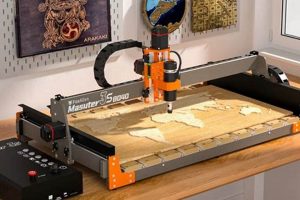
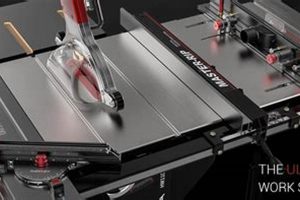
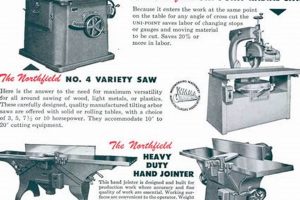
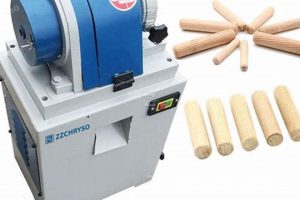
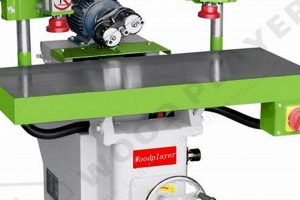
Equipment utilized in shaping, cutting, and joining timber is fundamental to the field of carpentry. This specialized apparatus allows for the efficient and precise manipulation of wood, enabling the creation of various structures and objects. Examples include saws for cutting, planers for smoothing surfaces, and jointers for creating flat edges.
The utilization of such tools offers several advantages. They enhance productivity, improve accuracy, and reduce the physical labor involved in woodworking. Historically, the development of powered versions has revolutionized the industry, making complex projects feasible and accelerating production timelines. The evolution of this technology is central to the progression of woodworking techniques and capabilities.
The subsequent sections will delve into specific types, their applications, maintenance, and safety considerations. This examination will provide a comprehensive understanding of the tools essential for efficient and quality workmanship with wood.
Essential Guidance for Woodworking Equipment
Adhering to best practices ensures optimal performance, longevity, and operator safety when working with tools designed for timber processing.
Tip 1: Regular Maintenance is Critical. Consistent cleaning and lubrication prevent premature wear and ensure smooth operation. For example, saw blades should be cleaned of resin buildup regularly to maintain cutting efficiency.
Tip 2: Adhere Strictly to Safety Protocols. Wear appropriate personal protective equipment (PPE), including safety glasses, hearing protection, and dust masks, to minimize the risk of injury. Machine guards must always be in place during operation.
Tip 3: Understand Material Compatibility. Different wood species possess varying densities and characteristics. Adjust settings accordingly to prevent damage to both the workpiece and the device. For instance, hardwoods require slower feed rates than softwoods.
Tip 4: Implement Proper Dust Collection. Wood dust is a significant health hazard and can impair visibility. Invest in a robust dust collection system to maintain a clean and safe working environment.
Tip 5: Perform Routine Inspections. Before each use, carefully inspect cords, blades, and all moving parts for signs of damage or wear. Replace worn components immediately.
Tip 6: Invest in Quality Equipment. Higher-quality tools generally offer better precision, durability, and safety features. While the initial investment may be greater, the long-term benefits outweigh the costs.
Tip 7: Secure Workpiece Effectively. Clamping the workpiece prevents movement during cutting, ensuring accuracy and minimizing risk. Select the correct clamp for the job, consider material and project size.
Consistently implementing these guidelines minimizes risk, extends the lifespan of equipment, and enhances the quality of finished products.
The subsequent sections will delve deeper into specific aspects of each tool’s operation and maintenance, offering a comprehensive guide for responsible woodworking practices.
1. Precision Cutting

The capacity for accurate and repeatable cuts is a defining characteristic of effective equipment for shaping wood. This attribute influences the quality of the finished product, the efficiency of the workflow, and the minimization of material waste. Precision cutting extends beyond simple separation of material; it encompasses dimensional accuracy, angular conformity, and surface finish.
- Blade Quality and Maintenance
The inherent sharpness and material composition of the cutting implement are critical factors. High-quality blades, properly sharpened and maintained, ensure clean cuts with minimal splintering or tear-out. For instance, a dull saw blade can cause excessive friction, leading to burning and inaccurate dimensions. Regular blade sharpening and replacement are essential for consistent performance.
- Machine Rigidity and Stability
The structural integrity of the device directly affects its ability to deliver accurate cuts. A stable and rigid frame minimizes vibration and deflection during operation, preventing deviations from the intended cutting path. Example: a table saw with a flimsy fence will produce inaccurate miter cuts.
- Measurement and Control Systems
Accurate scales, stops, and digital readouts enable precise setting of cutting parameters. These systems allow for repeatable cuts to specified dimensions, minimizing errors and ensuring consistency across multiple workpieces. Consider laser-guided systems improving the accuracy and efficiency of cutting process.
- Feed Rate and Material Properties
Optimal cutting speed and material feed rate must be carefully matched to the wood species being processed. Excessive feed rate can lead to blade deflection and inaccurate cuts, while insufficient feed rate can cause burning and material damage. The machine must give a certain control to optimize the feed rate and material properties.
The interrelationship of these factors highlights the importance of selecting and maintaining equipment that prioritizes precision cutting. The ability to achieve accurate cuts consistently translates to reduced rework, improved material utilization, and enhanced product quality, all of which are fundamental to successful woodworking operations.
2. Surface Finishing

Surface finishing, the process of refining the external characteristics of wood, represents a critical stage in woodworking. The selection and application of appropriate equipment dictates the quality, aesthetics, and functionality of the final product. The tools employed range from abrasive planers to specialized sanding devices, each contributing to the creation of a smooth, even, and visually appealing surface.
- Abrasive Planing and Thicknessing
Planing machines, including thickness planers, remove material to achieve a uniform surface and precise dimensions. These tools employ rotating cutterheads equipped with blades that shave away wood, resulting in a smooth, flat surface. For instance, a thickness planer ensures all boards intended for a tabletop are of uniform thickness. Proper maintenance and blade sharpness are essential for minimizing tear-out and achieving a consistent finish. The resulting surface becomes the basis for subsequent sanding and finishing operations.
- Sanding Operations
Sanding equipment employs abrasive materials to refine surfaces, removing imperfections and preparing wood for finishing. Various types of sanders, including orbital sanders, belt sanders, and drum sanders, are selected based on the project’s scale and the desired level of smoothness. For example, a belt sander quickly removes material on large surfaces, while an orbital sander delivers a finer finish. The selection of appropriate grit levels and consistent sanding techniques are crucial for achieving a uniform and scratch-free surface.
- Spindle and Edge Sanding
Shaping and smoothing curved or intricate profiles requires specialized sanding equipment. Spindle sanders, with their rotating drums, excel at smoothing internal curves and contours. Edge sanders, designed for finishing the edges of workpieces, ensure consistent profiles and smooth surfaces. An example is the smoothing of rounded edges on a chair rail with a spindle sander or the even sanding of a table edge with an edge sander. Their precise control makes them essential for detailing and intricate work.
- Buffing and Polishing
Buffing and polishing equipment applies fine abrasives or compounds to enhance the luster and smoothness of finished surfaces. These tools employ soft pads or wheels to distribute polishing agents evenly, creating a high-gloss or satin sheen. An example is the application of wax to a finished table using a buffing wheel, enhancing its protective qualities and creating a visually appealing finish. Buffing and polishing are the final steps in achieving a refined and professional appearance.
The effective application of surface finishing equipment relies on understanding material properties, machine capabilities, and proper techniques. The quality of the resulting finish directly impacts the aesthetic value, durability, and overall success of woodworking projects. These aspects illustrate the integral role these specialized devices play in the woodworking process.
3. Material Shaping

Equipment for shaping wood is fundamentally linked to the manipulation of raw materials into defined forms. The ability to transform timber from its initial state into components for furniture, structures, or artistic creations hinges directly on the capabilities of these tools. This transformation encompasses a range of processes, including but not limited to: the removal of excess material, the creation of curved or complex profiles, and the forming of specific geometric shapes. For instance, a bandsaw facilitates the cutting of intricate curves in wood, a process nearly impossible with hand tools alone. The effectiveness of the machine directly impacts the achievable complexity and precision of the resulting shape.
The selection of appropriate tools is crucial for achieving desired material shaping outcomes. Different woodworking tasks necessitate specific types of devices. Lathes, for example, are designed for creating cylindrical forms, such as table legs or spindle components. Milling machines allow for precise shaping of complex profiles, often used in cabinetry or architectural molding. The understanding of each device’s strengths and limitations enables operators to select the optimal equipment for the task at hand, maximizing efficiency and minimizing material waste. Careful consideration of cutting speed, material feed rate, and blade sharpness is essential to avoiding defects and achieving the intended shape. This involves balancing the machine’s capabilities with material characteristics.
In conclusion, the ability to effectively shape material stands as a central function of woodworking machinery. The precision, efficiency, and versatility afforded by these tools underpin the modern woodworking industry. While technological advancements continue to refine these capabilities, a fundamental understanding of the principles governing material shaping remains essential for achieving quality outcomes. Improper machine operation or inappropriate tool selection may result in material defects, safety hazards, and compromised project outcomes. The connection between machine and material is inseparable in woodworking.
4. Joint Creation
The efficacy of woodworking machinery is inextricably linked to the creation of robust and precise joints. The ability to accurately and efficiently join separate pieces of wood to form a unified structure is a fundamental requirement for various woodworking applications, from furniture construction to building frameworks. Specialized equipment significantly enhances this process, allowing for consistent and repeatable results that would be difficult or impossible to achieve through manual techniques alone. The proper utilization of these machines dictates the structural integrity and aesthetic appeal of the finished product. For instance, a precisely cut mortise and tenon joint, produced with a mortising machine, provides superior strength compared to a poorly executed hand-cut joint.
Various types of machinery contribute to joint creation, each designed for specific joint types and woodworking applications. Table saws, equipped with dado blades, create precise grooves for lap joints or rabbets. Jointers and planers ensure perfectly flat and square surfaces, essential for tight-fitting edge joints. Router tables, with a variety of bits, allow for the creation of intricate profiles and joinery elements. Specialized mortising machines and tenoning machines automate the creation of mortise and tenon joints, dramatically increasing efficiency and accuracy. The selection of appropriate equipment hinges on the specific joint type required, the material being used, and the desired level of precision. Incorrect application or maintenance of these devices compromises the strength and stability of the finished piece.
The pursuit of reliable joint creation is a continual driver of innovation in woodworking machinery design. Advancements in digital control and automation are leading to greater precision and repeatability in jointing operations. However, a foundational understanding of joint mechanics and woodworking principles remains essential. Challenges persist in achieving tight-fitting joints with complex geometries or when working with difficult or inconsistent materials. Ultimately, the success of any woodworking project depends on the proper selection, maintenance, and skillful application of equipment designed for creating strong and aesthetically pleasing joints. The equipment’s function is inseparable from the outcome of durable construction.
5. Operational Safety
Operational safety constitutes a paramount consideration in any woodworking environment where machinery is utilized. The inherent risks associated with high-speed cutting, shaping, and material manipulation necessitate rigorous adherence to safety protocols and comprehensive understanding of equipment operation. The potential for serious injury demands a proactive approach to risk mitigation.
- Machine Guarding Systems
Physical barriers designed to prevent contact with moving parts are integral to safe operation. Examples include blade guards on saws, shields on lathes, and enclosures around milling cutters. The absence or removal of such guards significantly increases the risk of injury. Regular inspection and maintenance of guarding systems are essential for their continued effectiveness. Modifying or bypassing these safety features compromises operator safety and may result in severe consequences. A properly functioning guard is a barrier against potential incidents.
- Personal Protective Equipment (PPE)
The use of appropriate PPE provides a crucial layer of protection against hazards such as projectiles, noise, and dust. Safety glasses shield eyes from flying debris, hearing protection minimizes noise-induced hearing loss, and respirators filter airborne particles. Selection of appropriate PPE must be informed by a thorough assessment of the specific risks associated with each task and piece of equipment. Failure to wear or properly maintain PPE compromises its protective capabilities.
- Emergency Stop Mechanisms
Readily accessible emergency stop devices provide a means to immediately halt machine operation in the event of a malfunction or hazardous situation. These mechanisms must be clearly marked and easily activated by the operator. Regular testing of emergency stop functionality is essential to ensure their reliable operation. Hesitation in actuation can lead to severe consequences. Emergency stop engagement should initiate prompt shut-down. Proper training is crucial for knowing when to engage these systems.
- Lockout/Tagout Procedures
Before performing maintenance, repairs, or adjustments on woodworking machinery, lockout/tagout procedures must be strictly followed. This involves disconnecting the equipment from its power source and affixing a lock and tag to prevent accidental energization. These procedures are essential to protect workers from unexpected startup of machinery during servicing. Bypassing these practices exposes personnel to grave risks. Strict adherence to lockout/tagout protocols is a non-negotiable aspect of operational safety.
The multifaceted nature of operational safety underscores the need for comprehensive training, diligent adherence to safety protocols, and ongoing evaluation of risk mitigation strategies. The integration of these elements is vital for fostering a safe and productive woodworking environment, minimizing the potential for injury, and ensuring the long-term well-being of equipment operators. A safer environment results from a holistic approach to safeguards.
6. Power Requirements
The operational effectiveness and scalability of equipment employed in woodworking are directly influenced by its electrical demands. The selection and implementation of these tools necessitate a comprehensive understanding of power consumption, voltage requirements, and circuit capacity. Inadequate power infrastructure can lead to equipment malfunction, safety hazards, and limitations on production capacity.
- Voltage and Phase Considerations
Woodworking machinery operates on varying voltage and phase configurations. Smaller, portable equipment typically utilizes single-phase 120V or 240V power, while larger, stationary equipment often requires three-phase 208V, 240V, or 480V power. Operating a machine on an incompatible voltage can result in equipment damage or failure. Example: Operating a three-phase table saw on a single-phase circuit leads to motor damage. Proper assessment of existing electrical infrastructure is crucial before equipment purchase. Selecting compatible equipment minimizes the need for costly electrical modifications.
- Amperage and Circuit Capacity
The amperage rating of a machine dictates the current draw during operation. Circuits must have sufficient capacity to handle the machine’s amperage requirements without overloading. Overloaded circuits pose a fire hazard and can trip circuit breakers, interrupting workflow. For instance, a dust collection system with a high amperage draw may require a dedicated circuit. Careful calculation of total circuit load is necessary to prevent overloading and ensure safe and reliable operation. Adequate circuit capacity is crucial.
- Power Consumption and Efficiency
The power consumption of woodworking machinery impacts operational costs and energy efficiency. Equipment with high power consumption increases electricity bills and contributes to a larger carbon footprint. Energy-efficient motors and variable frequency drives (VFDs) can reduce power consumption and improve overall efficiency. An example is replacing a traditional induction motor with an energy-efficient model that reduces energy usage during idle times. Consideration of power consumption and efficiency contributes to sustainable woodworking practices.
- Motor Horsepower and Load
The horsepower (HP) rating of a machine’s motor indicates its ability to perform work. Matching motor horsepower to the intended load is essential for optimal performance. Undersized motors struggle to handle heavy loads, leading to overheating and premature failure. Example: Attempting to resaw thick hardwood on a bandsaw with an underpowered motor can stall the blade and damage the motor. Selecting appropriately sized motors ensures efficient and reliable operation across a range of woodworking tasks. This proper load matching enables optimum performance.
These factors highlight the critical importance of power considerations in the selection and operation of woodworking equipment. A thorough understanding of voltage, amperage, power consumption, and motor horsepower enables informed decisions that enhance efficiency, safety, and sustainability. Accurate assessment of power requirements is indispensable for a successful woodworking operation.
7. Maintenance Schedule

A structured maintenance schedule is an indispensable component of woodworking equipment management. The cause-and-effect relationship between consistent upkeep and equipment longevity is demonstrably clear. Without scheduled maintenance, woodworking machinery experiences accelerated wear and tear, leading to decreased precision, increased downtime, and potential safety hazards. As an example, neglecting to regularly lubricate the bearings on a table saw will result in increased friction, overheating, and eventual bearing failure. A maintenance schedule, therefore, proactively mitigates these risks, ensuring equipment operates within optimal parameters and maintains its designed functionality. The practical significance of adhering to a maintenance schedule extends to cost savings. Preventative measures are invariably less expensive than reactive repairs or replacements.
The implementation of a detailed maintenance schedule involves several practical considerations. First, each piece of equipment must be assessed to identify its specific maintenance requirements. This includes consulting manufacturer manuals to ascertain recommended lubrication intervals, filter replacement schedules, and inspection procedures. Second, the schedule must be integrated into the woodworking shop’s workflow, ensuring that maintenance tasks are completed promptly and documented accurately. For instance, a checklist could be utilized to track completed maintenance activities, such as blade sharpening, belt tensioning, and dust collection system cleaning. Consistent adherence to this schedule ensures equipment operates efficiently, minimizes the risk of unexpected breakdowns, and maximizes the return on investment in woodworking machinery. Safety inspections should also be incorporated into the schedule.
In conclusion, a meticulously planned and consistently implemented maintenance schedule is not merely a supplementary aspect of woodworking operations but rather an integral element of responsible equipment stewardship. The challenges of time management and resource allocation must be addressed to prioritize preventative maintenance. By recognizing the direct correlation between a proactive maintenance schedule and equipment performance, woodworking professionals can optimize productivity, enhance safety, and extend the lifespan of their valuable machinery. The value of consistent scheduled maintenance cannot be overstated for machines used in timber processing.
Frequently Asked Questions About Woodworking Machinery
The following section addresses common inquiries concerning the selection, operation, and maintenance of machinery used in the shaping and processing of wood. The information provided is intended to offer clarification and guidance to individuals involved in woodworking activities.
Question 1: What factors should be considered when selecting equipment for woodworking?
The selection process necessitates a comprehensive assessment of project requirements, material types, desired precision, and budget constraints. Considerations should include machine capacity, power requirements, safety features, and long-term maintenance costs. Matching equipment capabilities to specific project demands ensures efficient and effective operation.
Question 2: What are the essential safety precautions for operating woodworking machinery?
Adherence to established safety protocols is paramount. This includes wearing appropriate personal protective equipment (PPE), ensuring all machine guards are in place and functioning correctly, and implementing lockout/tagout procedures during maintenance. Thorough training on equipment operation is mandatory prior to use. Familiarity with emergency stop mechanisms is critical.
Question 3: How frequently should woodworking machinery be serviced and maintained?
Maintenance schedules should be based on manufacturer recommendations and the frequency of equipment usage. Regular lubrication, blade sharpening, filter replacement, and inspection of critical components are essential. Consistent adherence to a maintenance schedule minimizes downtime and extends equipment lifespan.
Question 4: What is the difference between single-phase and three-phase power, and how does it affect equipment selection?
Single-phase power is typically used for smaller equipment, while three-phase power is often required for larger, more powerful machinery. Operating a three-phase machine on a single-phase circuit can result in equipment damage. The available power supply must be compatible with the equipment’s voltage and phase requirements.
Question 5: What are the common causes of inaccurate cuts or finishes when using woodworking equipment?
Inaccurate cuts or finishes can result from dull blades, improper machine settings, loose components, or incorrect material feed rates. Ensuring blades are sharp, settings are accurate, and machines are properly calibrated minimizes these issues.
Question 6: How can dust collection systems improve woodworking operations?
Dust collection systems effectively remove airborne particles, improving air quality and visibility. They also reduce the risk of respiratory problems and minimize the accumulation of dust on equipment. A properly sized and maintained dust collection system is essential for a safe and healthy working environment.
In summary, the informed selection, safe operation, and diligent maintenance of woodworking equipment are critical for achieving quality results and ensuring operator well-being. A proactive approach to these aspects is essential for a successful and sustainable woodworking practice.
The subsequent sections will delve further into specialized aspects of specific woodworking tools, providing advanced insights and practical guidance.
Conclusion
This exploration has underscored the multifaceted role of the apparatus employed in timber processing. From precision cutting to surface finishing and joint creation, this equipment dictates the efficiency, safety, and quality of woodworking endeavors. Furthermore, operational safety, power requirements, and a structured maintenance schedule are paramount for the longevity and performance of the investment.
Therefore, a comprehensive understanding of these interconnected elements is crucial for informed decision-making. Continued adherence to best practices in selection, operation, and maintenance remains essential to the advancement and sustainability of the field. The responsible utilization of this technology ensures its continued contribution to the creation of functional and aesthetically pleasing structures.