![Best Planer Woodworking Machine [Guide]](data:image/svg+xml;base64,PHN2ZyB4bWxucz0iaHR0cDovL3d3dy53My5vcmcvMjAwMC9zdmciIHdpZHRoPSI0NzQiIGhlaWdodD0iMTAwIiB2aWV3Qm94PSIwIDAgNDc0IDEwMCI+PHJlY3Qgd2lkdGg9IjEwMCUiIGhlaWdodD0iMTAwJSIgc3R5bGU9ImZpbGw6I2NmZDRkYjtmaWxsLW9wYWNpdHk6IDAuMTsiLz48L3N2Zz4= "Best Planer Woodworking Machine [Guide] Step-by-Step Guides, Tools & Inspiration to Build Beautiful Wooden Decor on a Budget")
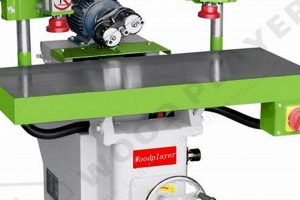
A device engineered for refining timber surfaces, this equipment achieves uniform thickness and smoothness across lumber. Employing rotating blades, it systematically shaves material from wood, ensuring consistent dimensions. Common applications range from preparing stock for furniture construction to creating level surfaces for joinery.
The adoption of such machinery significantly elevates efficiency and precision in woodworking. It reduces the reliance on manual methods, leading to quicker project completion and enhanced accuracy. Historically, these devices have evolved from hand-cranked models to sophisticated, automated systems, mirroring advancements in manufacturing technology and contributing to higher quality woodworking outputs.
The following sections will delve into the different types available, focusing on their operational characteristics and ideal applications. Maintenance procedures critical for longevity and optimal performance will also be addressed, alongside safety guidelines essential for secure operation.
Essential Usage Considerations
Optimizing performance and ensuring longevity requires adherence to specific guidelines. Proper operation minimizes waste, enhances precision, and safeguards both the equipment and the operator.
Tip 1: Material Inspection is Crucial. Prior to introducing any stock, meticulously examine it for foreign objects such as nails, screws, or embedded debris. These can cause significant damage to the blades and compromise the equipment’s accuracy.
Tip 2: Grain Direction Awareness. Always feed lumber with the grain to prevent tear-out and ensure a smooth, consistent surface. Observe the grain pattern closely before commencing the planing process.
Tip 3: Gradual Material Removal. Avoid attempting to remove excessive material in a single pass. Instead, make multiple shallow passes to minimize stress on the machine and produce a cleaner finish. Incremental adjustments are key.
Tip 4: Regular Blade Maintenance. Sharp blades are essential for optimal performance and safety. Dull blades require more force, increasing the risk of kickback. Sharpen or replace blades as needed to maintain peak cutting efficiency.
Tip 5: Dust Collection System Utilization. Employ an effective dust collection system to mitigate airborne particles and maintain a clean work environment. This practice enhances visibility and reduces the risk of respiratory problems.
Tip 6: Secure Workpiece Fixturing. Ensure the workpiece is firmly supported and properly aligned during operation. Loose or improperly positioned material can lead to inaccuracies and potential hazards.
Tip 7: Consistent Feeding Rate. Maintain a steady and uniform feeding rate to avoid inconsistencies in the finished surface. Erratic movements can result in uneven planing and compromised quality.
Adherence to these considerations promotes efficient operation, minimizes material wastage, and contributes to the production of high-quality woodworking projects. These practices are integral to maximizing the utility and lifespan of the equipment.
The final section will summarize the key elements discussed and offer concluding thoughts on the overall significance of this essential woodworking equipment.
1. Surface Refinement

Surface refinement represents a critical function achieved through the utilization of woodworking machinery. Specifically, planing equipment is instrumental in achieving consistent smoothness and dimensional accuracy across timber surfaces. The degree of refinement attained directly impacts the subsequent stages of woodworking projects, influencing aesthetics, joinery precision, and overall structural integrity.
- Blade Sharpness and Configuration
The condition and geometry of the cutting blades directly correlate to the quality of surface finish. Sharper blades yield smoother surfaces with minimal tear-out. Different blade configurations, such as helical cutterheads, are employed to reduce grain disruption and produce superior finishes, especially on figured wood.
- Feed Rate Control
The rate at which material is fed through the device influences surface texture. Excessive feed rates can lead to uneven planing and visible imperfections, while slower, controlled rates allow for finer cuts and a smoother result. Optimal feed rate is contingent on material hardness, grain direction, and desired finish quality.
- Depth of Cut Adjustment
The depth of each pass regulates the amount of material removed and subsequently the smoothness of the planed surface. Small incremental cuts minimize stress on the wood and blades, yielding a flatter, less marred surface. Conversely, aggressive cuts can result in tear-out and require additional sanding or finishing.
- Machine Calibration and Maintenance
Precise calibration of the infeed and outfeed tables ensures consistent planing depth across the entire board length. Regular maintenance, including lubrication and blade alignment, preserves machine accuracy and contributes to a superior surface finish. Neglecting maintenance can lead to inconsistencies and diminished performance.
The successful integration of these elements within the operational framework contributes directly to the device’s capacity to deliver refined surfaces. Surface Refinement directly impacts the applicability and quality of subsequent procedures involved in timber construction.
2. Thickness Consistency

Thickness consistency, a critical aspect of woodworking, is fundamentally reliant on the precision afforded by planing machinery. Maintaining uniform dimensions across multiple workpieces is essential for joinery, structural integrity, and the aesthetic appeal of finished projects. Planing equipment facilitates this consistency, enabling efficient and accurate material preparation.
- Parallel Planing Surfaces
Planing machines ensure that opposing faces of a workpiece are parallel to one another. This is achieved through a system of infeed and outfeed tables aligned to a rotating cutterhead. Deviation from parallelism compromises the accuracy of subsequent joinery and can result in structural weaknesses. For instance, consistently parallel stock is necessary for creating tight, gap-free dovetail joints.
- Dimensional Accuracy
These machines enable the precise reduction of lumber to specified thicknesses. This is achieved through incremental adjustments to the cutterhead height. Accurate dimensioning is crucial when replicating components in quantity, ensuring uniformity in projects such as cabinet making or furniture construction. Deviations from specified dimensions introduce errors and potential assembly issues.
- Mitigation of Material Defects
Planing equipment can remove surface irregularities, such as cupping, bowing, and twisting, which contribute to dimensional inconsistencies. Addressing these defects is essential for achieving a flat, stable surface prior to subsequent machining operations. Failure to correct such defects results in accumulated errors throughout the project.
- Repeatability and Efficiency
The mechanized nature of planing equipment allows for rapid and repeatable dimensioning of lumber. Manual planing methods are significantly more time-consuming and prone to error. This efficiency is particularly advantageous in production environments where large volumes of material must be processed to exacting specifications.
The aforementioned facets underscore the indispensable role of planing machines in achieving thickness consistency within woodworking applications. The ability to precisely dimension, correct defects, and efficiently replicate components is paramount for producing high-quality, structurally sound, and aesthetically pleasing projects. Failure to prioritize thickness consistency compromises the integrity and overall value of the finished product.
3. Blade Precision

Blade precision is a fundamental determinant of a planing machine’s performance and the quality of the resulting workpiece surface. The sharpness, alignment, and material composition of the blades directly influence the smoothness, accuracy, and consistency of the planed surface. A lack of blade precision translates to imperfections such as tear-out, gouging, and uneven thickness. This directly increases post-planing processing, such as sanding, and introduces the potential for dimensional inaccuracies that compromise joinery.
The relationship between blade precision and machine performance is symbiotic. Precisely manufactured and maintained blades, correctly installed and aligned within the cutterhead, extract optimal performance from the planing device. For example, helical cutterheads, known for their blade arrangement and superior cutting action, demonstrate this principle. The staggered placement of individual cutting edges, each acting with high precision, reduces the load on the motor and produces a smoother finish compared to traditional straight blades. A real-world illustration involves preparing lumber for fine furniture making, where any deviation from a perfectly smooth and dimensionally accurate surface necessitates extensive rework, undermining efficiency and aesthetic quality.
In summary, blade precision is not merely a desirable attribute but an indispensable component of effective planing. Maintaining blades through regular sharpening and proper alignment procedures directly contributes to superior outcomes and minimizes waste. Investing in high-quality blades and understanding their impact on the process ensures efficient operation and improved woodworking craftsmanship. Ultimately, blade precision dictates the degree to which planing machinery fulfills its core purpose: to refine and dimension lumber with accuracy and efficiency.
4. Material Feed Rate

The material feed rate, measured as the speed at which stock is advanced through a planing machine, directly impacts surface finish and operational efficiency. A rate that is excessively rapid introduces tear-out, where wood fibers are lifted and torn from the surface rather than cleanly severed. Conversely, an excessively slow feed rate can lead to burning, particularly when planing hardwoods, and may generate uneven surfaces due to subtle pauses or variations in the feed mechanism. Therefore, optimal material feed rate represents a balance between maximizing throughput and maintaining surface quality.
The selection of an appropriate material feed rate is further influenced by wood species, grain orientation, and depth of cut. Softwoods, generally requiring higher feed rates due to their lower density, risk excessive tear-out if the feed rate is not carefully monitored. Hardwoods, demanding slower feed rates to prevent burning, necessitate adjustments based on the specific species’ density and oil content. The machine’s horsepower rating is also an influencing factor. In the production of high-end cabinetry, where surface quality is paramount, slower feed rates and shallower cuts are frequently employed, even at the expense of increased processing time. Similarly, when dimensioning rough lumber for structural applications, a slightly faster feed rate may be acceptable, provided the resulting surface imperfections are within acceptable tolerances.
In conclusion, material feed rate functions as a crucial variable governing planing machine performance. Precise control over this parameter allows operators to optimize surface finish, minimize material waste, and ensure efficient machine operation. The challenges lie in selecting an appropriate rate that is adapted to the material properties, machine characteristics, and desired outcome. An understanding of the principles of feed rate optimization is thus essential for effective utilization of planing equipment in diverse woodworking applications.
5. Dust Management

The operation of planing machinery generates significant quantities of fine particulate matter. This byproduct, consisting of wood dust and shavings, poses substantial health risks and operational challenges. The direct consequence of inadequate dust control includes respiratory irritation, visibility impairment, and fire hazards. A planer without effective dust management contributes to a work environment that is both unhealthy and inefficient. For example, prolonged exposure to wood dust can lead to occupational asthma and other respiratory ailments, resulting in decreased productivity and potential long-term health consequences for woodworking professionals. The accumulation of dust on machinery and work surfaces also increases the risk of accidental ignition, particularly given the flammable nature of finely divided wood particles. Consequently, the implementation of robust dust management systems is not merely a best practice, but an essential component of safe and efficient planing operations.
Effective dust management in planing operations relies on a multifaceted approach. The primary method involves the integration of dust collection systems directly connected to the planer. These systems typically consist of a high-efficiency particulate air (HEPA) filter or cyclone separator coupled with a powerful extraction fan. The system captures dust at its source, preventing it from becoming airborne and circulating throughout the workspace. Furthermore, regular maintenance of the dust collection system is critical to ensuring its continued effectiveness. Clogged filters reduce airflow, diminishing the system’s ability to capture dust, and necessitating periodic cleaning or replacement. In the context of a small woodworking shop, a portable dust collector may suffice, while large-scale industrial operations require centralized dust collection systems with greater capacity and filtration capabilities. In either scenario, the objective remains consistent: to minimize airborne particulate matter and maintain a clean, safe working environment.
In summary, dust management represents an indispensable aspect of operating planing machinery. The implementation of effective dust collection systems mitigates health risks, enhances visibility, reduces fire hazards, and improves overall operational efficiency. While challenges related to cost, space constraints, and system maintenance exist, the benefits of proactive dust management far outweigh the potential drawbacks. Adopting a comprehensive approach to dust control, incorporating appropriate equipment and diligent maintenance practices, is crucial for ensuring the long-term health and safety of woodworking personnel and the sustainability of woodworking operations. The integration of dust management principles with planer usage is an operational and ethical imperative.
Frequently Asked Questions
The following addresses common inquiries regarding the functionality, maintenance, and appropriate usage of this equipment. These FAQs provide concise and factual information designed to enhance user understanding and optimize operational outcomes.
Question 1: What distinguishes a thickness planer from a jointer?
A thickness planer, also known as a thicknesser, is designed to reduce stock to a consistent thickness across its entire surface. A jointer, conversely, establishes a flat reference face and edge on lumber, preparing it for subsequent planing operations. The jointer creates a flat surface, while the planer makes a board of even thickness.
Question 2: How often should the blades on this machine be sharpened or replaced?
Blade sharpness depends on usage frequency and the types of wood being planed. As a general guideline, blades require sharpening or replacement when the resulting surface exhibits tear-out, burning, or a reduction in cut quality. Frequent inspection of the cutting edges is essential for identifying when maintenance is necessary.
Question 3: What safety precautions are paramount when operating this equipment?
Essential safety precautions include wearing appropriate personal protective equipment (PPE), such as safety glasses and hearing protection. Ensure proper dust collection is employed to mitigate airborne particulate matter. Never bypass or disable safety mechanisms. And inspect lumber to guarantee that no metal objects are present.
Question 4: What is the optimal depth of cut for hardwoods versus softwoods?
The optimal depth of cut is contingent upon the wood’s density and grain structure. Hardwoods generally require shallower cuts, typically no more than 1/16 inch per pass, to prevent motor strain and tear-out. Softwoods can often accommodate slightly deeper cuts, but excessive depth increases the risk of surface defects. Testing with scrap material is advisable.
Question 5: Why is proper dust collection critical when using a planer?
Effective dust collection mitigates the risk of respiratory problems associated with inhaling wood dust. Furthermore, it reduces the fire hazard posed by accumulating wood shavings and enhances visibility, contributing to a safer and more efficient working environment. Without adequate dust control, significant risks of health and safety complications are probable.
Question 6: What factors influence the accuracy and consistency of thicknessing operations?
Several factors affect accuracy, including proper machine calibration, the sharpness and alignment of the blades, consistent feed rate, and the rigidity of the machine’s construction. Any variation in these elements can compromise the dimensional consistency of the planed material, potentially impacting subsequent joinery and assembly processes.
These frequently asked questions encapsulate fundamental knowledge necessary for the safe and effective utilization of this essential woodworking equipment. Adherence to these principles maximizes productivity and minimizes potential risks.
The concluding section will summarize the key concepts discussed throughout this document, providing a comprehensive overview of the “planer woodworking machine” and its application in modern woodworking.
Conclusion
This document has comprehensively examined the planer woodworking machine, elucidating its function in dimensioning and refining timber. The analysis encompassed operational characteristics, maintenance requirements, and essential safety considerations. The discussion emphasized the impact of blade precision, material feed rate, and dust management on the quality and safety of planing operations. Key differentiations between planers and similar woodworking tools, such as jointers, were also delineated, providing a clear understanding of each machine’s specific purpose.
The planer woodworking machine remains an indispensable asset in both professional and amateur woodworking contexts. Understanding its principles and implementing best practices are paramount for achieving optimal results and mitigating potential risks. Continuous advancements in machine design and material technology promise further enhancements in precision, efficiency, and safety. As such, ongoing engagement with the latest developments in planer technology is encouraged for any woodworker seeking to maximize the potential of this fundamental tool.