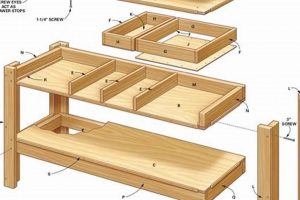
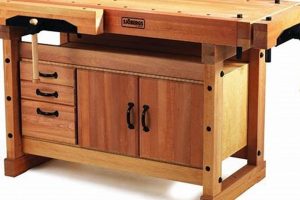
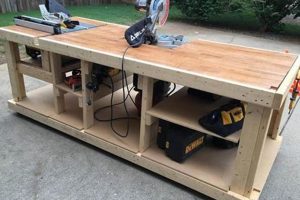
Components constituting the framework and surface upon which woodworking operations are executed form an essential assembly. These elements, encompassing legs, aprons, a work surface, and potentially vises or storage solutions, collectively determine the stability and functionality of the structure. For example, a robust leg and apron system provides resistance to racking forces, while a flat, solid surface offers a reliable plane for tasks such as planing or joinery.
The proper selection and construction of these constituent elements directly impact efficiency, accuracy, and user safety during woodworking activities. Historically, the design and material selection for these structures have evolved in parallel with woodworking techniques, reflecting a constant optimization for specific applications and available resources. The quality and configuration of these assemblies contribute significantly to the overall lifespan and effectiveness of a woodworking workspace.
Understanding the function and characteristics of individual components is paramount to selecting or constructing a suitable platform for woodworking tasks. Subsequent sections will delve into specific aspects such as material choices, joinery methods, and the incorporation of specialized features to enhance performance and versatility.
Considerations for Selection and Optimization
Maximizing the utility and longevity of a woodworking surface necessitates careful consideration of several factors pertaining to its constituent elements.
Tip 1: Material Selection: Hardwoods such as maple or beech offer superior durability and resistance to wear compared to softwoods like pine. Select material appropriate for the intended workload and frequency of use.
Tip 2: Joint Integrity: Mortise and tenon joints, dovetails, or robust mechanical fasteners are crucial for a stable and long-lasting framework. Weak or improperly executed joints will compromise the overall structural integrity.
Tip 3: Surface Flatness: A perfectly flat work surface is paramount for accurate joinery and planing. Employ leveling techniques and utilize a reliable straightedge to ensure planarity.
Tip 4: Vise Selection: Choose vises appropriate for the types of work being performed. Face vises, leg vises, or quick-release mechanisms can significantly improve workholding capabilities.
Tip 5: Leg Stability: Legs should be adequately sized and braced to prevent racking or movement during strenuous activities. Consider splayed legs or additional stretchers for increased stability.
Tip 6: Apron Rigidity: Aprons connecting the legs provide essential support to the work surface. Select aprons of sufficient thickness and depth to resist deflection under load.
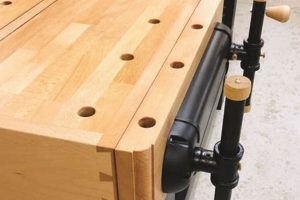
Tip 7: Consider Dog Holes: Regularly spaced dog holes across the work surface enhance versatility for workholding with bench dogs and other accessories.
By carefully considering the material selection, joint integrity, surface flatness, vise selection, leg stability, apron rigidity, and potential for dog holes, a woodworking platform can be optimized for performance and longevity, increasing accuracy and work efficiency. Proper attention to these details contributes to a safe and productive workspace.
These considerations lay the groundwork for exploring more advanced features and customization options that can further enhance the utility of a woodworking surface.
1. Work Surface Material

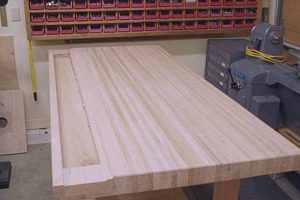
The work surface material constitutes a primary determinant of a woodworking platform’s overall utility and longevity. As a key component, its properties directly influence the precision, safety, and ease with which woodworking tasks can be executed. Material selection dictates resistance to wear, impact, and deformation, thereby impacting the consistency of results and the maintenance requirements of the structure. For example, a surface constructed from softwoods will exhibit a greater propensity for dents and scratches compared to hardwoods, potentially compromising the accuracy of subsequent operations.
Consider the practical application of hardwood surfaces, such as maple or beech, in environments demanding rigorous use. These materials offer exceptional stability and resistance to racking forces, contributing to a more solid and reliable work platform. Conversely, engineered materials like laminated plywood can provide a cost-effective alternative, offering a stable and flat surface with reduced weight. However, their durability may be lower compared to solid hardwoods, leading to a trade-off between cost and long-term performance. The choice is contingent upon the anticipated workload and the desired balance between initial investment and operational lifespan.
Ultimately, the work surface material is a crucial decision point when constructing or selecting a woodworking station. Informed selection hinges on a thorough understanding of material properties, anticipated usage patterns, and budgetary constraints. Prioritizing material quality contributes directly to the overall efficacy and enduring value of the entire woodworking assembly. Improper material selection, conversely, introduces inherent limitations that can negatively impact project outcomes and user experience.
2. Frame Joint Integrity

Frame joint integrity represents a critical factor in the structural performance and long-term durability of woodworking platform framework. The quality and execution of joints directly influence the capacity of the structure to withstand stress, resist racking forces, and maintain dimensional stability over time. Weak or poorly constructed joints introduce points of failure, leading to instability and potential compromise of the entire system. As a constituent of structural system, this is woodworking bench parts.
For example, consider a woodworking structure subjected to repetitive impact during hammering or planing operations. Inadequate joint strength, such as loose mortise-and-tenon joints or improperly secured dovetails, will allow for movement and deflection within the frame. This movement not only diminishes the precision of woodworking tasks but also accelerates the deterioration of the joints themselves, leading to a cascading effect of structural weakening. Conversely, robust and well-fitted joints, achieved through careful craftsmanship and appropriate adhesive selection, distribute stress evenly across the frame, enhancing its ability to absorb impact and maintain rigidity.
In conclusion, frame joint integrity is not merely a construction detail but a fundamental determinant of a woodworking structure’s effectiveness and lifespan. Prioritizing sound joinery techniques, employing appropriate materials and fasteners, and rigorously inspecting completed joints are essential steps in ensuring a stable and reliable woodworking platform. Neglecting this aspect introduces risks that can compromise both the quality of woodworking projects and the longevity of the workspace.
3. Vise Mechanism Type

The vise mechanism type constitutes a critical component of any woodworking assembly, directly influencing the user’s ability to secure workpieces for shaping, joining, or finishing. The selection of an appropriate vise mechanism is contingent upon the specific tasks to be performed and the characteristics of the materials being worked. Different mechanisms offer varying levels of clamping force, adjustability, and workpiece accessibility, all of which impact workflow and precision.
- Face Vise Functionality
The face vise, typically mounted flush with the front edge of the platform, provides versatile clamping for a wide range of projects. Its parallel jaws, driven by a screw mechanism, apply consistent pressure to secure boards for edge jointing, planing, or detail work. However, the limited throat depth of some face vises may restrict their effectiveness for large or irregularly shaped workpieces.
- Leg Vise Operation
The leg vise, characterized by a single chop pivoting against the bench leg, offers a large clamping capacity and adaptability for holding long or wide materials. This mechanism excels at securing doors, panels, and other sizable components. However, achieving consistent clamping pressure across the entire workpiece can require careful adjustment and shimming.
- Tail Vise Applications
The tail vise, integrated into the end of the platform, often incorporates a series of dog holes in conjunction with bench dogs. This configuration allows for clamping workpieces of various lengths along the platform’s surface, providing stable support for tasks such as sawing tenons or cutting dovetails. The effectiveness of the tail vise relies on the precise alignment of dog holes and the quality of the bench dogs themselves.
- Quick-Release Vise Efficiency
Quick-release mechanisms can be incorporated into various vise designs, allowing for rapid adjustment of the jaws without the need for extensive turning of the screw. This feature enhances efficiency when frequently repositioning workpieces or working with materials of varying thickness. Quick-release vises are particularly advantageous in production environments or when performing repetitive tasks.
In conclusion, the choice of vise mechanism directly affects the versatility and efficiency of the woodworking station. Each type of vise offers distinct advantages and limitations, necessitating careful consideration of the intended applications and the characteristics of the workpieces to be secured. Proper selection and maintenance of the vise mechanism contribute significantly to the overall productivity and precision of woodworking operations.
4. Leg Stability Design
Leg stability design, a critical aspect of woodworking framework construction, directly influences the rigidity and operational safety of the structure. The configuration of the legs, their dimensions, and their method of attachment to the frame determine the capacity of the unit to resist racking forces, vibration, and overall instability. Inadequate leg stability compromises precision and introduces safety hazards.
- Leg Material Selection
The selection of leg material impacts the structure’s ability to withstand compressive loads and resist deformation. Hardwoods such as maple or oak provide superior strength and stiffness compared to softwoods like pine. The appropriate material choice is contingent upon the anticipated workload and the desired balance between cost and performance. For instance, a leg constructed from kiln-dried hardwood will exhibit greater dimensional stability and resistance to warping than a comparable leg made from green lumber.
- Leg Geometry and Footprint
The geometry and footprint of the legs directly influence the distribution of weight and resistance to tipping. Splayed legs, angled outwards from the frame, increase the base of support and enhance stability. The footprint, defined by the area enclosed by the leg positions, should be sufficiently large to prevent overturning under normal operating conditions. A wider footprint provides increased resistance to lateral forces and reduces the risk of accidental displacement.
- Bracing and Stretcher Systems
Bracing and stretcher systems, connecting the legs to each other and to the frame, provide additional support and rigidity. Stretchers, horizontal members running between the legs, resist racking forces and prevent lateral movement. Braces, typically diagonal members, provide further reinforcement and enhance resistance to torsion. The configuration and material of these support structures are crucial for maintaining overall stability. For example, a robust stretcher system constructed from hardwood can significantly reduce the likelihood of wobbling or shifting during use.
- Attachment Methods and Joint Integrity
The methods used to attach the legs to the frame and the integrity of the resulting joints directly impact the structural integrity of the entire assembly. Mortise-and-tenon joints, dovetail joints, and robust mechanical fasteners provide strong and reliable connections. Weak or improperly executed joints introduce points of failure, leading to instability and potential collapse under load. The use of high-quality adhesives, combined with precise joinery techniques, is essential for achieving maximum joint strength and longevity.
The interplay between leg material selection, geometry, bracing, and attachment methods determines the overall stability and performance of woodworking framework. Attention to these details ensures a safe, stable, and reliable platform for woodworking operations. Neglecting these considerations introduces risks that can compromise both the quality of work and the safety of the user.
5. Apron Thickness Specification
Apron thickness specification, a fundamental parameter in the design of framework, directly influences the structural rigidity and load-bearing capacity of the entire assembly. The aprons, horizontal members connecting the legs beneath the work surface, resist deflection under load and provide crucial support to the work surface itself. Insufficient apron thickness leads to noticeable sag and diminished stability, particularly when subjected to heavy workpieces or forceful operations. Conversely, an adequately specified apron thickness ensures a flat, stable work surface, enhancing precision and minimizing the risk of material movement during critical operations such as joinery or planing. For instance, a framework intended for heavy milling operations or holding sizable workpieces necessitates a thicker apron profile to prevent unwanted deformation. It’s is one of the most important woodworking bench parts for the entire structural integrity.
The relationship between apron thickness and overall stability can be exemplified by contrasting two framework designs. A lightweight designed for occasional hobbyist use might employ aprons of minimal thickness (e.g., 1 inch), sufficient for supporting light materials. However, a framework intended for professional use, supporting heavy tools and materials, mandates aprons of significantly greater thickness (e.g., 3 inches) to maintain structural integrity. This difference in specification directly correlates with the intended application and the expected load. Moreover, apron thickness interacts synergistically with material selection and joint design. A thicker apron, coupled with robust mortise-and-tenon joints, creates a highly rigid framework capable of withstanding substantial force without compromising the flatness of the work surface.
In summary, apron thickness specification is a pivotal consideration in framework design, directly impacting its stability, load-bearing capacity, and long-term performance. Optimal specification requires a careful evaluation of the intended application, the weight of expected workpieces, and the desired level of precision. By prioritizing appropriate apron thickness, woodworkers can ensure a safe, stable, and reliable work surface, contributing to improved accuracy, efficiency, and overall project quality. The selection is a trade-off between material cost and structural performance, demanding informed decision-making based on specific needs and constraints. This underscores its importance as one of woodworking bench parts.
6. Dog Hole Arrangement
Dog hole arrangement within woodworking framework represents a critical design element impacting workpiece clamping versatility and overall functionality. The configuration of these apertures, typically circular or rectangular, directly influences the ability to secure materials for a wide range of operations, including sawing, planing, and joinery. As such, dog hole placement and spacing are integral considerations in the design and construction of woodworking bench parts.
- Grid Pattern Configuration
A grid pattern, characterized by equally spaced dog holes arranged in rows and columns, offers maximum versatility for securing workpieces of various shapes and sizes. This configuration allows for flexible placement of bench dogs and clamping accessories, accommodating a wide range of project requirements. An example would be a 3-inch grid pattern across the entire work surface. The implication is enhanced adaptability for diverse woodworking tasks.
- Linear Arrangement Along Vise Jaw
A linear arrangement of dog holes, typically positioned along the face of a vise jaw, facilitates secure clamping of long or narrow workpieces. This configuration allows for consistent clamping pressure along the entire length of the material, preventing bowing or slippage during planing or edge jointing. An example is a series of holes spaced 2 inches apart. The implication is optimized edge clamping for long boards.
- Offset and Angled Orientations
Offset and angled dog hole orientations provide specialized clamping options for specific woodworking tasks. Angled holes can be used in conjunction with tapered bench dogs to secure angled workpieces, while offset holes offer alternative clamping points for irregularly shaped materials. An example would be 15 degree angle. The implication is specialized clamping for non-orthogonal shapes.
- Material and Dimensional Consistency
The material and dimensional consistency of dog holes are critical for ensuring proper function and long-term durability. Holes should be precisely drilled or routed to the specified diameter, with smooth and consistent sidewalls. The use of hardened bushings or inserts can prevent wear and tear, extending the lifespan of the dog hole arrangement. An example is using a steel bushing. The implication is enhanced durability and precise dog fit.
The relationship between dog hole arrangement and woodworking framework functionality is symbiotic. The configuration of the dog holes determines the clamping capabilities of the structure, while the overall design influences the placement and spacing of the holes. Careful consideration of these factors is essential for creating a versatile and efficient woodworking assembly, directly impacting woodworking bench parts.
7. Storage Solutions Integration

The incorporation of storage solutions into woodworking frameworks represents a strategic enhancement, optimizing workspace efficiency and organization. Integrated storage directly addresses the need for readily accessible tools and materials, minimizing workflow interruptions and contributing to a safer, more productive environment. The design and implementation of these storage features should be carefully considered as part of the overall framework architecture.
- Tool Drawer Configuration
Tool drawers, integrated beneath the work surface or within the framework structure, provide dedicated storage for hand tools, measuring instruments, and frequently used accessories. Drawer dimensions, quantity, and internal organization (e.g., dividers, custom inserts) should be tailored to the specific needs of the woodworker. For instance, a shallow drawer dedicated to chisels, featuring individual slots, prevents damage and ensures easy access. The systematic arrangement of tools within drawers minimizes search time and promotes a more streamlined workflow.
- Shelf and Cabinet Integration
Shelves and cabinets, incorporated into the framework, offer storage for larger tools, power equipment, and bulk materials. Shelves, either fixed or adjustable, can accommodate various container sizes and tool configurations. Cabinets, featuring doors or drawers, provide enclosed storage, protecting contents from dust and debris. For example, a cabinet housing a benchtop planer, with integrated dust collection connections, centralizes essential equipment and streamlines operations. Strategic shelf and cabinet placement optimizes accessibility and maximizes space utilization.
- Vertical Tool Storage Solutions
Vertical tool storage, such as wall-mounted racks or pegboards, offers an alternative approach to organizing frequently used tools. This configuration maximizes visibility and accessibility, allowing for quick retrieval of essential implements. A wall-mounted chisel rack, for example, allows for instant identification and selection of the desired tool. Vertical storage solutions can be particularly beneficial in smaller workspaces, minimizing clutter and optimizing available surface area.
- Material Storage and Organization
Dedicated storage for raw materials, such as lumber, plywood, and hardware, is essential for maintaining an organized and efficient workspace. Lumber racks, designed to support long boards horizontally, prevent warping and facilitate easy access. Hardware organizers, featuring multiple compartments, allow for the systematic storage of screws, nails, and other fasteners. For example, a designated lumber rack, capable of storing various board sizes, ensures organized inventory and prevents damage to valuable materials. Effective material storage minimizes waste, reduces material handling time, and contributes to a safer working environment.
The strategic integration of storage solutions into woodworking framework extends beyond mere convenience, impacting workflow efficiency, safety, and long-term organization. Careful planning and implementation of these features contribute to a more productive and enjoyable woodworking experience. Integrated storage complements other design considerations, such as vise placement and dog hole configuration, creating a cohesive and optimized workspace. This integration is an integral part of woodworking bench parts design and implementation.
Frequently Asked Questions
This section addresses common inquiries regarding the constituent elements of woodworking platforms, offering clarity on material selection, design considerations, and functional aspects.
Question 1: What constitutes the foundational elements of a woodworking bench?
The core elements consist of a work surface (typically solid wood or laminated material), a supporting frame (including legs and aprons), and work-holding devices such as vises. Optional elements may include storage solutions (drawers, shelves) and dog holes for versatile clamping.
Question 2: What criteria govern the selection of work surface material?
Durability, flatness, and resistance to wear are primary considerations. Hardwoods like maple or beech are preferred for heavy use, while engineered materials may offer cost-effective alternatives. Stability and resistance to warping are also important factors.
Question 3: How does frame joint integrity affect the stability of a woodworking structure?
Robust joints, such as mortise-and-tenon or dovetail joints, are essential for resisting racking forces and maintaining structural rigidity. Weak or poorly executed joints compromise stability and reduce the overall lifespan of the assembly.
Question 4: What are the key distinctions between different types of woodworking vises?
Face vises provide versatile clamping for general tasks, while leg vises offer a large clamping capacity for wide materials. Tail vises, integrated into the end of the bench, facilitate secure clamping of long workpieces using bench dogs. Quick-release mechanisms enhance efficiency.
Question 5: How does leg stability design impact the safety and precision of woodworking operations?
Stable legs, constructed from appropriate materials and properly braced, prevent wobbling and minimize vibration. Splayed legs increase the base of support, enhancing stability. Secure attachment to the frame is crucial for preventing movement during use.
Question 6: What considerations should guide the integration of storage solutions into woodworking framework?
Accessibility, organization, and space optimization are key factors. Tool drawers, shelves, and vertical storage solutions should be tailored to the specific needs of the woodworker. Dedicated storage for materials, such as lumber and hardware, promotes efficiency and safety.
Understanding these frequently asked questions provides a solid foundation for informed decision-making regarding woodworking framework construction and configuration.
This foundational knowledge facilitates a seamless transition to more advanced topics such as customization and specialized woodworking framework designs.
Conclusion
The preceding discussion has detailed the constituent elements that comprise an effective woodworking surface. Key considerations, including material selection, joint integrity, vise mechanism functionality, and integrated storage solutions, directly influence the performance and longevity. A comprehensive understanding of these aspects allows for informed decisions regarding design, construction, or selection of woodworking bench parts.
Investing in robust, well-configured woodworking framework is an investment in precision, efficiency, and safety. Careful attention to the specifications and construction of these components will yield a durable and reliable workspace, fostering successful woodworking endeavors. The quality and design of woodworking bench parts ultimately determine the efficacy and enjoyment of the craft.