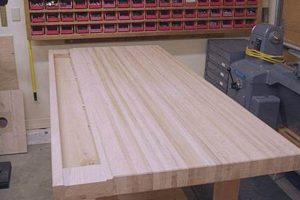
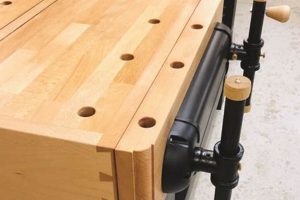
A fundamental piece of furniture for woodworking activities, this provides a stable, horizontal surface upon which materials can be worked. Characterized by a straightforward design, it often features a solid top, robust legs, and sometimes includes a vise or other work-holding mechanisms. An example would be a basic table constructed from lumber, strong enough to withstand hammering, sawing, and assembly processes.
Its importance stems from its role as a dedicated workspace, improving efficiency and accuracy. Benefits include enhanced safety due to the stable surface, increased precision in cuts and joints, and the ability to secure workpieces effectively. Historically, these have evolved from rudimentary tables to specialized designs tailored to specific woodworking tasks, reflecting the development of woodworking techniques and tools.
Further examination will delve into the design considerations for these foundational pieces of equipment, including materials, dimensions, and the integration of essential features. Detailed attention will also be given to construction methods suitable for both novice and experienced woodworkers.
Tips for Selecting and Utilizing a Fundamental Woodworking Surface
The selection and proper use of a fundamental woodworking surface contribute significantly to the success and safety of woodworking projects. The following tips outline key considerations for optimizing its functionality.
Tip 1: Material Selection: Opt for hardwood such as maple or beech for the benchtop. These materials offer superior durability and resistance to dents and warping compared to softer woods.
Tip 2: Benchtop Thickness: A minimum benchtop thickness of 3 inches is recommended. This provides sufficient mass and stability to dampen vibrations and resist movement during strenuous tasks.
Tip 3: Leg Construction: Employ mortise and tenon joinery for attaching the legs to the benchtop. This method creates a strong and durable connection capable of withstanding significant stress.
Tip 4: Vise Placement: Consider the placement and type of vise. A face vise positioned on the front of the bench and a tail vise integrated into the end provide versatile work-holding capabilities.
Tip 5: Bench Height: Determine the optimal bench height based on individual stature and typical woodworking posture. A bench that is too low or too high can lead to discomfort and reduced efficiency.
Tip 6: Surface Maintenance: Regularly apply a protective finish, such as boiled linseed oil, to the benchtop. This helps to prevent moisture absorption and maintain a smooth, usable surface.
Tip 7: Tool Storage: Integrate storage solutions into the design. Drawers or shelves located beneath the benchtop provide convenient access to frequently used tools and supplies.
By adhering to these tips, woodworkers can ensure that their fundamental woodworking surface provides a stable, reliable, and efficient platform for a wide range of projects.
The subsequent sections will explore various designs and construction techniques to further enhance the functionality and longevity of this essential woodworking tool.
1. Stability

Stability is a cornerstone of effective woodworking, inextricably linked to the functionality of a foundational woodworking surface. Without a stable platform, precision and safety are compromised, leading to inaccuracies and potential injury. The following points detail specific facets of stability within the context of a fundamental woodworking surface.
- Leg Construction and Bracing
Robust leg construction, often employing mortise and tenon joinery, directly contributes to stability. Bracing, such as stretchers connecting the legs, further minimizes racking and movement. For example, a bench with slender, unbraced legs is prone to wobbling, while a bench with thick legs and diagonal stretchers offers superior stability. The implications are clear: a stable base minimizes vibrations and ensures accurate cuts.
- Weight Distribution
Even weight distribution across the base is crucial. Uneven weight can lead to instability, particularly when working with heavy or awkwardly shaped materials. Consider a bench with a top-heavy design; it will be susceptible to tipping. Proper weight distribution, achieved through strategic material placement and design, ensures that the bench remains firmly planted during use. The consequence of poor weight distribution is decreased precision and heightened risk.
- Surface Contact Area
The contact area between the bench legs and the floor directly influences stability. Wider feet or the use of leveling feet increase the surface contact, minimizing rocking and maximizing stability on uneven surfaces. A bench with narrow, pointed legs will be less stable than one with broad, flat feet. This is especially relevant in workshops with imperfect floors. Maximizing contact area prevents unwanted movement, enabling consistent and accurate work.
- Mass of the Benchtop
The mass of the benchtop contributes to overall stability by resisting movement caused by impact or vibration. A heavy, solid benchtop will dampen vibrations and provide a more stable surface than a lightweight, hollow-core top. Imagine attempting to hand-plane a board on a flimsy surface versus a solid, heavy bench; the difference in stability is significant. Greater mass translates to improved control and accuracy.
These facets of stability are interconnected and critical for a practical woodworking surface. A bench lacking in any of these areas will be less effective and potentially dangerous. The selection or construction of a robust and stable workbench is an investment in the quality and safety of all woodworking projects.
2. Durability
Durability, in the context of a fundamental woodworking surface, signifies the capacity to withstand prolonged use and resist degradation from the stresses inherent in woodworking activities. The inherent connection between durability and this type of woodworking setup is causal; robust materials and construction directly lead to a longer lifespan and sustained performance. For instance, a bench constructed from softwood and secured with weak joints is prone to rapid wear and tear, rendering it unusable for demanding tasks. Conversely, a bench built from hardwood, using strong joinery techniques, can endure decades of service, resisting warping, splitting, and the effects of repeated hammering and sawing. Durability is not merely a desirable trait; it is a fundamental requirement for any woodworking surface intended for regular use. Without it, the investment in time and materials is quickly negated.
The selection of materials plays a pivotal role in determining the bench’s overall durability. Hardwoods such as maple, beech, and oak are preferred due to their density and resistance to abrasion. In addition to material choice, construction methods are equally crucial. Mortise and tenon joints, dovetail joints, and robust fasteners contribute significantly to the structural integrity of the bench. For example, a bench assembled with screws alone may weaken over time, whereas one employing mortise and tenon joints with glue provides a much stronger and more durable connection. The application of a protective finish, such as oil or varnish, further enhances durability by preventing moisture absorption and reducing the risk of damage from spills and scratches. Properly applying and maintaining a suitable finish provides a barrier against the wear and tear associated with active woodworking.
In conclusion, the inherent connection between durability and a basic woodworking surface is critical for its longevity and functionality. Material selection, robust construction methods, and protective finishes are all essential factors that contribute to the overall durability of the bench. A durable bench represents a long-term investment, providing a stable and reliable platform for woodworking projects for years to come. While challenges in maintaining a woodworking surface may exist, particularly in demanding environments, understanding the importance of durability ensures that the surface remains a cornerstone of effective woodworking.
3. Work Holding
Work holding constitutes an indispensable component of a fundamental woodworking surface, functioning as the primary means of securing materials during various woodworking operations. The ability to reliably fix workpieces is directly causal to the precision and safety of tasks such as sawing, planing, chiseling, and joinery. Without adequate work holding capabilities, materials are prone to shifting or vibrating, resulting in inaccurate cuts, compromised joinery, and an increased risk of injury. Consider the task of hand-planing a long board: if the board is not securely held, it will move under the force of the plane, rendering the process inaccurate and potentially hazardous. The presence of effective work holding mechanisms, such as vises and clamping systems, transforms a simple surface into a functional workstation capable of producing accurate and repeatable results.
The integration of work holding solutions within the bench’s design directly expands its utility. Face vises, typically mounted to the front of the bench, provide a robust method for securing boards for edge work and joinery. Tail vises, integrated into the end of the bench, allow for clamping boards against bench dogs, offering a versatile system for securing wider panels and boards. In addition to vises, other work holding accessories, such as holdfasts and clamping jigs, can be used to secure workpieces in various orientations and configurations. An example of practical application would be using a holdfast to quickly secure a workpiece for a dovetail joint or employing a clamping jig to hold a drawer box square during glue-up. The diversity of available work holding options allows woodworkers to adapt to a wide array of project requirements, further emphasizing the critical role this functionality plays in successful woodworking.
In summary, work holding is an essential and inseparable attribute of a basic woodworking surface, directly influencing the accuracy, safety, and versatility of woodworking operations. The presence of effective work holding mechanisms transforms a simple platform into a functional and productive workstation. The absence or inadequacy of work holding compromises the entire process, leading to inaccuracies, increased risks, and ultimately, diminished results. Therefore, careful consideration of work holding options and their integration into the bench’s design is paramount for any woodworker seeking to maximize the potential of their workspace.
4. Surface Area

Surface area, in the context of a fundamental woodworking surface, directly influences the range and efficiency of tasks that can be performed. This critical attribute dictates the ability to accommodate various project sizes, tool layouts, and assembly operations, establishing a causal relationship between available workspace and overall productivity.
- Project Size Accommodation
Larger surface areas facilitate work on expansive projects, such as assembling large cabinets or working with long boards. A limited surface restricts project dimensions, necessitating segmented construction or off-bench assembly. A bench top of 36″ x 72″ accommodates most common furniture pieces, while smaller dimensions necessitate creative solutions. This constraint highlights the tangible impact of surface area on project scope.
- Tool and Material Layout
Adequate surface area enables the organized arrangement of tools, materials, and measuring devices, minimizing clutter and streamlining workflow. A cluttered surface increases the risk of accidents and slows down work. Consider the act of hand-cutting dovetails: a dedicated space for the saw, chisels, marking gauge, and the workpiece itself promotes efficiency. Conversely, a cramped surface requires constant rearrangement and increases the likelihood of misplacing tools, affecting work quality.
- Assembly Operations
Sufficient surface area is essential for assembling complex projects. Gluing up multiple components simultaneously requires ample space to spread out parts, apply adhesive, and clamp the assembly. A lack of space complicates the process, potentially leading to uneven glue application or misalignment. Cabinet construction, for instance, benefits significantly from a large surface where all components can be dry-fitted and then glued and clamped in a single operation. Surface area directly dictates the feasibility of complex assemblies.
- Versatility and Adaptability
A larger surface offers increased versatility, accommodating a wider range of woodworking techniques and project types. It also provides space for jigs and fixtures, expanding the bench’s functionality. While a smaller surface may suffice for basic tasks, it limits the potential for advanced woodworking. A generously sized surface area empowers woodworkers to tackle diverse projects with confidence and efficiency, ensuring that the bench adapts to evolving needs and skills.
These facets illustrate the integral role of surface area. While other considerations like material and stability remain important, a sufficient workspace enables efficient workflow, complex assembly, and adaptability, underscoring its value. The proper dimensions ensures effective operations.
5. Material Quality
Material quality exerts a profound influence on the performance and longevity of a simple woodworking bench. The inherent characteristics of the materials employed directly impact the bench’s stability, durability, and resistance to wear and tear. For example, a bench constructed from low-grade softwood will exhibit diminished stability due to its inherent flexibility and lower density. Furthermore, it will be more susceptible to dents, scratches, and warping, significantly reducing its service life. Conversely, the utilization of high-quality hardwood, such as maple or beech, results in a more rigid and durable structure, capable of withstanding substantial loads and resisting deformation over time. This demonstrates that the choice of materials is not merely an aesthetic consideration but a fundamental determinant of the bench’s functional lifespan and work-holding capacity.
The selection of appropriate fasteners and adhesives further exemplifies the importance of material quality. Inferior screws or nails can strip easily or fail to provide adequate holding power, compromising the structural integrity of the bench. Similarly, low-quality adhesives may exhibit poor bonding strength or susceptibility to moisture, leading to joint failure and eventual collapse. A practical example of this principle is evident in the construction of a bench leg assembly. If the legs are attached using weak screws and substandard glue, they are prone to loosening under stress, potentially leading to instability and a dangerous working environment. In contrast, the use of high-quality screws and a reputable wood glue ensures a robust and durable connection, enhancing the overall safety and reliability of the bench.
In summary, the quality of materials used in a simple woodworking bench is paramount to its functionality and longevity. While cost considerations may tempt some to opt for cheaper alternatives, the long-term benefits of investing in high-quality lumber, fasteners, and adhesives far outweigh any initial savings. The improved stability, durability, and overall performance of a well-constructed bench directly contribute to the accuracy and safety of woodworking projects. While the initial investment may be higher, the enhanced lifespan and reliability of the bench make it a worthwhile expenditure for any serious woodworker, reinforcing the importance of material selection and implementation during construction to achieve these practical advantages.
6. Accessibility

Accessibility, in the context of a fundamental woodworking bench, refers to the ease with which tools, materials, and workspace features can be reached and utilized during woodworking tasks. This attribute directly influences workflow efficiency, safety, and overall user experience.
- Tool Storage Solutions
Integrated tool storage, such as drawers, shelves, or pegboards, ensures that frequently used tools are readily available. Reaching for tools across the workshop introduces delays and increases the risk of accidents. A bench with drawers sized to accommodate hand planes, chisels, and measuring tools significantly improves workflow. The absence of dedicated storage necessitates searching and handling tools, potentially disrupting concentration and increasing task duration.
- Work Surface Height
Appropriate work surface height minimizes strain and fatigue. A bench that is too low requires excessive bending, while a bench that is too high forces the user to work with raised shoulders. Both scenarios can lead to discomfort and long-term health issues. Determining the ideal height involves considering individual stature and typical woodworking posture. An adjustable-height bench offers maximum flexibility, accommodating a range of users and tasks. Neglecting ergonomic considerations can negatively impact productivity and well-being.
- Vise Placement and Operability
Accessible vise placement allows for efficient workpiece clamping. Vises that are difficult to reach or operate impede workflow and reduce precision. Face vises positioned close to the front edge of the bench and tail vises with easily adjustable mechanisms contribute to a more fluid work process. Conversely, awkwardly placed or stiff vises necessitate awkward maneuvering and reduce the speed and accuracy of clamping operations. Direct access to these fixtures increases productivity, preventing unnecessary strain.
- Clearance and Maneuverability
Sufficient clearance around the bench enables comfortable movement and material handling. A cramped workspace restricts movement and limits the size of projects that can be accommodated. Providing adequate space for walking, maneuvering long boards, and accessing different areas of the bench is crucial. Obstructions, such as tools left on the floor or inadequate lighting, can create hazards and impede workflow. Ample surrounding space permits safe and efficient navigation, preventing physical strain and optimizing work processes.
These facets of accessibility are crucial to the utility of a fundamental woodworking bench. By prioritizing ease of access and ergonomic design, woodworkers can enhance their efficiency, safety, and overall enjoyment of the craft. A well-designed bench considers these factors, optimizing the relationship between the user and their tools and materials.
Frequently Asked Questions About Simple Woodworking Benches
This section addresses common inquiries regarding the selection, construction, and utilization of fundamental woodworking surfaces, aiming to clarify misconceptions and provide practical guidance.
Question 1: What constitutes a “simple” woodworking bench?
A simple woodworking bench is characterized by a straightforward design, typically featuring a solid top, sturdy legs, and potentially a vise or other work-holding apparatus. It prioritizes functionality and ease of construction over ornate aesthetics or complex features.
Question 2: What are the essential dimensions for a functional woodworking bench?
While dimensions vary based on individual needs and workspace constraints, a common range includes a length of 48-72 inches, a width of 24-36 inches, and a height of 34-38 inches. Height is crucial; it should allow comfortable working without excessive bending or reaching.
Question 3: What materials are recommended for building a durable bench?
Hardwoods such as maple, beech, and oak are preferred for the benchtop due to their density and resistance to wear. Softwoods can be used for the base but should be of sufficient thickness to ensure stability. The choice of material directly impacts the bench’s longevity.
Question 4: Is a vise necessary for a basic woodworking bench?
While not strictly essential, a vise significantly enhances the bench’s functionality by providing a secure means of holding workpieces. A face vise mounted on the front and/or a tail vise integrated into the end are common configurations, greatly improving work efficiency.
Question 5: What is the best way to maintain a simple woodworking bench?
Regular maintenance includes cleaning the surface, applying a protective finish (such as boiled linseed oil), and periodically tightening fasteners. This prevents moisture absorption, minimizes damage, and ensures structural integrity.
Question 6: Can a beginner construct a simple woodworking bench?
Yes, a fundamental woodworking surface is an excellent project for beginners. Simple designs utilize basic joinery techniques and readily available materials, providing a valuable learning experience and a functional tool for future projects.
In conclusion, the selection, construction, and maintenance of a fundamental woodworking surface hinges on understanding its key attributes and addressing common concerns. A well-built and properly maintained bench significantly enhances the woodworking experience.
The subsequent section will delve into specific design variations and project plans for constructing a fundamental woodworking surface tailored to individual needs and skill levels.
Simple Woodworking Bench
This exploration has elucidated the core attributes of a simple woodworking bench. From stability and durability to work holding and accessibility, each element contributes directly to the efficacy of woodworking endeavors. Careful consideration of material quality and surface area, alongside thoughtful design and construction, are essential for realizing the bench’s potential as a foundational tool.
The simple woodworking bench, therefore, represents more than a mere surface. It is an investment in precision, safety, and the enduring quality of craftsmanship. Its significance extends beyond the individual project, fostering skill development and providing a stable platform for future creative pursuits. Constructing or acquiring such a bench signifies a commitment to the principles of sound woodworking practice and a dedication to the craft itself.
![Build A Roman Woodworking Bench [DIY Guide] | Step-by-Step Guides, Tools & Inspiration to Build Beautiful Wooden Decor on a Budget](https://woodfromhome.com/wp-content/uploads/2026/05/th-207-300x200.jpg "Build A Roman Woodworking Bench [DIY Guide] Step-by-Step Guides, Tools & Inspiration to Build Beautiful Wooden Decor on a Budget")