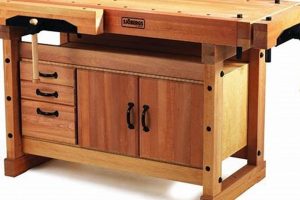
A staple in many workshops, a robust work surface designed primarily for woodworking distinguishes itself through specific construction features, often including a thick, solid wood top, integrated vises, and dog holes for securing workpieces. These benches prioritize stability and versatility, offering woodworkers a reliable platform for a variety of tasks like planing, sawing, and joinery. Variations exist, but the core functionality remains centered around providing a stable and adaptable workspace for precise woodworking.
The advantages of using such a bench stem from its inherent stability, which reduces vibrations and allows for more accurate cuts. Its design enables efficient clamping and workpiece manipulation, improving both speed and precision. Historically, this style reflects a long tradition of craftsmanship, where durable and well-designed tools enhance the quality of the finished product. The longevity and adaptability inherent in its construction make it a valuable investment for serious woodworkers.
The subsequent sections will delve into the specific components that contribute to its effectiveness, examining the roles of different vise types, dog hole configurations, and the optimal wood species for constructing a durable and functional woodworking surface. Further discussion will explore best practices for maintaining and customizing this essential workshop tool.
Tips for Optimizing a European Woodworking Bench
The effectiveness of a woodworking bench is directly correlated with its configuration and maintenance. Adhering to the following guidelines will maximize the functionality and lifespan of a bench designed in the European tradition.
Tip 1: Vise Maintenance: Routinely lubricate vise screws with a high-quality grease designed for metal threads. This reduces friction and ensures smooth, reliable clamping pressure. Neglecting lubrication leads to binding and eventual thread damage.
Tip 2: Dog Hole Alignment: Regularly check the alignment of dog holes on the benchtop and in the vises. Misaligned holes impede efficient workpiece clamping. Consider creating a custom alignment tool for accurate positioning.
Tip 3: Benchtop Flatness: Maintain a flat benchtop surface. Periodically check for cupping or warping using a straightedge and winding sticks. If necessary, flatten the surface using a hand plane or power planer.
Tip 4: Proper Workholding: Select workholding methods appropriate for the task. Avoid over-tightening vises, as this can damage the workpiece or the vise itself. Employ shims to distribute pressure evenly on irregularly shaped objects.
Tip 5: Surface Protection: Apply a durable finish to the benchtop to protect against spills and stains. A finish comprised of oil and wax offers reasonable protection while remaining easily repairable. Avoid film-forming finishes that can chip or crack.
Tip 6: Regularly Clean the Bench: Clean the benchtop regularly, removing sawdust and debris. Accumulated debris can interfere with workpiece placement and clamping. A stiff brush and vacuum cleaner are effective tools.
Tip 7: Consider a Tail Vise: If the bench lacks a tail vise, evaluate the benefits of adding one. A tail vise provides unparalleled versatility for clamping wide panels and long workpieces.
Adherence to these principles will ensure that a solid woodworking platform provides reliable and efficient service for years to come.
The subsequent section will explore specific project plans incorporating bench techniques.
1. Solid wood construction

Solid wood construction is a defining characteristic of the archetypal European woodworking bench, directly influencing its stability, durability, and suitability for demanding woodworking tasks. The choice of solid wood, as opposed to engineered materials, is deliberate, reflecting a commitment to longevity and performance.
- Vibration Dampening
Solid wood possesses inherent vibration-dampening properties. This reduces unwanted movement during tasks such as planing or chiseling, resulting in greater precision. A bench constructed from solid wood absorbs impact and minimizes the transfer of vibrations to the workpiece, improving the quality of the work.
- Weight and Stability
The density of solid wood provides substantial weight, crucial for workbench stability. A heavier bench resists movement, even under significant force. This stability is essential for tasks requiring controlled pressure, such as hand-cut joinery or shaping large pieces. A solid foundation translates to improved accuracy and reduced errors.
- Repairability and Longevity
Solid wood is inherently repairable. Dents, scratches, and even significant damage can often be addressed through techniques such as planing, sanding, and patching. This allows a solid wood bench to withstand decades of use and remain a functional tool, unlike benches constructed from composite materials that are more challenging to repair. The investment in a solid wood bench represents a long-term commitment to woodworking.
- Workholding Performance
Solid wood provides superior holding power for vises and dog holes. The dense grain structure resists deformation under clamping pressure, ensuring secure and reliable workholding. This is essential for tasks requiring precise alignment and controlled force, such as dovetailing or tenoning. Weak workholding compromises accuracy and efficiency.
The attributes of solid wood constructionvibration dampening, weight, repairability, and superior workholdingare inextricably linked to the functionality and enduring value of a European woodworking bench. The selection of appropriate wood species and joinery methods further enhance these inherent advantages, culminating in a robust and reliable tool for serious woodworking.
2. Integrated vise system

The presence of an integrated vise system is a defining characteristic of the European woodworking bench, distinguishing it from simpler work surfaces. This system comprises one or more vises strategically incorporated into the bench’s structure, enabling secure workpiece clamping and facilitating a wide range of woodworking operations.
- Face Vise Functionality
The face vise, typically located on the front of the bench, is designed to clamp workpieces vertically. It provides stable clamping force, essential for tasks such as planing edges or shaping smaller components. The design often incorporates a quick-release mechanism for efficient adjustment and repositioning. This vise often features a chop faced with wood, protecting the workpiece and providing even clamping pressure.
- Tail Vise Application
The tail vise, situated at the end of the bench, is designed to clamp workpieces horizontally along the length of the bench. It commonly works in conjunction with bench dogs, providing secure clamping for wide panels and long boards. The tail vise is particularly useful for edge-jointing boards or performing operations on large assemblies, facilitating precise alignment and preventing movement during machining.
- Leg Vise Features
The leg vise, mounted to one of the bench’s legs, offers high clamping force and substantial holding capacity. Its position allows for clamping thick or irregularly shaped workpieces that cannot be accommodated by traditional face or tail vises. The leg vise is frequently used for tasks such as chopping dovetails or working on large timber components. Its robust design ensures stability and resists racking under heavy loads.
- Vise Jaw Construction
The construction of vise jaws is critical for effective clamping. Jaws are typically made of hardwood and are often lined with leather or cork to prevent marring the workpiece. Parallelism of the jaws is essential for even clamping pressure and accurate results. Integrated dog holes within the vise jaws provide additional workholding options, allowing for complex clamping setups.
The strategic integration of these vise components within the structure enhances versatility. The integrated vise system allows for efficient and secure workholding, enabling precise and accurate woodworking. Absence of these would impair the bench’s overall functionality, reducing its suitability for advanced woodworking projects.
3. Dog hole configuration

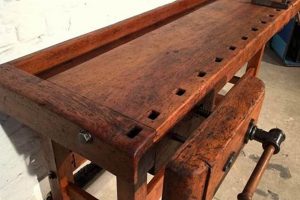
Dog hole configuration is a critical component defining the functionality of a European woodworking bench. The strategic placement and consistent sizing of these holes directly influence the bench’s ability to securely hold workpieces during various woodworking operations. Typically, these holes are drilled in a grid pattern across the benchtop and often integrated into the vise jaws. The precision of their placement is paramount; misaligned holes render clamping systems ineffective. The diameter must be standardized, allowing compatibility with commercially available or self-made bench dogs and clamping accessories. A well-executed configuration allows for versatile clamping setups, accommodating diverse workpiece shapes and sizes. For instance, edge-jointing long boards often necessitates a series of dog holes and bench dogs to maintain consistent pressure and prevent bowing.
Beyond simple clamping, the dog hole configuration facilitates specialized techniques. Consider using a series of precisely spaced dog holes in conjunction with a planing stop. This configuration provides a stable and repeatable method for planing boards to consistent thickness. Another example is the use of dog holes to create a temporary fence or jig. Woodworkers frequently utilize a series of holes and a length of wood to create a fence for guiding a router or saw, demonstrating adaptability in addressing unforeseen challenges. The systematic arrangement of dog holes expands the bench’s utility beyond basic clamping, promoting precise and repeatable results.
In summary, the effectiveness of a European woodworking bench is intimately linked to the design and execution of its dog hole configuration. This element, though seemingly simple, is central to workholding and directly impacts accuracy and efficiency. While often overlooked, attention to detail during the creation and maintenance of the dog hole system will yield substantial improvements in overall workflow. Incorrect placement or inconsistent sizing can negate many of the bench’s intended advantages, underscoring the importance of understanding and implementing a thoughtfully designed dog hole setup.
4. Benchtop thickness

Benchtop thickness is a critical factor in the construction of a European woodworking bench, significantly influencing its stability, vibration dampening capabilities, and overall suitability for demanding woodworking tasks. It’s not merely a matter of dimension, but rather a carefully considered design element that directly affects the bench’s performance.
- Vibration Dampening and Mass
Increased benchtop thickness directly correlates with increased mass. A thicker benchtop provides greater inertia, reducing vibrations caused by hand planing, chiseling, or sawing. This reduction in vibration leads to improved accuracy and cleaner cuts, crucial for fine woodworking. A benchtop of insufficient thickness transmits vibrations, compromising precision.
- Resistance to Warping and Deflection
A thicker benchtop is more resistant to warping and deflection under load. The substantial cross-section provides greater structural integrity, minimizing movement caused by uneven clamping pressure or heavy workpieces. This stability is essential for maintaining a flat and true work surface, ensuring consistent and accurate results over time. Thinner benchtops are more prone to deformation, negatively impacting precision.
- Workholding Capacity
Benchtop thickness directly impacts the effectiveness of workholding devices such as vises and bench dogs. A thicker benchtop provides more material for secure vise mounting, preventing racking or movement under heavy clamping pressure. Furthermore, thicker tops allow for deeper and more robust dog holes, enhancing their ability to withstand lateral forces. Inadequate thickness compromises the integrity of workholding systems.
- Longevity and Durability
A thicker benchtop offers a greater margin for error during its lifespan. The top surface can be planed flat multiple times over the years to correct wear and tear or minor imperfections, extending the bench’s useful life. A thinner benchtop, on the other hand, provides less material for resurfacing, ultimately limiting its longevity and resistance to damage. Therefore, thickness is an investment in the bench’s future usability.
The relationship between benchtop thickness and the characteristics of a European woodworking bench highlights a direct connection between design and performance. A sufficient thickness is essential for vibration dampening, resistance to warping, secure workholding, and long-term durability, all contributing to a stable and reliable woodworking platform. Failure to account for proper thickness compromises the bench’s overall functionality and undermines its value as a precision tool.
5. Workbench stability

Workbench stability is not merely a desirable attribute but a foundational requirement for any woodworking surface, particularly within the context of the European woodworking bench tradition. Stability directly influences precision, efficiency, and safety, shaping the overall woodworking experience. A stable platform minimizes unwanted movement, allowing for accurate cuts, controlled shaping, and secure assembly.
- Mass and Material Density
Stability in a woodworking bench is intrinsically linked to its mass and the density of materials used in its construction. European-style benches traditionally utilize hardwoods such as beech or maple, known for their high density and weight. This increased mass provides substantial resistance to movement during planing, sawing, and chiseling. A heavier bench absorbs vibrations and minimizes lateral displacement, improving the accuracy of hand tool operations. Conversely, a lighter bench is more susceptible to shifting and vibration, leading to imprecise results and increased user fatigue.
- Leg Design and Joinery
The design and joinery of the bench legs are critical for maintaining stability. Legs are typically splayed outwards slightly to increase the footprint and improve resistance to tipping. Mortise-and-tenon joints, often reinforced with wedges or drawbores, are employed to create strong and rigid connections between the legs and the benchtop. These joints resist racking forces and prevent the bench from wobbling during use. Poorly designed or executed leg joinery compromises the entire structure, regardless of the benchtop’s quality.
- Floor Contact and Leveling
Maintaining consistent contact with the floor is crucial for overall stability. Uneven flooring can introduce wobble and instability, negatively impacting precision. European woodworking benches often incorporate adjustable feet or shims to compensate for uneven surfaces, ensuring that all legs bear weight evenly. This adjustment is essential for creating a stable and level work surface, irrespective of the floor’s condition. Failure to address floor irregularities undermines the bench’s intended stability.
- Workholding Integration
The integration of workholding devices, such as vises and bench dogs, plays a significant role in overall stability. Properly mounted and aligned vises provide secure clamping pressure, preventing workpiece movement during machining. Bench dogs, strategically placed in dog holes across the benchtop, further enhance workholding capabilities, allowing for clamping of large panels and irregular shapes. An effective workholding system, integrated into a stable bench platform, enables efficient and accurate woodworking.
The interconnectedness of mass, leg design, floor contact, and workholding illustrates the holistic approach required to achieve optimal stability in a European woodworking bench. Each element contributes to a cohesive system, working in concert to provide a solid and reliable foundation for woodworking endeavors. Inadequate attention to any single facet compromises the entire structure, highlighting the importance of a well-designed and carefully constructed bench for achieving accurate and efficient results.
6. Wood species selection

Wood species selection is a critical determinant of the longevity, stability, and overall performance characteristics of a European woodworking bench. The properties inherent in various wood species directly influence the bench’s ability to withstand the stresses of heavy use, resist warping and movement, and provide a reliable platform for precise woodworking tasks. The selection process necessitates a careful consideration of factors such as hardness, density, stability, and workability, balancing these characteristics to achieve optimal functionality. For instance, beech and maple, commonly employed in European bench construction, are chosen for their exceptional hardness and density, providing resistance to denting and wear under repeated impact from mallets and tools. Conversely, softer species, while potentially easier to work, lack the required durability for a demanding workbench environment. The choice thus represents a strategic trade-off based on intended use and performance expectations.
The consideration of wood stability is paramount to mitigate warping and twisting, common issues that compromise the flatness of the benchtop and impact the accuracy of woodworking operations. Kiln-dried hardwoods, properly acclimated to the workshop environment, exhibit greater dimensional stability compared to green or improperly seasoned lumber. Species with tight grain patterns and low shrinkage rates are preferred to minimize movement resulting from changes in humidity. Real-world examples illustrate the consequences of neglecting stability considerations. A benchtop constructed from improperly dried softwood is prone to cupping or twisting, rendering it unsuitable for precision planing or joinery. The selection of a stable, properly dried hardwood, though potentially more costly initially, represents a long-term investment in the bench’s performance and reliability. The choice also influences the ease of maintenance and repair; harder species tolerate repeated flattening and resurfacing without significant material loss.
In conclusion, understanding the relationship between wood species selection and the performance of a European woodworking bench is of significant practical importance. The appropriate selection, based on factors such as hardness, stability, and workability, contributes directly to the bench’s durability, accuracy, and overall usefulness. Challenges associated with species selection include balancing cost considerations with performance requirements, as well as ensuring proper drying and acclimation prior to construction. In the broader context of woodworking, the bench serves as a foundation for craftsmanship, and its quality is fundamentally linked to the careful selection and preparation of its constituent materials.
7. Joinery techniques
Joinery techniques are intrinsically linked to the construction and long-term performance of a European woodworking bench. The methods employed to connect the various componentslegs, stretchers, benchtopdirectly influence the bench’s stability, rigidity, and overall durability. Sound joinery ensures that the bench can withstand the stresses of daily use and maintain its structural integrity over decades of service.
- Mortise and Tenon Joints
Mortise and tenon joints are fundamental in bench construction, particularly for connecting legs to the benchtop and stretchers to the legs. This joint provides exceptional strength and resistance to racking forces. A well-executed mortise and tenon joint, often reinforced with wedges or drawbores, creates a mechanical interlock that prevents movement and ensures long-term stability. A poorly fitted mortise and tenon joint, conversely, introduces weakness and instability into the structure.
- Dovetail Joints
Dovetail joints, while not always utilized in every section of the bench, are frequently employed to connect the front and side aprons, or to secure the vise chop to its sliding mechanism. This joints interlocking nature provides superior resistance to pulling forces, preventing separation of the components. A precisely cut dovetail joint demonstrates craftsmanship and contributes significantly to the bench’s overall rigidity. The absence of dovetails in critical areas can compromise the bench’s structural integrity over time.
- Lap Joints
Lap joints are commonly used to connect stretchers to legs, providing a wide glue surface and distributing stress evenly. While not as strong as mortise and tenon joints, lap joints offer a balance of strength and ease of construction, making them suitable for secondary structural elements. A properly executed lap joint, reinforced with screws or bolts, provides sufficient support and prevents racking. An inadequately sized or poorly glued lap joint is prone to failure under stress.
- Bridle Joints
Bridle joints offer a robust connection between legs and stretchers, sometimes used as an alternative to mortise and tenon. The bridle joint encases the tenon, providing increased surface area for gluing and enhanced resistance to twisting. This method is particularly effective for situations requiring high strength and stability, contributing to the bench’s overall rigidity and preventing movement between components under heavy use.
The integration of these joinery techniques is not merely a matter of aesthetics but a crucial determinant of the European woodworking bench’s performance and longevity. The selection and execution of these methods, based on a thorough understanding of structural principles, ensures that the bench remains a reliable and functional tool for generations.
Frequently Asked Questions
The following addresses common inquiries regarding the construction, maintenance, and optimal utilization of a European woodworking bench.
Question 1: What constitutes a ‘European’ woodworking bench, distinguishing it from other designs?
The defining characteristics include a robust solid wood construction, typically featuring a thick benchtop, an integrated vise system (often a face vise and tail vise), and strategically placed dog holes for versatile workholding.
Question 2: What is the minimum recommended benchtop thickness for a European woodworking bench?
A minimum thickness of 3 inches (7.62 cm) is recommended to provide adequate mass for vibration dampening, resistance to warping, and secure mounting of vises and other hardware.
Question 3: What wood species are most suitable for constructing a European woodworking bench?
Hardwoods such as European beech, hard maple, or ash are preferred due to their density, hardness, and stability. Softwoods are generally unsuitable due to their lack of durability and resistance to wear.
Question 4: How frequently should a European woodworking bench be flattened?
The frequency depends on usage and environmental conditions. Regular inspection for cupping, bowing, or twisting is recommended. Flattening should be performed as needed to maintain a true and level work surface.
Question 5: What is the purpose of dog holes, and how should they be configured?
Dog holes are strategically placed holes used in conjunction with bench dogs or clamping accessories to secure workpieces. They should be accurately drilled and consistently sized, typically spaced 4-6 inches (10-15 cm) apart in a grid pattern.
Question 6: How should vises on a European woodworking bench be maintained?
Vise screws should be regularly lubricated with a high-quality grease. Jaws should be checked for parallelism and adjusted as needed. Damaged vise components should be promptly repaired or replaced to maintain optimal clamping performance.
These inquiries emphasize key considerations for constructing and maintaining a functional tool. A thorough understanding of these principles is essential for ensuring the longevity and effectiveness of any woodworking surface constructed in the European tradition.
The following section will explore available plans and resources for building a European woodworking bench.
Conclusion
This exploration of the European woodworking bench has underscored its fundamental role in woodworking. The defining characteristics, including solid wood construction, integrated vises, and strategic dog hole placement, contribute to a stable and versatile work platform. Proper wood selection, robust joinery, and diligent maintenance are vital for maximizing the bench’s longevity and functionality.
The principles outlined within represent a synthesis of traditional craftsmanship and practical engineering. Attention to detail, from the thickness of the benchtop to the alignment of the dog holes, translates directly to improved accuracy and efficiency in woodworking endeavors. The investment in a properly constructed and maintained European woodworking bench is an investment in the quality of the craft itself.