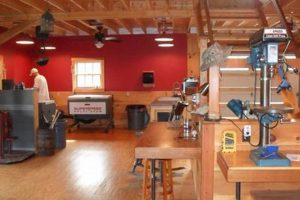
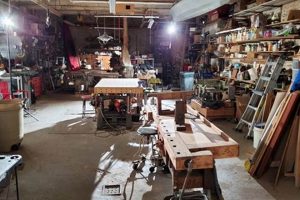
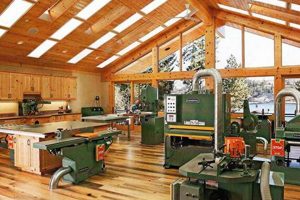
A compact, often home-based workshop designed for woodworking activities represents a scaled-down version of a traditional woodworking facility. It typically incorporates essential tools and equipment necessary for crafting wood projects within a limited physical space. For instance, a spare room or garage corner can be transformed into a dedicated area for sawing, sanding, and assembling wooden objects.
The significance of these scaled-down workshops lies in their accessibility and affordability. They democratize the craft, allowing individuals with limited resources or spatial constraints to engage in woodworking as a hobby or small business. Historically, these spaces have fostered creativity and innovation, providing a platform for artisans to develop unique skills and produce bespoke items. The efficient use of space and resources promotes sustainable practices and reduces the environmental impact associated with larger-scale operations.
The subsequent sections will delve into the essential tools required for a productive workspace, explore effective space-saving strategies, and discuss optimal organizational techniques for maximizing efficiency within a limited footprint.
Optimizing a Compact Woodworking Workspace
Effective utilization of space and resources is paramount in a compact woodworking environment. The following guidelines aim to maximize productivity and safety within constrained areas.
Tip 1: Implement Vertical Storage. Utilize wall-mounted shelves and pegboards to store tools and materials. This frees up valuable floor space and keeps frequently used items within easy reach.
Tip 2: Employ Multi-Functional Tools. Invest in tools designed for multiple operations, such as combination sanders or drill presses with routing capabilities. This reduces the need for a multitude of specialized equipment.
Tip 3: Prioritize Dust Collection. A small, efficient dust collection system is crucial for maintaining air quality and reducing cleanup time. Consider a portable unit or a shop vacuum with a HEPA filter.
Tip 4: Optimize Lighting. Adequate illumination is essential for precision work and safety. Supplement overhead lighting with adjustable task lights focused on the work surface.
Tip 5: Maximize Table Saw Utility. Employ a folding or mobile table saw stand to allow for easy storage when not in use. Consider incorporating auxiliary fences and jigs to enhance functionality.
Tip 6: Maintain a Clean Work Area. Regularly clear debris and sawdust to prevent clutter and potential hazards. A tidy workspace promotes efficiency and reduces the risk of accidents.
Tip 7: Utilize Mobile Tool Bases. Equip stationary tools with mobile bases to facilitate rearrangement and create flexible work zones. This allows for efficient adaptation to different project requirements.
Adhering to these recommendations promotes a safe, organized, and productive woodworking environment, even within limited spatial confines.
The subsequent section will address project selection criteria suitable for small workshop capacities, focusing on maximizing output while minimizing space requirements.
1. Space Optimization

Space optimization is a critical component in the effective operation of a compact woodworking workshop. Given the inherent limitations of a small area, the strategic organization and utilization of every available square foot directly impact workflow, safety, and overall productivity.
- Vertical Storage Solutions
Implementing vertical storage maximizes available space by utilizing wall-mounted shelving, pegboards, and cabinets. This allows for the organization of tools, materials, and supplies, keeping them off the floor and easily accessible. For example, a French cleat system can efficiently store a variety of tools on a wall, preventing clutter and improving visibility. The use of vertical storage is vital in a small workshop to maintain a clear and safe workspace.
- Multi-Functional Equipment
Investing in tools designed for multiple operations is essential for reducing the overall footprint of equipment within the workspace. Combination machines, such as a belt and disc sander or a lathe with milling capabilities, consolidate functionality, minimizing the need for individual specialized tools. A folding workbench that can be stored against a wall when not in use is a practical example. This consolidation reduces the number of stationary items, freeing up valuable space for projects.
- Mobile Workstations
Employing mobile bases for stationary tools enables the creation of flexible work zones. By placing tools like table saws or drill presses on wheels, they can be easily moved and reconfigured to suit the specific needs of a project. This mobility allows for efficient adaptation of the workspace layout as required, enhancing overall flexibility and utility. As an instance, a mobile cart with integrated power strip and tool storage makes work more efficient.
- Strategic Layout Planning
A well-planned layout is crucial for optimizing workflow and minimizing wasted space. Consider the natural flow of work and arrange tools and equipment accordingly. Minimize unnecessary movement and ensure adequate clearance around machinery. The strategic arrangement can prevent congestion and improve efficiency. For example, placing frequently used tools within easy reach and positioning workbenches to maximize access to natural light are key elements of a well-designed shop layout.
The implementation of these space optimization strategies is paramount to the successful operation of a restricted woodworking area. It not only enhances functionality but also promotes safety and efficiency, allowing woodworkers to maximize their potential within a limited physical environment.
2. Tool Selection

Tool selection represents a cornerstone of effective operation within a compact woodworking environment. The constrained spatial dimensions dictate a strategic approach to acquiring and utilizing equipment. Ill-considered tool choices can directly impede productivity and compromise safety. For instance, opting for a large, industrial-grade jointer in a small shop would consume excessive space and limit maneuverability, thus impairing the ability to undertake diverse projects. Conversely, prioritizing compact, multi-functional tools, such as a combination belt and disc sander, optimizes space utilization and expands operational capacity. Therefore, informed tool selection is not merely a matter of preference, but a fundamental determinant of a workspace’s functionality and viability.
Practical implications of astute tool selection are manifold. Efficient dust collection systems, scaled down to suit the volume of the shop, are imperative for maintaining air quality and preventing health hazards. Similarly, portable power tools, like cordless drills and routers, offer increased flexibility and eliminate the constraints of cords, facilitating movement within the limited area. Hand tools also occupy a crucial role, particularly for tasks requiring precision and control in tight spaces. A well-curated selection of hand saws, chisels, and planes can complement power tools and provide alternatives for noise-sensitive environments. Therefore, the interplay of diverse tool types, each carefully chosen for its spatial efficiency and operational effectiveness, defines a well-equipped workshop.
In summary, tool selection in a confined woodworking space demands a discerning approach that prioritizes space optimization, versatility, and safety. Challenges associated with inadequate space can be effectively mitigated through careful consideration of tool size, functionality, and portability. The resulting efficiency and enhanced productivity directly contribute to the success and sustainability of the woodworking endeavor. This connection underscores the importance of meticulous planning and judicious investment in equipment, ensuring the workshop remains a productive and safe environment, regardless of its physical dimensions.
3. Dust Management

In a compact woodworking workshop, effective dust management is not merely a matter of cleanliness; it is a critical determinant of health, safety, and the longevity of equipment. The confined space intensifies the concentration of airborne particulate matter generated by sawing, sanding, and routing operations. Inadequate dust control elevates the risk of respiratory ailments, such as asthma and bronchitis, for individuals working within the area. Furthermore, accumulated dust poses a fire hazard and can interfere with the optimal performance of precision machinery, potentially leading to premature failure. For instance, fine dust can clog the internal components of power tools, reducing their efficiency and lifespan. The implementation of robust dust management strategies is, therefore, an indispensable component of a functional and safe woodworking workspace.
Practical applications of effective dust management in such a setting necessitate a multi-faceted approach. A central element is the use of a dedicated dust collection system, appropriately sized for the volume of the workshop. Portable dust collectors or shop vacuums equipped with HEPA filters can effectively capture dust at the source, minimizing its dispersion into the surrounding air. Regular cleaning routines, including vacuuming and wiping down surfaces, are also essential for preventing the accumulation of dust. Additionally, the implementation of localized exhaust ventilation, such as downdraft tables or hoods positioned near dust-generating tools, provides targeted dust extraction. Real-world examples demonstrate that consistently implementing these measures significantly reduces airborne particulate matter, creating a healthier and more efficient work environment.
In summation, the connection between dust management and a diminutive woodworking operation is inextricably linked to health, safety, and operational sustainability. The challenges posed by limited space necessitate a proactive and comprehensive approach to dust control. Ignoring this crucial aspect can lead to detrimental consequences, while prioritizing effective dust management fosters a safer, healthier, and more productive environment. The adoption of appropriate dust collection systems, regular cleaning practices, and localized exhaust ventilation is not merely advisable but essential for the long-term viability and well-being of the woodworking endeavor.
4. Safety Protocol

The correlation between adherence to established safety protocol and the viability of a compact woodworking shop is direct and consequential. Confined workspaces amplify the potential hazards inherent in woodworking activities. Reduced maneuverability increases the likelihood of accidental contact with tools or materials. Proximity to electrical sources and the concentration of airborne particulates escalate the risk of fire and respiratory complications, respectively. Consequently, strict enforcement of safety protocol is not discretionary but rather integral to minimizing risk and ensuring operational continuity.
Practical application necessitates a multi-tiered approach. Mandatory utilization of personal protective equipment (PPE), including eye protection, hearing protection, and respiratory masks, mitigates exposure to common hazards. Maintaining clear, unobstructed pathways minimizes tripping hazards and allows for rapid egress in emergency situations. Implementing lockout/tagout procedures during equipment maintenance prevents accidental start-up. Consistent adherence to these protocols serves as a preventative measure against injuries and equipment damage. For instance, a woodworking shop without a dust collection system risks accumulation of sawdust, a fire hazard, compounded by the difficulty of navigating a small space quickly in case of an emergency. Similarly, working without eye protection increases the risk of eye injury from projectiles, especially crucial in tight quarters where tools and materials are in close proximity.
Effective safety protocol within a small woodworking environment hinges on proactive risk assessment, rigorous training, and unwavering commitment to established procedures. Challenges associated with spatial constraints and limited resources can be addressed through diligent planning and consistent reinforcement of safe work habits. Ultimately, the successful integration of safety protocol translates to a reduced incidence of accidents, improved operational efficiency, and a more sustainable and productive woodworking enterprise.
5. Project Scope

The operational capacity of a diminutive woodworking shop is intrinsically linked to the scope of projects undertaken within its confines. Physical space limitations directly constrain the size and complexity of items that can be fabricated, assembled, or stored. Attempting to execute projects exceeding the shop’s capacity can lead to decreased efficiency, increased safety risks, and potentially, the abandonment of unfinished work. For example, constructing large pieces of furniture, such as dining tables or wardrobes, within a limited area necessitates extensive material handling, restricted maneuverability, and storage challenges, ultimately impeding the workflow.
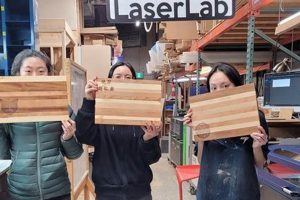
Conversely, aligning project scope with spatial constraints maximizes productivity and minimizes potential hazards. Focusing on smaller, more manageable items, such as cutting boards, small wooden boxes, or intricate carvings, allows for efficient utilization of available workspace. This approach promotes better organization, reduces clutter, and enhances safety by minimizing the risk of accidents related to material handling or obstructed pathways. Moreover, smaller projects often require fewer specialized tools and materials, thereby reducing the overall investment and storage requirements associated with the woodworking endeavor. As a case study, one might compare the output of a craftsman producing ornate jewelry boxes versus another attempting to build custom cabinetry, in a similarly sized space. The former would likely exhibit greater production volume and lower material waste.
In conclusion, the project scope stands as a critical determinant of success within a compact woodworking environment. Prudent project selection, carefully tailored to the spatial limitations and available resources, enhances efficiency, promotes safety, and maximizes the overall viability of the woodworking operation. Embracing a focus on smaller, more manageable projects is not a limitation but an opportunity to refine skills, optimize workflow, and achieve consistent output within the unique constraints of a small-scale workshop.
Frequently Asked Questions
The following questions address common inquiries and misconceptions regarding the establishment and operation of a woodworking space in limited physical areas.
Question 1: What is the minimum acceptable space for a functional woodworking area?
The minimum acceptable space varies based on the intended project scope and equipment inventory. However, a dedicated area of at least 8 feet by 10 feet is generally recommended to accommodate essential tools and provide sufficient maneuverability.
Question 2: Are specialized dust collection systems mandatory, or can simpler alternatives suffice?
While simpler alternatives, such as shop vacuums with HEPA filters, can offer some dust control, specialized dust collection systems are strongly recommended for maintaining air quality and minimizing health risks associated with prolonged exposure to wood dust.
Question 3: What power tool features are most crucial in a limited space?
Versatility, compact size, and integrated dust collection capabilities are paramount. Multi-functional tools that perform multiple operations, along with designs prioritizing minimal footprint, are preferable.
Question 4: How essential is adherence to strict noise reduction measures?
Noise reduction measures are highly important, especially in residential settings or shared workspaces. Operating woodworking equipment generates significant noise pollution, necessitating the use of soundproofing materials and strategies to mitigate disturbances to neighbors or other occupants.
Question 5: What type of wood materials are suitable for utilization?
Wood variety has no impact on this kind of workplace but be mindful of project scope.
Question 6: How important is local building codes or permit requirements?
Compliance with local building codes and permit requirements is mandatory for ensuring the structural integrity and safety of the woodworking space. Failure to adhere to these regulations can result in fines, legal penalties, or the forced closure of the operation.
Effective space management, judicious tool selection, and unwavering compliance with safety protocol are integral to the successful operation of a compact woodworking area.
The subsequent section will detail specific tools recommendations tailored for confined woodworking spaces, emphasizing versatility and space efficiency.
In Summary
This exploration has detailed the crucial aspects of establishing and maintaining a functional tiny woodworking shop. Effective space optimization, strategic tool selection, diligent dust management, unwavering safety protocol adherence, and carefully considered project scope are identified as essential components. The synergy of these elements defines the viability and productivity of small-scale woodworking endeavors.
The “tiny woodworking shop” represents more than just a scaled-down workspace. It exemplifies focused craftsmanship, resourcefulness, and a commitment to efficient practice. Its success hinges on meticulous planning and diligent execution, demonstrating that significant creative output is achievable even within limited confines. The future of woodworking may well see increasing innovation within these compact spaces, driven by resource constraints and a desire for localized, sustainable production.