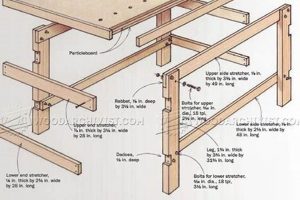
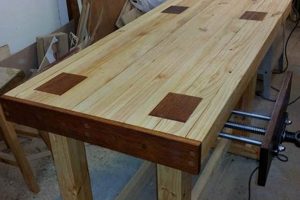
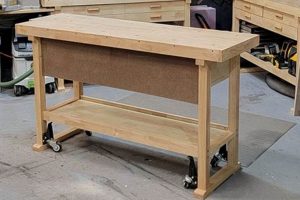
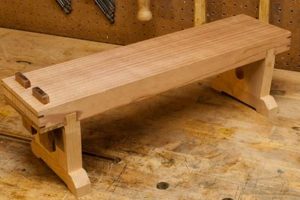
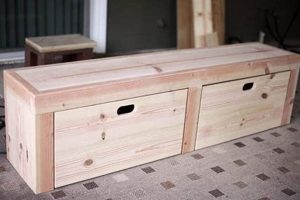
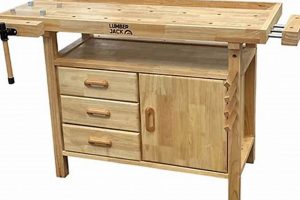
A foundational piece of equipment for various woodworking activities, this stable platform provides a dedicated surface for tasks such as sawing, planing, chiseling, and assembly. Constructed typically from solid wood, it features a flat, robust top, often incorporating vises, dog holes, and other work-holding mechanisms to secure materials during the construction process. An example would be a simple workbench constructed with a thick pine top and sturdy legs, equipped with a face vise and bench dogs for holding workpieces.
This essential element contributes significantly to efficiency and precision in woodworking. Its stable and dedicated work area enhances safety by minimizing material movement during shaping and joining. Historically, such platforms have been integral to woodworking trades, evolving in design to meet the changing needs of craftspeople and industries. The presence of a reliable surface allows for focused application of skills, leading to improved quality and accuracy in the final product.
The following sections will delve into specific aspects of this crucial workshop component, including its design considerations, construction techniques, maintenance procedures, and selection criteria for different woodworking needs. Furthermore, alternatives and modifications will be explored to address various space constraints and project requirements.
Essential Tips for a Functional Woodworking Platform
Optimizing this primary workspace enhances safety, efficiency, and precision in woodworking projects. The following tips address key aspects of its setup and usage.
Tip 1: Prioritize Stability. A stable work surface is paramount. Bolting the platform to the floor or adding substantial weight significantly reduces movement during rigorous tasks like planing and hammering. For example, consider incorporating a cabinet base with drawers filled with heavy tools to add mass.
Tip 2: Optimize Vise Placement. The positioning and type of vises are crucial. A face vise should be aligned flush with the workbench edge for efficient clamping. A tail vise, if incorporated, allows for longitudinal clamping of long pieces using bench dogs. Consider adding a quick release mechanism to the vise for faster workflow.
Tip 3: Incorporate Dog Holes Strategically. Regularly spaced dog holes along the workbench top, aligned with the vises, enable secure clamping of various workpiece sizes and shapes. Ensure dog holes are precisely drilled to maintain consistent holding power. For instance, a 3/4-inch diameter dog hole is a common standard.
Tip 4: Maintain a Flat and Smooth Surface. A flat and smooth surface is essential for accurate referencing and reliable work. Periodically flatten the workbench top using hand planes or a router sled. Regularly apply a protective finish, such as oil or wax, to prevent moisture absorption and surface damage. For example, a single layer of boiled linseed oil followed by wax.
Tip 5: Optimize Tool Storage and Accessibility. Keep frequently used tools within easy reach to minimize interruptions. Consider installing tool racks or drawers underneath the platform. A well-organized workspace promotes efficiency and safety. Having commonly used tools like chisels and marking gauges within arms reach saves significant time.
Tip 6: Ensure Adequate Lighting. Proper illumination is critical for accurate work. Install adjustable task lighting above the platform to provide focused light on the workpiece. Sufficient lighting reduces eye strain and enhances visibility of fine details. Articulating LED lamps are a great example.
Tip 7: Regularly Inspect and Maintain Hardware. Check screws, bolts, and vises for tightness and proper functioning. Lubricate moving parts to ensure smooth operation. Replace damaged or worn components promptly to maintain safety and performance. Tightening screws and lubricating the vise threads every few months is ideal.
Implementing these recommendations contributes to a more productive and safer woodworking experience, ultimately enhancing the quality of finished projects. A well-maintained workspace fosters efficiency and precision.
The following section will examine the alternatives and modifications available for different needs and shop sizes.
1. Stability

The stability of a woodworking platform is paramount for safe and accurate execution of woodworking tasks. It directly influences the precision achievable during operations such as planing, sawing, and joinery. A lack of stability compromises control, increases the risk of accidents, and diminishes the overall quality of the finished product.
- Mass and Rigidity
A substantial weight and rigid construction are fundamental to stability. High mass resists movement caused by the forces applied during woodworking processes. Rigidity prevents unwanted flexing or vibration, maintaining a consistent working surface. A lightweight or flexible structure will tend to shift and vibrate, reducing precision. An example is a workbench constructed with a thick hardwood top and substantial legs, as opposed to a workbench made with thin, lightweight materials.
- Footprint and Support Structure
The footprint of the structure, or the area of its base, contributes to stability by distributing weight over a larger surface area. A wider base provides greater resistance to tipping. Similarly, the design of the support structure, including the arrangement and bracing of the legs, influences overall rigidity. A wider footprint and well-braced legs greatly enhance stability. A narrow or poorly supported setup will be prone to wobbling or tipping.
- Floor Surface Interaction
The interaction between the platform’s feet and the floor surface affects stability. Uneven or compliant flooring can introduce instability, even in a well-constructed workbench. Measures such as leveling feet or shims can compensate for unevenness. Conversely, a rough or textured floor might enhance friction, increasing resistance to sliding. Without firm ground contact, a workbench can rock or shift, negatively impacting accuracy.
- Joinery and Construction Techniques
The quality of joinery used to assemble the parts significantly impacts the overall structural integrity and resistance to racking. Strong and precisely fitted joints, such as mortise-and-tenon or dovetail joints, enhance stability by preventing movement between components. Weak or poorly executed joinery will lead to instability and potential failure under stress. Well-fitted and glued mortise-and-tenon joints, for instance, contribute greatly to the bench’s overall strength and stability.
The stability is directly connected to overall work quality. When a platform provides a solid foundation, it allows the woodworker to confidently exert force and focus on accuracy. Compromised stability inhibits efficient work, leads to mistakes, and presents potential safety hazards. Therefore, the principles of stability must be addressed in the design and construction of any structure intended for serious woodworking.
2. Workholding

Securely clamping and immobilizing workpieces on a fundamental woodworking platform constitutes a critical aspect of precise and efficient woodworking. Effective workholding techniques are essential for ensuring accuracy and safety during a variety of operations, including sawing, planing, chiseling, and assembly. The workholding system dictates the type and complexity of projects that can be undertaken.
- Vises
Vises are a primary component of most workholding systems. Face vises, typically mounted flush with the benchtop’s front edge, provide clamping force for various tasks. Tail vises, often used in conjunction with bench dogs, enable longitudinal clamping of long stock. The type, size, and placement of vises directly influence the range and efficiency of workholding capabilities. A vise with quick-release mechanisms accelerates workflow by facilitating rapid adjustments.
- Bench Dogs
Bench dogs, typically cylindrical or rectangular pegs, fit into precisely drilled holes in the benchtop. These dogs, often paired with a tail vise or other clamping devices, create a secure clamping system for a variety of workpiece shapes and sizes. The spacing and accuracy of dog holes are critical for maximizing workholding versatility. Misaligned or poorly spaced dog holes compromise the functionality of the workholding system.
- Clamping Accessories
Various clamping accessories, such as holdfasts, cam clamps, and specialized jigs, expand the workholding capabilities. Holdfasts provide a quick and secure method for clamping workpieces to the benchtop using friction. Cam clamps offer adjustable clamping pressure for a variety of applications. Custom-made jigs can be designed for specific tasks, enhancing accuracy and repeatability. Proper utilization of clamping accessories streamlines workflow and improves precision.
- Surface Friction
Surface friction between the workpiece and the workbench top contributes to stability during certain operations. Non-slip mats or strategically placed sandpaper can increase friction, preventing unwanted movement. A smooth, polished surface, while aesthetically pleasing, may reduce friction and compromise workholding effectiveness. Careful consideration of surface properties is necessary for optimizing workholding performance.
The integration of vises, bench dogs, clamping accessories, and surface friction dictates the overall effectiveness of a woodworking platform’s workholding capabilities. The ability to securely immobilize workpieces enhances safety, promotes accuracy, and expands the range of projects that can be successfully undertaken.
3. Surface Flatness

The degree of planarity exhibited by the surface of a fundamental woodworking platform directly influences the accuracy and efficiency of numerous woodworking operations. A surface deviating from true flatness introduces inaccuracies that can propagate throughout a project, compromising the final result.
- Reference Plane for Hand Tool Operations
A flat surface serves as a critical reference plane for hand tool operations, particularly planing and joinery. When planing a workpiece, the benchtop provides a stable and consistent surface against which the plane sole can register, ensuring consistent material removal and the creation of flat, square surfaces. Similarly, a flat benchtop is essential for accurately laying out and executing joinery, such as dovetails or mortise-and-tenon joints. Discrepancies in surface flatness introduce errors that can compromise the fit and strength of these joints. For instance, if the benchtop has a hollow, planing a board will result in edges that are higher than the center, making it difficult to achieve a truly flat surface.
- Assembly and Glue-Up Platform
During assembly and glue-up, a flat surface ensures that components are joined in a geometrically accurate manner. An uneven surface can introduce stresses and distortions into the assembly, leading to structural weakness or aesthetic imperfections. Clamping pressure applied to an uneven surface may exacerbate these distortions, resulting in a compromised final product. Imagine gluing up a tabletop on a workbench with a twist; the resulting tabletop will likely inherit that twist, making it unusable.
- Calibration and Setup of Machines
A flat surface is necessary for the accurate calibration and setup of woodworking machinery, such as saws and routers. When setting the fence on a table saw, for example, the benchtop can serve as a reference surface to ensure that the fence is parallel to the blade. Similarly, a flat surface is essential for setting the base of a router to ensure consistent cutting depth. Using an unflat surface for calibration will transfer inaccuracies into the machine setup, leading to inaccurate cuts. If a miter saw is calibrated on an uneven surface, the resulting cuts will not be square.
- Dimensional Accuracy and Measurement
Precise measurement and layout rely on a stable and consistent reference surface. When measuring or marking dimensions, an uneven benchtop can introduce parallax errors or cause the workpiece to rock, leading to inaccuracies. A flat surface provides a reliable foundation for accurate dimensional control. If a board is measured and marked on an unflat bench, the markings may not be consistent or accurate, leading to errors during cutting or shaping.
Maintaining surface flatness on a woodworking structure is an ongoing process that requires periodic inspection and correction. Regular flattening with hand planes or specialized power tools, as well as preventative measures to minimize warping or distortion, are essential for ensuring long-term accuracy and efficiency in woodworking operations. The investment in maintaining a flat surface directly translates to improved quality and precision in finished projects. The bench becomes the primary source of truth.
4. Material Durability

The lifespan and performance of a fundamental woodworking platform are intrinsically linked to the durability of its constituent materials. Material selection dictates the workbench’s ability to withstand the rigors of daily use, resist wear and tear, and maintain structural integrity over an extended period.
- Resistance to Impact and Abrasion
The workbench surface is subjected to repeated impact from hand tools, dropped workpieces, and the force of hammering or chiseling. A durable material, such as hardwood like maple or beech, exhibits a high resistance to denting, scratching, and abrasion. Softer materials, such as pine or fir, are more susceptible to damage and wear, potentially compromising the surface’s flatness and usability over time. The surface of a softwood bench will degrade quicker with heavy pounding compared to the denser hardwood.
- Dimensional Stability and Resistance to Moisture
Fluctuations in humidity can induce expansion and contraction in wood, potentially leading to warping, cracking, or joint failure. Durable materials, particularly those that have been properly seasoned and treated, exhibit greater dimensional stability and resistance to moisture absorption. Unstable materials are more prone to movement, affecting the flatness of the surface and the integrity of the structure. A workbench constructed from kiln-dried hardwood is less likely to warp compared to one built from green lumber.
- Structural Strength and Load-Bearing Capacity
The workbench must be capable of supporting the weight of tools, workpieces, and the applied forces during woodworking operations. Durable materials possess high tensile and compressive strength, enabling them to withstand significant loads without deformation or failure. Undersized or structurally weak materials can compromise the workbench’s stability and safety. A bench constructed of laminated lumber offers more load-bearing capacity than one built with solid stock that has significant knots.
- Resistance to Biological Degradation
Wood is susceptible to attack by insects, fungi, and other organisms, which can weaken its structural integrity and shorten its lifespan. Durable materials, particularly those that have been treated with preservatives or are naturally resistant to decay, offer greater protection against biological degradation. Untreated materials are more vulnerable to infestation and rot, leading to premature failure. A workbench constructed from rot-resistant cedar or treated lumber is more resistant to decay compared to one built from untreated pine.
The selection of appropriate materials is a critical factor in determining the longevity, stability, and overall performance of a fundamental woodworking platform. Prioritizing durability ensures that the workbench remains a reliable and functional tool for years to come, providing a stable foundation for a variety of woodworking tasks. Selecting materials that can withstand high-wear applications is key.
5. Ergonomic height

The ergonomic height of a fundamental woodworking platform is not merely a matter of comfort; it directly influences posture, reduces physical strain, and enhances overall efficiency during woodworking activities. Proper ergonomic design minimizes the risk of musculoskeletal disorders and maximizes productivity.
- Reduction of Back Strain
A workbench that is too low forces the user to bend excessively at the waist, placing undue stress on the lower back. Conversely, a workbench that is too high necessitates raised shoulders and extended arms, leading to upper back and neck strain. The optimal ergonomic height allows the user to maintain a neutral spine position, minimizing back strain. A workbench height that is approximately at wrist level when standing upright promotes a comfortable and sustainable working posture. This is particularly important with prolonged use of hand tools.
- Optimization of Arm and Shoulder Positioning
Proper ergonomic height facilitates optimal arm and shoulder positioning during various woodworking tasks, such as planing, sawing, and chiseling. When the workbench is at the correct height, the user can apply force efficiently without overextending or contorting their limbs. This reduces fatigue and the risk of repetitive strain injuries. If the workbench forces arms upwards, fatigue sets in quicker.
- Enhanced Control and Precision
Maintaining a comfortable and stable posture promotes better control and precision during woodworking operations. When the body is properly aligned and supported, the user can focus on the task at hand without being distracted by discomfort or pain. This leads to improved accuracy and reduced errors. Trying to saw a straight line at an improperly positioned bench can be difficult.
- Adaptability to Different Tasks
Ideally, a workbench should be adaptable to accommodate a range of woodworking tasks and user preferences. Features such as adjustable legs or the incorporation of risers allow the user to customize the height of the workbench to suit specific needs. This ensures that the workbench remains ergonomically sound regardless of the task being performed. A bench with adjustable height allows a user to work at different thicknesses of materials.
The ergonomic height of a fundamental woodworking platform is a critical design consideration that directly impacts user health, comfort, and productivity. Investing in a workbench with proper ergonomic features is a worthwhile investment that can pay dividends in terms of reduced strain, improved accuracy, and enhanced enjoyment of the woodworking process. The impact over long periods of use is significant.
6. Tool accessibility
Tool accessibility, in the context of a fundamental woodworking platform, constitutes a critical factor influencing efficiency and workflow. The organization and readily available placement of essential implements directly impacts the speed and ease with which tasks can be completed. A well-designed platform prioritizes proximity and organization, reducing the time spent searching for or retrieving tools. This translates to increased productivity and a more seamless working process. Consider, for instance, a workbench equipped with integrated tool storage, such as drawers or racks, positioning frequently used items like chisels, saws, and measuring tools within easy reach. Conversely, a platform lacking dedicated storage forces a woodworker to constantly interrupt their workflow to locate necessary equipment, resulting in wasted time and diminished concentration.
Effective tool accessibility extends beyond mere proximity; it also encompasses organization and ease of retrieval. A cluttered or disorganized workbench, even with tools nearby, can impede workflow and increase the risk of accidents. Implementing strategies such as shadow boards, labeled drawers, or standardized storage systems ensures that tools are not only readily accessible but also easily identifiable and retrievable. As an example, a shadow board provides a visual outline for each tool, facilitating quick identification and ensuring that tools are returned to their designated locations after use. Furthermore, a well-lit work area contributes to tool accessibility by enhancing visibility and reducing the likelihood of misplacing or overlooking items.
In summary, tool accessibility is an integral component of a functional woodworking platform. It impacts not only efficiency and productivity but also safety and organization. Prioritizing thoughtful tool storage and retrieval systems is crucial for optimizing the woodworking experience and ensuring a smooth, productive workflow. Neglecting tool accessibility can lead to frustration, wasted time, and an increased risk of accidents, highlighting the practical significance of incorporating this element into the design and setup of any fundamental woodworking structure.
7. Overall dimensions

The overall dimensions of a fundamental woodworking platform represent a critical design parameter that significantly influences its functionality, suitability for various tasks, and integration within a specific workspace. Appropriately sized and proportioned platforms optimize user ergonomics, facilitate efficient workflow, and accommodate diverse project requirements. Incorrect dimensions, conversely, can lead to compromised comfort, reduced efficiency, and limitations in project scope.
- Workbench Length and Project Size
The length of the workbench directly dictates the maximum size of workpieces that can be comfortably accommodated. A longer workbench facilitates the manipulation of larger boards and panels, while a shorter workbench may limit the scope of potential projects. For instance, a workbench intended for furniture making would require a substantially greater length compared to a workbench designed for smaller craft projects. Consider that a six-foot-long workbench easily accommodates a standard door slab.
- Workbench Width and Accessibility
The width of the workbench impacts the accessibility of the working surface and the ease with which tools and materials can be arranged. A wider workbench provides ample space for multiple tasks and allows for convenient placement of tools within easy reach. However, excessive width can hinder access to the far edge of the bench. The ideal width balances accessibility with sufficient working space. A workbench that is two and a half feet wide allows the user to reach the center of the bench.
- Workbench Height and Ergonomics
The height of the workbench, as previously discussed in relation to ergonomics, must be carefully considered in conjunction with other dimensions. The ideal height promotes a comfortable and efficient working posture, minimizing strain and fatigue. A workbench that is too low requires excessive bending, while a workbench that is too high forces the user to raise their shoulders. The appropriate height is typically determined by the user’s height and the specific tasks being performed. Typically, height at the wrists when standing.
- Footprint and Shop Space Constraints
The overall footprint of the workbench must be compatible with the available space within the workshop. A workbench that is too large may impede movement and restrict access to other tools or equipment. Conversely, a workbench that is too small may not provide sufficient working surface. Careful consideration of the shop layout and available space is essential when determining the overall dimensions of the platform. A small shop would require a more compact bench.
In conclusion, the overall dimensions of a woodworking platform are not arbitrary but rather carefully considered parameters that influence its functionality, ergonomics, and compatibility with the intended workspace and projects. Optimizing these dimensions is crucial for creating a productive and enjoyable woodworking experience. The correct dimensions enhance usability.
Frequently Asked Questions
The following addresses common inquiries regarding foundational woodworking platforms, aiming to clarify misconceptions and provide informed guidance.
Question 1: What is the minimum size recommended for a basic woodworking bench?
The minimum recommended dimensions are approximately 48 inches in length, 24 inches in width, and a height appropriate for the user’s stature, generally around 34-36 inches. This provides adequate surface area for smaller projects while remaining manageable in limited spaces. Shorter lengths hinder usability.
Question 2: What type of wood is best suited for constructing a sturdy platform?
Hardwoods such as maple, beech, and oak are generally preferred due to their inherent strength, durability, and resistance to wear. Softwoods like pine can be used, but may require reinforcement and are more susceptible to damage over time. Hardwoods yield more robust surfaces.
Question 3: Is a vise essential for a basic platform, and if so, which type is recommended?
A vise is highly recommended as it significantly enhances workholding capabilities. A face vise mounted flush with the benchtop is a versatile option suitable for a wide range of tasks. Quick-release mechanisms improve efficiency. Absence of work-holding devices severely limits function.
Question 4: How critical is surface flatness for a fundamental woodworking structure?
Surface flatness is crucial for accurate hand tool operations and assembly. Deviations from flatness can compromise the precision of joinery and lead to structural inconsistencies. Regular maintenance to ensure planarity is necessary. Inaccurate surfaces reduce quality of work.
Question 5: What are the key considerations for ensuring platform stability?
Stability is paramount for safety and accuracy. Factors such as substantial weight, a wide footprint, robust joinery, and secure contact with the floor all contribute to a stable platform. Wobbling structures hinder precise movements. Bolting to the floor helps stability.
Question 6: How frequently should a woodworking platform be inspected and maintained?
Regular inspection, ideally monthly, should be conducted to identify loose joints, surface damage, or hardware issues. Periodic flattening of the surface, lubrication of moving parts, and tightening of fasteners are essential for maintaining optimal performance. Neglect causes wear and tear.
These FAQs provide a foundational understanding of key aspects related to basic woodworking platforms. Addressing these considerations ensures a safe, efficient, and productive woodworking experience.
The subsequent section will explore advanced modifications and specialized designs tailored to specific woodworking disciplines.
Basic Woodworking Bench
This exploration of the basic woodworking bench underscores its indispensable role in the craft. The stability, dimensions, material durability, and workholding capabilities significantly impact the precision, efficiency, and safety of woodworking operations. A well-constructed and maintained platform serves as a solid foundation, enabling the execution of diverse projects with confidence and accuracy.
Therefore, careful consideration of the design principles and practical tips outlined herein is crucial for both novice and experienced woodworkers. Investing in a quality workbench and diligently maintaining its functionality is an investment in the craft itself, fostering a more rewarding and productive pursuit of woodworking excellence. The workbench remains a cornerstone of the trade.