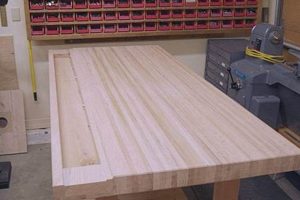
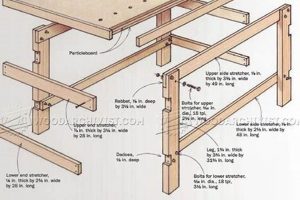
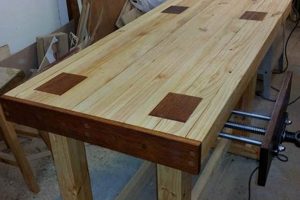
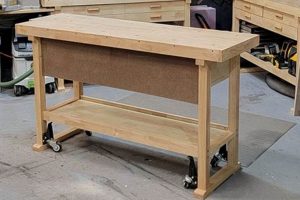
This particular style of workbench, named after the 18th-century French cabinetmaker Andr Jacob Roubo, is characterized by its robust construction and simple design. Typically featuring a thick, solid top and sturdy legs, it prioritizes stability and workholding capabilities. A distinguishing characteristic is the absence of a traditional tool well, offering instead a continuous, uninterrupted work surface. The leg vise and tail vise are integral components, facilitating secure clamping for a wide range of woodworking tasks.
Its inherent stability provides a solid platform, minimizing vibration and enhancing precision during demanding operations. The expansive, flat surface proves invaluable for large-scale projects, assembly work, and detailed carving. Historically, this design represents a shift towards workbenches optimized for joinery and fine craftsmanship. Its enduring popularity among woodworkers testifies to its functional effectiveness and adaptability to various working styles.
The following sections will delve into specific aspects of construction, including material selection, vise installation techniques, and strategies for optimizing its configuration for different woodworking applications. Further exploration will cover modifications and adaptations suitable for the modern workshop environment.
Tips for Optimizing a Roubo Workbench
The following recommendations outline strategies for maximizing the utility and performance of the aforementioned workbench design. Implementing these suggestions will enhance its functionality and adapt it to specific woodworking needs.
Tip 1: Material Selection: Prioritize dense, hardwood species such as maple, beech, or birch for the benchtop. These species offer superior stability, wear resistance, and screw holding power, crucial for reliable clamping and long-term durability. Avoid softwoods, which are prone to denting and may not provide sufficient support.
Tip 2: Benchtop Thickness: Aim for a minimum benchtop thickness of 4 inches. This substantial mass contributes significantly to the bench’s stability, reducing vibration and flexing during vigorous tasks like hand planing or chopping. Thicker tops are generally preferable for heavy use.
Tip 3: Leg Vise Placement: Position the leg vise close to the front of the bench, ensuring minimal overhang. This minimizes racking and provides maximum clamping force directly where it is needed. Consider the dominant hand when determining the optimal side for vise placement.
Tip 4: Tail Vise Design: Opt for a robust tail vise mechanism with a substantial acme screw. The tail vise should be capable of generating significant clamping pressure across the width of the benchtop. Consider integrating adjustable dogs or bench pups to accommodate workpieces of varying sizes and shapes.
Tip 5: Incorporate Holdfast Holes: Drill strategically placed holdfast holes across the benchtop. Holdfasts offer a versatile and efficient means of securing workpieces, particularly for irregular shapes or situations where traditional clamping is impractical. Experiment with different holdfast designs to find the most suitable options.
Tip 6: Surface Treatment: Apply a durable finish to the benchtop to protect it from moisture, stains, and abrasion. A simple oil finish or a combination of oil and wax provides adequate protection while maintaining a tactile, non-slip surface. Avoid polyurethane finishes, which can become brittle and prone to chipping.
Tip 7: Bench Height Optimization: Adjust the bench height to suit individual ergonomics and typical working postures. A height that allows for comfortable hand planing with slightly bent elbows is generally recommended. Consider adding shims or adjustable feet to fine-tune the height.
Proper implementation of these recommendations will significantly enhance the performance and longevity of this workbench. The resulting improved stability and workholding capabilities will contribute to increased accuracy and efficiency in woodworking tasks.
The next section will explore advanced techniques for utilizing this type of workbench, including specialized joinery methods and project-specific modifications.
1. Massive Top

The characteristic massive top is fundamental to the functionality of this particular workbench design. Its robust construction provides the stability and rigidity necessary for precise woodworking operations.
- Vibration Dampening
The substantial mass of the thick benchtop effectively dampens vibrations generated by hand tools, such as planes and chisels. This reduces chatter and improves the accuracy and quality of cuts. A lighter benchtop would be more susceptible to movement, compromising precision.
- Workholding Stability
The weight of the benchtop contributes significantly to its overall stability, preventing movement or shifting during vigorous work. This is especially crucial when using vises or holdfasts to secure large or heavy workpieces. A stable bench is essential for maintaining consistent clamping pressure and preventing workpiece slippage.
- Dimensional Stability
A thick, well-seasoned benchtop is less prone to warping or twisting over time. This dimensional stability ensures that the work surface remains flat and true, providing a reliable reference plane for woodworking operations. Regular maintenance and proper storage contribute to maintaining this stability.
- Impact Resistance
The massive top can withstand significant impact from mallet blows or dropped tools without sustaining damage. This durability ensures that the bench remains functional and aesthetically pleasing for years. Selecting hardwoods with high density and resistance to wear further enhances impact resistance.
These attributes of a massive top are integral to the design, enabling woodworkers to perform demanding tasks with greater accuracy and efficiency. Without it, the stability and functionality of this type of workbench would be significantly compromised. It’s a cornerstone of its lasting appeal.
2. Leg Vise

The leg vise constitutes a primary workholding apparatus integral to the functioning and utility of a particular style of workbench. Its direct connection stems from the design’s emphasis on robust clamping capabilities. The vise operates by applying pressure directly against one of the bench’s legs, providing a stable and secure hold on workpieces of varying sizes and shapes. Without an effective leg vise, the ability to perform tasks such as mortising, tenoning, and edge jointing would be significantly impaired. For instance, securing a long board vertically for edge jointing is greatly facilitated by the vise’s ability to apply consistent pressure along the workpiece’s length. The effectiveness of the leg vise depends on the vise’s construction, the materials used, and the overall stability of the bench itself.
The mechanical advantage provided by the leg vise is crucial for generating substantial clamping force, allowing woodworkers to securely hold even large or awkwardly shaped items. The positioning of the vise relative to other bench features, such as dog holes and the tail vise, dictates its effectiveness for various operations. Specifically, a properly positioned leg vise, coupled with bench dogs, can create a “dead man” effect, providing support for long workpieces that would otherwise sag or flex. This precise control contributes to the accuracy and efficiency of woodworking projects.
In summary, the leg vise is more than just an accessory; it is a foundational element, directly influencing the practical application and operational capabilities. The workbench itself serves as the stable anchor point upon which the leg vise mechanism exerts its force. Understanding the interplay between the vise and the overall workbench design is paramount for achieving optimal results in woodworking endeavors. The leg vise provides a secure and versatile platform for holding workpieces.
3. Tail Vise
The tail vise, a prominent feature found on many, but not all, examples of the specified workbench style, extends the workholding capabilities beyond those offered by the leg vise. Its integration allows for securing workpieces along the length of the bench, facilitating operations that require consistent pressure and alignment.
- End-Grain Clamping
The tail vise excels at clamping workpieces for end-grain operations, such as dovetailing or tenoning. By utilizing bench dogs in conjunction with the vise, the workpiece can be held securely against the benchtop, providing a stable platform for precise cuts. This method is particularly useful when creating joinery that requires a high degree of accuracy.
- Wide Board Support
When working with wide boards, the tail vise provides essential support along the length of the workpiece. It prevents bowing or flexing during planing or sanding, resulting in a flatter and more consistent surface. The wider the board, the more crucial the support provided by the tail vise becomes.
- Panel Glue-Ups
The tail vise is also useful for panel glue-ups. By applying pressure to the edges of the panels, it ensures tight and even joints. Bench dogs inserted into the vise and along the benchtop provide consistent clamping pressure, which is essential for achieving a strong and durable bond. This approach offers a controlled alternative to traditional clamping methods.
- Material Adaptations
The specific construction and materials of the tail vise can vary greatly. Some utilize wood screws and a sliding chop, while others incorporate metal acme screws and sophisticated mechanisms for smooth operation and increased clamping force. The choice of materials and design influences the overall performance and longevity of the vise.
The presence and functionality of the tail vise significantly impact the overall versatility. While the design can function without it, the addition substantially expands its range of capabilities, particularly for complex joinery and large-scale projects. The integration of a robust tail vise enhances its suitability for a wider array of woodworking tasks.
4. Holdfast Compatibility

The inclusion of holdfast compatibility within a specific workbench design reflects a commitment to versatility and traditional woodworking techniques. This feature allows for rapid and secure workpiece clamping without relying solely on conventional vises, augmenting its adaptability to varied tasks.
- Rapid Clamping Solutions
Holdfasts provide a quick and efficient means of securing workpieces. Unlike screw-operated vises, holdfasts can be engaged or disengaged with a single strike, significantly reducing setup time for repetitive operations. For example, when hand-planing multiple boards to the same thickness, holdfasts allow for swift repositioning of each piece.
- Accommodating Irregular Shapes
The inherent design of holdfasts allows them to secure workpieces with irregular shapes or those that are difficult to clamp using traditional methods. For instance, securing a cabriole leg for shaping or carving is effectively achieved with a holdfast, due to its ability to conform to non-uniform surfaces.
- Strategic Hole Placement
Effective holdfast compatibility relies on the strategic placement of dog holes across the workbench surface. The spacing and pattern of these holes determine the range of clamping possibilities. Closer spacing allows for finer adjustments, while wider spacing accommodates larger workpieces. The diameter of the holes must also be precisely sized to fit the specific holdfasts being used.
- Material Considerations
The material composition of the workbench top influences the effectiveness of holdfasts. Hardwoods provide superior grip and resistance to deformation compared to softwoods. The thickness of the benchtop also plays a crucial role, as insufficient thickness may result in the holdfast pulling through the hole under significant pressure. Proper seasoning of the wood minimizes warping and ensures consistent performance.
The integration of holdfast compatibility enhances the functionality of the workbench, providing an alternative clamping method that complements the capabilities of the leg and tail vises. This feature underscores the design’s emphasis on versatility and adaptability to a wide spectrum of woodworking tasks. Further, the choice of specific holdfast designs significantly impacts the overall effectiveness of the workholding system.
5. Solid Construction

Solid construction represents a defining characteristic of the specified workbench design, directly influencing its stability, durability, and overall effectiveness as a woodworking platform. The integrity of the bench is predicated on robust joinery, high-quality materials, and a design that prioritizes structural integrity.
- Joinery Integrity
The use of mortise-and-tenon joints, dovetails, and other robust joinery techniques is essential for creating a rigid and durable framework. These joints resist racking and deformation under load, ensuring that the bench remains stable and square over time. For example, properly executed mortise-and-tenon joints in the legs and stretchers prevent the bench from wobbling or shifting during strenuous tasks like hand planing.
- Material Density and Selection
Dense hardwoods such as maple, beech, or oak are commonly employed in the construction of this workbench due to their superior strength and resistance to wear. These materials provide a solid foundation for woodworking operations and can withstand years of use without significant degradation. The selection of properly seasoned lumber is crucial to minimize warping and ensure dimensional stability.
- Mass and Vibration Dampening
The substantial mass inherent in its solid construction contributes to the bench’s ability to dampen vibrations. This characteristic is particularly important when using hand tools, as it reduces chatter and improves the precision of cuts. A lighter, less robust bench would be more susceptible to movement and vibration, compromising accuracy.
- Resistance to Racking
Solid construction is essential for resisting racking forces, which occur when the bench is subjected to uneven loads or stresses. A well-built bench will maintain its shape and structural integrity, even when subjected to significant forces from clamping, planing, or other woodworking operations. This resistance to racking ensures that the bench remains a reliable and consistent platform for precision work.
The facets of solid construction are integral to the performance and longevity of the specified workbench. These elements synergistically contribute to its reputation as a robust and dependable platform, capable of withstanding the demands of serious woodworking. The investment in quality materials and meticulous craftsmanship directly translates to improved stability, accuracy, and overall user experience.
6. Uninterrupted Surface
The absence of a traditional tool well is a defining characteristic that distinguishes a specific workbench design, directly influencing workflow and workspace organization. This continuous surface presents advantages and potential drawbacks that warrant consideration.
- Enhanced Workpiece Support
A primary benefit is the ability to support large workpieces across the entire bench length without obstruction. This is particularly advantageous when assembling large panels or working with long boards that require consistent support to prevent sagging or flexing. The elimination of the tool well allows the entirety of the benchtop to serve as a stable and level platform.
- Flexible Layout and Configuration
The unencumbered surface provides increased flexibility in layout and tool placement. Woodworkers can position tools and materials according to the specific needs of a project, without being constrained by the fixed dimensions of a tool well. This adaptability promotes efficiency and allows for a more personalized workspace arrangement.
- Reduced Debris Accumulation
The absence of a tool well minimizes the accumulation of shavings and small debris that can collect in enclosed spaces. This facilitates easier cleanup and prevents tools from becoming buried under waste material. A clear and uncluttered workspace contributes to improved safety and productivity.
- Potential for Tool Organization Challenges
While the uninterrupted surface offers benefits, it also requires alternative tool storage solutions. Woodworkers must devise methods for keeping frequently used tools readily accessible without cluttering the work surface. This may involve utilizing wall-mounted tool racks, drawers, or other organizational systems. Effective tool management becomes paramount to maximizing the benefits of a continuous surface.
The uninterrupted surface represents a trade-off between traditional tool storage and enhanced workpiece support. Its suitability depends on individual work habits and preferences. While it necessitates alternative tool storage strategies, the benefits of increased workpiece support and layout flexibility often outweigh the challenges for many woodworkers familiar with the specified workbench design.
Frequently Asked Questions About Woodworking Bench Roubo
This section addresses common inquiries regarding the design and implementation of a specific style of workbench, providing clarity on its features, benefits, and potential drawbacks.
Question 1: What distinguishes the Roubo workbench from other workbench designs?
The defining characteristics include a thick, solid wood top, typically without a tool well, and an emphasis on robust leg and tail vise systems. This design prioritizes stability and uninterrupted work surface area, facilitating a wide range of woodworking tasks.
Question 2: Is a Roubo workbench suitable for all types of woodworking?
While versatile, this workbench excels in tasks requiring substantial clamping force and a stable platform, such as joinery and hand tool work. Its size and mass may be less suitable for smaller shops or woodworkers primarily engaged in light crafting.
Question 3: What are the optimal wood species for constructing a Roubo workbench?
Dense hardwoods like maple, beech, and oak are preferred due to their strength, stability, and resistance to wear. These species provide a solid foundation and ensure long-term durability.
Question 4: Why does the Roubo workbench typically lack a traditional tool well?
The absence of a tool well provides a continuous, uninterrupted work surface, allowing for greater flexibility in layout and support for large workpieces. This design choice necessitates alternative tool storage solutions.
Question 5: Are specialized skills required to build a Roubo workbench?
Constructing this workbench demands proficiency in woodworking techniques, including mortise-and-tenon joinery, accurate milling of lumber, and vise installation. A solid understanding of woodworking principles is essential for successful construction.
Question 6: How does the leg vise on a Roubo workbench function?
The leg vise operates by applying direct pressure against one of the bench legs, providing a powerful clamping force for holding workpieces vertically. Its effectiveness relies on the vise’s construction, the stability of the bench, and proper alignment.
In essence, the particular design of a workbench necessitates thoughtful consideration of materials, construction techniques, and individual woodworking needs to maximize its utility.
The following section will explore design variations and adaptations of a specified workbench to suit different shop environments and working styles.
Woodworking Bench Roubo
The preceding exploration has detailed the defining characteristics, construction principles, and functional attributes of the woodworking bench roubo. Key points discussed included its massive top, integrated vise systems, holdfast compatibility, and the strategic absence of a traditional tool well. Emphasis was placed on material selection, joinery techniques, and the overall impact of these elements on the bench’s stability and workholding capabilities.
The choice to adopt this particular workbench design represents a significant investment in both time and resources. Careful consideration of individual woodworking needs, workspace constraints, and the specific demands of planned projects is essential. The enduring legacy and continued relevance of the woodworking bench roubo underscore its inherent value as a robust and adaptable platform for serious woodworking pursuits. Continued refinement and adaptation will ensure its place in future woodworking practices.