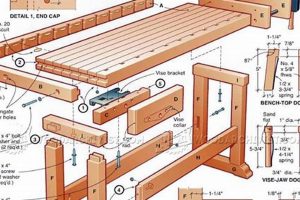
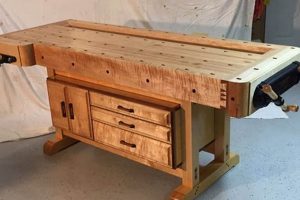
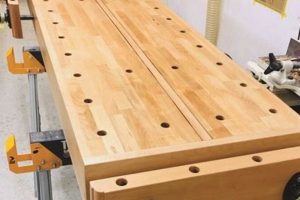
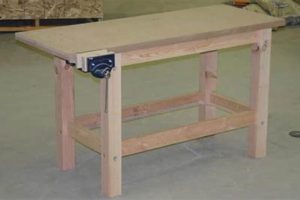
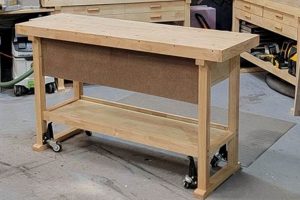
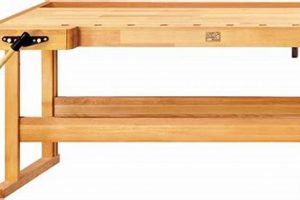
A robust and meticulously crafted work surface designed specifically to facilitate the execution of high-precision woodworking tasks. This structure typically features a solid, flat surface, often constructed from hardwoods, and incorporates features such as vises, dog holes, and tool trays to aid in securing workpieces and organizing tools. As an example, consider a maple-topped platform equipped with a quick-release vise, allowing a craftsman to securely clamp intricate carvings while shaping them.
This essential piece of equipment offers numerous advantages in the creation of detailed and intricate wooden objects. It provides a stable and reliable foundation, promoting accuracy and efficiency. Historically, these specialized surfaces evolved from simple tables to sophisticated platforms as woodworking techniques became more refined. The presence of such a dedicated area promotes proper posture and reduces fatigue, contributing to improved craftsmanship and overall project quality. The inherent stability also minimizes vibration, a critical factor when using hand tools for delicate operations.
The following sections will delve into the specific components typically found in this essential woodworking apparatus, explore various design considerations, and outline best practices for construction and maintenance. Subsequent discussions will also address the selection of appropriate materials and the integration of specialized features tailored to specific woodworking disciplines.
Essential Considerations for a Superior Woodworking Platform
This section outlines crucial considerations to maximize the effectiveness and longevity of a dedicated woodworking station.
Tip 1: Prioritize Material Selection: Hardwoods such as maple, beech, or birch are recommended for the main construction. These species offer superior density, wear resistance, and dimensional stability, all critical for a dependable work surface.
Tip 2: Ensure a Flat and Stable Surface: The work surface must be meticulously flattened and kept level. Irregularities can compromise accuracy and introduce errors into the project. Regular checks with a straightedge and shims, as needed, are advisable.
Tip 3: Incorporate a Robust Vise System: A high-quality vise is indispensable. Consider both face and tail vises for versatile workpiece clamping. The vise should operate smoothly and exert consistent pressure without racking or slippage.
Tip 4: Integrate Dog Holes Strategically: Dog holes, typically arranged in a grid pattern, allow for flexible workpiece fixturing in conjunction with bench dogs and other accessories. Careful planning of dog hole placement will expand the utility of the structure.
Tip 5: Design for Ergonomics: The height of the work surface should be appropriate for the individual user to minimize strain and fatigue. A height that allows for comfortable elbow flexion while planing is generally recommended.
Tip 6: Provide Ample Storage: Integrated storage solutions, such as drawers or shelves, can keep essential tools readily accessible and maintain a tidy workspace. This promotes efficiency and reduces the risk of misplaced tools.
Tip 7: Implement a Solid Base: The base must be exceptionally stable to prevent movement or vibration during use. Mortise-and-tenon joinery, combined with strategically placed stretchers, provides excellent rigidity.
Implementing these suggestions contributes to a more productive and enjoyable woodworking experience. A well-designed structure provides a foundation for precision and craftsmanship.
The following section will explore diverse design variations, considering both traditional and contemporary approaches to building this critical woodworking component.
1. Solid hardwood construction

Solid hardwood construction is fundamentally linked to the creation of a high-caliber woodworking platform. The choice of material directly influences the structure’s stability, durability, and resistance to warping, all critical factors in facilitating accurate and precise woodworking. Hardwoods, such as maple, beech, or birch, provide a dense and rigid foundation that withstands the forces exerted during planing, sawing, and joinery operations. For example, a table crafted from solid maple will exhibit significantly less deflection under load compared to one constructed from softwood, ensuring consistent results in intricate projects. The inherent properties of hardwoods contribute directly to the performance and longevity of the equipment.
The significance of solid hardwood extends beyond structural integrity. It also affects the ability to maintain a perfectly flat and stable work surface over time. While softer woods are prone to dents, scratches, and dimensional changes due to humidity, hardwoods resist these issues, preserving the integrity of the plane. The selection of appropriate hardwood is also affected by the types of joinery that will be involved, and the finish applied. For instance, a workbench intended for heavy use with hand tools will benefit from the use of a dense hardwood like hard maple, ensuring the structure resists racking, splitting, and damage. The selection and use of a solid hardwood adds significant weight which aids in stabilization.
In summary, the use of solid hardwood in the construction of a fine woodworking platform is not merely a design choice but a prerequisite for achieving the required stability, durability, and precision. This understanding informs the selection of materials and the implementation of construction techniques. Properly employing solid hardwood results in a high-performing structure that facilitates accurate and enjoyable woodworking for years to come.
2. Integrated Vise Mechanism

The integrated vise mechanism is a core component of a functional and high-quality woodworking platform. Its presence and design directly dictate the range of operations that can be performed efficiently and accurately. The primary purpose of the vise is to securely clamp workpieces, enabling the application of force during sawing, planing, carving, and joinery tasks. Without a robust and well-integrated vise, achieving precise cuts and stable workpiece control becomes significantly more challenging. For example, when hand-planing a board, a securely clamped workpiece prevents movement and vibration, ensuring a smooth and consistent surface finish. Therefore, the vise mechanism is not merely an add-on but an integral part of the whole.
The design and integration of the vise mechanism directly impact the versatility and usability. A traditional face vise, typically mounted on the front of the woodworking structure, is suitable for general clamping tasks. A tail vise, often integrated into the end of the structure, provides additional clamping options, particularly for long boards or when combined with bench dogs. A well-designed vise mechanism will operate smoothly, exert consistent pressure across the clamping surfaces, and resist racking or distortion under load. The quality of materials used in the construction of the vise such as cast iron or hardened steel is directly correlated to its durability and clamping force. Consider, for instance, an older, poorly maintained vise; it may exhibit play in the screw threads, making it difficult to apply sufficient clamping pressure. Choosing the right vise will also be affected by the work that will be performed on the platform.
In summary, the integrated vise mechanism is an essential element of any woodworking platform intended for accurate work. Its quality and design directly affect the ability to securely hold workpieces and perform a wide range of woodworking operations efficiently. Choosing a structure with a well-designed and robust vise mechanism is a crucial decision for any woodworker seeking to improve the quality and efficiency of their work. Neglecting this aspect compromises the integrity of the platform. A quality vise is, therefore, an investment in accurate, safe, and high-quality woodworking.
3. Precision Surface Flatness

The concept of “precision surface flatness” is inextricably linked to the functionality and effectiveness of a “fine woodworking bench.” The degree to which the work surface approaches perfect flatness directly impacts the accuracy and quality of woodworking operations performed upon it. A non-planar surface introduces errors into the cutting, joining, and assembly processes, leading to compromised results. The relationship is one of direct cause and effect: deviations from flatness invariably translate to inaccuracies in the finished workpiece. As an example, consider attempting to flatten a board on a surface with even a slight crown; the resulting board will inherit that curvature, rendering it unsuitable for applications requiring a true, flat surface. Thus, precision surface flatness is not merely a desirable attribute but a fundamental requirement for a high-quality woodworking structure.
The practical significance of precision surface flatness manifests in numerous ways. Accurate joinery, essential for creating strong and aesthetically pleasing furniture, relies on perfectly flat mating surfaces. When assembling a tabletop, for instance, any inconsistencies in the flatness of the individual boards will result in gaps, unevenness, and structural weakness. Similarly, when using hand planes, a flat work surface is crucial for achieving consistent depth of cut and preventing the plane from rocking or skipping. The effort expended in ensuring precision surface flatness during the construction and maintenance of a woodworking station is a direct investment in the quality and accuracy of subsequent woodworking projects. The stability of the surrounding workspace may affect this so regular monitoring and maintenance should be part of a maintenance schedule.
In summary, precision surface flatness is a non-negotiable attribute of a “fine woodworking bench.” Its importance stems from the direct influence it exerts on the accuracy and quality of woodworking operations. While achieving and maintaining perfect flatness presents ongoing challenges, the benefits it provides in terms of improved joinery, enhanced tool performance, and reduced errors far outweigh the effort required. The pursuit of precision surface flatness is, therefore, an essential aspect of fine woodworking practice. It is part of the reason that fine woodworking benches are often favored in place of other surfaces.
4. Ergonomic Height Consideration

Ergonomic height consideration is a critical aspect in the design and utilization of a woodworking platform. The height of the work surface directly influences posture, comfort, and the potential for musculoskeletal strain during prolonged woodworking activities. A woodworking bench that is either too high or too low can lead to back pain, neck strain, and fatigue, negatively impacting both the quality of work and the woodworker’s well-being. The relationship is causal: an improperly sized structure precipitates physical discomfort and compromised performance. A common example illustrates this point: a user working at a station that is too low will tend to hunch over, increasing the risk of lower back problems. Therefore, ergonomic height is not a peripheral concern but an integral component of a well-designed woodworking station.
The practical application of ergonomic principles in woodworking station design involves determining the optimal height for the individual user and the specific tasks being performed. A generally accepted guideline suggests that the top should be at or slightly below the user’s elbow height when standing. This allows for efficient planing, carving, and other operations while maintaining a neutral spine position. Adjustable-height platforms offer versatility, accommodating different users and varying tasks. Consideration should also be given to the height of any integrated vises, as these can affect the working level during clamping and joinery. The selection of tools and materials should be considered as well. Therefore, incorporating ergonomic height considerations into a design is a critical component.
In summary, ergonomic height consideration is a non-negotiable aspect of woodworking station design, directly influencing user comfort, productivity, and long-term physical health. While determining the ideal height may require careful measurement and adjustment, the benefits derived from a properly sized structure far outweigh the effort involved. Addressing the challenges of varying user needs and task requirements through adjustable designs or customized platforms represents a worthwhile investment in the woodworker’s well-being and the quality of their craft. In general, the ergonomic advantages will also increase the lifetime of the tool by providing more control and avoiding accidental mishaps due to poor posture.
5. Strategic Dog Hole Placement

Strategic dog hole placement is intrinsically linked to the functionality and versatility of a quality woodworking platform. Dog holes, precisely drilled apertures in the surface, act as anchor points for bench dogs, clamps, and other work-holding accessories. Their strategic arrangement significantly expands the range of clamping configurations achievable, enhancing the woodworker’s ability to secure workpieces of various shapes and sizes. In essence, the thoughtful positioning of dog holes transforms a simple work surface into a highly adaptable fixturing system. For example, a series of dog holes arranged in a grid pattern allows for the secure clamping of long boards during edge jointing, ensuring accurate and consistent results. The absence of such a system severely limits clamping options, restricting the woodworker’s ability to tackle diverse projects effectively.
The practical benefits of strategic dog hole placement extend beyond simple clamping. When combined with specialized accessories, dog holes facilitate intricate joinery operations, such as mortise-and-tenon cutting and dovetailing. Bench dogs, acting as stops and supports, allow for precise alignment and control during these demanding tasks. Furthermore, the inclusion of dog holes near vise jaws expands the clamping capacity, enabling the secure holding of large or awkwardly shaped workpieces. Proper layout accounts for common workpiece dimensions, orientation relative to vises, and intended joinery methods. The placement should be a balance between density and clear working space.
In conclusion, strategic dog hole placement is a defining feature of a woodworking platform designed for precision and versatility. Their arrangement directly influences the ability to secure workpieces, perform intricate joinery, and adapt to diverse project requirements. Careful planning and execution of dog hole placement represent a critical investment in the functionality of the woodworking surface, ultimately enhancing the woodworker’s efficiency and the quality of their work. Poor planning or execution severely limits the potential of the structure. Therefore, their strategic positioning is a hallmark of quality construction.
6. Rigid Base Stability
Rigid base stability is fundamental to the performance and utility of a woodworking platform. This attribute, relating to the resistance of the structure to deformation and movement under load, directly influences the accuracy and safety of woodworking operations. A structure lacking stability will transmit vibrations, deflect under pressure, and potentially shift during use, introducing errors into cuts, joinery, and assembly processes. This can lead to uneven surfaces, misaligned joints, and ultimately, compromised structural integrity of the finished workpiece. For instance, if a platform flexes during planing, the resulting surface will be uneven. Rigid base stability is, therefore, not merely a desirable feature but a prerequisite for precise and controlled woodworking.
The practical benefits of rigid base stability manifest in several ways. It enables the effective use of hand tools, particularly planes and chisels, by providing a solid, unyielding surface against which to work. When chopping mortises, for example, a stable structure absorbs the impact of the mallet, preventing the platform from shifting and ensuring accurate mortise placement. A stable base also reduces the risk of accidents by minimizing unintended movement of the structure or the workpiece. Various design elements, such as robust leg joinery, strategically placed stretchers, and the use of dense, heavy materials, contribute to overall base stability. The selection and quality of these materials is an important consideration.
In conclusion, rigid base stability is an indispensable characteristic of a quality woodworking station, directly impacting the accuracy, safety, and efficiency of woodworking operations. While achieving optimal stability may require careful attention to design and construction techniques, the benefits in terms of improved precision, enhanced tool control, and reduced risk of errors far outweigh the effort involved. Addressing stability through robust construction is, therefore, a worthwhile investment in the long-term performance of the equipment and the quality of the craft. It will also add to the longevity of the workbench as a whole.
7. Durable Finish Application
The application of a durable finish is critical to protecting the structural integrity and aesthetic appeal of a fine woodworking platform. The finish serves as a barrier against moisture, abrasion, and chemical damage, extending the lifespan of the structure and preserving its functionality.
- Moisture Resistance
A durable finish prevents moisture absorption, which can lead to warping, swelling, and eventual structural failure. Finishes such as polyurethane and epoxy provide excellent moisture resistance, safeguarding the underlying wood from humidity and spills. For instance, a polyurethane finish on a maple bench top will prevent water from penetrating the wood fibers, maintaining the flatness and stability of the work surface.
- Abrasion Resistance
Woodworking platforms are subject to constant wear and tear from tools, workpieces, and general use. A durable finish, such as a catalyzed varnish or a conversion varnish, provides a hard, scratch-resistant surface that withstands abrasion. An example is a catalyzed varnish applied to the legs; this prevents wear from constant contact with the floor.
- Chemical Resistance
Woodworking often involves the use of solvents, adhesives, and other chemicals that can damage unprotected wood. A durable finish provides a barrier against these substances, preventing staining, discoloration, and degradation of the wood. A conversion varnish finish, for example, will resist the dissolving effects of common woodworking solvents, preserving the integrity of the structure.
- Enhanced Aesthetics
A well-applied finish enhances the natural beauty of the wood, accentuating its grain and color. Durable finishes, such as oil-based varnishes and lacquers, can provide a rich, lustrous appearance while simultaneously protecting the wood. For instance, an oil-based varnish on a cherry bench top will deepen the color and enhance the grain, creating a visually appealing and durable work surface.
In summation, durable finish application is an integral component in the construction of a fine woodworking platform. It protects against the elements, chemical and mechanical abrasions while highlighting the natural beauty of the wood. The selection of an appropriate finish should be made considering the specific materials and the environment. Proper application enhances functionality and longevity, representing a worthwhile investment in a durable work surface.
Frequently Asked Questions
This section addresses common inquiries concerning the construction, selection, and maintenance of a quality woodworking surface. The objective is to provide clear, concise answers based on established practices and expert knowledge.
Question 1: What type of wood is most suitable for a woodworking platform’s construction?
Hardwoods such as maple, beech, and birch are typically recommended due to their density, wear resistance, and dimensional stability. These species minimize warping and provide a solid foundation for precise woodworking operations.
Question 2: How is the optimal height determined for a woodworking structure?
The ideal height is typically at or slightly below the user’s elbow height when standing. This promotes a neutral spine position and reduces strain during prolonged use. Adjustable-height models offer versatility for multiple users.
Question 3: What is the purpose of dog holes, and how should they be arranged?
Dog holes serve as anchor points for bench dogs and other work-holding accessories. They should be strategically placed in a grid pattern to maximize clamping options and accommodate various workpiece sizes and shapes.
Question 4: Why is a flat surface so crucial for a woodworking surface?
Surface flatness directly impacts the accuracy of joinery, cutting, and assembly operations. Any deviation from flatness introduces errors into the finished workpiece, compromising its structural integrity and aesthetic appeal.
Question 5: What constitutes a high-quality integrated vise mechanism?
A robust vise should operate smoothly, exert consistent pressure across the clamping surfaces, and resist racking or distortion under load. Materials such as cast iron and hardened steel are indicative of a quality vise.
Question 6: How should a woodworking structure be protected from moisture and wear?
A durable finish, such as polyurethane or catalyzed varnish, provides a protective barrier against moisture, abrasion, and chemical damage. Regular cleaning and maintenance further extend the lifespan of the structure.
These FAQs represent key considerations for understanding and optimizing the use of a woodworking structure. Proper attention to these details ensures a more efficient, accurate, and enjoyable woodworking experience.
The subsequent section will discuss various design considerations for customizing a woodworking surface to meet individual needs and preferences.
In Conclusion
This discourse has explored the defining characteristics of a woodworking platform designed for precision and longevity. Factors such as the selection of hardwoods, the integration of robust vises, the necessity of surface flatness, ergonomic considerations, strategic dog hole placement, base stability, and durable finish application, all contribute to its overall functionality and value. A meticulous approach to each of these elements is essential for creating a structure capable of supporting intricate and accurate woodworking operations.
Therefore, the acquisition or construction of such a woodworking station represents a significant investment in the pursuit of quality craftsmanship. It is a foundational element that can dramatically improve the precision, efficiency, and enjoyment of woodworking endeavors. Further research and diligent application of these principles will yield lasting rewards in the form of superior results and a more fulfilling woodworking experience. Continued adherence to these standards will provide many years of reliable service.