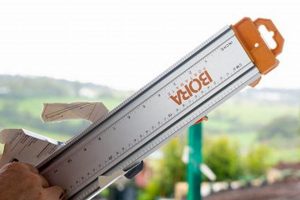
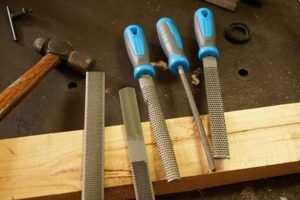
A rigid bar or blade utilized in woodworking to establish and verify the trueness of a line or surface. For instance, a craftsman might use one to ensure a tabletop is perfectly flat before applying a finish. Its design permits visual inspection for deviations from a true, linear plane.
This instrument is fundamental to achieving precision in joinery and overall project quality. Its adoption has historically allowed for the creation of furniture and structures exhibiting refined accuracy and aesthetic appeal. Accurate marking and cutting, facilitated by this tool, are critical for strong and visually pleasing results.
The following sections will delve into the different types available, materials used in their construction, factors influencing their selection, and proper usage techniques for optimal performance.
Usage Considerations
Optimal performance requires careful attention to several key factors. Adhering to these suggestions will contribute to accurate and reliable results in woodworking projects.
Tip 1: Material Selection: Consider the material of construction relative to the woodworking environment. Metal versions offer stability but may be susceptible to rust; wood options, while traditionally used, can be affected by humidity and temperature fluctuations.
Tip 2: Calibration Verification: Regularly check its accuracy against a known, reliable reference surface, such as a granite surface plate. Discrepancies indicate a need for recalibration or replacement.
Tip 3: Storage Practices: Store vertically or horizontally on a flat surface to prevent warping or bending. Avoid leaning it against walls or other objects that could introduce stress.
Tip 4: Surface Preparation: Before use, ensure the surface to be checked is free of debris, dust, and imperfections. These can introduce inaccuracies in measurement.
Tip 5: Lighting Conditions: Adequate and consistent lighting is crucial for accurate visual inspection. Shadows can obscure small deviations and lead to errors.
Tip 6: Handling Techniques: Handle with care to avoid dropping or impacting it against hard surfaces. Impacts can cause dents or bends that compromise accuracy.
Tip 7: Application of Pressure: Apply minimal pressure when checking a surface. Excessive force can distort both the straight edge and the workpiece, resulting in inaccurate assessments.
By implementing these recommendations, woodworkers can maximize the accuracy and longevity of this essential tool, leading to superior outcomes in their craft.
The following sections explore the advanced considerations in selecting the appropriate type for specialized woodworking applications.
1. Material Stability

Material stability is paramount in the context of woodworking straight edges. Fluctuations in temperature and humidity can affect a tool’s dimensions, compromising accuracy. The inherent stability of the chosen material dictates the reliability and longevity of the straight edge in maintaining a true reference surface.
- Coefficient of Thermal Expansion
Materials expand and contract with temperature changes. A low coefficient of thermal expansion is desirable in a straight edge. Aluminum, for example, expands more than steel for the same temperature increase. This differential expansion can lead to inaccuracies, particularly when working in environments with fluctuating temperatures. Steel or stabilized wood are often preferred for their lower expansion rates in critical applications.
- Resistance to Moisture Absorption
Wood, a traditional material, is susceptible to moisture absorption. This can cause warping, bending, or swelling, rendering a wood straight edge unreliable. While some hardwoods are more stable than others, they still require careful sealing and storage. Metal straight edges are generally immune to moisture absorption, providing a more consistent reference surface in humid environments.
- Internal Stress Relief
Manufacturing processes can induce internal stresses within a material. Over time, these stresses can relieve themselves, leading to dimensional changes. High-quality straight edges undergo stress-relieving processes during manufacturing to minimize this effect. Cryogenic treatment or heat soaking are methods used to stabilize the material and ensure long-term dimensional stability.
- Resistance to Permanent Deformation
The ability of a material to resist permanent deformation under load is crucial. A straight edge should maintain its flatness even when subjected to minor impacts or pressure. Materials with high yield strength and hardness are more resistant to deformation. Hardened steel, for instance, is less likely to develop nicks or bends compared to softer metals or wood.
These facets of material stability directly impact the accuracy and consistency of a woodworking straight edge. Selecting a material with minimal thermal expansion, moisture absorption, and susceptibility to deformation is essential for achieving precise and reliable results in woodworking tasks. Failing to account for these material properties can lead to inaccuracies that compromise the final product.
2. Edge Flatness

Edge flatness represents a critical attribute of any woodworking straight edge. A deviation from perfect flatness, even by a minute fraction, directly compromises the tool’s primary function: the establishment of a true reference line or surface. The extent to which an edge deviates from absolute flatness dictates the accuracy attainable when using the straight edge for tasks such as marking, checking for twist, or setting up machinery. For example, if a straight edge possesses a slight convex curvature, attempting to use it to draw a perfectly straight line will result in a line that reflects that curvature, albeit potentially on a reduced scale. Similarly, when assessing the flatness of a board, a non-flat straight edge will yield a false reading, potentially leading to incorrect milling or joining operations.
The method by which edge flatness is assessed and maintained is of significant practical consequence. Precision instruments, such as granite surface plates and dial indicators, are typically employed to measure and verify the flatness of a straight edge. Regular calibration against such known standards is essential to ensure ongoing accuracy. Furthermore, the material selection plays a role; denser, more stable materials like hardened steel are less prone to deformation and thus more likely to retain their edge flatness over time. The manufacturing process also contributes significantly, with processes like grinding and lapping used to achieve the desired level of precision. Maintenance procedures, such as careful storage and handling to prevent accidental impacts, are also critical for preserving edge flatness.
In summary, edge flatness is not merely a desirable characteristic of a woodworking straight edge; it is the defining property that dictates its usefulness. A compromise in edge flatness translates directly to a compromise in accuracy and, consequently, in the quality of the final woodworking project. The ability to understand, measure, and maintain edge flatness is therefore essential for any woodworker who strives for precision and excellence in their craft.
3. Length Appropriateness
Length appropriateness in the context of woodworking straight edges pertains to selecting a tool of sufficient length to effectively perform the intended task without introducing unnecessary complexity or error. The length must accommodate the dimensions of the workpiece, allowing the user to accurately assess straightness or flatness across the entire surface or length of interest. A straight edge that is too short necessitates multiple placements and alignments, increasing the likelihood of cumulative inaccuracies. Conversely, an excessively long straight edge can be unwieldy, particularly in confined spaces, making precise manipulation and visual assessment more difficult.
The relationship between length appropriateness and task accuracy is causal. For instance, when checking the straightness of a long table edge before joining, a short straight edge would require numerous repositionings, each introducing potential alignment errors. These small errors compound, potentially leading to a final product that is not truly straight. In contrast, a straight edge spanning the entire table edge allows for a single, definitive assessment, minimizing the chance of cumulative error. Another example involves machine setup. When aligning a jointer fence, a short straight edge might obscure subtle misalignments present over the full length of the fence, resulting in tapered cuts. A longer straight edge provides a more comprehensive view, facilitating precise adjustments.
Optimal length selection contributes directly to the accuracy and efficiency of woodworking operations. Choosing a straight edge of appropriate length is, therefore, not merely a matter of convenience but a critical factor in achieving desired outcomes. A well-considered length ensures that the tool serves its intended purpose without introducing avoidable sources of error, thereby enhancing the overall quality of the woodworking project.
4. Weight Distribution

Weight distribution, concerning a woodworking straight edge, directly influences ease of use, accuracy, and stability. An imbalanced tool can introduce errors due to operator fatigue or unintentional tilting. Optimal weight distribution ensures consistent contact with the workpiece and reduces the effort required for precise positioning.
- Balance Point Location
The location of the balance point relative to the tool’s geometry is crucial. Ideally, the balance point should be close to the tool’s center of mass or at a point that allows for comfortable one-handed operation when necessary. An offset balance point can lead to uneven pressure distribution against the workpiece, potentially inducing errors in marking or measurement. For example, a straight edge with excessive weight concentrated at one end may require constant corrective force, increasing the risk of slippage or inaccurate line drawing.
- Material Density Variations
Variations in material density along the length of the straight edge can create imbalances. For instance, if the tool is constructed from a composite material with inconsistent density, sections with higher density will exert more gravitational force. This can cause the straight edge to tilt or rock, especially when used on vertical surfaces or when spanning gaps. Uniform material density, achieved through careful material selection and manufacturing processes, promotes consistent weight distribution and minimizes the risk of unintended movement.
- Cross-Sectional Symmetry
Symmetry in the cross-sectional design contributes to balanced weight distribution. Asymmetrical designs, such as those with a significantly wider flange on one side, can create a lever effect, making it more difficult to maintain a consistent angle against the workpiece. Symmetrical designs distribute the weight evenly around the central axis, reducing the tendency to tip or rotate. This is particularly important when using the straight edge for tasks requiring high precision, such as aligning machinery or checking for twist.
- Handle Design and Placement
The presence and placement of handles influence the perceived weight distribution and ease of control. Handles should be positioned to allow for a balanced grip, minimizing the need for excessive force to maintain the tool’s orientation. Poorly positioned or shaped handles can concentrate pressure in certain areas of the hand, leading to fatigue and reduced control. Ergonomic handle designs that distribute the weight evenly across the hand promote comfortable and accurate use, especially during prolonged tasks.
These facets highlight the integral relationship between weight distribution and the effective use of a woodworking straight edge. A tool that is well-balanced enhances precision, reduces user fatigue, and promotes consistent results across a range of woodworking applications. Recognizing and addressing these factors contribute to improved overall craftsmanship.
5. Calibration Accuracy
Calibration accuracy is a defining characteristic of any woodworking straight edge, directly influencing its capacity to yield reliable results. The degree to which a straight edge deviates from a perfectly straight reference directly correlates with the potential error introduced into woodworking operations. A straight edge lacking accurate calibration serves as a misleading instrument, potentially compromising the precision of cuts, joinery, and overall project dimensions. The consequences range from minor aesthetic imperfections to structural instability in assembled pieces.
The reliance on calibration accuracy is evident in diverse woodworking scenarios. When setting up a jointer, the straight edge is employed to ensure the infeed and outfeed tables are coplanar. Inaccurate calibration of the straight edge leads to misaligned tables, resulting in boards that are not truly flat or square. Similarly, when verifying the flatness of a large tabletop, a poorly calibrated straight edge can provide a false reading, masking subtle warps or twists that will become apparent only after finishing. The pursuit of accurate joinery, such as dovetails or mortise-and-tenon joints, demands precise marking and cutting; a straight edge with compromised calibration introduces errors that accumulate throughout the joint-making process, weakening the final assembly.
Maintaining calibration accuracy presents ongoing challenges. Environmental factors, such as temperature and humidity fluctuations, can induce dimensional changes in the straight edge itself. Furthermore, repeated use and accidental impacts can cause subtle deformations that affect its straightness. Regular verification against a known standard, such as a granite surface plate, is essential for identifying and correcting any deviations. The practical significance of understanding calibration accuracy lies in the ability to proactively mitigate potential errors, thereby achieving higher levels of precision and quality in woodworking endeavors. Woodworkers who prioritize calibration accuracy demonstrate a commitment to excellence and a thorough understanding of the fundamental principles underpinning their craft.
6. Storage Method

The storage method employed for a woodworking straight edge tool is directly linked to its long-term accuracy and utility. Improper storage can induce stresses, warping, or physical damage, ultimately compromising the tool’s ability to serve as a reliable reference. The cause-and-effect relationship is demonstrable; negligent storage practices inevitably lead to diminished performance. A straight edge left leaning against a wall, for example, is subjected to uneven pressure, potentially causing a permanent bend. Similarly, exposure to extreme temperature fluctuations or humidity within a workshop environment can promote warping, particularly in wood-based straight edges. The importance of proper storage stems from the tool’s intrinsic role in establishing true lines and planes; a compromised straight edge propagates inaccuracies throughout woodworking projects.
Consider a steel straight edge left exposed to moisture. The resultant corrosion not only alters the surface finish but also introduces dimensional changes, negating its precision. Conversely, a properly stored straight edge, suspended vertically or laid flat on a dedicated rack, remains protected from external forces that could induce deformation. Utilizing a protective case or wrapping the tool in acid-free paper further safeguards against scratches or environmental contaminants. The practical significance of this understanding is evident in the quality of finished woodworking pieces; precise joinery, flat surfaces, and accurate dimensions are directly contingent upon the integrity of the straight edge, which is, in turn, preserved through appropriate storage protocols.
In summary, the method of storage is not merely a peripheral consideration but an integral aspect of maintaining a woodworking straight edge tool’s accuracy and extending its lifespan. Addressing storage challenges through dedicated racks, environmental controls, and protective measures safeguards against potential damage, thereby ensuring the tool continues to function as a reliable reference for precise woodworking operations. Prioritizing proper storage ultimately contributes to higher-quality craftsmanship and reduced material waste.
7. Application Technique

The application technique directly governs the accuracy achieved when employing a woodworking straight edge tool. The tool’s inherent precision is rendered ineffective without proper handling and usage. Inconsistent pressure, parallax errors during visual inspection, and failure to properly clean the tool or workpiece all introduce inaccuracies that negate the benefits of a high-quality straight edge. The cause-and-effect relationship is demonstrable; improper application technique inevitably results in inaccurate readings and compromised woodworking outcomes. For instance, applying excessive downward force while using a straight edge to mark a line can cause the tool to flex imperceptibly, resulting in a curved line instead of a straight one. This becomes particularly critical when marking for precision joinery such as dovetails or mortise and tenon joints.
Specific application techniques exemplify this connection. When checking a surface for flatness, the straight edge should be supported only by its own weight, minimizing external forces that could induce bending. Visual inspection should be performed with the eye positioned directly perpendicular to the straight edge and the workpiece to eliminate parallax errors. Before each use, both the straight edge and the workpiece should be meticulously cleaned to remove any debris that could interfere with accurate contact. Furthermore, the straight edge should be oriented in multiple directions to account for potential biases caused by subtle imperfections in the tool itself. For example, rotating the straight edge 180 degrees and repeating the measurement can reveal discrepancies indicative of a slightly warped edge.
In summary, application technique represents an indispensable component in the effective utilization of a woodworking straight edge tool. Recognizing and mitigating potential sources of error through meticulous handling, precise visual alignment, and thorough cleaning practices are crucial for realizing the tool’s intended purpose: the establishment of true lines and planes. Woodworkers who master proper application techniques maximize the accuracy and reliability of their straight edges, resulting in improved craftsmanship and reduced material waste.
Frequently Asked Questions
The subsequent questions address common inquiries regarding the selection, maintenance, and application of woodworking straight edge tools, offering clarity on critical aspects of their use.
Question 1: What constitutes an acceptable level of flatness deviation for a woodworking straight edge tool intended for high-precision joinery?
The acceptable deviation hinges on the specific application. For high-precision joinery, deviations should not exceed 0.001 inches per foot. Exceeding this tolerance introduces cumulative errors that compromise joint integrity.
Question 2: How frequently should a woodworking straight edge tool be calibrated against a known reference surface?
Calibration frequency depends on usage intensity and storage conditions. A minimum of once per year is recommended for infrequent use; for daily use, calibration should occur monthly. Any suspected impact warrants immediate recalibration.
Question 3: What are the primary disadvantages of utilizing wooden straight edges compared to those constructed from metal?
Wooden straight edges exhibit greater susceptibility to dimensional changes due to moisture absorption and temperature fluctuations. Metal straight edges, particularly those made from steel or aluminum, offer superior stability under varying environmental conditions.
Question 4: Is there a discernible difference in performance between a straight edge tool with a beveled edge versus one with a square edge?
Beveled edges facilitate closer visual inspection when checking for gaps, allowing for more precise assessment of flatness. Square edges, however, provide a more stable surface for marking and referencing.
Question 5: What cleaning agents are deemed appropriate for maintaining a woodworking straight edge tool and preventing corrosion or damage?
Mild solvents such as mineral spirits or denatured alcohol are suitable for removing resin or grime. A light coating of machine oil or paste wax can protect against corrosion. Abrasive cleaners should be avoided to prevent surface scratching.
Question 6: How does the cross-sectional shape of a woodworking straight edge tool affect its rigidity and resistance to bending?
A thicker cross-section inherently provides greater resistance to bending. I-beam or box-section designs offer enhanced rigidity compared to simple rectangular profiles, particularly for longer straight edges.
Understanding these facets enhances the capacity to effectively utilize woodworking straight edge tools, leading to superior precision and quality in woodworking projects.
The following section presents a comparative analysis of different types of straight edges, focusing on their specific applications and limitations.
Conclusion
The preceding discourse has elucidated the crucial role of the woodworking straight edge tool in achieving precision within woodworking endeavors. Key considerations, encompassing material stability, edge flatness, length appropriateness, weight distribution, calibration accuracy, storage method, and application technique, were identified as critical factors influencing tool performance. Furthermore, frequently encountered inquiries were addressed to foster a comprehensive understanding of the instrument’s utilization.
A thorough comprehension of these principles equips practitioners to make informed decisions regarding the selection, maintenance, and employment of this fundamental instrument. Continued adherence to best practices will ensure the enduring accuracy and reliability of the woodworking straight edge tool, contributing to elevated standards of craftsmanship. Future advancements in materials science and manufacturing processes may further refine tool design and performance, yet the foundational principles outlined herein will remain integral to achieving precision in woodworking for years to come.