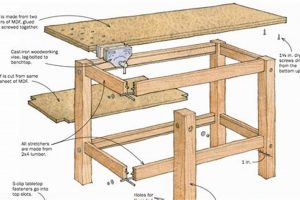
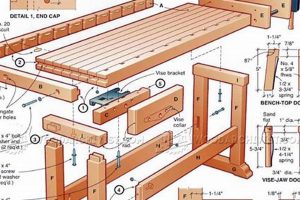
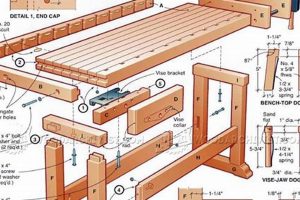
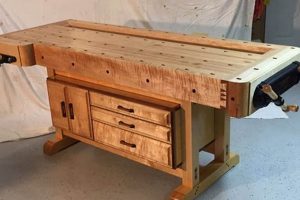
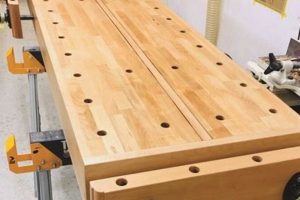
A work surface designed for woodworking, featuring strategically placed apertures, allows for the secure clamping or dogging of materials. This design element enhances stability and precision during cutting, shaping, and assembly processes. The perforations typically accommodate bench dogs or similar holding devices, enabling efficient workpiece fixation from multiple angles.
The inclusion of these apertures offers several advantages in the workshop. They provide versatile clamping options, increasing accuracy and reducing the risk of material slippage. Historically, such features have evolved from rudimentary clamping methods to sophisticated, integrated systems, enhancing efficiency and safety in woodworking practices. This design improves workflow, reduces fatigue, and supports repeatable accuracy for professional and amateur woodworkers alike.
Further discussion will explore specific hole patterns, compatible work-holding accessories, and the various construction materials used in creating these specialized work surfaces. Factors influencing optimal hole size, spacing, and bench material selection will also be examined to provide a complete understanding of their design and usage.
Woodworking Bench Aperture Optimization
Effective utilization of a workbench with integrated apertures significantly enhances woodworking precision and efficiency. The following guidelines are intended to maximize the functionality and longevity of the work surface and related accessories.
Tip 1: Select Bench Dog Material Strategically: The choice of bench dog material impacts holding power and potential workpiece damage. Hardwoods like maple offer robust grip, while softer materials like rubber or cork prevent marring of delicate surfaces. Consider material properties relative to the task at hand.
Tip 2: Maintain Aperture Cleanliness: Sawdust and debris accumulation within the apertures compromises clamping effectiveness. Regular cleaning with compressed air or specialized cleaning tools ensures secure and consistent dog placement.
Tip 3: Optimize Dog Spacing for Workpiece Size: Strategic placement of bench dogs, based on the dimensions of the workpiece, distributes clamping pressure evenly. Utilizing multiple dogs minimizes flexing and potential deformation of the material.
Tip 4: Ensure Dog Compatibility: Verify the diameter and shape of bench dogs are compatible with the workbench apertures. Incompatible dogs may damage the bench or provide inadequate holding force.
Tip 5: Utilize Auxiliary Clamping Aids: In conjunction with bench dogs, consider incorporating face clamps or holdfasts for additional security when working with complex shapes or during aggressive machining operations.
Tip 6: Regularly Inspect Aperture Integrity: Periodically examine the apertures for signs of wear, splintering, or damage. Prompt repair or reinforcement prevents further degradation and maintains the bench’s structural integrity.
Tip 7: Consider Adjustable Bench Dogs: Adjustable bench dogs allow for fine-tuning of clamping pressure and adaptation to varying workpiece thicknesses. This enhances versatility and reduces the need for shims or improvised solutions.
Adherence to these recommendations extends the service life of the workbench and improves the accuracy of woodworking operations. Prioritizing maintenance and thoughtful application of work-holding accessories leads to enhanced project outcomes.
The subsequent section will address common issues encountered with these work surfaces and propose remedial actions to address these challenges.
1. Aperture Diameter

Aperture diameter, referring to the size of the holes integrated into a woodworking bench, directly impacts the versatility and effectiveness of the work-holding system. It determines the range of compatible bench dogs and accessories that can be used to secure workpieces. If the diameter is too small, standard-sized dogs will be unusable, limiting clamping options. Conversely, an excessively large diameter results in a loose fit, compromising holding power and potentially damaging the workpiece. For example, a bench with 19mm (3/4 inch) apertures accommodates the most commonly available bench dogs, providing a wide selection of options. Deviation from this standard often necessitates custom-made or adapted accessories, increasing costs and reducing accessibility.
The selection of an appropriate aperture diameter also influences the long-term durability of the bench. Overly large apertures can weaken the structural integrity of the work surface, particularly when subjected to significant clamping forces. This is especially relevant when working with hardwoods or during operations that generate substantial vibration, such as routing. Furthermore, precise aperture dimensions are crucial for ensuring consistent clamping performance. Variations in diameter, even within a small tolerance, can lead to uneven pressure distribution and unreliable workpiece fixation. Therefore, aperture diameter must be carefully considered during the bench design and construction process to achieve optimal functionality and longevity.
In summary, aperture diameter is a critical specification for a woodworking bench with holes. Its selection dictates the range of compatible accessories, influences the structural integrity of the bench, and affects the consistency of clamping performance. Proper consideration of this parameter ensures that the work surface can effectively secure workpieces, enabling precision and efficiency in woodworking tasks. Ignoring this aspect can lead to reduced functionality, increased expenses, and compromised results.
2. Hole Spacing

Hole spacing, within the context of a woodworking bench equipped with apertures, directly determines the versatility and efficiency of workpiece clamping. Closer spacing allows for more precise positioning and increased clamping points, particularly beneficial when securing smaller or irregularly shaped materials. Conversely, wider spacing limits the fineness of adjustments but can accommodate larger workpieces without requiring excessive bench dog repositioning. The choice of hole spacing impacts the user’s ability to securely hold materials for a range of woodworking tasks. For example, benches intended for detailed carving often feature tighter hole patterns, whereas benches designed for assembly might prioritize wider spacing to accommodate larger components.
The selection of hole spacing also influences the overall structural integrity of the workbench. Excessive hole density can weaken the work surface, potentially leading to deformation or failure under heavy loads. Therefore, a balance must be struck between clamping versatility and structural stability. In practice, a grid pattern with holes spaced approximately 96mm (approximately 3.78 inches) apart is frequently observed, offering a compromise between clamping options and bench strength. Furthermore, the pattern layout itself can influence workflow. Regularly spaced rows and columns allow for easy alignment and consistent clamping setups, reducing setup time and improving accuracy.
Optimal hole spacing is not universally defined but rather depends on the intended applications of the workbench. Prioritizing versatility requires a closer pattern, while prioritizing large-scale assembly benefits from wider spacing. However, excessive hole density can compromise structural integrity. By understanding the relationship between hole spacing, clamping options, and bench strength, woodworkers can select or design a bench that effectively meets their specific needs and enhances their workflow. This thoughtful consideration improves precision and reduces the likelihood of material slippage or workpiece deformation.
3. Bench Dog Compatibility

Bench dog compatibility is a pivotal aspect of a woodworking bench featuring apertures. The extent to which various bench dog types and sizes can be effectively utilized dictates the versatility and practicality of the bench for diverse woodworking operations. Incompatibility severely limits the bench’s usefulness, regardless of other design merits.
- Aperture Diameter Conformity
Aperture diameter must precisely match the shank diameter of the bench dog. A loose fit compromises holding power, leading to workpiece slippage. A tight fit prevents insertion. Standardized dog sizes (e.g., 19mm or 3/4 inch) demand correspondingly sized apertures. Deviation from established standards necessitates custom dog fabrication, a potentially costly and time-consuming endeavor.
- Dog Material and Aperture Material Interaction
The materials of both the bench dog and the bench surface influence clamping effectiveness and longevity. Hard steel dogs used in softwood apertures can cause premature wear and enlargement of the holes, reducing holding power over time. Conversely, softer dog materials may deform under heavy clamping pressure. Consideration must be given to material pairings to optimize performance and minimize degradation.
- Dog Shape and Aperture Edge Configuration
The shape of the bench dog, whether cylindrical, rectangular, or tapered, must correspond to the aperture’s edge profile. Beveled or rounded aperture edges facilitate easier dog insertion and reduce the risk of damaging the workpiece edge. Sharp, unchamfered edges can cause marring or indentation, particularly when clamping delicate materials. The design must promote secure seating without causing aesthetic or structural harm.
- Dog Length and Bench Thickness Relationship
The length of the bench dog shank must be appropriate for the thickness of the bench top. Dogs that are too short may not protrude sufficiently to effectively engage the workpiece. Dogs that are excessively long can interfere with legroom or adjacent tools. The shank length must be carefully selected to optimize holding power without compromising user comfort or workspace efficiency.
These factors collectively highlight the critical role of bench dog compatibility in maximizing the utility of a woodworking bench with apertures. Inadequate attention to these details results in compromised clamping effectiveness, reduced bench longevity, and diminished overall woodworking precision.
4. Material Stability

Material stability is paramount in a woodworking bench featuring apertures, as dimensional changes or deformation compromise the accuracy and repeatability of clamping operations. The presence of holes inherently weakens the structural integrity of the bench top, making material selection critical to mitigate warping, twisting, or sagging under load. A bench top constructed from unstable material, such as improperly seasoned softwood, will exhibit significant movement over time, leading to misalignment of the apertures and inconsistent clamping pressure. This instability directly translates to inaccuracies in woodworking projects. For instance, if a bench surface bows, workpieces secured with bench dogs will no longer be held parallel to the intended plane, impacting joinery and assembly precision.
The influence of environmental factors, particularly humidity, further underscores the importance of material stability. Materials with high moisture content, such as green lumber, are prone to significant expansion and contraction with fluctuations in relative humidity. This movement disrupts the alignment of the apertures and alters the overall flatness of the work surface, making it difficult to achieve accurate results. Conversely, stable materials like kiln-dried hardwoods or engineered wood products, such as Baltic birch plywood or MDF, exhibit minimal dimensional changes, maintaining the integrity of the bench top and ensuring consistent clamping performance. The choice of material, therefore, directly affects the long-term usability and reliability of the woodworking bench. Using a material like MDF, while initially stable, can sag over time if not properly supported, especially when numerous holes are introduced.
In conclusion, material stability is an indispensable characteristic of a woodworking bench with apertures. Instability undermines clamping accuracy, compromises project quality, and necessitates frequent adjustments or repairs. Selecting stable materials, employing appropriate construction techniques, and accounting for environmental factors are essential to maximizing the long-term performance and reliability of this critical woodworking tool. The relationship between material stability and the functionality of a woodworking bench with apertures is direct and consequential; neglecting this relationship invariably leads to diminished woodworking outcomes.
5. Clamping Versatility
The incorporation of apertures within a woodworking bench significantly enhances clamping versatility, enabling secure fixation of workpieces in various orientations. These perforations, typically arranged in a grid pattern, accommodate bench dogs, holdfasts, and other clamping accessories, allowing woodworkers to apply pressure from multiple directions. This capability is crucial for complex woodworking operations where traditional clamping methods prove inadequate. For example, when carving a curved surface, bench dogs can be positioned to hold the workpiece firmly in place while allowing unobstructed access for carving tools. The ability to adapt clamping configurations to the specific demands of each project is a defining characteristic of a well-designed woodworking bench with apertures.
The increased clamping versatility afforded by these work surfaces translates directly to improved accuracy and efficiency in woodworking. By providing numerous clamping points, the risk of workpiece slippage or movement during machining operations is minimized. This, in turn, reduces the likelihood of errors and rework, saving time and materials. Furthermore, the ability to quickly and easily reposition clamping devices allows woodworkers to adapt to changing project requirements without significant disruption. For instance, when assembling a cabinet, the bench apertures enable precise alignment and secure clamping of components during glue-up, ensuring a strong and square assembly. This level of control and adaptability is essential for producing high-quality woodworking results.
In summary, the connection between clamping versatility and a woodworking bench with apertures is fundamental to its functionality. The strategic placement of perforations enables a wide range of clamping options, improving accuracy, efficiency, and overall project quality. While challenges may arise in selecting the appropriate clamping accessories or maintaining the bench’s structural integrity, the benefits of enhanced clamping versatility far outweigh these concerns. This design element is a critical component of any well-equipped woodworking shop, providing woodworkers with the tools they need to execute complex and demanding projects with precision and confidence.
6. Workpiece Support
Effective workpiece support is a fundamental attribute of a woodworking bench incorporating apertures. The presence of these perforations, designed to accommodate bench dogs and related accessories, directly influences the stability and security with which materials can be held during various woodworking processes. Inadequate workpiece support introduces the risk of material slippage, vibration, or distortion, leading to inaccurate cuts, compromised joinery, and potential damage to both the workpiece and the cutting tools. For example, when hand-planing a large panel, strategically positioned bench dogs provide a secure and level surface, preventing the panel from shifting and ensuring a consistent planing depth. The apertures, therefore, facilitate a system of workpiece support that is both versatile and essential for precision woodworking.
The relationship between workpiece support and this bench design extends beyond simple stability. The apertures, in conjunction with appropriate work-holding devices, enable complex orientations and secure clamping of irregularly shaped objects. This capability is particularly relevant when working on intricate carvings or assembling complex joinery. Consider the task of dovetailing a drawer; bench dogs can be used to securely hold the drawer sides at the precise angle required for accurate sawing, ensuring tight-fitting joints. Furthermore, the bench surface itself, if properly flattened and maintained, contributes to overall workpiece support by providing a consistent reference plane. The combined effect of a stable bench surface and versatile clamping options enhances the woodworker’s ability to control and manipulate the workpiece, leading to improved results and reduced errors.
In conclusion, workpiece support is inextricably linked to the functionality of a woodworking bench with apertures. The strategic placement of these holes creates a system that allows for secure, adaptable, and precise material holding. Challenges related to selecting appropriate bench dogs or preventing aperture wear exist, but the advantages of enhanced workpiece support far outweigh these concerns. By prioritizing the integration of effective support mechanisms, the woodworking bench becomes an indispensable tool for achieving accurate and efficient woodworking outcomes.
7. Surface Planarity

Surface planarity, the degree to which a surface conforms to a true plane, is critically important for a woodworking bench integrated with apertures. Deviations from planarity compromise the accuracy of all woodworking operations performed upon it. This is particularly true when utilizing the apertures in conjunction with bench dogs or other clamping mechanisms.
- Impact on Joinery
Non-planar surfaces induce inaccuracies in joinery. If the bench surface is not flat, components cannot be reliably referenced for cutting accurate angles or ensuring flush alignments. Mortise and tenon joints, dovetails, and other joinery techniques are particularly sensitive to deviations in surface planarity. A skewed reference surface translates directly to misaligned joints and structurally unsound assemblies.
- Effect on Workpiece Stability
Workpieces placed on a non-planar surface are inherently unstable. This instability undermines the effectiveness of bench dogs and other clamping devices. Even with secure clamping, the workpiece may be subject to subtle rocking or shifting, leading to inaccurate cuts and difficulty in achieving consistent results. This is particularly problematic when performing delicate operations such as carving or inlay work.
- Influence on Tool Performance
Surface planarity directly affects the performance of hand tools such as hand planes and chisels. A non-planar bench surface makes it difficult to maintain a consistent cutting angle and pressure, resulting in uneven material removal and a compromised finish. Furthermore, the uneven surface can accelerate wear on the tools themselves, requiring more frequent sharpening and maintenance.
- Interaction with Aperture Functionality
Deviations from planarity can negate the benefits of the bench’s apertures. If the surface is warped or twisted, bench dogs inserted into the apertures will not provide consistent clamping pressure across the workpiece. This uneven pressure can lead to material distortion or slippage, undermining the intended purpose of the clamping system. Accurate aperture placement is irrelevant if the surrounding surface lacks planarity.
In summation, surface planarity is not merely a desirable attribute of a woodworking bench with apertures; it is a fundamental requirement for accurate and reliable woodworking. A non-planar surface undermines the effectiveness of all other features, including the aperture system itself. Maintaining a true and stable surface is essential for achieving precise joinery, stable workpiece support, and optimal tool performance.
Frequently Asked Questions
This section addresses common inquiries regarding the design, functionality, and optimal utilization of woodworking benches equipped with apertures for work-holding. The information presented aims to provide clarity and informed guidance for prospective users.
Question 1: What is the primary benefit of integrating holes into a woodworking bench?
The primary benefit lies in the enhanced versatility and precision afforded for workpiece clamping. Strategically placed apertures accommodate bench dogs, holdfasts, and other clamping accessories, enabling secure fixation from multiple angles and orientations.
Question 2: What is the standard diameter for these apertures, and why?
The most common diameter is 19mm (3/4 inch). This dimension corresponds to the prevalent size of commercially available bench dogs, facilitating widespread compatibility and accessory availability.
Question 3: How does hole spacing impact the functionality of the woodworking bench?
Hole spacing dictates the granularity of clamping adjustments. Closer spacing allows for finer positioning and increased clamping points, particularly beneficial for smaller or irregularly shaped workpieces. Wider spacing accommodates larger materials with fewer dog repositionings.
Question 4: What materials are best suited for constructing a woodworking bench with holes?
Stable, dimensionally consistent materials such as kiln-dried hardwoods (e.g., maple, beech) or engineered wood products (e.g., Baltic birch plywood) are preferred. These materials minimize warping, twisting, and sagging, maintaining surface planarity essential for accurate work.
Question 5: How should these apertures be maintained to ensure optimal performance?
Regular cleaning is essential to remove sawdust and debris accumulation. Compressed air or specialized cleaning tools are recommended to ensure unobstructed dog placement. Periodic inspection for wear or damage is also advisable.
Question 6: Does the density of holes affect the structural integrity of the bench?
Yes, excessive hole density can weaken the bench top, particularly under heavy loads. A balance must be struck between clamping versatility and structural stability. Careful design and material selection are crucial to mitigate this risk.
In summary, the incorporation of apertures into a woodworking bench offers significant advantages in terms of clamping versatility and precision. Careful consideration of hole diameter, spacing, material selection, and maintenance practices is essential to maximizing the functionality and longevity of the work surface.
The subsequent section will address common troubleshooting scenarios encountered with woodworking benches featuring integrated apertures and propose effective remedial actions.
Conclusion
This exploration of the woodworking bench with holes has underscored its fundamental role in precision woodworking. The strategic integration of apertures provides enhanced clamping versatility, improves workpiece support, and contributes to overall accuracy in joinery and assembly. Aperture diameter, spacing, material stability, and surface planarity have been identified as critical factors influencing the effectiveness of this specialized work surface. The selection of appropriate accessories and diligent maintenance are paramount to maximizing its long-term performance.
As woodworking practices continue to evolve, the woodworking bench with holes remains a cornerstone of the craft. Its inherent adaptability ensures continued relevance in both traditional and contemporary woodworking settings. Therefore, a comprehensive understanding of its design principles and optimal utilization is essential for woodworkers seeking to achieve superior results and elevate their craftsmanship.