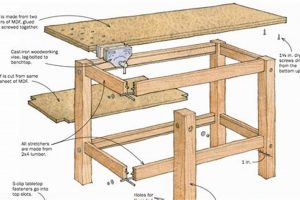
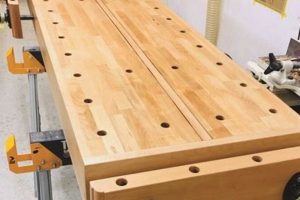
An inexpensive work surface designed for woodworking tasks often represents a practical solution for hobbyists, beginners, or individuals with budget constraints. These structures prioritize functionality and affordability, typically constructed from readily available materials like softwood lumber or repurposed components. For example, a basic model might incorporate a simple frame built from 2×4 studs with a plywood top, offering a stable platform for sawing, sanding, and assembly.
The value of a budget-friendly woodworking area lies in its accessibility. It allows individuals to engage in woodworking without significant upfront investment. Furthermore, it provides a dedicated space that can improve safety and organization in a workshop or garage. Historically, simpler, more affordable benches have always been crucial for enabling wider participation in woodworking, ensuring that skills and crafts are not limited to those with ample resources. They provide a foundation upon which more elaborate and specialized setups can be built.
The following sections will delve into different types of these economically viable work platforms, materials frequently employed in their construction, considerations for design and stability, and strategies for sourcing or building one’s own efficient and affordable woodworking station. We will also explore options for upgrading a basic model to enhance its versatility and longevity.
Tips for Selecting or Constructing an Economical Woodworking Station
Maximizing the utility and longevity of a budget-conscious woodworking setup requires careful planning and execution. The following are essential considerations.
Tip 1: Prioritize Stability: A stable work surface is paramount for accurate and safe woodworking. Even if budget constraints exist, ensure the frame is robust. Employ cross-bracing to minimize racking and wobble. Weight added to the base can also enhance stability.
Tip 2: Choose Appropriate Materials: Softwoods, such as pine or fir, are frequently used due to their affordability. However, consider incorporating hardwood elements in high-wear areas, such as the benchtop edges, for increased durability. Reclaimed lumber can also be a cost-effective and sustainable option.
Tip 3: Optimize Workspace: Consider the available space and typical project size. A smaller, more manageable station is preferable to a larger, unwieldy structure that dominates the workspace. Folding or collapsible designs can be beneficial in limited areas.
Tip 4: Incorporate Basic Storage: Even minimal storage options, such as shelves or drawers underneath the work surface, can significantly improve organization. Utilizing repurposed containers or building simple wooden boxes can provide practical storage solutions without substantial expense.
Tip 5: Surface Considerations: The benchtop surface should be flat and smooth. Plywood or MDF are common choices, but a solid wood top, even if constructed from narrower boards glued together, will offer greater durability and resistance to wear. A thin coat of sealant can protect the surface from spills and stains.
Tip 6: Consider Vise Integration: A vise is an indispensable tool for many woodworking operations. While high-end vises can be costly, consider a smaller, more affordable model or explore options for building a simple wooden vise. Even a basic vise will greatly expand the capabilities of the work station.
Tip 7: Plan for Future Upgrades: Design the initial construction with potential upgrades in mind. This might involve leaving space for additional storage, incorporating pre-drilled holes for mounting accessories, or choosing materials that can be easily modified or replaced.
Effective planning and thoughtful material selection can result in a functional and reliable woodworking space even on a restricted budget. Prioritizing stability and considering future needs will ensure a worthwhile investment.
The subsequent sections will examine specific design considerations and construction techniques for building a robust and affordable work platform, along with tips on sourcing materials and maximizing its utility.
1. Affordable materials

Affordable materials are a cornerstone of any inexpensive woodworking structure. The availability and selection of these materials directly influence the overall cost and accessibility of such setups. Without budget-friendly options, constructing a functional woodworking platform becomes significantly more challenging, potentially excluding hobbyists, beginners, and those with limited resources from engaging in the craft. Common affordable materials include softwood lumber like pine or fir, plywood, and medium-density fiberboard (MDF). These materials offer a balance of workability and cost-effectiveness, allowing for construction without substantial financial investment. For example, a simple frame constructed from pine 2x4s and a plywood top provides a sturdy and functional surface at a fraction of the cost of hardwood alternatives.
The choice of affordable materials necessitates consideration of their limitations. Softwoods, while inexpensive, are more susceptible to dents and scratches than hardwoods. Plywood and MDF, while providing a flat and stable surface, may require sealing or edge banding to improve durability and aesthetics. Careful selection and proper treatment of these materials, however, can mitigate these drawbacks. Reclaimed lumber represents another avenue for obtaining affordable materials, though it often requires additional preparation and cleaning. The use of repurposed components, such as old doors or tabletops, can also contribute to cost savings while promoting sustainability. Understanding the properties of different materials and their suitability for specific applications is crucial for building a successful and economical woodworking area.
In summary, affordable materials form the foundation upon which the accessibility and feasibility of inexpensive woodworking platforms are built. While these materials may present certain limitations compared to more expensive alternatives, their cost-effectiveness and workability make them indispensable for democratizing the craft. Strategic selection, proper preparation, and thoughtful design considerations allow for the creation of functional and durable woodworking structures even with limited financial resources, ensuring that woodworking remains accessible to a wider range of individuals.
2. Structural stability

Structural stability is a paramount consideration in the context of an inexpensive woodworking platform. A stable surface is essential for accurate work and user safety. Compromises in stability to reduce cost can lead to inaccurate cuts, insecure clamping, and potential injury, negating any initial savings.
- Frame Rigidity
The frame is the primary structural element. Cost-effective designs often employ simpler joinery techniques and less expensive lumber. However, inadequate joinery or insufficiently sized lumber can result in racking and instability. Properly designed bracing, such as diagonal supports, is crucial for maintaining rigidity even with less robust materials. For example, a frame built from 2×4 pine with well-placed cross braces can provide adequate stability for many woodworking tasks.
- Leg Design and Support
The design and support of the legs directly impact the overall stability. Legs that are too thin or lack adequate bracing can cause the entire structure to wobble. Splaying the legs outwards or incorporating a lower shelf connecting the legs can significantly enhance stability. Furthermore, ensuring all legs are in full contact with the floor is essential; shimming or leveling feet may be necessary to address uneven surfaces.
- Benchtop Attachment
The method of attaching the benchtop to the frame is critical. A weak or poorly executed attachment can allow the benchtop to move independently of the frame, reducing stability. Screws, bolts, or glue are commonly used, but the choice depends on the materials and intended use. Using a combination of adhesive and mechanical fasteners, such as screws or bolts, provides the most secure and stable connection. Ensuring the benchtop is adequately supported by the frame, with minimal overhang, also contributes to stability.
- Material Selection and Weight Distribution
While cost considerations often dictate the use of lighter materials, strategically adding weight can improve overall stability. Placing heavy objects on a lower shelf or filling the base of the legs with sand or concrete can significantly reduce movement. Furthermore, the distribution of weight across the benchtop should be considered; avoid concentrating heavy loads in one area, as this can stress the structure and lead to instability. Choosing slightly thicker lumber for critical components, such as the legs or stretchers, can also enhance stability without significantly increasing the overall cost.
Achieving adequate structural stability in an economical woodworking station necessitates careful design and execution. While compromises may be necessary to meet budget constraints, prioritizing key elements such as frame rigidity, leg design, and benchtop attachment is essential for creating a safe and functional workspace. Strategic material selection and weight distribution further contribute to stability, ensuring the platform remains reliable and accurate over time.
3. Compact design

Compact design constitutes a crucial element in the realm of affordable woodworking platforms. The spatial footprint directly correlates with material requirements and construction complexity, consequently influencing the overall cost. Smaller designs necessitate fewer materials, reducing the initial financial outlay. Furthermore, compact structures often feature simplified joinery and less elaborate construction techniques, minimizing both labor costs and the need for specialized tools. This synergy between size and affordability enables a broader range of individuals to access functional woodworking facilities, regardless of space constraints or budget limitations. For example, a simple knockdown workbench constructed from 2×4 lumber and a plywood top, designed to occupy a minimal area, represents a common manifestation of this principle.
The efficient use of space in compact designs also translates to enhanced versatility within confined environments. Apartments, small garages, or shared workshops often necessitate maximizing the utility of available area. A smaller station facilitates maneuverability and minimizes obstruction, allowing for more flexible utilization of the workspace. Moreover, compact designs can incorporate features that further optimize space, such as folding work surfaces, integrated storage compartments, or modular components that can be easily reconfigured or stowed away when not in use. This adaptability enhances the practical value of the platform, making it suitable for a diverse range of projects and workstyles. Consider, for instance, a wall-mounted folding workbench that provides a stable surface when needed, yet folds away flush with the wall when not in service, freeing up valuable floor space.
In summary, compact design plays a pivotal role in achieving affordability and functionality in woodworking environments. By minimizing material requirements, simplifying construction techniques, and maximizing space utilization, it broadens access to woodworking and enhances its practicality in diverse settings. Challenges related to stability and functionality in smaller designs can be addressed through careful planning and the implementation of innovative solutions, such as robust joinery, strategic bracing, and multi-functional features, reinforcing the symbiotic relationship between compact design and economical woodworking solutions. This understanding further underscores the importance of prioritizing thoughtful design principles in the pursuit of accessible and effective woodworking platforms.
4. Essential functionality
The concept of essential functionality, in the context of a budget-conscious woodworking platform, dictates the minimum capabilities required to perform core woodworking tasks effectively and safely. Prioritizing these fundamental features allows for cost savings without compromising the utility of the workspace. Determining these essential functionalities is crucial when selecting or constructing an inexpensive woodworking solution.
- Secure Work Surface
A stable and flat work surface constitutes the most fundamental requirement. It provides a platform for sawing, planing, and assembly. The surface must resist movement during these operations. Examples include a solid wood top constructed from dimensional lumber or a sheet of plywood adequately supported by a rigid frame. Failure to provide a secure work surface directly impairs the ability to perform woodworking tasks accurately and safely.
- Effective Clamping Mechanism
The ability to securely clamp workpieces is essential for many woodworking operations. Clamping allows for hands-free work, ensuring accuracy and safety. An inexpensive vise or a series of dog holes with bench dogs can provide effective clamping solutions. The clamping mechanism must exert sufficient force to hold workpieces firmly in place during cutting, shaping, and assembly. Without adequate clamping, the risk of workpiece slippage and potential injury increases significantly.
- Adequate Lighting
Sufficient illumination is necessary for clear visibility of the workpiece and tools. Proper lighting reduces eye strain and improves accuracy. This may involve utilizing existing overhead lights, supplementing them with task-specific lighting, or positioning the platform near a natural light source. Inadequate lighting can lead to errors, inaccuracies, and increased risk of accidents.
- Basic Tool Storage
A dedicated space for storing essential tools within easy reach enhances efficiency and organization. Even minimal storage, such as a shelf underneath the benchtop or a simple tool rack, can significantly improve workflow. Having tools readily accessible minimizes downtime and reduces the risk of misplacing or damaging them. Proper tool storage also promotes a safer work environment by preventing tools from cluttering the work surface.
Integrating these essential functionalities into an economical woodworking workspace allows for the completion of a wide range of projects without the need for expensive or elaborate equipment. By focusing on core requirements, individuals can maximize the utility of their platforms while minimizing costs. Subsequent enhancements and upgrades can be added as needed, allowing for a gradual expansion of capabilities based on evolving needs and available resources. The presence of these key functionalities differentiates a usable workspace from a mere surface, enabling safe and effective woodworking.
5. Easy assembly

Easy assembly is a crucial consideration when evaluating an inexpensive woodworking platform. Complex assembly procedures increase labor costs, require specialized tools, and potentially deter individuals with limited woodworking experience. Therefore, simplified construction is often a defining characteristic of budget-friendly designs, directly influencing their accessibility and overall affordability.
- Reduced Labor Time
Designs emphasizing ease of assembly minimize the time required for construction. This reduction translates to lower costs for pre-fabricated kits, as less assembly labor is factored into the price. For DIY projects, simplified assembly allows individuals to quickly create a functional workspace without dedicating excessive time to the build process. An example includes designs utilizing pre-cut components and straightforward bolt-together construction, eliminating the need for complex joinery.
- Simplified Joinery Techniques
Complex woodworking joints, such as dovetails or mortise-and-tenon joints, demand skill, precision, and specialized tools. Easy-to-assemble platforms typically employ simpler joinery methods, such as butt joints, screw connections, or metal fasteners. These methods require less skill and fewer tools, making them accessible to a wider range of individuals. For instance, a basic workbench frame can be constructed using butt joints reinforced with screws and metal corner braces, providing adequate strength without requiring advanced woodworking expertise.
- Minimal Tool Requirements
Designs requiring specialized tools, such as planers, jointers, or mortising machines, increase the barrier to entry for potential builders. Easy-to-assemble platforms prioritize designs that can be constructed with basic hand tools or readily available power tools, such as a saw, drill, and screwdriver. This reduces the need for costly tool purchases and allows individuals to build their own platforms with equipment they already possess. An example includes a simple workbench that can be constructed entirely with a circular saw, drill, and measuring tape.
- Clear and Concise Instructions
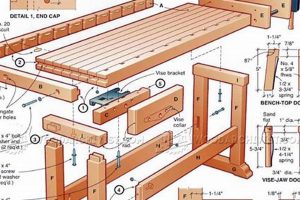
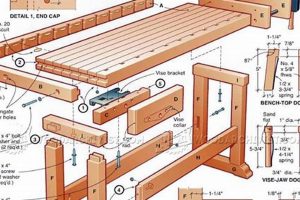
Even simplified designs can be challenging to assemble without clear and concise instructions. Easy-to-assemble platforms should be accompanied by detailed assembly diagrams, step-by-step instructions, and, ideally, video tutorials. These resources guide users through the assembly process, minimizing errors and ensuring a successful outcome. An example includes pre-fabricated workbench kits that include illustrated assembly manuals and online video demonstrations, facilitating a smooth and straightforward construction process.
The emphasis on easy assembly in economical woodworking platforms extends beyond mere convenience. It directly contributes to lower costs, increased accessibility, and a more satisfying building experience. By simplifying construction, reducing tool requirements, and providing clear instructions, these platforms empower individuals to create functional workspaces without significant investment or specialized skills, further reinforcing the appeal of budget-friendly woodworking solutions.
6. Storage integration

Storage integration in budget-conscious woodworking platforms represents a critical factor in maximizing functionality and minimizing workspace clutter. The incorporation of storage solutions, even in their most basic forms, significantly enhances the utility of an economical bench, addressing the common challenge of limited space and resources.
- Under-Bench Shelving
Shelving beneath the work surface provides readily accessible storage for frequently used tools and materials. This vertical utilization of space minimizes the footprint of the storage solution. Examples include simple open shelves constructed from plywood or dimensional lumber, providing dedicated areas for hand tools, fasteners, or works-in-progress. The strategic placement of shelves can also reinforce the structural integrity of the bench, contributing to overall stability.
- Drawer Systems
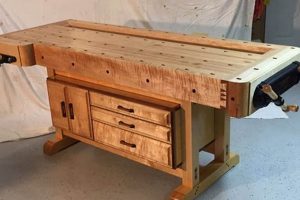
Drawers offer enclosed storage, protecting tools and materials from dust and debris. While more complex to construct than open shelving, drawers provide superior organization and security. In inexpensive platforms, drawers may be constructed from basic materials like plywood and feature simple slide mechanisms. The inclusion of dividers within drawers allows for further compartmentalization, optimizing space and preventing tools from shifting during use.
- Tool Racks and Holders
Specialized racks and holders offer dedicated storage for specific tools, improving accessibility and preventing damage. Examples include wall-mounted racks for hand saws, drill bit organizers, and chisel holders. The integration of tool racks keeps frequently used tools within easy reach, streamlining workflow and reducing the need to search for misplaced items. These racks can be constructed from scrap lumber or repurposed materials, minimizing costs while maximizing efficiency.
- Vertical Storage Solutions
Utilizing the space above the workbench with pegboards or wall-mounted cabinets provides additional storage without consuming valuable floor space. Pegboards offer flexible storage, allowing tools to be easily repositioned as needed. Simple wall-mounted cabinets constructed from plywood or repurposed materials provide enclosed storage for larger items or those requiring protection from the elements. These vertical solutions maximize storage capacity in limited areas, enhancing the functionality of compact woodworking platforms.
The implementation of these storage solutions within an economical woodworking station transforms a simple work surface into a more organized and efficient workspace. By strategically integrating storage, users can minimize clutter, improve accessibility, and enhance the overall functionality of their platforms, ultimately maximizing their woodworking capabilities within budget constraints. The focus should remain on cost-effective, practical solutions that contribute to a more productive and enjoyable woodworking experience.
7. Surface durability
Surface durability is a key limiting factor in the lifespan and utility of an inexpensive woodworking platform. While cost considerations often prioritize affordability over high-end materials, the work surface endures significant wear and tear during typical woodworking operations. The impact of impacts, abrasions from tools and workpieces, and exposure to solvents and finishes can degrade the surface, compromising its functionality and necessitating premature replacement. Consequently, inadequate surface durability directly reduces the long-term value of an otherwise economical bench. For example, a cheap woodworking bench utilizing an unfinished soft plywood surface may quickly develop dents, scratches, and chemical stains, rendering it unsuitable for precise work or clean finishes.
The selection of materials and finishes directly impacts surface durability. While solid hardwoods offer superior resistance to wear, their cost often prohibits their use in inexpensive platforms. Alternatives include high-density plywood, MDF, or reclaimed solid wood. Properly applied protective coatings, such as polyurethane or epoxy resin, can significantly enhance the durability of less expensive surfaces. For instance, several layers of polyurethane can provide a robust, solvent-resistant barrier on a plywood top, extending its lifespan considerably. Edge banding, whether of wood or durable plastic, protects the vulnerable edges of sheet goods from impact damage, further enhancing the surface’s resilience. The level of investment in protective measures dictates the ultimate surface lifespan and overall value.
Ultimately, balancing cost and surface durability is essential in the construction or selection of a cheap woodworking bench. While high-end materials and finishes offer superior performance, practical solutions exist for enhancing the lifespan of more affordable options. Prioritizing appropriate surface protection, such as durable coatings and edge banding, significantly improves the bench’s longevity and reduces the need for frequent replacement. A surface that is both functional and durable represents a more sustainable and cost-effective investment in the long run, aligning with the core principles of economical woodworking.
Frequently Asked Questions
This section addresses common inquiries concerning budget-friendly woodworking benches, providing factual information to aid in informed decision-making.
Question 1: What materials are typically employed in the construction of an inexpensive woodworking bench?
Common materials include softwood lumber, such as pine or fir, plywood, and occasionally, reclaimed wood. These options offer a balance of affordability and workability, suitable for basic woodworking tasks. Hardware typically includes screws, bolts, and potentially metal fasteners for joint reinforcement.
Question 2: How is stability achieved in a budget-friendly woodworking platform?
Stability is achieved through robust frame construction, utilizing bracing, and ensuring adequate leg support. Cross-bracing, gussets, and solid joinery techniques enhance rigidity. Adding weight to the base can further improve stability. A level working surface is also crucial, requiring adjustment of leg height if necessary.
Question 3: What is the expected lifespan of an economical woodworking bench?
The lifespan varies depending on material quality, construction methods, and usage intensity. A well-constructed bench from decent materials, properly maintained, can last for several years. However, high usage or exposure to harsh conditions may shorten its lifespan. Regular inspection and maintenance are advisable.
Question 4: How is a vise typically integrated into a budget-friendly woodworking bench?
A smaller, less expensive vise is commonly integrated. This may involve a metal vise bolted to the benchtop or a wooden vise constructed as part of the bench structure. The vise is usually positioned at the front corner for optimal access and clamping force.
Question 5: What are the potential limitations of an inexpensive woodworking bench?
Limitations include a shorter lifespan compared to professional-grade benches, reduced weight capacity, and potentially less precise surfaces. The materials may be more susceptible to wear and tear. However, these limitations are balanced by the affordability and suitability for hobbyist or beginner use.
Question 6: What maintenance is required to prolong the lifespan of an economical woodworking bench?
Regular cleaning, tightening of fasteners, and reapplication of protective finishes are essential. Surfaces should be kept free of debris. Periodic inspection for damage or wear is advisable, with prompt repairs to prevent further deterioration.
In summary, economical woodworking platforms offer a practical solution for those with budget constraints. By understanding their limitations and implementing proper maintenance, these benches can provide years of reliable service.
The subsequent sections will explore strategies for maximizing the utility and value of an inexpensive woodworking bench, including upgrades and modifications.
Conclusion
The preceding sections have systematically explored the subject of the cheap woodworking bench, examining materials, stability, design, functionality, assembly, storage, and surface durability. The analysis highlights the crucial balance between affordability and utility, emphasizing that while cost constraints are significant, fundamental aspects of a functional and safe workspace must not be entirely sacrificed. Effective planning, strategic material selection, and a clear understanding of woodworking needs are paramount in acquiring or constructing a suitable platform.
Ultimately, the value of an inexpensive woodworking surface extends beyond its mere price point. It lies in its capacity to enable engagement with the craft, fostering skill development and creative expression. Therefore, whether purchasing or constructing a cheap woodworking bench, prioritizing sound construction principles and focusing on essential features will ensure a worthwhile investment and a foundation for future woodworking endeavors. Continued refinement and thoughtful upgrades can transform a basic platform into a highly functional and personalized workspace for years to come.