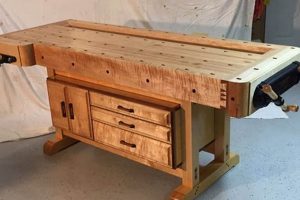
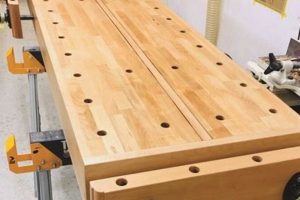
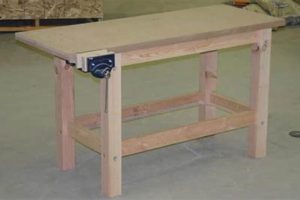
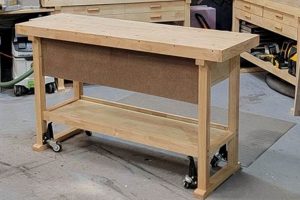
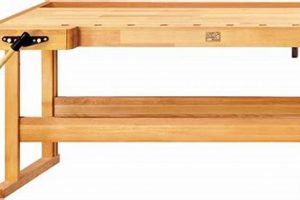
These small, cylindrical or rectangular pieces, typically crafted from wood or metal, serve as removable supports in the surface of a workbench. Inserted into pre-drilled holes, these components provide secure anchor points for securing workpieces during various woodworking operations, such as sawing, planing, and carving. For instance, a woodworker might use several of these supports to elevate a board above the bench surface, allowing unobstructed access for hand planing.
Their significance lies in their ability to stabilize material, preventing movement and enhancing precision during critical tasks. This contributes to safer and more efficient workflows, leading to improved accuracy and overall project quality. Historically, similar devices have been used for centuries, evolving from simple wooden dowels to more sophisticated designs that accommodate diverse holding needs and accommodate different size and shape work pieces.
The selection, placement, and utilization of these supports are crucial aspects of effective bench work. Subsequent sections will delve into the different types available, optimal hole spacing strategies, and techniques for maximizing their utility in a woodworking setting.
Maximizing the Effectiveness of Bench Supports
The proper use of bench supports significantly enhances the stability and efficiency of woodworking tasks. The following guidelines provide insights into optimizing their application.
Tip 1: Material Selection: Choose supports crafted from hardwood like maple or beech for superior durability and resistance to wear. Avoid softwood variants, which are prone to compression and breakage under sustained pressure.
Tip 2: Precise Hole Placement: Drill holes for these supports in a consistent grid pattern across the workbench surface. Standard spacing of 4 to 6 inches allows for versatile workpiece positioning and secure clamping.
Tip 3: Ensuring Proper Fit: The diameter of the supports should correspond precisely with the diameter of the drilled holes. A tight fit prevents slippage during operation, while excessive tightness can cause binding and damage.
Tip 4: Strategic Use of Shims: Employ shims or small pieces of wood to compensate for variations in workpiece thickness. This ensures consistent support and prevents rocking or instability.
Tip 5: Clamping in Conjunction: Utilize clamps in combination with the supports to further secure the workpiece. Position clamps strategically to distribute pressure evenly and prevent distortion.
Tip 6: Regular Maintenance: Periodically inspect the supports for signs of wear, such as splitting or cracking. Replace damaged components promptly to maintain optimal performance and prevent accidents.
Tip 7: Consider Specialized Designs: Explore different support designs, such as those with angled faces or adjustable heights, to accommodate specific woodworking tasks. This includes planing stops and other forms.
Adhering to these guidelines ensures secure workholding, improving accuracy, safety, and the overall quality of woodworking projects. Strategic implementation of bench supports results in a more stable and efficient workspace.
The next section will cover the storage and organization strategies.
1. Material Durability

Material durability is a critical determinant of the performance and longevity of bench supports. The stresses exerted during woodworking operations, such as clamping pressure and impact from tools, demand that these supports possess substantial resistance to deformation and fracture. The selection of materials lacking sufficient strength directly contributes to premature failure, compromising workholding stability and potentially leading to unsafe working conditions.
Hardwoods, such as maple, beech, and oak, are frequently chosen for crafting these components due to their inherent density and resistance to compressive forces. Conversely, softwoods like pine or fir offer inadequate support, particularly when subjected to significant lateral pressure or repeated use. For example, a support constructed from pine may exhibit noticeable compression after securing a workpiece for planing, reducing the clamping force and increasing the likelihood of slippage. In contrast, a maple support will maintain its form and hold, providing a stable platform.
The relationship between material durability and bench support functionality is therefore direct: higher durability translates to increased reliability, extended lifespan, and enhanced safety during woodworking processes. Understanding this connection allows woodworkers to make informed decisions regarding material selection, thereby optimizing the effectiveness and usability of their bench setups. Neglecting this aspect introduces significant risk, potentially resulting in project inaccuracies, material damage, and user injury.
2. Diameter Accuracy
Diameter accuracy constitutes a fundamental aspect of bench supports, directly influencing their functionality and effectiveness. The precision of the support’s diameter relative to the corresponding hole drilled in the workbench surface establishes the foundation for secure workholding. If the diameter is significantly undersized, the support will lack sufficient friction, resulting in slippage under load. Conversely, an oversized diameter leads to difficulty in insertion, potential damage to the support or workbench, and compromised stability. This interplay between support diameter and hole size is critical in preventing workpiece movement during various woodworking operations.
In practical terms, a tolerance exceeding 0.005 inches between the support diameter and the hole diameter is generally considered unacceptable. A loose fit, even by a small margin, can amplify vibrations and reduce the accuracy of cuts or shaping. For example, when planing a long board held by loose-fitting supports, the workpiece may shift with each stroke, leading to an uneven surface. To mitigate this, manufacturers offer supports in incrementally sized diameters, allowing woodworkers to select the optimal fit. Additionally, adjustable supports incorporating a cam or expandable mechanism provide a versatile solution for accommodating slight variations in hole sizes or workpiece thickness.
Achieving optimal diameter accuracy in bench supports represents a foundational element of efficient and precise woodworking. Addressing this factor directly minimizes the risk of workpiece movement, enhances safety, and contributes to superior project outcomes. While seemingly a small detail, the impact of diameter accuracy reverberates throughout the entire woodworking process. Failure to recognize and address this concern undermines the utility of the bench support system and compromises overall performance. This reinforces the necessity of careful measurement and precise execution in both the manufacture and utilization of these crucial tools.
3. Placement Strategy

The effectiveness of supports in woodworking is inextricably linked to placement strategy. The arrangement and density of support locations directly influence the stability and support offered to a workpiece. An inadequate placement strategy results in insufficient support, potentially leading to workpiece movement, vibration, or distortion during operations. Conversely, a well-considered arrangement optimizes support, minimizes these risks, and enhances overall precision. For instance, a long, thin board requires supports placed at frequent intervals to prevent bowing under the pressure of planing. Failure to address this through strategic positioning compromises the accuracy of the finished surface.
The specific placement strategy should adapt to the workpiece’s geometry and the nature of the woodworking task. For example, when routing a mortise, supports should be positioned close to the mortise’s perimeter to prevent flexing and maintain consistent depth. A grid pattern of support holes across the workbench surface offers maximum versatility, allowing for various workpiece configurations and accommodating future projects. Employing a dedicated marking gauge or template to ensure consistent hole spacing improves precision and simplifies setup. Irregular support placement introduces variability and increases the risk of errors, therefore consistency is recommended for best performance.
In summation, the positioning represents a non-negotiable determinant of the bench supports’ utility. Strategic placement mitigates risks associated with instability, enhances precision, and contributes directly to the successful completion of woodworking tasks. While the individual components offer inherent value, their collective effectiveness is ultimately defined by the underlying plan. Ignoring this connection undermines the potential of the bench support system, leading to suboptimal results and potential safety hazards. Therefore, woodworking process should consider the placement plan to the needs of a stable outcome.
4. Support Strength

Support strength constitutes a critical performance parameter of woodworking bench supports. It directly relates to the ability of the support to withstand applied forces without deformation or failure. Insufficient strength compromises workholding security, introduces instability, and elevates the risk of workpiece damage or operator injury. This parameter is intrinsically linked to the material properties of the support, its geometry, and the magnitude and direction of forces experienced during woodworking operations. For example, a support intended to resist the lateral forces generated during hand planing must possess sufficient shear strength to prevent buckling or snapping under load. Without adequate support strength, even properly placed and dimensioned components will fail to perform their intended function.
The determination of adequate strength requires consideration of several factors. The type of wood, the intended load, the size of the dowel or peg used, and any design enhancements all contribute. While some woodworkers might opt for inexpensive materials, the long-term risk of work damage makes the choice a less desirable outcome. Choosing supports with verified load-bearing capabilities or creating them with substantial dimensions can help mitigate any future problems. Consider, for instance, supports with a larger diameter or those reinforced with metal inserts will exhibit superior resistance to bending or compression under heavy loads. Prioritization of support strength is paramount when dealing with heavy workpieces or aggressive woodworking techniques.
In conclusion, support strength is a non-negotiable requirement for ensuring the reliable performance of any bench support system. Neglecting this aspect introduces significant risks to the woodworking process, potentially leading to substandard results and unsafe working conditions. A thorough understanding of material properties, load considerations, and appropriate design principles is essential for selecting or fabricating supports with sufficient strength to withstand the demands of the intended woodworking tasks. Only by prioritizing support strength can woodworkers confidently secure their workpieces and achieve the desired level of precision and safety.
5. Grip Enhancement
Grip enhancement, in the context of woodworking bench supports, pertains to modifications or features that improve the frictional interface between the support, the workpiece, and the workbench. This feature directly influences the stability and security of workholding, impacting precision and safety during woodworking operations. Enhanced grip minimizes the likelihood of slippage, particularly under significant lateral forces.
- Textured Surfaces
Texturing the surface of a bench support, through methods such as knurling, scoring, or the application of abrasive coatings, increases the coefficient of friction. This results in a more secure hold on the workpiece. For instance, a support with a knurled surface provides greater resistance to slippage than a smooth, untreated support, especially when working with oily or resinous woods.
- Tapered Designs
Tapering a bench support increases its grip by creating a wedging effect when inserted into the workbench hole. As force is applied to the workpiece, the tapered support becomes more firmly seated, resisting displacement. This design is particularly beneficial when working with materials that require substantial force, such as during hand planing or carving.
- Material Selection
The material chosen for a bench support can directly affect its grip capabilities. Certain woods, such as oak or maple, possess naturally higher frictional coefficients than others like pine or basswood. Similarly, the use of rubber or synthetic coatings on metal supports enhances grip and reduces the risk of marring delicate workpieces. For example, rubber-coated metal supports are often preferred for assembling furniture where cosmetic damage must be avoided.
- Cam Mechanisms
Supports incorporating a cam locking mechanism allow for adjustable grip. By rotating the cam, the support expands slightly within the hole, creating a tight, secure fit. This feature is particularly advantageous for workbenches with slightly oversized or worn support holes. Cam-locking supports provide a reliable means of securing workpieces regardless of minor variations in hole diameter.
These grip-enhancing features collectively contribute to a more stable and secure workholding environment. Improving the support’s ability to resist movement under force, allows for more precise and efficient woodworking. Enhancements minimize the risk of project errors and injuries. Careful consideration of grip enhancement during support selection or design leads to a more reliable and predictable woodworking workflow.
6. Versatile Applications
The adaptability of bench supports significantly broadens the scope of woodworking projects that can be undertaken with efficiency and precision. Their utility extends beyond simple workholding, enabling complex operations across diverse project types. The following explores several facets of this versatility.
- Adaptable Workpiece Support
Bench supports facilitate the secure positioning of workpieces with varying shapes and sizes. Their adjustability accommodates irregular forms that cannot be easily clamped. For instance, carving a complex chair leg necessitates secure support at multiple points along its contoured surface; pegs are strategically positioned to achieve this.
- Specialized Jig Integration
They function as anchoring points for custom jigs and fixtures. These jigs can enhance accuracy and repeatability for operations such as routing, dovetailing, or mortising. A dovetailing jig, for example, can be secured to the workbench with supports acting as registration points, ensuring precise alignment and consistent cuts.
- Finishing and Assembly Aid
These supports elevate workpieces during finishing processes, preventing contact with the workbench surface and allowing for even application of coatings. During assembly, they provide temporary support for components while glue dries or fasteners are installed. When finishing a tabletop, supports lift the piece, allowing easy access to all edges for sanding and coating application.
- Tool Holding and Organization
Beyond workholding, bench supports can organize small tools and accessories. Specialized supports with recesses or integrated magnets can hold chisels, marking gauges, or screws within easy reach. For example, a support with a magnetic insert can secure frequently used screwdrivers, preventing them from rolling off the bench.
These facets collectively illustrate the expansive role in woodworking. This extends from simple clamping to jig integration, finishing assistance, and tool organization. Their adaptable nature makes them an indispensable element for any woodworker seeking to maximize the functionality and efficiency of their workspace.
Frequently Asked Questions About Woodworking Bench Pegs
The following addresses common inquiries regarding bench supports, offering clarification on their usage, selection, and maintenance within a woodworking context.
Question 1: What materials are most suitable for constructing bench supports?
Hardwoods, such as maple, beech, and oak, are preferred due to their superior strength and resistance to wear. Softwoods lack the necessary durability for sustained use.
Question 2: How should the spacing between bench support holes be determined?
A grid pattern with 4 to 6 inches between holes provides a versatile arrangement for supporting various workpiece sizes and shapes. Closer spacing offers greater flexibility.
Question 3: What is the optimal diameter tolerance between a bench support and its corresponding hole?
A tolerance exceeding 0.005 inches is generally unacceptable. A tight fit prevents slippage, while excessive tightness can cause binding or damage.
Question 4: How can grip be enhanced to prevent workpiece slippage?
Texturing the support surface, using tapered designs, selecting high-friction materials, or employing cam locking mechanisms can improve grip and stability.
Question 5: How frequently should bench supports be inspected for wear or damage?
Regular inspection is recommended, particularly before undertaking critical woodworking operations. Damaged supports should be replaced promptly to maintain safety and accuracy.
Question 6: Can bench supports be used in conjunction with other workholding methods?
Yes, bench supports are frequently used in combination with clamps, vises, and other devices to achieve maximum workpiece stability and security. This synergistic approach optimizes workholding effectiveness.
Proper selection, installation, and maintenance of bench supports contribute significantly to a safe and efficient woodworking environment. The guidelines offered provide a foundation for informed decision-making.
The succeeding section will explore troubleshooting techniques.
The Enduring Relevance of Woodworking Bench Pegs
This exploration has illuminated the foundational role that “woodworking bench pegs” play in achieving precision and stability in woodworking. Key considerations, from material selection and diameter accuracy to strategic placement and grip enhancement, have been addressed. Understanding these elements is crucial for optimizing workholding effectiveness and ensuring project success.
As woodworking continues to evolve with new tools and techniques, the fundamental principles of secure workholding remain indispensable. Prioritizing the proper implementation of “woodworking bench pegs” ensures the stability and accuracy necessary for executing complex projects with confidence, underscoring their lasting significance in the craft.