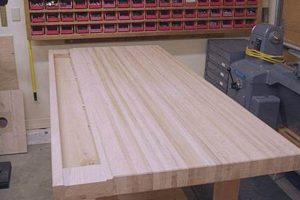
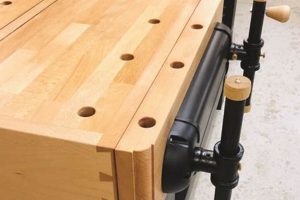
The creation of a sturdy and functional workstation is a cornerstone of successful woodworking. Such a platform facilitates precise cuts, secure clamping, and comfortable posture, all contributing to higher quality finished products. Constructing this essential piece of equipment involves selecting appropriate materials, employing sound joinery techniques, and adhering to accurate measurements.
A well-designed and executed example of this type of furniture offers numerous advantages. It provides a stable surface for intricate tasks, minimizes movement during demanding operations, and extends the lifespan of tools by providing dedicated storage. Historically, these structures have evolved from simple, ad-hoc solutions to highly engineered pieces of equipment, reflecting advances in materials science and woodworking practices. Their presence enables more efficient workflow, enhancing both accuracy and safety.
The following sections will delve into specific aspects of the construction process. Topics to be covered include material selection, design considerations, joinery methods, surface finishing, and accessory integration, offering a structured approach to achieving a superior and durable result.
Key Considerations for Bench Construction
Prior to embarking on the construction process, certain preparatory measures and design choices warrant careful consideration. These factors directly influence the functionality, durability, and overall suitability of the finished structure.
Tip 1: Material Selection: The choice of lumber significantly impacts stability and longevity. Hardwoods like maple or beech offer superior resistance to wear and tear compared to softwoods. Proper drying and acclimatization are essential to minimize warping or cracking post-construction.
Tip 2: Dimensional Accuracy: Precise measurements and consistent execution are paramount. Employing accurate measuring tools and adhering to a detailed plan will prevent cumulative errors that compromise structural integrity.
Tip 3: Robust Joinery: The joints connecting the various components must be capable of withstanding significant stress. Mortise and tenon, dovetail, or lap joints, when properly executed, provide exceptional strength and stability.
Tip 4: Surface Flatness: A level and smooth work surface is crucial for precision woodworking. Consider using a hand plane or power planer to achieve a perfectly flat top. Regular maintenance may be required to maintain flatness over time.
Tip 5: Vise Placement: Strategic placement of vises optimizes work-holding capabilities. Consider the type of work frequently performed and position the vises accordingly to provide maximum versatility and accessibility.
Tip 6: Sturdy Leg Design: The legs provide the foundation of the entire structure. Choose a leg design that distributes weight evenly and prevents racking or wobbling. Consider incorporating stretchers or aprons to enhance rigidity.
Tip 7: Integrated Storage: Incorporating drawers, shelves, or cabinets into the design maximizes efficiency. Plan storage solutions tailored to the specific tools and materials frequently used.
Proper planning, careful execution, and meticulous attention to detail are vital for constructing a woodworking surface that meets specific needs and provides years of reliable service. Ignoring these key areas can lead to frustration and compromise the quality of work.
The following sections will further elaborate on specific techniques and considerations that contribute to successful construction and optimal performance of the finished product.
1. Planning blueprints

Blueprints serve as the foundational document for the successful construction of a woodworking surface. These detailed plans mitigate errors by providing precise dimensions, joinery specifications, and material lists. Without a comprehensive blueprint, the construction process becomes susceptible to inaccuracies, potentially compromising the structural integrity and overall functionality of the finished product. For instance, the absence of detailed joinery specifications could lead to poorly fitted components, resulting in a wobbly or unstable structure.
The blueprint acts as a communication tool, ensuring all phases of the project align with the initial design. It allows for pre-emptive identification of potential challenges, such as material shortages or complex joinery requirements. This proactive approach allows for adjustments and modifications before the actual construction commences, thereby minimizing wasted resources and time. Consider the situation where a blueprint lacks specific details regarding the type and placement of fasteners. This oversight could lead to the selection of inappropriate fasteners, jeopardizing the long-term stability of the framework.
In summary, blueprints are indispensable for the effective assembly of a woodworking platform. They provide a structured framework, minimize errors, and facilitate efficient resource management. Ignoring the blueprint planning phase can result in a substandard product, characterized by instability and reduced lifespan. The initial investment in detailed planning yields significant returns in the form of a robust, functional, and durable workspace.
2. Acquiring materials

The process of obtaining suitable materials directly dictates the quality, durability, and overall success of any woodworking workstation project. This procurement phase is not merely a preliminary step but an integral component that significantly impacts the entire construction process. The type of lumber selected, the quality of fasteners employed, and the availability of necessary hardware collectively determine the structural integrity, functional capabilities, and aesthetic appeal of the finished product. For instance, employing inexpensive softwood for the benchtop will invariably lead to premature wear and tear, rendering the surface unsuitable for demanding tasks. Conversely, investing in high-quality hardwood, while initially more expensive, ensures long-term durability and resistance to deformation.
Proper material acquisition necessitates careful consideration of factors such as wood species, moisture content, and dimensional stability. Seasoned hardwood, appropriately dried to minimize warping or cracking, is generally preferred for critical structural elements. In addition to lumber, the selection of appropriate fasteners screws, bolts, and nails is equally important. The size, type, and material composition of these fasteners must be carefully matched to the intended application. Utilizing undersized or inappropriate fasteners can compromise the strength of joints, leading to eventual failure. Similarly, the selection of appropriate hardware, such as vises, dog holes, and tool storage components, significantly enhances the functionality and versatility of the structure. A woodworking platform lacking adequate work-holding capabilities or convenient tool storage becomes significantly less efficient and productive.
In conclusion, the process of procuring suitable materials represents a critical determinant of the outcome of any woodworking surface construction effort. Thoughtful consideration of wood species, moisture content, fastener selection, and hardware integration directly impacts the structural integrity, functional capabilities, and overall longevity of the finished product. Neglecting the importance of material acquisition inevitably leads to compromised performance and reduced lifespan, ultimately undermining the investment in time and resources.
3. Cutting accurately

Precision in cutting represents a cornerstone of woodworking platform construction. Deviations from specified dimensions compound inaccuracies throughout the assembly process, potentially compromising structural integrity and functional utility.
- Mitigating Cumulative Error
Inaccurate cuts introduce incremental errors that accumulate across multiple components. Even slight discrepancies can result in significant misalignments during assembly, requiring corrective measures or, in severe cases, rendering components unusable. Precise cuts minimize these cumulative effects, ensuring that each element conforms to the design specifications.
- Ensuring Joint Integrity
Joinery techniques, such as mortise and tenon or dovetail joints, rely on precise dimensional correspondence between mating pieces. Inaccurate cuts disrupt this correspondence, weakening the joints and diminishing the overall strength of the structure. For instance, an oversized tenon compromises the tightness of the mortise, creating a loose and unstable connection.
- Maintaining Surface Flatness
The utility of a woodworking surface is directly proportional to its flatness and stability. Inaccurate cuts can introduce warps or twists in individual components, leading to an uneven work surface. This compromises the ability to perform precise operations, such as planing or assembly, on the resulting furniture.
- Optimizing Material Utilization
Accurate cutting minimizes waste and optimizes the utilization of raw materials. Precise measurements and efficient cutting strategies reduce the likelihood of miscuts and rework, leading to cost savings and reduced environmental impact.
The preceding facets highlight the critical role of precision in the woodworking platform assembly process. Achieving dimensional accuracy minimizes cumulative errors, ensures joint integrity, maintains surface flatness, and optimizes material utilization, ultimately contributing to a durable, functional, and aesthetically pleasing result.
4. Assembling securely

Secure assembly forms an indispensable component of constructing a durable and functional woodworking platform. The method by which individual components are joined dictates the overall structural integrity, stability, and longevity of the finished structure. Weak or improperly executed assembly techniques invariably lead to instability, premature failure, and compromised functionality, rendering the workspace inadequate for its intended purpose. For example, a workbench assembled with poorly fitted joints may exhibit excessive racking, making it unsuitable for tasks requiring a stable and level surface. Securing components with insufficient fasteners or inadequate adhesive further exacerbates these issues, leading to a workspace incapable of withstanding the stresses inherent in woodworking activities. Therefore, secure assembly is not merely a procedural step but a fundamental requirement for achieving a reliable and productive woodworking environment.
Various joinery methods offer differing degrees of structural integrity, each suited to specific applications and material properties. Traditional techniques such as mortise and tenon, dovetail, and lap joints provide exceptional strength and resistance to racking when properly executed. These methods require precise cuts and careful fitting to ensure a tight and durable connection. Modern techniques, utilizing fasteners such as screws, bolts, and adhesives, offer alternative approaches to assembly. However, the selection of appropriate fasteners and adhesives is critical to achieving adequate strength and long-term durability. For instance, constructing a workbench leg assembly using undersized screws or an insufficient amount of adhesive will inevitably result in a weak and unstable connection. Careful consideration of the loads and stresses the structure will endure, coupled with appropriate joinery techniques and material selection, is essential for ensuring secure and lasting assembly.
In summary, secure assembly is a critical determinant of the overall success of any woodworking surface construction project. The choice of joinery methods, the selection of appropriate fasteners and adhesives, and the precision of execution all contribute to the structural integrity and longevity of the finished product. Neglecting the importance of secure assembly inevitably leads to compromised performance and a reduced lifespan, ultimately undermining the investment in time and resources. Adherence to sound assembly principles guarantees a stable, reliable, and productive woodworking environment capable of withstanding the demands of rigorous use.
5. Finishing protectively

The application of a protective finish represents the final, critical step in the creation of a woodworking platform. This process safeguards the structure against environmental factors and operational wear, directly impacting its lifespan and maintaining its functionality.
- Moisture Resistance
Wood, being a hygroscopic material, is susceptible to dimensional changes due to variations in humidity. Protective finishes, such as varnishes or polyurethanes, create a barrier that minimizes moisture absorption and prevents warping, cracking, or swelling of the surface. Without such protection, a workbench in a humid environment will degrade rapidly, compromising its flatness and stability.
- Abrasion Resistance
Woodworking tasks inherently involve the use of sharp tools and abrasive materials. Protective finishes provide a durable layer that resists scratches, dents, and other forms of surface damage. This maintains the integrity of the working surface, preventing the development of imperfections that could interfere with precise operations. For example, a benchtop subjected to frequent sanding without a protective finish would quickly exhibit significant wear and tear.
- Chemical Resistance
Workbenches are often exposed to a variety of chemicals, including solvents, adhesives, and finishes. Protective finishes offer resistance to these substances, preventing staining, discoloration, or degradation of the wood. This is particularly important when working with dyes or harsh chemicals that could permanently damage an unprotected surface.
- Ease of Maintenance
A properly applied protective finish simplifies routine maintenance and cleaning. The sealed surface prevents dirt and grime from penetrating the wood, allowing for easy removal of spills and debris. This maintains a clean and functional workspace, enhancing the overall woodworking experience.
In conclusion, the selection and application of a suitable protective finish are essential for preserving the integrity and extending the lifespan of any woodworking surface. This final step transforms a raw structure into a durable, functional, and aesthetically pleasing workspace, thereby maximizing the investment in time and materials.
Frequently Asked Questions
This section addresses common inquiries regarding the design, materials, and construction of a robust and functional woodworking surface. The aim is to clarify ambiguities and provide guidance for informed decision-making throughout the construction process.
Question 1: What is the minimum recommended size for a general-purpose woodworking structure?
A surface measuring approximately 60 inches in length and 24 inches in width is generally considered a minimum size for versatility. This allows for accommodating a range of project sizes while maintaining sufficient working area.
Question 2: Which type of wood is most suitable for the benchtop?
Hardwoods like maple, beech, or birch offer excellent durability and resistance to wear. Softwoods, such as pine, are less suitable due to their susceptibility to denting and scratching.
Question 3: What joinery methods provide the greatest strength?
Mortise and tenon joints, particularly those reinforced with wedges, offer exceptional strength and resistance to racking. Dovetail joints also provide superior structural integrity.
Question 4: How can the flatness of the benchtop be ensured?
Employing a hand plane or power planer to flatten the surface after assembly is recommended. Regular checking with a straightedge and shimming as needed maintains flatness over time.
Question 5: What is the optimal placement for vises?
A face vise positioned on the front edge and a tail vise integrated into one end provide maximum versatility for work-holding. Consider the types of projects commonly undertaken when determining precise placement.
Question 6: How can racking be prevented?
Diagonal bracing or the incorporation of solid aprons beneath the benchtop significantly enhances rigidity and prevents racking. Properly constructed leg joinery is also critical.
These answers address fundamental aspects of woodworking surface construction. Careful consideration of these points contributes to a robust and functional outcome.
The subsequent sections will explore more advanced topics, including accessory integration and specialized workbench designs.
Conclusion
This examination of the elements involved in constructing a woodworking bench has emphasized critical aspects ranging from initial design and material selection to precise assembly techniques and protective finishing measures. A carefully considered and executed approach to each of these facets is paramount in achieving a durable, functional, and stable workstation. A thorough understanding of joinery methods, dimensional accuracy, and material properties is essential for minimizing errors and maximizing the lifespan of the structure.
The successful creation of a woodworking platform represents a significant investment in skill and resources. Continued adherence to sound construction principles and regular maintenance practices will ensure that the structure continues to serve as a reliable and productive workspace for years to come. Further investigation into specialized designs and advanced techniques is encouraged for those seeking to optimize their woodworking capabilities.
![Build A Roman Woodworking Bench [DIY Guide] | Step-by-Step Guides, Tools & Inspiration to Build Beautiful Wooden Decor on a Budget](https://woodfromhome.com/wp-content/uploads/2026/05/th-207-300x200.jpg "Build A Roman Woodworking Bench [DIY Guide] Step-by-Step Guides, Tools & Inspiration to Build Beautiful Wooden Decor on a Budget")