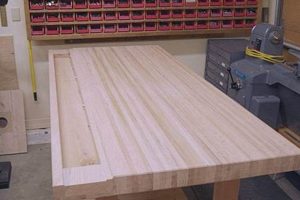
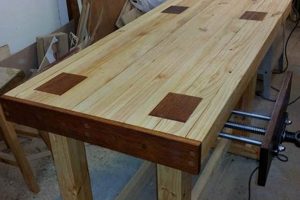
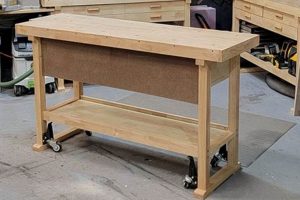
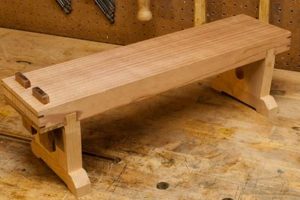
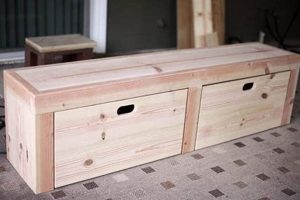
These pre-owned work surfaces, traditionally crafted from robust materials like hardwood, serve as central hubs for various woodworking activities. They typically feature a solid, flat top, often equipped with vises and dog holes to secure workpieces during cutting, shaping, and assembly. For example, an individual might acquire one to facilitate furniture construction or detailed carving projects.
Procuring such an item offers economic advantages, allowing access to high-quality, seasoned equipment at a reduced cost compared to purchasing new. These benches often possess a rich history, reflecting the craftsmanship of previous owners and potentially adding character to a workshop. Their established stability and durability, often enhanced by years of use, can provide a reliable foundation for intricate projects. The acquisition supports resource conservation by extending the life cycle of existing equipment.
This article will address key considerations when evaluating these items, including assessing condition, identifying suitable features, and understanding market value. Factors to consider encompass the integrity of the benchtop, the functionality of vises, and the presence of any structural damage. Understanding these facets is crucial for making an informed purchase.
Considerations for Purchasing Pre-Owned Workstations
Careful evaluation is paramount when acquiring previously owned woodworking workstations. The following guidelines are intended to assist prospective buyers in making informed decisions.
Tip 1: Assess Benchtop Flatness. Prior to purchase, meticulously examine the benchtop surface for warping, cupping, or twisting. Use a straightedge and feeler gauges to quantify any deviations from flatness. Significant irregularities may necessitate extensive resurfacing.
Tip 2: Evaluate Vise Functionality. Test the smooth operation and clamping force of all integrated vises. Inspect the vise screws for wear or damage. Consider the cost and availability of replacement parts should repairs be needed.
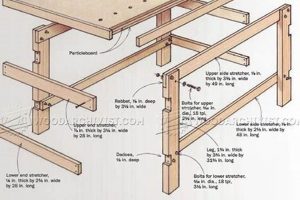
Tip 3: Inspect Structural Integrity. Scrutinize the bench’s legs, stretchers, and joinery for signs of weakness, rot, or previous repairs. Ensure that all connections are solid and secure, as instability will compromise the bench’s usability.
Tip 4: Identify Wood Species. Determine the type of wood used in the bench’s construction. Hardwoods such as maple or beech provide greater durability and resistance to wear than softer species like pine or fir.
Tip 5: Examine Dog Holes. Assess the condition and alignment of any dog holes present on the benchtop. Misaligned or damaged dog holes will limit the effectiveness of workholding accessories.
Tip 6: Verify Stability. Place the bench on a flat surface and check for wobbling. Instability can hinder precise work and should be addressed before purchase or rectified afterward.
Tip 7: Evaluate Storage Solutions. If the bench includes drawers or cabinets, inspect their functionality and condition. Ensure that drawers slide smoothly and cabinet doors close securely.
Adhering to these recommendations will enable buyers to select a suitable pre-owned woodworking workstation that meets their specific needs and budget.
The subsequent sections will delve into pricing benchmarks and market trends, providing further context for informed acquisition.
1. Workbench Condition

The condition of a pre-owned woodworking bench is a primary determinant of its value and suitability for purchase. A comprehensive assessment transcends mere aesthetic considerations, encompassing structural integrity, functional efficacy, and potential remediation costs. Prudent evaluation mitigates unforeseen expenses and ensures the acquisition of a reliable and productive tool.
- Surface Flatness and Integrity
The benchtop’s flatness is paramount for precision woodworking. Warping, cupping, or significant surface damage compromise accuracy during layout, assembly, and finishing processes. For example, a workbench with a severely uneven surface necessitates extensive planing or resurfacing, adding to the overall investment. Furthermore, the presence of excessive nail holes or gouges indicates past usage patterns and potential weaknesses in the wood’s structure. A bench exhibiting minimal surface imperfections commands a higher price due to its immediate usability and reduced restoration needs.
- Structural Stability
The overall stability of the workbench is critical for safety and efficiency. Loose joinery, weakened legs, or a compromised frame can lead to instability, hindering precise work and potentially posing a safety hazard. Examination of leg connections, stretcher integrity, and frame alignment is essential. A bench with wobbly legs or a racking frame will require reinforcement or repair, incurring additional costs and labor. A structurally sound bench provides a stable platform for demanding woodworking tasks.
- Vise Functionality and Condition
Vises are integral components of a woodworking bench, providing secure workholding during various operations. The condition of the vises, including the screw mechanism, jaws, and alignment, directly impacts their usability. A vise with stripped threads, cracked jaws, or misalignment will require repair or replacement. Original vises in good working order contribute significantly to the bench’s value and functionality. Aftermarket vise replacements may not match the original quality or fit, potentially diminishing the bench’s appeal.
- Material Degradation and Wear
Years of use can lead to material degradation, impacting the workbench’s long-term durability. Signs of rot, insect infestation, or excessive wear indicate compromised structural integrity. The presence of these issues necessitates significant restoration efforts or may render the bench unsuitable for purchase. A bench constructed from high-quality hardwood and showing minimal signs of degradation represents a more prudent investment. Understanding the wood species and its inherent resistance to decay is crucial in assessing long-term viability.
These facets of workbench condition directly influence the overall suitability and value of “used woodworking benches for sale.” A comprehensive evaluation, encompassing surface flatness, structural stability, vise functionality, and material degradation, enables buyers to make informed decisions, ensuring the acquisition of a reliable and productive woodworking asset. Disregarding these factors can result in unforeseen expenses and compromised workmanship.
2. Vise Functionality

The operational effectiveness of vises significantly influences the valuation and practicality of previously owned woodworking benches. A properly functioning vise is essential for secure workpiece retention, facilitating precision in cutting, shaping, and assembly tasks. Its condition directly impacts the bench’s overall usability.
- Clamping Pressure and Stability
A vise’s capacity to exert consistent and substantial clamping pressure is paramount. Insufficient pressure allows workpiece slippage, compromising accuracy and potentially leading to material damage or user injury. For “used woodworking benches for sale,” a demonstration of the vise’s clamping force using representative materials becomes a critical evaluation criterion. A vise lacking adequate clamping power diminishes the bench’s utility, requiring either repair or supplementary clamping solutions.
- Smooth Operation and Thread Integrity
The ease and consistency of vise operation reflect the condition of its internal mechanisms, particularly the screw threads. Rough or binding operation indicates worn or damaged threads, potentially leading to premature failure. Scrutinizing the screw threads for wear, corrosion, or damage is crucial when evaluating “used woodworking benches for sale.” Significant thread degradation necessitates costly repairs or replacement, reducing the bench’s overall value proposition.
- Jaw Alignment and Parallelism
Proper alignment and parallelism of the vise jaws are essential for uniform clamping pressure across the workpiece surface. Misaligned or non-parallel jaws result in uneven pressure distribution, increasing the risk of slippage or damage. Examination of jaw alignment using a straightedge or feeler gauges is a necessary step when assessing “used woodworking benches for sale.” Correcting jaw misalignment may require shimming, planing, or, in severe cases, jaw replacement.
- Vise Type and Suitability
Various vise types exist, each suited to specific woodworking tasks. Face vises, leg vises, and shoulder vises offer distinct advantages in workholding. For “used woodworking benches for sale,” the type of vise installed must align with the intended use. A bench equipped with an inappropriate vise type may limit its versatility, necessitating the acquisition of additional workholding devices. The presence of a versatile and well-maintained vise enhances the bench’s appeal and functionality.
In summary, the functionality of the vise or vises installed is a pivotal factor when considering “used woodworking benches for sale.” Assessing clamping pressure, operational smoothness, jaw alignment, and vise type ensures the acquisition of a workbench that meets the user’s specific needs and provides a reliable platform for woodworking endeavors. Disregarding these elements can result in frustration, compromised workmanship, and the need for costly repairs or modifications.
3. Wood Species

The type of wood used in the construction of a woodworking bench significantly influences its durability, stability, and overall value. For individuals considering acquiring “used woodworking benches for sale,” understanding the species of wood employed is crucial for assessing its suitability and longevity.
- Hardness and Resistance to Wear
Hardwoods, such as maple, beech, and oak, offer superior resistance to wear and tear compared to softwoods like pine or fir. A bench constructed from a hardwood will withstand the rigors of frequent use, resisting dents, scratches, and other forms of damage. In the context of “used woodworking benches for sale,” a hardwood bench generally commands a higher price and offers a longer service life. Conversely, a softwood bench may exhibit signs of wear more readily, requiring more frequent maintenance or repairs. For example, a maple bench can endure heavy mallet blows without significant damage, whereas a pine bench may show noticeable indentations.
- Dimensional Stability and Resistance to Warping
Dimensional stability refers to a wood’s ability to resist changes in size and shape due to variations in moisture content. Woods with high dimensional stability, such as cherry or mahogany, are less prone to warping, cupping, or twisting, which can compromise the flatness of the benchtop. When evaluating “used woodworking benches for sale,” checking for warping is critical, as a severely warped benchtop requires extensive resurfacing. A dimensionally stable wood maintains its shape over time, ensuring a consistent and reliable work surface. For instance, cherry will expand and contract less than pine under similar humidity conditions.
- Strength and Load-Bearing Capacity
The strength of the wood affects the bench’s ability to support heavy loads and withstand the stresses of woodworking operations. Stronger woods, like hickory or ash, are less likely to crack or break under pressure. This is particularly important for benches intended for heavy-duty tasks, such as timber framing or large-scale furniture construction. When considering “used woodworking benches for sale,” assessing the wood’s strength is vital to ensure it can handle the intended workload. A bench made from a weak wood species may not provide adequate support, potentially leading to structural failure. For example, a bench built from hickory can support heavier items without bowing or breaking compared to one constructed of poplar.
- Workability and Repairability
Different wood species exhibit varying degrees of workability, impacting ease of repair and modification. Softer woods are easier to work with hand tools but more prone to damage. Harder woods resist damage but require sharper tools and more effort. When buying “used woodworking benches for sale”, consider that while harder woods resist daily wear, the softwood parts are easier to repair or replaced. A balance of both properties would be beneficial for an overall robust and repairable piece. For example, a beech bench that has a minor leg crack would require more expertise than a pine bench.
In conclusion, the wood species used in the construction of “used woodworking benches for sale” is a critical factor influencing its durability, stability, strength, and overall value. Evaluating these properties enables informed purchasing decisions, ensuring the acquisition of a reliable and long-lasting woodworking asset. Failing to consider wood species can lead to dissatisfaction and potentially costly repairs.
4. Benchtop Flatness
The degree to which a workbench surface deviates from true flatness is a critical determinant of its utility and value, particularly when considering “used woodworking benches for sale.” A non-flat benchtop introduces inaccuracies into woodworking operations, impacting precision and potentially compromising project quality. The presence of warping, cupping, or twisting directly influences the bench’s ability to serve as a reliable reference surface for layout, assembly, and other critical tasks. A benchtop that rocks or slopes introduces cumulative errors, particularly in projects requiring precise joinery or intricate detailing. For instance, attempting to assemble a cabinet on a warped surface results in misaligned components and structural instability.
The causes of benchtop flatness issues are varied, ranging from improper drying of the lumber during initial construction to environmental factors such as humidity fluctuations or uneven support. Prior usage patterns can also contribute to surface degradation. A bench subjected to heavy impact or prolonged exposure to moisture may exhibit localized depressions or overall distortion. Therefore, a thorough inspection is essential before acquiring “used woodworking benches for sale.” This inspection should include the use of a straightedge and feeler gauges to quantify any deviations from planarity. Furthermore, assessing the bench’s storage history can provide insights into potential contributing factors to its current condition. Correcting a non-flat benchtop often requires significant effort and expertise, potentially involving planing, shimming, or even complete surface replacement. Such remediation efforts add to the overall cost of acquisition and should be factored into the purchasing decision.
In summary, the flatness of the benchtop is a fundamental attribute that directly impacts the functionality and value of “used woodworking benches for sale.” Deviations from true flatness introduce inaccuracies, complicate woodworking processes, and may necessitate costly repairs. A prudent buyer meticulously assesses benchtop flatness, understanding that this characteristic directly influences the workbench’s suitability for precision woodworking tasks and its long-term utility. Ignoring this aspect can lead to frustration, compromised project quality, and unnecessary expense.
5. Frame Stability
Frame stability, defined as the resistance to deformation under load, represents a critical attribute for any woodworking bench. This characteristic directly influences the accuracy and safety of woodworking operations. The acquisition of “used woodworking benches for sale” necessitates careful assessment of frame stability, as any compromise in this area can lead to diminished performance and potential hazards. A stable frame ensures that the benchtop remains level and resists racking or twisting forces applied during sawing, planing, or assembly. The cause of instability often stems from deteriorated joinery, wood rot, or inadequate material selection during the bench’s original construction. An unstable frame transmits vibrations and inaccuracies to the workpiece, impeding precise cuts and joinery.
The importance of frame stability becomes evident in practical woodworking scenarios. For example, attempting to hand-plane a long board on a bench with a wobbly frame results in inconsistent planing depth and an uneven surface. Similarly, when chopping mortises, a rocking bench absorbs the impact energy, reducing the effectiveness of the chisel and increasing the risk of misaligned mortises. A structurally sound frame, conversely, provides a solid and responsive platform, enabling efficient and accurate work. The long-term effects of neglecting frame stability may include accelerated wear and tear on bench components, such as the vise, and increased frustration for the woodworker. Proper bracing, solid joinery, and appropriate material selection contribute to frame integrity, directly enhancing the bench’s usability and extending its lifespan.
Assessing the frame stability of “used woodworking benches for sale” involves visual inspection for loose joints, evidence of wood rot, and any signs of previous repairs. Physically testing the bench for racking or wobbling provides further insight into its structural integrity. While minor instability may be addressed through repairs, significant frame damage may render the bench unsuitable for purchase. A stable and robust frame ensures that the bench serves as a reliable anchor for woodworking projects, facilitating precision and enhancing the overall woodworking experience. Ultimately, prioritizing frame stability when selecting “used woodworking benches for sale” represents a sound investment in both performance and safety.
6. Storage Options

Storage integrated within a woodworking bench directly influences its overall utility, particularly for those considering “used woodworking benches for sale.” The availability of drawers, shelves, or cabinets offers immediate organizational benefits, consolidating tools and materials within reach. This minimizes workspace clutter, increasing efficiency and promoting a safer working environment. For instance, a bench equipped with a dedicated drawer for chisels prevents misplacement and protects delicate cutting edges. Similarly, shelving beneath the bench can accommodate larger items, such as hand planes or sharpening stones, keeping them readily accessible without occupying valuable benchtop space.
The condition and design of storage solutions in “used woodworking benches for sale” require careful evaluation. Drawers should operate smoothly, without sticking or binding, indicating sound construction and proper maintenance. Cabinets should feature secure closures to prevent accidental opening and potential spills. The material and construction of these storage components should be consistent with the overall quality of the bench, reflecting durability and longevity. For example, plywood drawers in an otherwise hardwood bench may suggest a less robust design or a later modification. The arrangement of storage elements should also align with the user’s specific needs and workflow, promoting a logical and efficient organization of tools and materials.
In conclusion, integrated storage significantly enhances the functionality and value of “used woodworking benches for sale.” The presence of well-designed and properly maintained storage options contributes to a more organized, efficient, and safer woodworking environment. Prudent buyers carefully assess the quantity, condition, and design of these storage elements, recognizing their direct impact on the bench’s long-term usability and overall value. Ignoring these considerations can result in a less productive workspace and potentially negate the economic advantages of purchasing a pre-owned workbench.
7. Price Comparison

Price comparison is a critical aspect of evaluating “used woodworking benches for sale.” It allows prospective buyers to gauge the fair market value of a bench relative to its condition, features, and historical pricing data. The absence of price comparison exposes buyers to the risk of overpayment, while informed comparison enables strategic negotiation and cost-effective acquisition. For example, a similar bench with comparable features and condition selling for significantly less on a different platform suggests an inflated price on the initial listing, warranting further investigation or negotiation. Furthermore, comparing prices across different geographic locations can reveal regional variations influenced by supply, demand, and local market conditions. Thus, price comparison functions as a safeguard against market inefficiencies, empowering buyers to make informed purchasing decisions.
The effective implementation of price comparison necessitates gathering data from diverse sources, including online marketplaces, auction sites, and local classifieds. Analyzing historical sales data provides insight into price trends, enabling buyers to anticipate fluctuations and identify opportune moments for purchase. Assessing the condition of the bench, factoring in the wood species, the functionality of the vises, and any repairs performed is crucial for accurate comparison. For example, a bench listed at a premium price may be justified if it boasts superior materials, impeccable vise functionality, and demonstrable restoration work. Neglecting to account for these factors can lead to misleading comparisons and suboptimal purchasing outcomes. Consider two benches made with different materials; they may superficially look the same, but a proper price comparison necessitates considering the raw materials value.
In conclusion, price comparison is an indispensable tool for navigating the market for “used woodworking benches for sale.” By systematically gathering pricing data, assessing the condition of individual benches, and considering relevant features, buyers can make informed decisions and optimize their purchasing power. While the process requires diligence and analytical skill, the benefits of avoiding overpayment and securing a valuable asset outweigh the effort. The importance of price comparison lies in its ability to transform a potentially opaque market into a transparent and efficient environment, promoting equitable transactions and fostering informed consumer behavior.
Frequently Asked Questions
The following questions address common inquiries and concerns related to acquiring pre-owned woodworking benches. This information is intended to provide clarity and promote informed decision-making.
Question 1: What factors contribute to the price variation observed in “used woodworking benches for sale”?
Price discrepancies arise from variations in condition, wood species, vise functionality, benchtop flatness, frame stability, storage options, and historical provenance. Benches in excellent condition crafted from durable hardwoods and equipped with functional vises command higher prices.
Question 2: How can potential buyers assess the structural integrity of a used woodworking bench before purchase?
Structural integrity can be assessed through visual inspection for loose joints, wood rot, and signs of previous repairs. Physical testing for racking or wobbling provides further insight. Careful examination of the leg connections and frame alignment is also essential.
Question 3: What are the potential risks associated with purchasing a used woodworking bench with a warped benchtop?
A warped benchtop introduces inaccuracies into woodworking operations, compromising precision and potentially impacting project quality. Correcting warping often requires significant effort and expense, potentially involving planing, shimming, or surface replacement.
Question 4: How does the wood species influence the longevity and performance of a used woodworking bench?
Hardwoods such as maple, beech, and oak offer superior resistance to wear and tear compared to softwoods. They also exhibit greater dimensional stability, resisting warping and cupping. The wood species directly impacts the bench’s durability and ability to withstand heavy use.
Question 5: What steps should be taken to maintain a used woodworking bench and prolong its lifespan?
Regular cleaning, waxing, and oiling help protect the wood from moisture and prevent deterioration. Tightening loose joints and addressing minor repairs promptly prevents further damage. Storing the bench in a climate-controlled environment minimizes warping and cracking.
Question 6: Are aftermarket vise replacements a viable option for used woodworking benches with damaged vises?
Aftermarket vise replacements can restore functionality, but may not match the original quality or fit. Careful consideration should be given to the vise’s size, clamping force, and mounting requirements to ensure compatibility with the existing bench structure.
These FAQs highlight key considerations for individuals seeking “used woodworking benches for sale.” A comprehensive understanding of these factors promotes informed purchasing decisions and contributes to a successful woodworking experience.
The subsequent section explores strategies for negotiating the purchase of a used woodworking bench and securing a favorable transaction.
Conclusion
The preceding analysis has explored diverse aspects of procuring used woodworking benches. Key considerations include condition assessment, vise functionality evaluation, wood species identification, benchtop flatness verification, and frame stability analysis. Furthermore, the integration of storage options and the execution of price comparisons have been examined to facilitate informed decision-making. The information presented serves as a resource for evaluating and acquiring these pre-owned tools.
Careful application of these guidelines will enable prospective buyers to navigate the used market effectively. A thorough understanding of the factors discussed contributes to a successful acquisition, securing a valuable asset for woodworking endeavors. The long-term utility of these benches hinges on a discerning approach to their selection and subsequent maintenance.