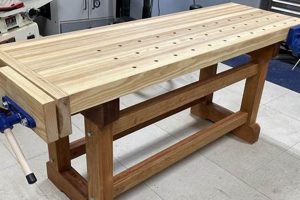
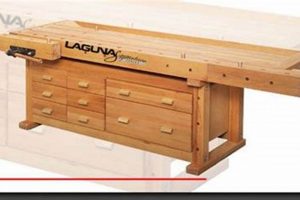
The optimal elevation for a carpentry workstation is a critical factor in ensuring efficient and comfortable task execution. A properly configured surface facilitates precise material manipulation, minimizes strain, and promotes overall safety during woodworking activities. This measurement typically considers the user’s stature and the nature of the intended work.
Appropriate table elevation significantly impacts productivity and long-term physical well-being. Historically, craftspeople adapted their work surfaces to suit their individual needs and body mechanics. The advantages of a tailored setup include reduced fatigue, enhanced accuracy, and prevention of musculoskeletal issues. These considerations contribute to a more enjoyable and sustainable woodworking practice.
Subsequent sections will examine methodologies for determining a user-specific surface elevation, explore the relationship between work style and optimal measurement, and discuss adjustable bench designs that accommodate diverse project requirements and operator preferences.
Optimizing Carpentry Workstation Elevation
The following guidelines assist in establishing a carpentry workstation that promotes efficient and comfortable operation, minimizing physical strain and maximizing productivity.
Tip 1: Consider Dominant Task: The nature of the primary woodworking tasks should influence the elevation. For detailed handwork, a higher surface may be preferred, while power tool operations may necessitate a lower stance for stability and control.
Tip 2: Employ the Elbow Rule: A common method involves adjusting the surface to approximately elbow height when standing. This allows for a neutral wrist position and reduces shoulder strain during many tasks.
Tip 3: Factor in Vise Placement: If a vise is regularly used, its position should be considered when setting the overall surface. Adjustments may be required to ensure comfortable clamping and material manipulation.
Tip 4: Prototype with Mockups: Before finalizing, use temporary supports to test various levels with sample tasks. This provides practical insight into the ergonomic suitability of each position.
Tip 5: Account for Footwear: The type of footwear typically worn while woodworking can affect overall body height. This variable needs to be factored into the final adjustment.
Tip 6: Prioritize Adjustability: Whenever feasible, select or construct a workstation with adjustable legs. This allows for fine-tuning the elevation to accommodate different projects and users.
Tip 7: Iterate and Refine: The optimal elevation may require periodic adjustments as work habits evolve. Regular assessment and modification can help maintain a comfortable and productive workspace.
Adhering to these tips results in a carpentry workstation tailored to individual needs, promoting comfort, efficiency, and long-term physical well-being.
The following section will delve into the long-term health implications of an inappropriately sized workstation.
1. Elbow Height Proximity

The principle of elbow height proximity serves as a foundational guideline in determining an appropriate elevation for a carpentry workstation. It posits that positioning the work surface near the user’s elbow height, when standing, facilitates a posture that minimizes strain and optimizes control. Deviation from this proximity can lead to compromised ergonomics and increased risk of musculoskeletal disorders. For example, a surface that is too low necessitates excessive bending, stressing the lower back, while one that is too high forces the shoulders to elevate, causing tension in the neck and upper back. The integration of elbow height proximity into the overall workstation design directly impacts the user’s physical comfort and productivity.
Practical application of this principle requires careful measurement and consideration of individual body mechanics. Elbow height can be accurately determined by measuring the distance from the floor to the elbow joint while the individual is standing upright with relaxed shoulders. This measurement then serves as a benchmark for setting or adjusting the workbench surface. Furthermore, it’s essential to recognize that elbow height proximity is not an absolute; minor adjustments may be needed to accommodate specific tasks or preferences. For instance, detailed carving might benefit from a slightly higher surface, while heavy planing could be more efficient with a surface positioned marginally lower.
In summary, elbow height proximity is a critical factor in establishing a carpentry workstation that supports a sustainable and efficient workflow. While not a rigid rule, it provides a valuable starting point for configuring a surface that minimizes physical strain and promotes a comfortable and productive working environment. The challenge lies in adapting this principle to individual needs and task-specific requirements, necessitating careful assessment and iterative adjustments. Understanding and applying this principle are essential for woodworkers who prioritize their long-term health and working enjoyment.
2. Task-Specific Elevation

The optimal elevation for a carpentry workstation is intrinsically linked to the specific tasks to be performed. A universal surface is unlikely to provide ideal ergonomics for all woodworking operations. Therefore, understanding how different tasks influence the determination of elevation is critical.
- Hand Tool Operations
Tasks involving hand tools, such as chiseling or carving, often benefit from a higher work surface. This elevation reduces the need for excessive bending, promoting a more upright posture and minimizing strain on the lower back. The increased proximity to the workpiece also enhances visibility and control.
- Power Tool Operations
Activities involving power tools, such as routing or sanding, typically require a lower surface. This lower stance provides greater stability and control, especially when working with larger pieces or resisting the torque generated by the tool. The reduced height lowers the center of gravity, enhancing safety.
- Assembly and Finishing
Assembly and finishing operations may necessitate an intermediate elevation. This allows for comfortable manipulation of components during assembly and provides adequate space for applying finishes without excessive reaching or bending. The height should facilitate a clear view of the entire assembly.
- Detailed Work and Precision
For tasks demanding high precision, such as intricate joinery, a slightly elevated surface can be advantageous. The increased height allows for closer visual inspection of the workpiece and enhances fine motor control. Proper lighting becomes even more critical at this height.
These task-specific considerations underscore the importance of adjustability in carpentry workstations. An adjustable surface enables woodworkers to tailor the elevation to the demands of each project, optimizing ergonomics and promoting both efficiency and safety. While elbow height serves as a useful benchmark, the final determination should always reflect the specific nature of the work being undertaken.
3. Vise Integration

The integration of a vise into a carpentry workstation design is inextricably linked to determining the optimal surface elevation. A vise’s functionality is directly influenced by its positioning relative to the user, therefore, its height relative to the work surface must be carefully considered during elevation planning.
- Workpiece Accessibility
The elevation of the vise jaws relative to the user’s stature determines the ease with which workpieces can be securely clamped and accessed for shaping, joining, or finishing. An improperly positioned vise necessitates excessive bending or reaching, leading to discomfort and potentially compromising the accuracy of the work. A face vise positioned too low, for instance, makes planing long boards cumbersome and fatiguing. Tail vises must also be considered.
- Leverage and Force Application
The height of the vise significantly impacts the user’s ability to apply force effectively during clamping and shaping operations. An optimally positioned vise allows the user to leverage body weight and strength efficiently, minimizing strain on the arms and shoulders. A vise that is too high or too low reduces leverage, requiring greater effort and potentially leading to inaccurate or unstable clamping.
- Ergonomic Considerations
Vise integration must prioritize ergonomic principles to minimize the risk of musculoskeletal disorders. The vise should be positioned at a height that allows for comfortable and natural hand and wrist movements during workpiece manipulation. Repeated twisting or overextension of the wrist, caused by an improperly placed vise, can contribute to carpal tunnel syndrome and other repetitive strain injuries. The elevation, in this case, must be matched to the user.
- Material Thickness and Project Type
The typical material thickness and project types undertaken influence the ideal vise placement. Working with predominantly thick stock may necessitate a lower vise position to provide stability, while thin materials may be more easily manipulated with a higher vise. The dimensions of the workpieces routinely handled should be factored into the overall workstation design to ensure that the vise can accommodate them comfortably and securely. These projects also dictate work surface height considerations.
These facets highlight the fundamental role vise integration plays in determining the optimal height of a carpentry workstation. Ignoring these considerations results in a compromised work environment, diminishing efficiency, and increasing the risk of injury. Adjusting the vise height via bench height is crucial.
4. Adjustability Imperative

The capacity to modify the elevation of a carpentry workstation is not merely a convenience but a fundamental requirement for achieving optimal ergonomics and maximizing productivity. The inherent variability in human stature, project demands, and task-specific needs necessitates a system that allows for customization. The concept of adjustability transitions a static workstation into a dynamic environment suited to the diverse needs of its operator.
- Accommodating Varied Anthropometry
Human dimensions exhibit significant variation. A workstation fixed at a single height is unlikely to be ergonomically suitable for individuals of differing statures. Adjustability provides the means to tailor the work surface to the user’s specific body dimensions, ensuring a comfortable and efficient working posture. The implications of this are reduced fatigue, decreased risk of musculoskeletal disorders, and enhanced work quality.
- Adapting to Diverse Tasks
Woodworking encompasses a wide range of tasks, each with unique ergonomic requirements. Finer detail work may benefit from a higher surface, whereas power tool operations often necessitate a lower stance for stability. Adjustability allows for adapting the workstation elevation to match the specific demands of the task at hand, optimizing both control and comfort. This adaptability is crucial for sustained productivity and accuracy.
- Facilitating Collaborative Work
In shared workshop environments, multiple users with varying physical characteristics may utilize the same workstation. Adjustability enables rapid reconfiguration to suit the needs of each individual, promoting collaboration and minimizing the potential for ergonomic conflicts. This shared adjustability promotes safety, productivity and efficiency of shared work space.
- Mitigating Physical Strain and Promoting Longevity
A static and inappropriate workstation height contributes to musculoskeletal strain. The constant repetition of unnatural postures leads to discomfort, fatigue, and ultimately, potential long-term injuries. Adjustability, however, empowers users to fine-tune their working environment, ensuring that the workstation supports proper posture and minimizes physical stress. This adaptability contributes to the overall well-being and sustained productivity of the woodworker over many years.
In conclusion, adjustability is not an optional feature but an essential attribute of a well-designed carpentry workstation. The capacity to adapt to varying anthropometry, diverse tasks, collaborative environments, and the imperative to mitigate physical strain underscores its importance. A truly optimized workstation leverages adjustability to create a dynamic and ergonomically sound environment, promoting both efficiency and the long-term health of the woodworker.
5. Postural Alignment

The elevation of a carpentry workstation directly influences the user’s postural alignment, impacting long-term physical health and work efficiency. An improperly configured surface compels individuals to adopt compensatory postures, disrupting natural spinal curves and leading to musculoskeletal imbalances. For instance, a surface positioned too low forces excessive forward bending, increasing stress on the lumbar spine and promoting lower back pain. Conversely, an elevated surface necessitates shoulder elevation and neck extension, potentially leading to tension headaches and upper back discomfort. These postural deviations, sustained over prolonged periods, contribute to chronic pain and reduced work capacity. Maintaining correct posture is a critical element of the correct woodworking bench height.
Optimal postural alignment during woodworking tasks requires a surface that facilitates a neutral spinal position. This entails maintaining the natural curves of the spine, minimizing excessive flexion, extension, or lateral bending. Achieving this neutral posture depends on factors beyond surface elevation, including chair height (if seated), the proximity of tools and materials, and the frequency of breaks. For example, a woodworker engaging in detailed carving might benefit from a slightly higher surface and a supportive chair, allowing them to maintain an upright posture and minimizing strain on the neck and shoulders. Proper arrangement of tools also minimize unnecessary movement.
Understanding the connection between surface elevation and postural alignment is paramount for promoting a safe and productive woodworking environment. By carefully considering individual body dimensions, task requirements, and ergonomic principles, individuals can configure workstations that support correct posture and minimize the risk of musculoskeletal injuries. Prioritizing adjustability and promoting awareness of proper body mechanics are essential steps in creating a sustainable and health-conscious woodworking practice. This can be accomplished through careful planning, and trial and error using mock ups to find the optimal height and position relative to the user.
6. Long-Term Health
Sustained physical well-being is directly affected by the ergonomic configuration of a carpentry workstation. The elevation of the work surface, in particular, plays a critical role in preventing musculoskeletal disorders and promoting sustained health over a woodworker’s career. Improper setup can lead to chronic pain, reduced mobility, and decreased overall quality of life.
- Spinal Health and Disc Degeneration
A workstation height positioned too low or too high necessitates sustained bending or reaching, placing undue stress on the spinal discs. Over time, this can accelerate disc degeneration, leading to chronic back pain, sciatica, and reduced spinal mobility. A surface height that facilitates a neutral spinal position minimizes this risk, preserving long-term spinal health. Regular stretching and movement, however, is paramount.
- Joint Stress and Arthritis
Improperly elevated surfaces contribute to increased joint stress, particularly in the wrists, elbows, shoulders, and knees. Repetitive movements performed at an unnatural angle exacerbate this stress, potentially accelerating the development of osteoarthritis. A workstation height optimized for ergonomic comfort minimizes joint strain, contributing to long-term joint health and mobility. Proper tool choice also plays a factor.
- Muscular Imbalances and Chronic Pain Syndromes
Sustained awkward postures resulting from an inadequately configured surface lead to muscular imbalances, with some muscles becoming shortened and tight, while others become weakened and elongated. These imbalances contribute to chronic pain syndromes, such as tension headaches, carpal tunnel syndrome, and thoracic outlet syndrome. A surface designed to promote neutral posture helps maintain muscular balance, reducing the risk of these debilitating conditions. Taking breaks is also helpful in this regard.
- Circulatory Compromise and Nerve Compression
Constricted postures induced by an ill-fitting workstation limit proper circulation and potentially compress nerves. Prolonged sitting with bent knees, or leaning forward, compromises blood flow and can lead to nerve impingement, resulting in numbness, tingling, and pain in the extremities. A station that allows for variations in posture and facilitates free movement of the limbs promotes healthy circulation and prevents nerve compression, contributing to long-term vascular and neurological health. The height of the bench is a crucial factor to consider.
These interlinked factors highlight the profound connection between workstation elevation and long-term physical well-being. Investing in an adjustable and ergonomically sound carpentry workstation represents a proactive approach to safeguarding health and ensuring a sustainable and fulfilling career in woodworking. This careful consideration will help prolong an active lifestyle beyond work.
Frequently Asked Questions
This section addresses common queries regarding the appropriate height for a woodworking bench, offering clarity and guidance based on established ergonomic principles.
Question 1: Is there a universally recommended height for a carpentry workstation?
No, a universally applicable measurement does not exist. The ideal surface elevation is contingent upon the individual’s stature, the type of woodworking tasks performed, and the presence of features such as a vise.
Question 2: What is the “elbow rule” and how does it relate to surface elevation?
The “elbow rule” suggests positioning the work surface at approximately elbow height when standing. This provides a starting point for adjusting the bench, promoting a neutral wrist position and minimizing shoulder strain. Adjustments should then be made based on specific task needs.
Question 3: Does the height of a woodworking vise influence the optimal surface elevation?
Yes. The vise placement directly impacts the user’s reach and posture during clamping and material manipulation. The bench should be configured to ensure comfortable and efficient vise operation, potentially necessitating adjustments to the overall elevation.
Question 4: Why is adjustability a desirable feature in a carpentry workstation?
Adjustability allows the user to fine-tune the work surface to accommodate varying project requirements, individual preferences, and changes in physical condition. It promotes versatility and minimizes the risk of musculoskeletal issues.
Question 5: How does the type of woodworking task influence the ideal surface elevation?
Detailed handwork may benefit from a slightly higher surface, while power tool operations generally require a lower stance for stability. The nature of the primary tasks should be considered when determining the optimal elevation.
Question 6: What are the long-term health consequences of an inappropriately sized workstation?
Prolonged use of a workstation with an improper elevation can contribute to chronic back pain, neck strain, carpal tunnel syndrome, and other musculoskeletal disorders. A correctly sized and ergonomically sound setup is essential for preserving long-term physical well-being.
Optimal surface elevation is not static; it necessitates careful assessment and adjustment to individual requirements. Adhering to ergonomic principles and prioritizing adjustability promotes a safe and productive woodworking environment.
The next section will address the tools and techniques used to measure and adjust woodworking bench height.
Determining the Optimal Carpentry Workstation Elevation
This discourse has explored the multifaceted considerations involved in establishing the most suitable elevation for a carpentry workstation. Key aspects highlighted encompass the principle of elbow height proximity, the task-specific nature of elevation requirements, the importance of vise integration, the imperative of adjustability, the significance of maintaining postural alignment, and the critical link between workstation height and long-term musculoskeletal health. These interconnected factors emphasize that a singular “best height for woodworking bench” is a misnomer; rather, optimal surface elevation is a personalized and dynamic attribute.
The commitment to implementing these ergonomic principles is an investment in both immediate work efficiency and sustained physical well-being. The ongoing assessment and refinement of workstation configuration remain crucial for woodworkers dedicated to maximizing productivity while mitigating the risk of long-term health complications. Prioritizing a tailored and adaptable work environment will serve as a foundation for a safe, efficient, and enduring career in woodworking.

![Top-Rated Best Portable Woodworking Bench [2024 Guide] | Step-by-Step Guides, Tools & Inspiration to Build Beautiful Wooden Decor on a Budget](https://woodfromhome.com/wp-content/uploads/2026/05/th-181-300x200.jpg "Top-Rated Best Portable Woodworking Bench [2024 Guide] Step-by-Step Guides, Tools & Inspiration to Build Beautiful Wooden Decor on a Budget")