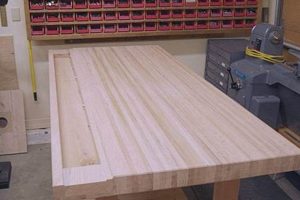
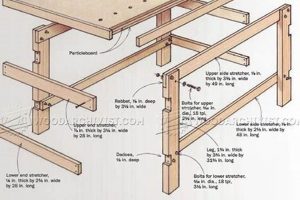
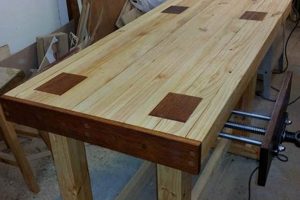
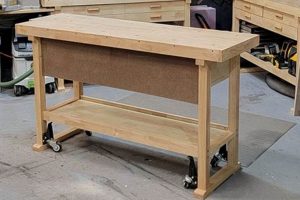
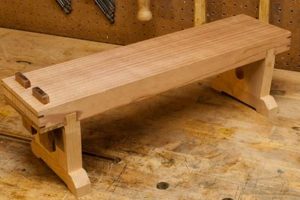
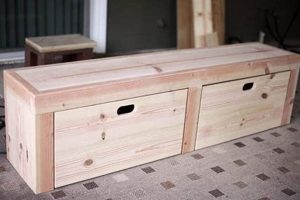
The process of constructing a sturdy and functional work surface, specifically designed for woodworking tasks, involves selecting appropriate materials, employing joinery techniques, and ensuring a stable structure. This creation serves as the central hub for a variety of woodworking projects, providing a platform for sawing, planing, assembling, and other related activities.
A well-crafted piece of furniture enhances workflow efficiency and precision. It provides a stable platform, minimizing movement and vibration during intricate operations. Historically, these structures have been integral to woodworking professions, evolving in design and function to accommodate changing techniques and tools. Their presence facilitates safer and more accurate craftsmanship, ultimately contributing to higher quality finished products.
The following sections will explore various aspects involved in creating such a fundamental element for any woodworking space, including design considerations, material selection, essential tools, and step-by-step construction processes, ensuring a practical and enduring addition to the workshop.
Essential Considerations for Fabrication
The following outlines crucial advice applicable during the construction phase. Adhering to these points can substantially improve the final product’s functionality and longevity.
Tip 1: Plan Dimensions Meticulously: Accurately assess workspace limitations before determining overall size. Insufficient planning can result in a structure that is impractical within the designated area.
Tip 2: Select Appropriate Wood Species: Hardwoods, such as maple or beech, offer superior durability and stability compared to softwoods. Choose based on anticipated usage and load-bearing requirements.
Tip 3: Emphasize Structural Rigidity: Employ robust joinery techniques, such as mortise and tenon or dovetail joints, to ensure minimal racking and deflection under load.
Tip 4: Prioritize a Flat and Level Surface: Use accurate leveling tools throughout construction to guarantee a consistently even work area. Inaccuracies will negatively impact precision woodworking.
Tip 5: Incorporate Effective Vise Placement: Strategic placement of vises is crucial for secure workpiece clamping. Consider both face and end vise options to accommodate various project sizes and orientations.
Tip 6: Integrate Storage Solutions: Incorporating drawers, shelves, or cabinets maximizes space utilization and organization. Proper storage minimizes clutter and improves workflow efficiency.
Tip 7: Apply a Durable Finish: Protect the wood surface with a durable finish, such as polyurethane or varnish, to resist moisture, scratches, and dents. Regular maintenance will extend its lifespan.
Implementing these suggestions contributes significantly to the creation of a stable, functional, and long-lasting platform for woodworking endeavors. Attention to detail during the construction phase translates directly to improved results in subsequent projects.
The concluding section will synthesize the information presented, reinforcing the significance of careful planning and execution in creating an essential and invaluable tool for any woodworking endeavor.
1. Stable Base

The structural integrity of a woodworking bench hinges significantly on the stability of its base. This foundational element directly influences the precision and safety of woodworking operations. A stable base minimizes movement, vibration, and racking, providing a secure platform for demanding tasks.
- Leg Configuration and Material Selection
The design and construction of the legs contribute directly to overall stability. Robust leg construction, employing thick timbers and secure joinery, is essential. Hardwoods such as maple or oak are frequently selected for their inherent strength and resistance to deflection under load. Widely spaced legs provide a broader footprint, enhancing resistance to tipping and lateral movement.
- Joinery Techniques
The methods used to join the legs to the benchtop and other structural components are crucial for maintaining a stable base. Mortise and tenon joints, reinforced with wedges or drawbores, offer exceptional strength and rigidity. Dovetail joints, while more complex to execute, provide superior resistance to racking forces. Poorly executed joinery can lead to instability and eventual structural failure.
- Weight Distribution and Mass
The overall weight and distribution of mass within the base contribute significantly to its stability. A heavier bench is inherently more resistant to movement and vibration. Adding weight to the lower portions of the base, such as through the use of stretchers or lower shelves, lowers the center of gravity, further enhancing stability.
- Leveling and Floor Contact
Ensuring consistent and even contact with the floor is essential for a stable base. Uneven flooring can introduce wobble and instability. Adjustable leveling feet allow for compensation for minor irregularities in the floor surface. Wide feet or pads distribute the load evenly, minimizing the risk of sinking or shifting on softer surfaces.
The integration of these facets, from material selection to meticulous joinery and attention to floor contact, collectively determines the stability of the bench’s base. A well-engineered and constructed base provides the necessary foundation for accurate, safe, and efficient woodworking, demonstrating the inextricable link between a stable base and the overall functionality of a woodworking bench.
2. Flat Work Surface

The flatness of a woodworking bench surface directly influences the precision achievable in various woodworking operations. It serves as a reference plane for accurate measurement, cutting, assembly, and finishing tasks. Deviation from flatness compromises the integrity of the project.
- Impact on Accurate Measurement and Marking
A flat surface provides a consistent reference point for measuring and marking wood. When the surface is uneven, the accuracy of measurements is compromised, leading to errors in cutting and joinery. For example, using a warped surface to mark a line for a dovetail joint can result in misaligned components and a structurally unsound joint. The lack of precision introduced at this stage propagates through the entire project.
- Effect on Stable Workpiece Support
A flat surface ensures consistent and stable support for workpieces during planing, sanding, and other operations. An uneven surface can cause the workpiece to rock or shift, making it difficult to maintain consistent pressure and achieve a uniform finish. For instance, planing a board on a surface with a bow can result in an uneven thickness or introduce unintentional curves.
- Role in Precise Assembly and Glue-Ups
During assembly and glue-up operations, a flat surface is essential for ensuring that components are properly aligned and that joints are tight and square. An uneven surface can cause components to shift or distort during the clamping process, resulting in weak or misaligned joints. Imagine assembling a cabinet on a surface that is not perfectly flat; the resulting structure may be out of square, leading to functional problems and aesthetic imperfections.
- Maintenance and Achieving Flatness
Achieving and maintaining a flat surface requires careful construction and regular maintenance. The benchtop material should be stable and resistant to warping. Techniques such as planing, scraping, and the use of flattening stones are employed to achieve a high degree of flatness. Routine checks with a straightedge and regular surface maintenance are necessary to preserve the integrity of the reference plane.
The correlation between surface flatness and the ability to execute precise woodworking operations cannot be overstated. A meticulously flattened benchtop is a prerequisite for achieving accurate cuts, stable workpiece support, and precise assemblies. The effort invested in creating and maintaining a flat work surface is directly proportional to the quality and accuracy of the finished projects.
3. Effective Clamping
Effective clamping is an indispensable element in woodworking, and its integration into the design and function is paramount. A workbench without a robust clamping system limits the scope and precision of woodworking tasks. The following examines critical facets that contribute to an effective clamping system.
- Vise Integration and Application
The incorporation of vises represents a primary method of securing workpieces. Face vises, leg vises, and tail vises offer versatility in clamping materials of varying sizes and orientations. A well-integrated vise system provides substantial holding power, minimizing workpiece movement during cutting, planing, and joinery operations. For example, a sturdy leg vise allows for the secure edge-jointing of long boards, ensuring a seamless glue-up.
- Dog Holes and Bench Dogs
Strategically placed dog holes in the workbench top, in conjunction with bench dogs, facilitate the secure clamping of larger or irregularly shaped workpieces. These elements create a flexible clamping system adaptable to various projects. Bench dogs, inserted into dog holes, act as clamping points, allowing the application of force using clamps or other securing mechanisms. This is particularly useful for securing wide panels during flattening operations.
- Clamp Storage and Accessibility
The design should incorporate readily accessible storage solutions for various types of clamps. This facilitates efficient workflow and minimizes downtime searching for the appropriate clamping device. Dedicated clamp racks or drawers ensure clamps are organized and easily retrievable. Quick access to clamps is crucial during glue-ups or when securing workpieces for intricate detailing.
- Surface Material and Friction
The surface material and texture contribute to the effectiveness of the clamping system. A surface that provides sufficient friction minimizes slippage and enhances clamping force. Materials such as rubber or non-slip coatings applied to vise jaws or bench dog surfaces increase gripping power. This is especially relevant when working with hardwoods or materials with smooth surfaces that are prone to slipping.
The facets outlined above collectively contribute to an environment conducive to precision and safety. A well-designed clamping system, incorporating robust vises, strategically placed dog holes, efficient storage, and appropriate surface friction, is an essential component of any functional, enhancing the scope and quality of woodworking endeavors.
4. Integrated Storage
Integrated storage, as a component of a woodworking bench, directly influences workshop organization and workflow efficiency. The absence of dedicated storage solutions necessitates reliance on external containers or floor-based organization, leading to spatial constraints and hindered accessibility. Conversely, the inclusion of drawers, shelves, or cabinets within the workbench footprint centralizes tool and material storage, minimizing the time spent searching for essential items. This reduction in wasted time translates to increased productivity and project completion rates. As an example, a bench equipped with drawers specifically sized for hand planes and chisels allows for immediate access to these frequently used tools, contrasting with a scenario where these tools are stored elsewhere, requiring a disruptive search process before each use.
The design of integrated storage solutions can be tailored to specific needs and tool collections. Shallow drawers accommodate small parts like screws and nails, preventing clutter and facilitating quick retrieval. Deeper cabinets provide space for larger tools, such as power sanders or routers, ensuring they are readily available yet safely stored. Open shelving can house materials like lumber or sheet goods, allowing for efficient inventory management and easy access during projects. Consider a cabinet maker’s bench featuring a combination of drawer sizes, a lower shelf for lumber, and a dedicated space for sharpening stones this represents a holistic approach to storage integration, enhancing both organization and workflow. The practicality of this understanding stems from its direct impact on the time, effort, and spatial efficiency within a woodworking environment. An organized workspace is a productive workspace, and integrated storage is a key facilitator of that organization.
The challenge inherent in integrated storage lies in balancing storage capacity with the structural integrity and working area of the bench. Overly large storage compartments can compromise the bench’s stability or reduce the available workspace. A well-designed storage solution prioritizes functionality and efficiency, optimizing space utilization without compromising the core purpose of the workbench. Ultimately, integrated storage is not merely an add-on feature, but rather an essential design element that contributes significantly to the overall effectiveness and practicality of the woodworking bench, directly affecting the user’s ability to execute projects efficiently and accurately.
5. Durable Material
The longevity and functionality of a woodworking bench are inextricably linked to the selection of durable materials. The bench, subjected to repetitive impacts, heavy loads, and potential exposure to moisture and solvents, necessitates materials capable of withstanding these stresses without significant degradation. Consequently, material choice directly influences the bench’s structural integrity, resistance to warping, and overall lifespan. For instance, a bench constructed primarily from softwood is prone to denting, splitting, and instability under load, limiting its usability and requiring frequent repairs. Conversely, hardwoods, such as maple or beech, offer superior resistance to these stresses, providing a stable and durable work surface for years of service.
Practical application demonstrates this principle clearly. Consider the differing performance of a bench constructed from construction-grade lumber compared to one made from kiln-dried hardwood. The former, often containing higher moisture content, is susceptible to warping and twisting as it equilibrates to the surrounding environment. This distortion compromises the flatness of the work surface, undermining precision woodworking tasks. The latter, properly dried and seasoned, exhibits greater dimensional stability, maintaining its flatness and structural integrity over time. Furthermore, the use of durable hardware, such as heavy-duty vises and threaded inserts, complements the robust construction, ensuring secure clamping and attachment points that can withstand repeated use and force.
In summation, the selection of durable materials is not merely a superficial consideration, but a fundamental requirement for creating a functional and lasting woodworking bench. The investment in high-quality, resilient materials translates to a reliable and stable work platform, enhancing the accuracy and efficiency of woodworking projects while minimizing the need for repairs or replacement. The relationship is causal and direct: durable materials underpin the practical utility and long-term value of any woodworking bench.
Frequently Asked Questions Regarding Woodworking Bench Construction
The following addresses common inquiries related to the design, construction, and usage of woodworking benches. The information presented is intended to provide practical guidance based on established woodworking principles.
Question 1: What constitutes the ideal height for a woodworking bench?
The optimal height is determined by individual ergonomics. A common guideline suggests the benchtop should be level with the user’s wrist when standing with arms relaxed. This minimizes strain during hand planing and other tasks performed directly on the surface.
Question 2: What wood species are recommended for bench construction?
Hardwoods, such as maple, beech, oak, and ash, are generally preferred due to their density, strength, and resistance to wear. Softwoods may be used for less critical components, but the benchtop and legs should ideally be constructed from a durable hardwood.
Question 3: How is flatness achieved and maintained on a woodworking benchtop?
Initial flatness is achieved through careful milling and assembly of the benchtop components. Subsequent maintenance involves the use of hand planes, scrapers, and occasionally power tools to remove any warping or irregularities that develop over time. Regular inspection with a straightedge is recommended.
Question 4: What are the essential clamping mechanisms for a woodworking bench?
A robust vise system is critical. Common configurations include a face vise, a tail vise (often in conjunction with bench dogs), and occasionally a leg vise. These mechanisms allow for secure clamping of workpieces during various woodworking operations.
Question 5: How should storage be integrated into a woodworking bench design?
Storage solutions should be tailored to individual needs and tool collections. Drawers, cabinets, and open shelving can be incorporated to store tools, hardware, and materials. The design should prioritize accessibility and efficient organization.
Question 6: What finishes are appropriate for a woodworking bench?
A durable finish that provides protection against moisture, scratches, and solvents is recommended. Options include oil-based finishes, varnishes, and polyurethane. The finish should be applied in multiple coats, allowing for proper curing between applications.
These responses offer foundational knowledge for those contemplating the construction of a woodworking bench. Careful consideration of these factors contributes to a more functional and enduring result.
The subsequent section will provide a concise summary of the key elements involved in constructing a woodworking bench.
Conclusion
The preceding discussion has examined critical aspects of the subject, emphasizing the integration of a stable base, flat work surface, effective clamping, integrated storage, and durable materials. Constructing a structure embodying these features necessitates careful planning and precise execution. Disregarding these principles results in a substandard platform unsuitable for demanding woodworking tasks.
Prioritizing these elements ensures the creation of a reliable and enduring workspace. Continued adherence to established woodworking practices, combined with informed material selection, will contribute to enhanced craftsmanship and efficiency. The informed application of these principles yields a tangible and lasting benefit to the woodworking endeavor.