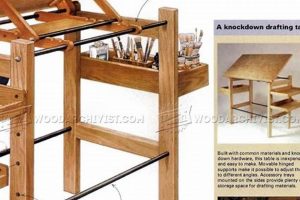
Structural supports crafted from wood, designed to elevate and stabilize a tabletop surface, are fundamental components in furniture construction. These supports, frequently made from hardwoods like maple, oak, or cherry, provide the necessary height and stability for a table, allowing it to serve its intended purpose, whether dining, working, or displaying objects.
The selection of appropriate materials and construction techniques for these supports is paramount to the overall durability and aesthetic appeal of the finished table. Historically, the design of these supports has reflected evolving stylistic trends, ranging from simple, functional forms to ornate, decorative elements. Their proper design and execution are crucial not only for the structural integrity of the table but also for its visual balance and ergonomic suitability.
The subsequent discussion will delve into various aspects of their creation, including material selection, joinery methods, design considerations related to style and load-bearing capacity, and techniques for finishing and protecting the wood surface.
Essential Guidance on Crafting Stable and Aesthetic Table Supports
The following guidelines offer crucial insights into achieving superior results when constructing structural supports for tables, emphasizing both structural integrity and visual appeal. Adherence to these principles will enhance the longevity and overall quality of the finished piece.
Tip 1: Material Selection: Employ hardwoods such as maple, oak, or walnut for increased durability and resistance to wear. The chosen wood should be kiln-dried to minimize warping or cracking after construction.
Tip 2: Joint Design: Utilize robust joinery techniques like mortise and tenon, dovetail, or bridle joints to ensure maximum structural strength. The selected joint should be appropriate for the anticipated load and stress.
Tip 3: Grain Orientation: Consider the grain direction of the wood to optimize strength and prevent splitting. Align the grain along the length of the support for greater resistance to bending forces.
Tip 4: Tapering Techniques: Employ tapering to enhance the aesthetic appeal and visual lightness of the supports. Consistent and even tapering demonstrates a commitment to detail and craftsmanship.
Tip 5: Foot Design: Integrate feet or levelers to protect flooring and accommodate uneven surfaces. The design of the feet should complement the overall style of the table.
Tip 6: Finishing Application: Apply a durable finish, such as polyurethane or varnish, to protect the wood from moisture and scratches. Multiple coats, with proper sanding between applications, will yield a superior result.
Tip 7: Dry Assembly: Conduct a dry assembly before applying glue or fasteners to ensure proper fit and alignment. This step allows for adjustments and prevents potential errors during final assembly.
Consistent application of these guidelines will contribute to the creation of stable, visually appealing, and enduring table supports. Attention to detail in material selection, joinery, and finishing is essential for achieving professional-grade results.
The following sections will further examine design considerations and advanced techniques for crafting unique and functional table supports.
1. Material Durability

The selection of materials significantly impacts the longevity and structural integrity of structural table supports. The inherent strength and resistance to wear and tear of the chosen wood directly influence the table’s ability to withstand load, resist environmental factors, and maintain its aesthetic appeal over time. Consequently, selecting durable materials is paramount to ensuring a lasting product. For instance, utilizing a softwood like pine for heavy-duty table supports could result in premature failure due to its lower density and susceptibility to denting and warping. Conversely, employing hardwoods such as oak, maple, or walnut provides enhanced resistance to these stresses, extending the table’s lifespan and reducing the likelihood of structural issues.
The practical application of material durability principles manifests in various design and construction choices. Identifying the intended use of the table is critical in determining the appropriate material. A dining table, subject to frequent use and potential spills, requires a more durable wood and finish than a decorative side table. Likewise, tables intended for outdoor use necessitate materials resistant to moisture, insect infestation, and UV degradation. Utilizing rot-resistant woods like cedar or teak, in conjunction with weather-resistant finishes, mitigates these risks. Furthermore, understanding the mechanical properties of different wood species allows for informed decisions regarding the dimensions and joint designs of the table supports, ensuring adequate strength and stability under load.
In summary, material durability is a non-negotiable aspect of crafting quality table supports. Its influence pervades the entire design and construction process, from wood selection to finishing application. Overlooking this crucial element compromises the table’s structural integrity, aesthetic appeal, and overall value. While initial material costs may vary, investing in durable materials ultimately translates to long-term cost savings and a more sustainable product.
2. Joint Strength

The structural integrity of a table, and consequently its utility, is directly proportional to the strength of the joints connecting its supports to the tabletop and to each other. Weak joints represent a critical failure point, leading to instability, wobbling, and eventual collapse under load. Thus, the selection and execution of appropriate joinery techniques are paramount in the construction of durable and reliable structural table supports. For example, a simple butt joint, secured only with fasteners, is insufficient for supporting a heavy tabletop, whereas a mortise and tenon joint, properly fitted and glued, provides significantly greater resistance to shear and tensile forces.
The selection of a specific joint design is contingent upon several factors, including the anticipated load, the type of wood being used, and the aesthetic requirements of the design. A dovetail joint, known for its exceptional tensile strength, is often employed in situations where resistance to racking forces is critical. A bridle joint, where one member straddles the other, offers a balance of strength and ease of construction. In scenarios where aesthetics are paramount, hidden or less visually obtrusive joints, such as dowel joints or pocket hole joints, may be preferred, provided they offer sufficient strength for the intended application. Furthermore, proper joint preparation, including precise cuts and a snug fit, is essential to maximizing the effectiveness of any joinery technique. Gaps or inconsistencies in the joint reduce the glue surface area and create stress concentrations, weakening the overall structure.
In conclusion, joint strength is an indispensable element in the construction of robust structural table supports. Its impact extends beyond mere structural stability, influencing the longevity, safety, and overall usability of the table. Understanding the principles of joint design, selecting appropriate joinery techniques, and executing them with precision are therefore critical skills for any woodworking professional. Overlooking this fundamental aspect inevitably compromises the quality and value of the finished product.
3. Design Aesthetics

Design aesthetics, in the context of structural table supports, encompasses the visual attributes that contribute to the overall appeal and stylistic coherence of a table. It is not merely an ornamental consideration, but an integral aspect that influences the perceived value, function, and integration of the piece within its intended environment. The visual language of the supports communicates intent and can evoke specific emotional responses in the observer. Therefore, the thoughtful consideration of design aesthetics is crucial to the successful creation of a refined and harmonious table.
- Form and Proportion
The shape and dimensions of the supports directly impact the visual balance and stability of the table. Slender, tapered supports may convey elegance and lightness, while thicker, more robust supports suggest strength and stability. The proportions of the supports relative to the tabletop influence the overall visual harmony of the piece. Incorrect proportions can lead to a sense of imbalance or awkwardness. For example, excessively thin supports under a large, heavy tabletop would appear inadequate and visually unappealing.
- Style and Ornamentation
The style of the supports should align with the overall design aesthetic of the table and its intended environment. Simple, minimalist supports are appropriate for contemporary settings, while ornate, carved supports may be more suitable for traditional or period-style interiors. Ornamentation, such as carvings, moldings, or inlays, can add visual interest and detail, but should be used judiciously to avoid overwhelming the design. The choice of ornamentation should complement the wood species and finish, creating a cohesive and unified aesthetic.
- Wood Grain and Color
The natural grain patterns and color variations of the wood can significantly impact the visual appeal of the supports. Straight-grained woods offer a clean and uniform look, while figured woods, such as curly maple or burl, add visual texture and character. The color of the wood should complement the tabletop and the surrounding environment. Darker woods may convey a sense of formality and elegance, while lighter woods offer a more casual and contemporary feel. The selection of wood grain and color should be carefully considered to achieve the desired aesthetic effect.
- Surface Finish and Texture
The surface finish applied to the supports plays a critical role in enhancing their visual appeal and protecting the wood from damage. A smooth, polished finish can accentuate the natural beauty of the wood grain, while a textured finish can add visual depth and character. The choice of finish should be appropriate for the intended use of the table and its environment. A durable, water-resistant finish is essential for tables that will be exposed to moisture or spills. The finish should also be compatible with the wood species and the design aesthetic of the table.
These facets of design aesthetics, when applied thoughtfully and consistently, contribute to the creation of table supports that are not only structurally sound but also visually appealing and harmonious. The successful integration of form, style, wood characteristics, and surface finish elevates the table from a mere functional object to a piece of furniture that enhances the aesthetic quality of its surroundings. The considered application of design principles ensures that the supports complement the tabletop and fulfill their role in supporting and elevating the design as a whole.
4. Tapering Precision
The precise tapering of structural wooden supports directly influences both the structural integrity and visual refinement of a table. Inaccuracies in tapering, such as inconsistent angles or uneven surfaces, can compromise the stability of the table and detract from its aesthetic value. The act of tapering redistributes material, reducing bulk where strength is not critical while maintaining support where it is most needed. This is particularly relevant in table construction, where supports often bear significant weight. For instance, supports intended for a dining table must withstand substantial downward force; a poorly executed taper could weaken the support at a crucial point, potentially leading to failure. Furthermore, visual uniformity in tapering contributes significantly to the perception of craftsmanship. Imagine a table where one support exhibits a different taper angle than the others; the asymmetry would be immediately noticeable, undermining the overall design.
The practical application of precise tapering techniques is evident in various woodworking styles and traditions. In Shaker furniture, for example, a subtle taper is often applied to supports to create a sense of lightness and elegance without sacrificing structural integrity. This requires meticulous planning and execution, often involving specialized jigs and measuring tools to ensure consistent results across all components. Similarly, in contemporary designs, complex tapers may be employed to achieve specific aesthetic goals, such as creating a dynamic, flowing form. In these cases, computer-aided design (CAD) software and CNC (Computer Numerical Control) machining may be utilized to achieve the required level of accuracy and repeatability. Regardless of the specific technique, the principle remains the same: precise tapering is essential for achieving both structural soundness and visual harmony.
In conclusion, tapering precision is a critical factor in the creation of high-quality structural supports for tables. It directly affects both the structural stability of the table and its overall aesthetic appeal. While achieving consistent and accurate tapers can be challenging, the benefits in terms of enhanced structural performance and visual refinement are considerable. The pursuit of precision in tapering reflects a commitment to quality craftsmanship and a deep understanding of the interplay between form and function in furniture design. Moreover, embracing tapering precision addresses the potential risk of structural weakness, aesthetic incongruence, and ultimately, the compromised longevity of the piece.
5. Foot Stability

Foot stability, the measure of a table support’s ability to remain firmly planted on a surface without wobbling or tipping, represents a critical functional attribute directly influenced by the design and construction of woodworking table legs. Instability in a table support compromises its utility, rendering it unsuitable for its intended purpose. The connection between the two is causal; the design and execution of the legs directly affect foot stability. A poorly designed or constructed table support, regardless of the quality of the tabletop, will lead to an unstable table. Consider, for example, a table support crafted with uneven leg lengths. This immediately introduces instability, preventing the table from sitting level. Similarly, supports with feet that are not properly aligned or are constructed from materials susceptible to warping will exhibit instability over time.
The importance of foot stability extends beyond mere functionality; it impacts safety and user experience. A wobbly table can cause spills, create a hazardous work surface, and be generally frustrating to use. To address this, woodworking table legs often incorporate features that enhance stability. Leveling feet, for instance, allow for fine adjustments to compensate for uneven floors. Similarly, the inclusion of stretchers, which connect the legs near the bottom, increases the overall rigidity of the structure and reduces the likelihood of wobbling. The choice of materials also plays a role; denser hardwoods are less prone to warping and compression, contributing to long-term foot stability. The practical significance of understanding this connection lies in the ability to design and construct tables that are both functional and durable. Furniture makers can anticipate potential stability issues and proactively incorporate design elements to mitigate these risks.
In summary, foot stability is an indispensable characteristic of well-designed and constructed woodworking table legs. The design and materials used must carefully consider the support’s propensity to remain fixed and the potential destabilizing effects of uneven surfaces or structural weakness. By prioritizing foot stability, furniture makers can create tables that provide a safe, reliable, and enjoyable user experience. The long-term stability of table legs affects their overall function and user satisfaction as well.
6. Finish Protection
The application of a protective finish to woodworking table legs directly impacts their longevity and resistance to environmental stressors. Wood, inherently susceptible to moisture, abrasion, and ultraviolet radiation, benefits significantly from a barrier that mitigates these degrading factors. The absence of adequate finish protection initiates a cascade of detrimental effects, ranging from surface scratches and discoloration to warping, cracking, and ultimately, structural failure. Conversely, a well-applied finish acts as a shield, preserving the integrity and aesthetic quality of the wood. Consider, for instance, table supports used in a dining environment; frequent contact with liquids, cleaning agents, and abrasive materials necessitates a robust finish to prevent staining, water damage, and wear. Without such protection, the supports would rapidly deteriorate, requiring costly repairs or replacement.
The selection of an appropriate finish is contingent upon several variables, including the wood species, the intended use of the table, and the desired aesthetic. Polyurethane finishes, known for their durability and resistance to moisture and chemicals, are well-suited for high-traffic areas. Oil-based finishes, such as varnish or linseed oil, penetrate the wood fibers, providing enhanced protection against moisture and creating a rich, lustrous appearance. Shellac, a natural resin, offers a delicate finish that is easily repairable but less resistant to water and chemicals. The application technique is equally critical; multiple thin coats, properly sanded between applications, yield a more durable and aesthetically pleasing result than a single thick coat. Proper surface preparation, including sanding to a smooth, even surface, is also essential for ensuring optimal adhesion and performance of the finish.
In conclusion, finish protection is an indispensable element in the construction of durable and aesthetically pleasing woodworking table legs. Neglecting this crucial aspect compromises the long-term integrity and appearance of the table. The careful selection and application of an appropriate finish, tailored to the specific needs of the wood and its intended use, safeguards against environmental damage, extends the lifespan of the table supports, and maintains its aesthetic value for years to come. This preservation reduces potential costs associated with repair or replacement.
7. Wood Selection
The selection of wood directly impacts the structural integrity, aesthetic appeal, and longevity of structural table supports. Wood choice is not merely a cosmetic decision; it is a fundamental engineering consideration that influences the table’s ability to withstand load, resist environmental factors, and maintain its visual characteristics over time. Hardwoods such as oak, maple, and walnut possess greater density and inherent strength compared to softwoods like pine or fir, making them better suited for applications requiring high load-bearing capacity. The practical consequence of selecting an inappropriate wood species is premature structural failure, warping, or excessive wear, necessitating costly repairs or replacements. For example, using pine for heavy dining tables is a common cause of sag and instability. The proper choice ensures structural integrity and longevity, thus a careful selection is important for stable table.
Beyond structural considerations, wood selection significantly influences the aesthetic quality of the table. Different wood species exhibit unique grain patterns, colors, and textures that contribute to the overall visual style. Cherry, for instance, is prized for its rich reddish-brown hue and smooth grain, lending a sense of warmth and elegance. Conversely, maple offers a lighter, more contemporary aesthetic with its subtle grain patterns. The choice of wood should align with the desired design aesthetic and complement the other elements of the table, such as the tabletop and finish. Wood selection is also important when considering environmental factors. It is always advantageous to consider the wood properties to reduce potential damage.
In summary, the selection of wood is a critical factor in the construction of high-quality structural table supports. It is not merely a cosmetic consideration but a fundamental engineering decision that directly affects the table’s structural integrity, aesthetic appeal, and longevity. Careful consideration of wood properties, such as strength, density, grain pattern, and color, is essential for achieving optimal results. The choice of wood greatly affects the outcome; neglecting proper wood choices can lead to compromised structural integrity and a shortened lifespan. Properly chosen woods extend the product lifecycle and enhances its overall value.
Frequently Asked Questions
The following section addresses common inquiries concerning the design, construction, and material considerations pertinent to structural table supports. These questions aim to clarify key concepts and provide practical guidance for woodworking professionals and enthusiasts.
Question 1: What hardwoods are most suitable for crafting durable structural table supports?
Oak, maple, walnut, and cherry are generally considered optimal choices for crafting durable table supports. These hardwoods possess a high strength-to-weight ratio, excellent resistance to wear, and favorable woodworking properties. Each species offers distinct aesthetic characteristics, allowing for versatile design options.
Question 2: Which joinery techniques are most effective for ensuring the structural integrity of table supports?
Mortise and tenon joints, dovetail joints, and bridle joints are among the most robust joinery techniques for securing table supports. These methods provide a strong mechanical interlock, distributing stress effectively and minimizing the risk of joint failure. The selection of an appropriate joinery method should consider the anticipated load and the specific design requirements of the table.
Question 3: What factors influence the stability of table supports?
Leg length, foot design, material properties, and the presence of stretchers or aprons all contribute to the stability of table supports. Uneven leg lengths introduce instability, while poorly designed feet can compromise ground contact. The use of stable, warp-resistant materials and the addition of structural bracing enhance overall stability.
Question 4: How does tapering affect the structural performance of table supports?
Tapering can enhance the aesthetic appeal and reduce the visual weight of table supports. However, excessive or improperly executed tapering can compromise structural integrity. The degree of tapering should be carefully calculated to ensure adequate load-bearing capacity, particularly in the lower sections of the supports.
Question 5: What protective finishes are recommended for woodworking table legs?
Polyurethane, varnish, and oil-based finishes offer varying degrees of protection against moisture, abrasion, and ultraviolet radiation. The selection of an appropriate finish depends on the wood species, the intended use of the table, and the desired aesthetic characteristics. Multiple thin coats are generally preferred over a single thick coat for optimal durability.
Question 6: How does wood grain orientation impact the strength and stability of table supports?
Orienting the wood grain along the length of the table supports maximizes their resistance to bending forces. This alignment ensures that the wood fibers are aligned with the primary stress vectors, preventing splitting or cracking under load. Careful attention to grain orientation is particularly important when working with highly figured or knotty wood.
In summary, a comprehensive understanding of material properties, joinery techniques, design considerations, and finishing methods is essential for crafting durable and aesthetically pleasing structural table supports. Prioritizing these factors ensures the creation of high-quality tables that withstand the test of time.
The subsequent section will explore advanced techniques and design innovations in table support construction.
Conclusion
This exploration of woodworking table legs has illuminated the multifaceted considerations critical to their design and construction. From the selection of durable hardwoods and robust joinery techniques to the precise execution of tapers and the application of protective finishes, each element contributes significantly to the structural integrity, aesthetic appeal, and longevity of the finished piece. Furthermore, understanding the importance of stable feet and appropriate wood grain orientation is essential for creating tables that are both functional and visually harmonious.
The pursuit of excellence in crafting structural table supports demands a commitment to both technical proficiency and artistic vision. As woodworking continues to evolve, a thorough comprehension of these fundamental principles will remain paramount for creating enduring and valuable pieces of furniture. Continued adherence to these best practices will ensure both longevity and visual appeal for years to come.
![Jefferson Woodworking Slide Table: [Benefits] & [Uses] | Step-by-Step Guides, Tools & Inspiration to Build Beautiful Wooden Decor on a Budget](https://woodfromhome.com/wp-content/uploads/2026/05/th-35-300x200.jpg "Jefferson Woodworking Slide Table: [Benefits] & [Uses] Step-by-Step Guides, Tools & Inspiration to Build Beautiful Wooden Decor on a Budget")