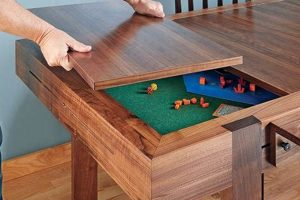
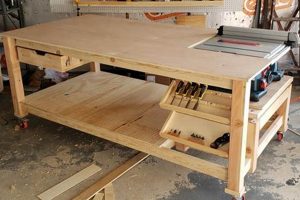
The crafting of billiard tables from timber represents a specialized area within woodworking. It involves the careful selection, shaping, and joinery of wood to create a stable and precise playing surface, as well as a visually appealing and structurally sound frame. An example is a table constructed from solid maple, featuring intricate leg carvings and a perfectly leveled slate bed.
Precision in this craft is paramount to ensure fair gameplay. The characteristics of the materials chosen, such as wood density and resistance to warping, directly affect the table’s longevity and playability. Historically, these tables were symbols of wealth and leisure, often showcasing elaborate designs that reflected the prevailing artistic styles of the time. Modern iterations continue to emphasize craftsmanship and quality, offering durable and aesthetically pleasing additions to homes and recreational spaces.
The following sections will delve into the specific aspects of timber selection, construction techniques, finishing processes, and maintenance considerations associated with creating and preserving a high-quality example of this handcrafted furniture.
Tips for a Quality Billiard Table Made of Wood
Achieving a superior billiard table from timber requires careful attention to detail throughout the entire process. The following are essential considerations for ensuring optimal performance and longevity.
Tip 1: Wood Selection: Employ hardwoods such as maple, oak, or cherry. These species offer the necessary density and stability to resist warping and provide a solid foundation for the playing surface. Avoid softwoods, as they are prone to denting and are less dimensionally stable.
Tip 2: Slate Bed Preparation: The slate must be precisely leveled and seamlessly joined. Even minor imperfections will affect ball roll. Secure the slate to the frame with robust fasteners and a vibration-dampening adhesive.
Tip 3: Frame Construction: Utilize mortise-and-tenon or dovetail joints for maximum structural integrity. The frame must be perfectly square and rigid to support the weight of the slate and resist deformation over time. Reinforcement with metal brackets at critical stress points is advisable.
Tip 4: Cloth Selection and Installation: Opt for high-quality billiard cloth made from a blend of wool and nylon. Install the cloth tautly and evenly, ensuring no wrinkles or creases. Proper stretching is crucial for consistent ball speed and accuracy.
Tip 5: Rail Cushion Material: Use high-grade rubber cushions that meet professional standards for rebound and durability. Ensure consistent cushion height and angle around the entire perimeter of the table. Securely adhere the cushions to the rails with appropriate adhesive.
Tip 6: Leveling Procedures: Employ a precision level to achieve a perfectly flat playing surface. Use adjustable leg levelers to compensate for uneven floors. Re-level the table periodically to maintain optimal performance.
Tip 7: Finishing Techniques: Apply a durable finish that protects the wood from moisture and wear. Multiple coats of varnish or lacquer are recommended. Sand between coats for a smooth, consistent surface.
Adhering to these guidelines will contribute significantly to the creation of a durable, accurate, and aesthetically pleasing timber billiard table. The resulting product will offer years of enjoyment.
The subsequent section will provide guidance on maintaining the crafted item.
1. Material Selection

The selection of wood fundamentally dictates the performance and longevity of a billiard table. The inherent properties of the timber influence dimensional stability, resistance to warping, and overall structural integrity. Consequently, a woodworking pool table’s quality is directly proportional to the judicious selection of its constituent materials. Hardwoods, such as maple, oak, and cherry, are frequently employed due to their high density and resistance to deformation under load. These species provide a stable platform for the slate bed and minimize the likelihood of the frame distorting over time. Conversely, using softwoods compromises the table’s structural integrity, rendering it susceptible to damage and affecting gameplay accuracy. For instance, a table constructed from pine would be significantly more prone to dents and scratches compared to one made from maple.
The choice of wood also extends to the aesthetic appeal of the finished billiard table. Different wood species exhibit distinct grain patterns and coloration, allowing for a range of design possibilities. The selection process must consider the desired aesthetic and its compatibility with the intended environment. Furthermore, the finish applied to the wood must be compatible with the chosen species to ensure proper adhesion and protection. Proper material selection is not merely a preliminary step, but a critical determinant of the final product’s quality and performance. A poorly chosen wood species can lead to premature failure of the table, resulting in diminished gameplay experience and costly repairs.
In conclusion, the connection between material selection and the overall quality of a timber billiard table is undeniable. The choice of wood influences structural stability, aesthetic appeal, and long-term durability. By prioritizing hardwoods and employing careful selection processes, manufacturers and artisans can ensure that their creations provide years of enjoyment and maintain their value over time. The challenges associated with inferior wood choices underscore the practical significance of informed material selection in this specialized craft.
2. Joinery Techniques

Effective joinery is paramount in the construction of a billiard table from timber. The strength and stability of the table’s frame depend directly on the quality of the joints connecting its constituent parts. Inadequate joinery results in a compromised structure, prone to warping, sagging, and ultimately, failure. The selection of appropriate joinery techniques is therefore not merely a cosmetic consideration but a functional imperative for ensuring long-term performance. For instance, a frame employing simple butt joints secured with screws will exhibit significantly less resistance to stress compared to one utilizing mortise-and-tenon or dovetail joints. The latter methods distribute load more effectively, minimizing the risk of joint separation and maintaining the table’s structural integrity over time.
Practical applications of specific joinery methods are evident in high-quality billiard table designs. The use of full blind dovetails in the corners of the frame provides exceptional strength and resistance to racking forces. Similarly, mortise-and-tenon joints are commonly employed to connect the legs to the frame, ensuring a secure and stable base. These techniques require precision and expertise to execute correctly. Improperly cut or fitted joints introduce weaknesses that compromise the entire structure. Furthermore, the choice of adhesive used in conjunction with the joinery is also critical. High-quality wood glues provide a strong, durable bond that resists moisture and temperature fluctuations. The consequences of neglecting proper joinery extend beyond structural instability; they directly impact gameplay. A warped or sagging frame affects the levelness of the playing surface, leading to inconsistent ball roll and diminished enjoyment.
In summary, the connection between joinery techniques and the overall quality of a timber billiard table is undeniable. Effective joinery ensures structural stability, prevents warping, and ultimately contributes to a superior gameplay experience. Challenges associated with mastering advanced joinery techniques underscore the need for skilled craftsmanship and attention to detail. The enduring appeal and value of well-constructed billiard tables lie, in part, in the robust and reliable joinery that supports their form and function.
3. Surface Planarity

Surface planarity, the degree to which a surface is perfectly flat, is a critical determinant of performance in a woodworking pool table. A deviation from true flatness, even a minor one, directly influences the trajectory of billiard balls, causing them to deviate from their intended paths. The construction process, therefore, necessitates meticulous attention to ensuring a perfectly level playing field. The slate bed, typically composed of multiple sections, requires precise grinding and joining to achieve this near-perfect flatness. Any imperfections in the slate, or in the underlying support structure, will manifest as inconsistencies in ball roll. For example, if one section of the slate is slightly higher than another, balls will consistently veer towards the lower section, creating an unfair playing condition. Similarly, if the wooden frame supporting the slate is not perfectly level, the entire playing surface will be tilted, impacting the game.
Achieving and maintaining surface planarity involves a multi-faceted approach. Firstly, the timber used in the frame must be dimensionally stable to resist warping or twisting over time. Secondly, the joints connecting the frame components must be strong and rigid to prevent any shifting or settling. Thirdly, the slate must be properly supported and secured to the frame to prevent any movement. Precision leveling is an ongoing requirement. Adjustable leg levelers are typically incorporated into the design to compensate for uneven floors. Regular monitoring and adjustment are necessary to maintain optimal surface planarity. Professionals often employ precision levels and straightedges to detect and correct even minor deviations.
In summary, surface planarity is inextricably linked to the performance and quality of a timber billiard table. Deviations from true flatness directly affect gameplay, leading to inconsistent ball roll and diminished enjoyment. Achieving and maintaining planarity requires meticulous attention to material selection, joinery techniques, support structure, and ongoing maintenance. Overcoming the challenges associated with maintaining a perfectly level playing surface is fundamental to creating a high-quality and accurate woodworking pool table.
4. Cushion Rebound

Cushion rebound, the elasticity and responsiveness of the rubber cushions affixed to the rails, critically influences the gameplay dynamics of any billiard table. Its properties dictate the angle and velocity at which a billiard ball rebounds from the rail, directly affecting shot execution and overall game strategy. In the context of a woodworking pool table, the quality and installation of these cushions are essential components that significantly contribute to the table’s performance and playing experience.
- Material Composition
The rubber compound used in billiard table cushions must exhibit consistent rebound characteristics across the entire temperature range encountered in a typical indoor environment. Natural rubber and synthetic blends are common choices, each possessing distinct properties regarding elasticity, durability, and resistance to degradation. Inferior materials can harden or lose their elasticity over time, resulting in inconsistent rebound angles and diminished shot accuracy. Professional-grade cushions adhere to strict specifications regarding rebound coefficient, ensuring predictable and repeatable ball behavior.
- Profile and Geometry
The cross-sectional profile of the cushion, specifically its height and angle relative to the playing surface, dictates the impact point and angle of reflection for billiard balls. Standardized profiles, such as the L-shape or K-shape, are designed to provide consistent rebound angles and minimize ball deflection. Deviations from these established geometries can lead to unpredictable ball behavior and difficulty in executing accurate shots. Precise adherence to established profiles is crucial for maintaining fair and consistent gameplay.
- Adhesion and Mounting
The method by which the cushions are affixed to the wooden rails of the billiard table directly impacts their performance and longevity. A secure and uniform bond between the cushion and the rail is essential to prevent vibration and ensure consistent energy transfer during ball impact. Improper adhesion can result in cushion detachment, inconsistent rebound angles, and reduced cushion lifespan. High-quality adhesives, specifically formulated for bonding rubber to wood, are employed to ensure a durable and reliable connection.
- Rail Construction Influence
The composition and construction of the wooden rails themselves also play a role in cushion rebound. Dense, rigid hardwoods, such as maple or oak, provide a stable and vibration-dampening platform for the cushions. Softer woods or poorly constructed rails can absorb energy from the ball impact, reducing the cushion’s rebound efficiency. The rails must be precisely aligned and securely fastened to the table frame to maintain consistent cushion performance across the entire playing surface.
These interconnected aspects underscore that the relationship between cushion rebound and a woodworking pool table is one of interdependent functionality. Optimized cushion rebound characteristics enhance the playability and overall enjoyment. Sub-standard materials and improper construction have serious consequences that detract from the gaming experience. Careful selection, installation, and maintenance of the cushions are therefore essential for maintaining a woodworking pool table’s performance.
5. Finishing Durability

The long-term preservation of a woodworking pool table hinges significantly on the durability of its finish. This protective layer shields the wood from a range of detrimental factors, including moisture, impacts, scratches, and ultraviolet (UV) radiation. The direct correlation between finish integrity and the lifespan of the table necessitates careful consideration of finish selection and application techniques. A robust finish prevents moisture absorption, which can lead to warping, swelling, and ultimately, structural damage to the timber frame. Similarly, a resilient finish resists abrasion from regular use, preserving the aesthetic appeal and preventing unsightly scratches or wear marks. UV radiation can cause fading and discoloration of the wood, further underscoring the need for a protective coating. An example of this consequence is the difference between a meticulously maintained table with a high-quality finish showing only minor wear after decades, compared to a neglected table with a compromised finish exhibiting extensive damage.
The practical application of understanding finishing durability involves several key considerations. Firstly, selecting the appropriate type of finish is crucial. Options include varnishes, lacquers, polyurethanes, and conversion varnishes, each possessing unique properties regarding hardness, flexibility, and resistance to specific environmental factors. Multiple coats are often required to achieve the desired level of protection, with sanding between coats to ensure proper adhesion and a smooth surface. Application techniques, such as spraying or brushing, must be executed with precision to avoid runs, drips, or uneven coverage. Regular maintenance, including cleaning and polishing, extends the lifespan of the finish and helps prevent damage. The choice of cleaning products is also important, as harsh chemicals can degrade the finish and accelerate its deterioration.
In summary, the durability of the finish is a critical factor in determining the longevity and aesthetic appeal of a woodworking pool table. A compromised finish leaves the wood vulnerable to damage, while a robust and well-maintained finish provides long-lasting protection. Challenges associated with achieving optimal finishing durability underscore the importance of careful material selection, meticulous application techniques, and regular maintenance. This understanding directly translates to a higher quality, more durable, and ultimately more valuable woodworking pool table.
Frequently Asked Questions
The following section addresses common inquiries regarding the construction, maintenance, and specific characteristics of billiard tables crafted from timber. The information presented aims to provide clarity and informed guidance.
Question 1: What wood species are most suitable for billiard table construction?
Hardwoods such as maple, oak, and cherry are preferred. These species exhibit superior dimensional stability, resistance to warping, and overall durability compared to softwoods. The selection should prioritize density and structural integrity.
Question 2: How does the slate bed affect gameplay, and what are the key considerations?
The slate bed must be perfectly level and seamlessly joined to ensure accurate ball roll. Imperfections in the slate will directly impact ball trajectory. Precision leveling and secure attachment to the frame are essential.
Question 3: What joinery techniques are recommended for billiard table frames?
Mortise-and-tenon or dovetail joints offer superior strength and resistance to racking forces compared to simpler joints like butt joints. Robust joinery is critical for maintaining the frame’s structural integrity over time.
Question 4: How should billiard table cushions be maintained to ensure optimal rebound?
Cushions should be cleaned regularly with a mild detergent and inspected for signs of wear or hardening. Exposure to extreme temperatures and direct sunlight should be avoided. Replacement is necessary when rebound becomes inconsistent.
Question 5: What are the common signs of damage or wear on a timber billiard table?
Warping of the frame, separation of joints, uneven slate, tears or abrasions in the cloth, and deterioration of the cushions are all indicators of potential problems. Prompt attention to these issues is crucial for preventing further damage.
Question 6: What is the recommended approach for leveling a billiard table?
A precision level should be used to assess the table’s flatness. Adjustable leg levelers can be used to compensate for uneven floors. Re-leveling may be necessary periodically to maintain optimal performance.
Understanding these core aspects of woodworking pool tables enhances the appreciation for their craftsmanship and ensures informed decision-making regarding their care and upkeep.
The subsequent section will delve into advanced topics regarding restoration projects.
Conclusion
The preceding analysis has explored the multifaceted nature of the woodworking pool table, encompassing material selection, construction techniques, surface planarity, cushion dynamics, and finishing durability. Each element contributes critically to the instrument’s functionality and enduring value. Comprehension of these interconnected variables is essential for both the artisan and the discerning consumer.
Continued research and refinement of woodworking techniques remain vital to ensuring the longevity and playability of these meticulously crafted gaming instruments. The enduring appeal of the woodworking pool table lies in its fusion of skilled craftsmanship and precise engineering, a testament to the enduring quality when artistry meets functionality.